
Red light therapy masks, glowing hair caps and red light slippers are everywhere this year. They promise an easy path: put it on, switch it on and ten minutes later you are done. Red light genuinely helps the skin, and nobody disputes that. So why don't we at Mitochondriak® sell them or recommend them? Because with light, we don't only ask how much of it we send into the body. We also ask what comes packaged with it. And we measured exactly that.
- Red and near-infrared light helps the skin and the scalp. Human studies confirm it, including studies with masks.
- An LED mask, cap or slipper carries electronics directly on your skin: a controller, switching transistors, a battery and hundreds of LEDs.
- Those electronics create an extremely low frequency electromagnetic field (ELF-EMF). The scientific debate about its long-term effects is ongoing, and nobody has clearly shown it to be harmless.
- In Mitochondriak Lab we measured a typical LED face mask: in red mode only 0.88 mW/cm² instead of the promised 10 to 25, 0.53 J/cm² in 10 minutes, an electric field at the skin 19 to 37 times higher and a higher body voltage.
- We recommend light from a distance: a panel at 50 to 60 cm, the LED bulb at least 30 cm away, the Mini and the laser briefly and on target.
- The first question: where does the energy come from, and what comes with it?
- Why does light make sense for skin and hair?
- What is different about masks, caps and slippers?
- Skin, calcium gates and artificial fields: how we see it
- Why do we choose caution with EMF?
- What we measured in Mitochondriak® Lab
- The balance: what your skin gets and what it pays
- What we recommend instead of masks, caps and slippers
- How to do it: skin, hair and feet
- Summary: yes to light, no to electronics on your skin
- Frequently asked questions
The first question: where does the energy come from, and what comes with it?
What if it is not only the kind of light that reaches your skin that matters, but also what it comes from and how close it is? The sun shines from 150 million kilometres away. Its spectrum is continuous, it does not flicker, and there is no cable, battery or switched-mode power supply between it and your skin. This is the light the body has evolved under for millions of years.
An LED mask is the exact opposite. Hundreds of tiny light sources, a circuit board, a controller, transistors that switch electric current at high speed and so create ELF-EMF, and a battery all sit directly on the skin of your face, a few millimetres from your eyes. The colour of the light may be similar, but the environment in which the cell receives it is different. And the environment decides.
(ELF-EMF stands for extremely low frequency electromagnetic fields: fields up to 300 Hz, the kind produced by household wiring and electronics. The World Health Organization devoted a separate monograph to them, Extremely low frequency fields (2007). Switching LEDs and controllers also adds faster changes in the kilohertz range, the so-called intermediate frequencies (IF, 300 Hz to 1 MHz), which researchers have measured in homes. In practice, all of this together is also called EMI, electromagnetic interference.)
If you remember one thing, make it this: light never arrives alone. It always arrives with its source.
Why does light make sense for skin and hair?
Every skin cell is powered by mitochondria. In plain language, they are transformers: they take in electrons from food and protons, and they make water, heat, CO₂ and ATP. Red light at around 630 to 670 nm and near-infrared light at around 810 to 850 nm is absorbed by the enzyme at the end of their respiratory chain (cytochrome c oxidase) and by the water that surrounds the mitochondria. The flow speeds up and the cell has more energy for renewal. That is why red light for the skin and scalp works.
Human studies confirm it too:
- 136 people, full-surface light sources at a distance, 30 sessions (randomised controlled trial): skin was smoother and ultrasound showed higher collagen density (Wunsch and Matuschka, 2014).
- A helmet with lasers and LEDs at 655 nm, 44 men and 47 women with thinning hair (double-blind studies with an inactive device): after 16 weeks, the men had 35 to 39% more hair than the placebo group (Lanzafame et al., 2013), and the women in the same trial 37% more.
- A home-use mask at 630 and 850 nm, at most 10 mW/cm², 60 people, 16 weeks (double-blind study with an inactive mask): better crow's feet wrinkle scores (multicentre study from Korea, 2025).
- A 660 nm mask at 6.4 mW/cm², 95 women, 4 weeks (double-blind study with an inactive mask): in photographs, shorter frown lines and wrinkles around the eyes, while the doctors' wrinkle scores did not differ (Bragato et al., 2025).
So light works, we have known that for a long time, potentially even from a mask. The real question is this: do we want a small benefit at the price of a potential, long-term, small "risk" down the road? Because that is exactly how EMF behaves. It does not hurt, it does not burn, you cannot see it. Does that make sense to you?
What is different about masks, caps and slippers?
A panel or a bulb shines on you from a distance. A mask, cap or slipper is worn on the body. That changes five things:
- The distance is zero. Both the light source and the electronics sit directly on the skin.
- The electronics are on your body the whole time. A controller, switching transistors, a battery or a cable, often hundreds of LEDs packed into a few square centimetres. The mask we measured has 80 light points with three chips each, 240 LEDs in total according to the manufacturer.
- The light is right at your eyes. Besides red, many masks also have blue, green and white modes. The mask from our measurement has 7 colours, including blue at 460 to 470 nm. Blue light right next to your eyes is precisely what we avoid after sunset.
- There is less light than you would expect. The manufacturer of the mask we measured states 10 to 25 mW/cm²; in red mode we measured 0.88 mW/cm². Our LED bulb delivers 90.1 mW/cm² at 30 cm and the Maxi panel 54.2 mW/cm² at the recommended 50 cm (both measured with spectrometers in Mitochondriak Lab). More light, from a distance, with no electronics on your skin.
- Distance matters more than it seems. The inverse square law applies: radiation from a point source weakens with the square of the distance. Twice the distance means a quarter, ten times the distance a hundredth. The electromagnetic field (EMF) that we Mitochondriaks try to avoid therefore drops sharply with every centimetre away from the source. A mask on your skin sits at zero, where the field is strongest.
Skin, calcium gates and artificial fields: how we see it
The membrane of every cell carries voltage-gated calcium channels (VGCCs). Put simply, they are voltage sensors. When the voltage at the membrane changes, they let calcium into the cell and the cell switches mode.
Skin is essentially an insulator wrapped around water, which conducts. A pulsing artificial field therefore does not vanish at the surface. The body picks it up, and the eye and the skin are the most sensitive. A theoretical model (Panagopoulos et al., 2015) explains why artificial fields are biologically more active than natural ones: they are polarised and pulsing, so they set the ions at these sensors oscillating in a single rhythm. A review of 23 studies (Pall, 2013) concluded that when researchers blocked the calcium channels, the non-thermal effects of the fields disappeared or were markedly reduced. In a test tube with human skin cells, one hour of a 50 Hz field increased the production of free radicals, which returned to normal within 24 hours (Calcabrini et al., 2016). To be fair, that field was 0.5 to 1 gauss, stronger than what we usually measure around household appliances.
The second part of the chain is body surface voltage. The Earth is a source of electrons. When you stand barefoot on grass, the voltage on the surface of your body drops almost to zero. A 2012 review of research on grounding (earthing) links this to a number of physiological changes. Indoors, in shoes and surrounded by wiring, the voltage rises. And what happens when you put switched-on electronics on your face?
When we connect these dots, a simple conclusion follows. For us Mitochondriaks, it makes no sense to give a cell light and at the same time add an electrical stimulus that the eye cannot see. Do you see the connection?
Why do we choose caution with EMF?
There are thousands of studies on EMF, and the scientific debate about their long-term effects continues to this day. Some studies find no effects; others find them at different frequencies, intensities or exposure times. Martin Pall has published many papers on how fields acting through calcium channels increase oxidative stress and the production of free radicals. Samuel Milham brought a new exposure metric into research: fast voltage spikes on wiring, known as "dirty electricity", which are generated precisely by switched-mode power supplies and electronics. If you read their work, you will see that the potential risks are there.
And here is the key point: to this day, no study has clearly shown that EMF, whether low frequency or high frequency, carries no risks at all. So this is more a dispute about communication than a closed case.
For people, the presumption of innocence applies: innocent until proven guilty. With technology you put on your skin, we Mitochondriaks see it the other way round: until it has been shown to be harmless in the long term, we would rather stay away from it. And a second legal principle applies as well: ignorance of the law is no excuse. As Mitochondriak® founder Jaroslav Lachký puts it: "Ignorance of your own biology is no excuse either."
It reminds us of the last century and cigarettes. For decades they were part of everyday life, even doctors promoted them in advertisements, and it took a long time before their risks were acknowledged and smoking began to be restricted. Until something has been shown to be safe, we would rather hold back.

Jaroslav Lachký has been working with light, mitochondria and electromagnetic fields for years and speaks about them at conferences, including on the same stage as Dr Jack Kruse and Dr Jessica Rose, most recently as a speaker at BTC Prague 2026. He is also a certified building biologist (Building Biology Consultant IBN, Institut für Baubiologie + Nachhaltigkeit, Rosenheim, 2026). Electromagnetic radiation, electrical wiring and light in buildings are part of that training.

What we measured in Mitochondriak® Lab
We Mitochondriaks (and above all our founder Jaroslav Lachký) love to measure everything. We are a bit of "geeks" about it and we never settle for average. Those who know us know our philosophy. That is why we also share a few measurements of our own, without naming any brand, of course (take them as an example of the category). In the photos you will see a typical LED face mask that we measured with certified instruments. We measured the light of all 7 colour modes, flicker, the electric and magnetic field and even body surface voltage without the mask and with the mask switched on, directly on the face, so you can see the difference.
Instruments: two certified spectrometers, the OHSP-350UVF and the UPRtek CV600, a TES 1333 solar meter, a Safe and Sound EM3 meter for body voltage and low frequency fields (50 Hz to 120 kHz) and a Cornet ED88 electrosmog meter. We measured on 18 November 2026, with fields and body voltage taken in a bedroom with a low background. The mask has no Bluetooth or other wireless component, so we do not report radio frequency (RF) radiation.
Light: less red than the box promises, and more blue
The manufacturer states 10 to 25 mW/cm². Right at the mask in red mode, the OHSP-350UVF spectrometer measured 0.88 mW/cm² (0.98 mW/cm² with the mask lying on a table), which is 10 to 28 times less. Near-infrared light (700 to 900 nm), which penetrates the deepest, is completely absent from the mask.

What the mask emits in its other modes is even more interesting. In the blue, purple, turquoise and white modes, the blue component is around 2.1 mW/cm², more than twice the red. Blue light a few millimetres from your eyes is exactly what we Mitochondriaks avoid after sunset.

On top of that, the modes are often not what the manual promises. For example, "yellow 590 nm after special treatment" is in reality green 521 nm and red 628 nm switched on at the same time. On its own, that need not be a big problem. But if you use it in the evening after sunset, believing you are not exposed to blue or green light, that belief is an illusion. The eye sees yellow; the cell gets green and red. And green light also suppresses melatonin production, which, as you know, is also made by the mitochondria themselves. "Purple" is blue 468 nm together with red 628 nm, "turquoise" is blue with green, and "white" is all three at once.

Dose: how much light the cell really gets in 10 minutes
With light, what counts is the dose: intensity multiplied by time, in joules per square centimetre (J/cm²). The mask switches itself off after 10 minutes. In that time, in red mode, it delivers 0.53 J/cm² (0.00088 W/cm² × 600 s). Our Maxi panel delivers 32.5 J/cm² from 50 cm in the same 10 minutes, more than 60 times as much, plus near-infrared light on top.
For comparison: the red mask study (Bragato et al., 2025) worked with 8 J/cm² per session. The mask we measured would need about 2.5 hours to reach that dose, i.e. 15 sessions of 10 minutes. The Maxi panel delivers it from 50 cm in 2.5 minutes, and the LED red and NIR bulb from 30 cm in 1.5 minutes.

More is not always better, though. Light follows a biphasic dose response (Huang et al., 2009): too little light has no effect, an appropriate dose helps and too much dampens the effect. That is why we control the dose through distance and time: for the skin, a few minutes in front of a panel is enough; deeper tissues need more. In 10 minutes, a mask will not get you into the dose range the studies worked with.
Body surface voltage with the mask on the face

Without the mask, the EM3 showed 554 mV on the body; with the mask switched on, on the face, 873 mV. In repeated measurements, the voltage with the mask rose every time, by at least about 100 mV, regardless of the colour mode (the differences between modes were only 5 to 10 mV). That is less than when you hold a mains-powered device in your hand. It is still extra voltage, though, that would not be on the body without electronics on the skin.
Electric and magnetic fields right at the skin

At the mask, the electric field on the EM3 rose from 3.33 V/m (off) to 64.60 V/m (on), and on the Cornet ED88 electrosmog meter from 3 V/m to 111 V/m. That is 19 to 37 times the bedroom background, directly on the skin of the face. Magnetic field: background 0.2 to 0.5 mG, with the mask switched on 2.87 mG.


For comparison, our devices: the Cornet ED88 electrosmog meter at 30 cm shows 0.1 µT (1 mG), an electric field of 0 V/m and radio frequency radiation of 0.0001 mW/m², i.e. background level. The GQ Multifield EMF meter (commonly called a tri-field meter) shows 0.4 mG and 0 V/m even at 10 cm. You will find the full measurements in our article New generation red light panels: spectrometer test.

Why such a big difference? The field of a small source drops very steeply with distance. The magnetic field of a small coil or circuit board does not fall to half when you double the distance, but to roughly an eighth. Measurements in homes in the 300 Hz to 1 MHz band (Aerts et al., 2017), exactly where switched-mode power supplies and LED drivers operate, showed the same thing: the background in a flat is low, and high exposure comes from appliances used up close, at 20 cm. A few centimetres make the difference.
Flicker

In white mode, the UPRtek CV600 spectrometer measured a fluctuation of 21.17% and a flicker index of 0.05. The OHSP-350UVF did not detect a regular flicker frequency, so the light does not blink in a fixed rhythm, it fluctuates. Our devices are zero flicker: fluctuation of 1.1 to 2.1%, flicker index 0.00, much like the sun. Why flicker matters, and how it differs from pulsing, is explained in our glossary entry Flicker.
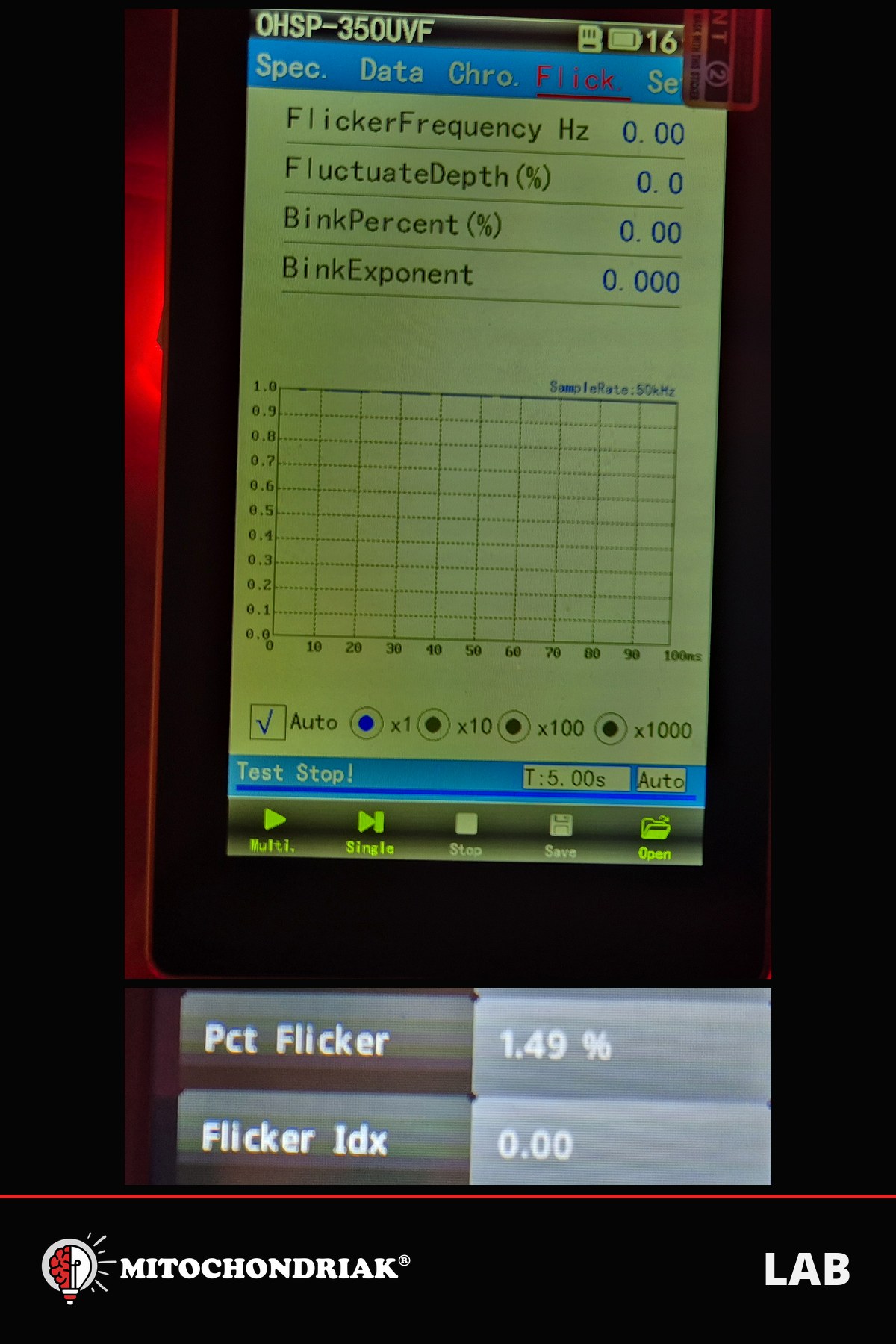
What the measurement shows: the mask delivers little red light and no infrared, more blue than red in four modes, and a dose of 0.53 J/cm² in 10 minutes. At the same time, it raises the electric field at the skin 19 to 37 times, the magnetic field about six times and the body surface voltage. In our view, the net benefit of the mask is therefore very low. A panel at 50 to 60 cm delivers the same dose in a few minutes, and its electronics stay well away from you.
The balance: what your skin gets and what it pays
Picture two situations. In the first, you sit half a metre from a panel. Your skin receives red and infrared light that does not flicker, and the panel's electronics are at background level where your body is. In the second, you have a mask on your face. The light is a similar colour, but it comes together with a controller, a battery and hundreds of LEDs on your skin, often with a blue mode right at your eyes.
The same light, a different environment. And the environment decides what the cell does with the stimulus. For us Mitochondriaks, what counts is the balance (the "net benefit"): how much light you give the cell and what other stimulus you add along with it. A short-term stimulus that the body can see and process makes it stronger. A long-term stimulus it cannot see tends to wear it down.
The point is not that all electronics up close are bad. The point is how much of it there is, how close, for how long and with what light.
What we recommend instead of masks, caps and slippers
The sun first, and it is free. We Mitochondriaks choose sunlight as the first option. It is rich in both red and infrared light, its spectrum is perfectly balanced, it does not flicker and it costs nothing. But if you want a supplement or spend little time outdoors, we recommend a quality red light panel.
Face, neck, décolletage and hair at once: a panel at 50 to 60 cm. The Mitochondriak® Office or Maxi panel lights up the whole face and scalp evenly and without flicker. At 50 to 60 cm, the field from the electronics is at background level and there is still plenty of light: the Maxi delivers 54.2 mW/cm² at 50 cm. We describe the differences between device types, including when to choose a bulb and when a panel, in our article on the best LED therapy bulb.

Targeted at the face, shoulders or feet: the LED bulb at least 30 cm away. The Mitochondriak® LED red and NIR bulb comes with a desk clamp and a long, adjustable gooseneck. You point it at your face or your feet and you don't have to hold it. At 30 cm it delivers 90.1 mW/cm², more than the mask directly on the skin.

For travel and short sessions: the Mini up close. The Mitochondriak® Mini runs on a battery, with no mains voltage, and shines without flicker. You hold it at 5 to 10 cm for a few minutes; you don't wear it on your body.
Spot treatment: the laser at 1 to 2 cm. The Mitochondriak® Pulse laser torch is for a small area and a few minutes. A short, targeted, battery-powered application is a different situation from electronics strapped to your face, head or feet.
Eyes: when shining light on your face, close your eyes or wear protective goggles, and don't look directly into the LEDs. In the evening, blue light blocking glasses belong with your light. More on eye protection and who should take extra care is in our guide Is red light therapy safe?
How to do it: skin, hair and feet
- Morning sun. No device replaces morning light outdoors. The red and infrared light in it is free.
- Skin: a panel at 50 to 60 cm or the LED bulb at least 30 cm away, on clean skin without cream, for the time given in the device manual. Start with shorter sessions and lengthen them gradually.
- Hair: a panel above or behind your head at 50 to 60 cm, with the scalp as uncovered as possible. Not a cap, but light from a distance. More in our article on red light and hair.
- Feet: ideally barefoot outdoors on grass or sand. At home, the LED bulb aimed at your feet from at least 30 cm.
- Evening: after sunset, red light only, no blue or white light near your eyes.
- Cold water before light. Before your face session, dip your face in cold water for a few seconds, or at least rinse it with cold water. Cold and stimulation of the facial receptors and the trigeminal nerve bring further benefits that add up. Only then switch on the light.
- The same goes for hair, gradually and in moderation, of course. Gradual exposure to cold, cold water swimming, or better still cold adaptation, has further long-term benefits. Combined with light, it can support the health and elasticity of facial skin and your hair even more.
If a skin or hair problem has been bothering you for a while, talk to your doctor.
Summary: yes to light, no to electronics on your skin
Light, yes. Electronics on your skin, no. Red and infrared light is information and energy for the cell, and we want to deliver it clean, without flicker and without an electrical stimulus the eye cannot see. That is why we shine light from a distance: a panel at 50 to 60 cm, the bulb at least 30 cm away, the Mini and the laser briefly and on target. You can buy a mask anywhere. We chose to measure one instead. The choice is yours.
Light for your face and hair, from a distance
A desk panel lights up your face, neck and scalp from 50 to 60 cm, without flicker and without electronics on your skin. In a few minutes it delivers a dose that a mask would need hours for.
See the Mitochondriak® Office panel All Mitochondriak® devices
Frequently asked questions
Are LED face masks safe?
Red light helps the skin, and studies with masks confirm it. A mask, however, carries electronics directly on your skin and often a blue and white mode right at your eyes. Nobody has clearly shown that long-term contact with EMF is harmless, so for us Mitochondriaks light from a distance is the better choice: the Office or Maxi panel at 50 to 60 cm, or the LED bulb at least 30 cm away. In Mitochondriak Lab, with the mask switched on, we measured an electric field 19 to 37 times stronger at the skin and a higher body voltage.
Which LED face mask is the best?
As you may have gathered from this article, the Mitochondriak® philosophy does not recommend face masks as such. In our view, the net benefit of a mask, meaning the benefit of the light minus the electronics directly on your skin, can be very low or even zero. As the best "face mask" we therefore recommend a red light panel, such as the Office or Maxi, which you hang up or place on a desk, turn your face towards and use from the recommended distance of 50 to 60 cm. That way you minimise the potential risks from EMF and maximise the benefits of red light therapy.
Where can I buy the best red light cap for hair?
Just as with the mask, we don't recommend a cap with LEDs and a battery on your head. For hair and the scalp, we believe the best choice is a panel above or behind your head at 50 to 60 cm (Office or Maxi), or the LED bulb on a gooseneck at least 30 cm away. There is more light, the electronics stay at background level and the net benefit is the highest.
Which is better: an LED mask or a red light panel?
A panel at 50 to 60 cm lights up your face, neck and hair at once, does not flicker, and the field from its electronics is at background level where your body is. And there is more light: the Maxi delivers 54.2 mW/cm² at 50 cm, the mask we measured 0.88 mW/cm² in red mode. In 10 minutes, that is 32.5 versus 0.53 J/cm².
How far from your face should the light be?
The large Office, Maxi, Profi and Advanced panels at 50 to 60 cm, the LED bulb at least 30 cm away, the Mini at 5 to 10 cm and the laser on a spot at 1 to 2 cm. Close your eyes or wear protective goggles.
Can you use red light on your hair without an LED cap?
Yes. A panel above or behind your head at 50 to 60 cm lights up the whole scalp at once, with no electronics on your head. The helmet studies on thinning hair used red light at 655 nm, which our panels deliver too. More in our article on red light and hair.
Can I use red light on my face every day?
Yes, as long as you stick to the distance and time given in the device manual. Start with shorter sessions, lengthen them gradually and, in the morning, give priority to the sun outdoors.
Why doesn't Mitochondriak® sell LED masks?
Because we want light without electronics on your skin. We measured our own devices: at 30 cm, 0.1 µT (1 mG), 0 V/m, no flicker (new generation measurements). The same light from a distance gives the cell energy without an extra stimulus the eye cannot see.
Sources and references
- Calcabrini C. 2016. Effect of extremely low-frequency electromagnetic fields on antioxidant activity in the human keratinocyte cell line NCTC 2544 doi.org
- Lanzafame RJ. 2013. The growth of human scalp hair mediated by visible red light laser and LED sources in males doi.org
- Bragato EF. 2025. Role of photobiomodulation application frequency in facial rejuvenation: randomized, sham-controlled, double-blind, clinical trial doi.org
- Aerts S. 2017. Measurements of intermediate-frequency electric and magnetic fields in households doi.org
- Panagopoulos DJ. 2015. Polarization: A Key Difference between Man-made and Natural Electromagnetic Fields, in regard to Biological Activity doi.org
- Wunsch A. 2014. A controlled trial to determine the efficacy of red and near-infrared light treatment in patient satisfaction, reduction of fine lines, wrinkles, skin roughness, and intradermal collagen density increase doi.org
- Pall ML. 2013. Electromagnetic fields act via activation of voltage-gated calcium channels to produce beneficial or adverse effects doi.org
- Huang YY. 2009. Biphasic dose response in low level light therapy doi.org