.png)
Waking up groggy and struggling to fall asleep often comes down to one overlooked factor: light. This guide shows you how to naturally raise melatonin in the evening by fixing your light environment, so your body produces its own sleep hormone on time, without pills, gadgets or guesswork.
25)
- Why melatonin is the master signal for sleep and how light controls it.
- How blue light blocking in the evening protects your natural melatonin rise.
- Which red and amber light sources keep your evening routine sleep-friendly.
- A simple, step-by-step evening routine to boost melatonin naturally.
- Who should be cautious and where melatonin light hacks have real limits.
What is this about and why does it matter?
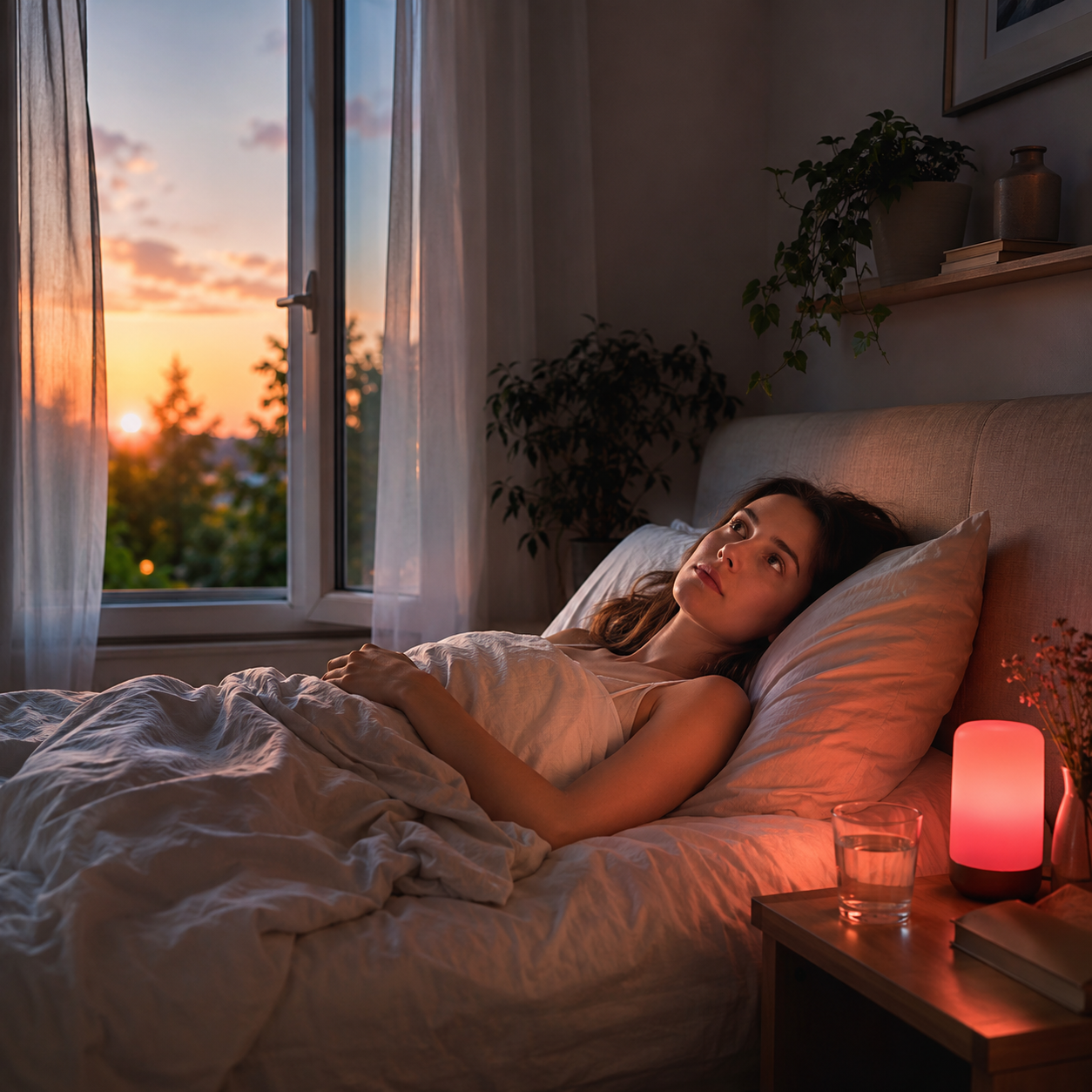
Raising melatonin naturally in the evening means letting your body produce its own sleep hormone by controlling light exposure, instead of relying on supplements. As darkness approaches, the brain increases melatonin to signal that it is time to sleep. Modern bright, blue-rich lighting blocks this signal and delays sleep.
Melatonin is often called the hormone of darkness, and for good reason. The researcher Russel J. Reiter (UT Health San Antonio) has spent decades showing that melatonin is tightly linked to the light-dark cycle and to the timing of our internal clock. [R] When your evenings are flooded with artificial light, your brain assumes it is still daytime and holds back melatonin release.
This matters because melatonin does far more than make you sleepy. It helps set the timing of your circadian rhythm, the roughly 24-hour cycle that governs sleep, hormones, digestion and repair. If you want to understand the bigger picture first, our overview of how the circadian rhythm and our internal clock work explains why timing is everything.
The practical takeaway is simple but powerful: you do not necessarily need to add melatonin from a bottle. In many cases you only need to stop suppressing the melatonin your body already wants to make. That starts with how you handle light in the last two to three hours before bed, which is exactly what the rest of this guide focuses on.
What does the research say?
Research shows melatonin release is controlled mainly by light hitting specialized cells in the retina. Bright, blue-enriched light in the evening suppresses melatonin and shifts your body clock later. Dimming lights and removing blue wavelengths in the last hours before bed allows melatonin to rise on its natural schedule.
The mechanism is well documented. Special retinal cells called intrinsically photosensitive retinal ganglion cells are most sensitive to short-wavelength blue light around 460 to 480 nm. A landmark study led by George C. Brainard (Thomas Jefferson University) mapped exactly which wavelengths suppress melatonin most strongly, confirming that blue light is the primary trigger. [R] This is why the colour of your evening light matters even more than its brightness.
Harvard Health has summarised this research clearly, noting that blue light at night suppressed melatonin for about twice as long as green light of comparable brightness and shifted circadian rhythms about twice as much (3 vs. 1.5 hours). [R] In practice, that means screens, LED ceiling lights and cool white bulbs are the main culprits behind delayed melatonin and difficulty falling asleep.
There are three research-backed levers you can pull every evening:
- Reduce blue light from screens and overhead lighting in the two to three hours before bed.
- Lower overall brightness, since even bright warm light can partially blunt melatonin.
- Favour red and amber wavelengths, which have the weakest effect on melatonin-suppressing retinal cells.
The American Academy of Sleep Medicine reinforces this in its sleep hygiene guidance, recommending dim lighting and avoiding bright screens before bed as core habits for healthy sleep. If you want to see how much your devices are working against you, our article on how screens disrupt your circadian rhythm breaks down the evening screen problem in detail.
What benefits and limits can you realistically expect?
Realistically, optimizing your evening light lets you fall asleep faster, wake less at night and feel more alert in the morning, often within one to two weeks. It works by protecting your natural melatonin rise. However, it will not fix sleep problems caused by stress, caffeine, medical conditions or poor sleep timing on its own.
The most reliable benefit is faster sleep onset. When you stop suppressing melatonin in the last hours of the day, the hormone climbs closer to its natural schedule, so the transition into sleep feels smoother. Light is one of the strongest external cues we can control to protect this timing.
A second, often underrated benefit is better morning alertness. When melatonin rises on time in the evening, it also clears on time in the morning, so you wake up less groggy. Many people report that within a week or two of dimming their evenings, that heavy "sleep inertia" feeling fades and mornings become easier.
There is also a growing interest in red light specifically. A small study in female basketball players found that 14 nights of red light exposure improved sleep quality and melatonin levels compared to a no-treatment group. [R] While this was a small sample, it supports what circadian science predicts: warm, long-wavelength light is far gentler on melatonin than blue-rich light.
The honest limits matter too. Evening light hygiene is a foundation, not a cure-all. It cannot outrun a late espresso, a stressful argument before bed, an irregular schedule or an untreated sleep disorder. If your evenings are already dark and warm and you still cannot sleep, the problem likely lies elsewhere, and that is a conversation for a doctor, not a light bulb.
How do you put this into practice safely?
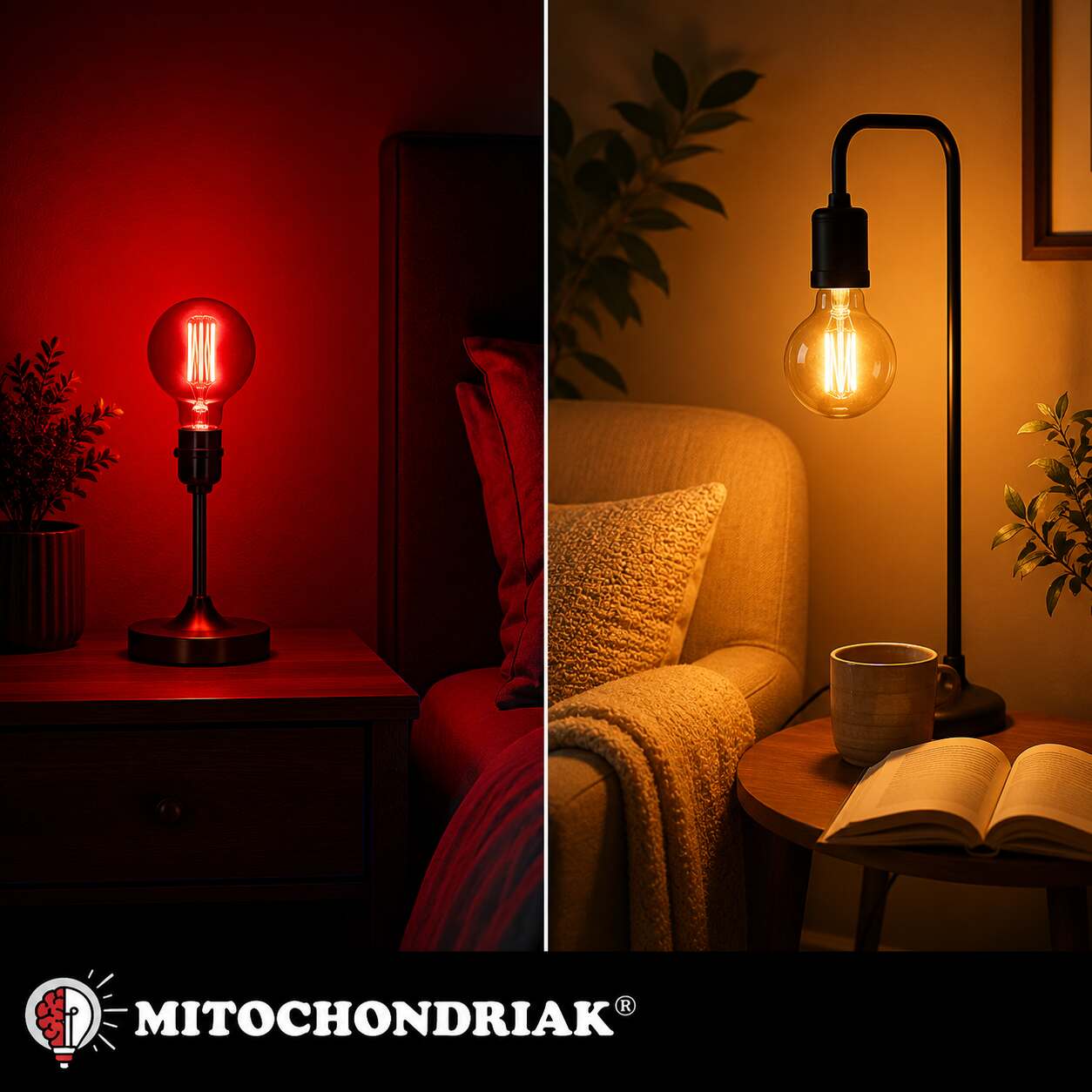
In practice, start about two to three hours before bed by dimming lights, removing blue-rich sources and switching to red or amber lighting. Add blue light blocking glasses for screen time you cannot avoid, and keep your bedroom as dark as possible. Consistency every night is what makes the effect stick.
Here is a simple, research-aligned evening routine you can follow step by step:
- Set a "digital sunset" time. Pick a fixed hour, ideally two to three hours before bed, when overhead lights go dim and bright screens get minimized.
- Swap your evening bulbs. Replace cool white bulbs in the rooms you use at night with warm, low-blue options. The Evening red bulb Mitochondriak® E27 is designed specifically for this, giving you usable light without the melatonin-suppressing blue wavelengths.
- Protect unavoidable screen time. If you must use a phone or laptop late, wear Blue light blocking glasses Mitochondriak® that block blue and green light, so your retinal clock cells stay in "night mode".
- Light your bathroom and hallway carefully. A single bright trip to the bathroom can reset your melatonin. A Red night light Mitochondriak® with motion sensor lets you see without the disruptive white flash.
- Make the bedroom truly dark. Cover LED standby lights, use blackout curtains, and remove or dim any bright displays. Darkness is the strongest natural signal for melatonin.
If you also use a red light therapy panel in the evening, keep it warm, dim and low-intensity, and always follow the recommended distance. For classic (non-battery) panels such as the Mitochondriak® Maxi Upgraded, never sit closer than 30 cm; typical evening use is comfortable at a greater distance where the light feels gentle rather than intense. For a dedicated, timed approach, our 15-minute evening red light protocol walks through the details.
Build a melatonin-friendly evening with the right light
You do not need pills to raise melatonin naturally. You need the right light after sunset. Warm red bulbs, blue light blocking glasses and a gentle red night light together recreate the dark, warm signal your body evolved to expect, so melatonin rises on time and sleep comes easier.
What should you watch out for and who should be careful?
Watch out for hidden blue light sources, over-reliance on glasses instead of fixing your environment, and expecting instant results. Most people can safely optimize their evening light, but those with certain eye conditions, mood disorders, or on light-sensitive medication should adjust their approach and consult a professional first.
The most common mistake is hidden blue light. You dim the main light, but the TV, tablet, smart speaker glow and kitchen LEDs are still pumping out short wavelengths. Do a quick "evening light audit" of every room you use at night and treat every bright white source as a melatonin blocker until proven otherwise.
A second pitfall is treating blue light blocking glasses as a licence to keep your rooms brightly lit. Glasses help with screens, but they are a supplement to a dim, warm environment, not a replacement for it. If you want a deeper look at choosing quality lenses, our guide to evening blue light blocking glasses covers what actually matters.
Some groups should be more careful. People with bipolar disorder or seasonal mood conditions can be sensitive to changes in light timing, and anyone taking photosensitizing medication should be cautious with any light therapy device. If you have an eye condition or are unsure, talk to your doctor before adding red light panels to your evening. Light hygiene through dimming and warm bulbs, however, is low-risk for almost everyone.
Summary: what should you remember?
The single most important idea is that you rarely need to add melatonin, you mostly need to stop blocking it. Your body is built to produce this hormone every night as darkness falls. Bright, blue-rich evening light is the modern habit that interrupts the signal, and it is almost entirely within your control to change.
Focus on the last two to three hours before bed. Dim your lights, swap cool white bulbs for warm red and amber sources, block blue light on any screens you cannot avoid, and make your bedroom genuinely dark. These few changes recreate the natural light-dark cycle your circadian rhythm depends on, and they are backed by decades of research from scientists like Russel J. Reiter and George C. Brainard.
Give it one to two weeks of consistency before judging the results. Natural melatonin optimization is a foundational habit, not an overnight fix, but for most people it is the cheapest, safest and most effective sleep upgrade available, and it starts simply by respecting the dark.
Frequently asked questions
How long before bed should I dim the lights to boost melatonin?
Aim to dim lights and reduce blue light exposure about two to three hours before your intended bedtime. This gives melatonin enough time to rise naturally on its evening schedule. Even one hour of dim, warm light before bed is far better than staying under bright white light until the moment you try to sleep.
Does red light really help raise melatonin in the evening?
Red and amber light have the weakest effect on the retinal cells that suppress melatonin, so they let your body produce it more freely than blue-rich light. Warm evening lighting will not force extra melatonin, but by not suppressing it, red light creates the darkness-like signal your brain needs to release melatonin on time.
Are blue light blocking glasses enough on their own?
Blue light blocking glasses are helpful for unavoidable screen time, but they work best as part of a wider evening routine. If your whole room is still brightly lit with cool white light, the glasses only cover part of the problem. Combine them with dimmed, warm lighting and a dark bedroom for the strongest effect on natural melatonin.
Should I take a melatonin supplement instead of changing my light?
For most healthy people, fixing evening light is a more natural first step than supplementing. Optimizing light supports your own melatonin production and overall circadian timing. Supplements may have a role in specific situations such as jet lag or shift work, but that is best discussed with a doctor, especially before long-term use.
Sources and references
- Brainard GC, Hanifin JP, Greeson JM, Byrne B, Glickman G, Gerner E, Rollag MD.. 2001. Action spectrum for melatonin regulation in humans: evidence for a novel circadian photoreceptor pubmed.ncbi.nlm.nih.gov
- Reiter RJ, Tan DX, Erren TC, Fuentes-Broto L, Paredes SD.. 2009. Light-mediated perturbations of circadian timing and cancer risk: a mechanistic analysis pubmed.ncbi.nlm.nih.gov
- Zhao J, et al.. 2012. Red light and the sleep quality and endurance performance of Chinese female basketball players pubmed.ncbi.nlm.nih.gov
- American Academy of Sleep Medicine. Healthy Sleep Habits (Sleep Education by the AASM) sleepeducation.org
- Harvard Health Publishing. 2012. Blue light has a dark side health.harvard.edu