.png)
Red light therapy is rapidly becoming one of the most talked-about evening rituals among biohackers, and for good reason. A simple 15-minute session before bed can help your body produce more melatonin, calm your nervous system and prepare you for deeper, more restorative sleep, all without a single supplement.
- Why red and near-infrared light helps your body ramp up melatonin production naturally
- What wavelengths and session timing deliver the best results for sleep quality
- A complete 15-minute evening protocol you can start tonight, step by step
- The practical difference between red bulbs and therapy panels for your bedtime routine
- Common mistakes that can sabotage your results, and how to avoid them
- Why does red light before bed support better sleep?
- What is the science behind red light therapy and sleep quality?
- Your 15-minute evening red light protocol, step by step
- Red light bulbs vs panels: which is better for your evening routine?
- What are the most common mistakes to avoid?
- Frequently asked questions
Why does red light before bed support better sleep?
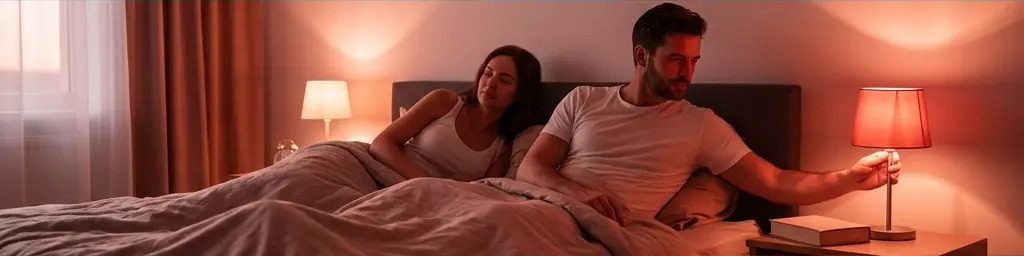
Red light in the 630 to 670 nm range signals to your brain that the sun has set, encouraging a natural rise in melatonin without suppressing it the way blue and green wavelengths do. In practical terms, swapping your bright overhead lights for red wavelengths in the last hour before bed can meaningfully improve both how quickly you fall asleep and how deeply you stay there.
Your body relies on light cues to regulate the circadian rhythm, the internal clock that governs when you feel alert and when you feel drowsy. During the day, short-wavelength blue light from screens and overhead LEDs tells your suprachiasmatic nucleus to suppress melatonin and boost cortisol. That is perfectly fine at noon. The problem arises when the same light hits your retina at 10 PM.
Red light sits at the opposite end of the visible spectrum, with wavelengths above 600 nm. Research published by Zhao and colleagues in the Journal of Athletic Training (2012) showed that 30 minutes of red light exposure over 14 days significantly increased serum melatonin levels and improved sleep quality scores among elite female athletes. The mechanism is straightforward: red photons do not activate the melanopsin receptors in your retinal ganglion cells, so your brain interprets the environment as "dusk" or "darkness" and begins melatonin synthesis on schedule.
There is also an energetic component. Near-infrared wavelengths (810 to 850 nm) penetrate deeper into tissue and interact with cytochrome c oxidase, an enzyme in the mitochondrial electron transport chain. When this enzyme absorbs NIR photons, it releases nitric oxide, which had been blocking the binding site, and allows oxygen to bind again. The result is improved ATP production and lower oxidative stress, both of which contribute to better cellular recovery during sleep.
In short, a red and near-infrared light session before bed works on two levels at once. First, it protects your melatonin rhythm by removing the blue light signal. Second, it actively primes your cells for the repair work that happens while you sleep. That dual mechanism is what makes an evening red light routine more effective than simply dimming the lights or wearing blue light blocking glasses alone.
What is the science behind red light therapy and sleep quality?
Photobiomodulation, the scientific term for red and near-infrared light therapy, improves sleep quality by boosting mitochondrial energy production, lowering inflammation markers and supporting the body's natural melatonin cycle. The evidence comes from controlled clinical studies, not anecdotes, and the key wavelengths are well documented.
The central player in this process is an enzyme called cytochrome c oxidase (CCO), located on the inner membrane of the mitochondria. When photons in the 630 to 670 nm (red) or 810 to 850 nm (near-infrared) range reach CCO, they dissociate a molecule of nitric oxide that had been inhibiting electron flow. Oxygen can then bind normally, and the mitochondrion produces more ATP. Michael R. Hamblin of Harvard Medical School described this mechanism in detail in a 2017 review published in AIMS Biophysics, noting that the downstream effects include reduced reactive oxygen species (ROS) and activation of transcription factors involved in cell repair.
What does ATP production have to do with sleep quality? Quite a lot. During deep sleep stages, your cells perform most of their maintenance work: DNA repair, protein synthesis, waste clearance through the glymphatic system. All of these processes are energy dependent. By increasing ATP availability before bed, a red light session essentially gives your cells a larger energy budget for overnight recovery.
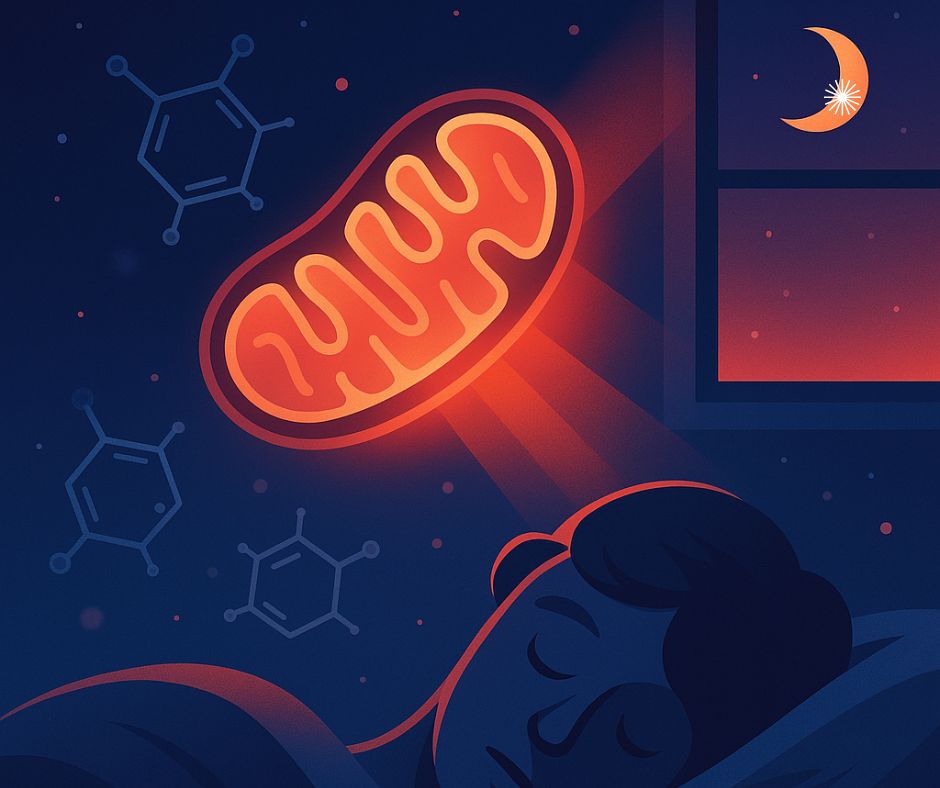
There is a melatonin angle as well. Russel J. Reiter of UT Health San Antonio has published extensively on the concept of mitochondrial melatonin, melatonin that is synthesized locally inside the mitochondria rather than exclusively in the pineal gland. Red and NIR light appear to support this local production, potentially amplifying the antioxidant protection that melatonin provides during the night.
The landmark clinical study by Zhao et al. (2012) remains one of the most cited references in this field. Thirty female basketball players were divided into a red light group and a placebo group. The red light group received 30-minute full-body sessions using 658 nm LEDs for 14 consecutive nights. Compared to placebo, the treatment group showed a statistically significant increase in serum melatonin, improved Pittsburgh Sleep Quality Index (PSQI) scores and better endurance performance. The researchers concluded that red light therapy at night is a "nonpharmacologic and noninvasive therapy" for sleep disorders.
More recent work by Figueiro et al. (2016) at the Lighting Research Center reinforced the circadian angle. Their research confirmed that wavelengths above 600 nm have negligible suppressive effects on melatonin, while light below 530 nm can reduce melatonin secretion by up to 50 % when exposure occurs in the two hours before sleep. The practical implication is clear: replacing your evening lighting with red spectrum alternatives is one of the simplest, most evidence-supported strategies for protecting your circadian rhythm.
These findings converge on a consistent message. Red light therapy sleep benefits are not placebo driven. They stem from measurable biochemical changes, higher melatonin, more efficient mitochondrial respiration and reduced oxidative stress, that together create better conditions for deep, restorative sleep.
Your 15-minute evening red light protocol, step by step
You can start improving your sleep quality tonight with nothing more than a red light panel, a dimmed room and 15 minutes of intentional downtime. This protocol is designed to be simple enough for beginners yet effective enough for experienced biohackers looking to refine their evening light routine.
Step 1: Set up your space
Begin by dimming or turning off all overhead lights in the room where you plan to do your session. The goal is to eliminate as much blue and green spectrum light as possible. Close blinds or curtains if streetlight enters the room. Position your red light therapy panel at a distance of 15 to 30 cm from your body, either mounted on a stand or placed on a stable surface at chest or face height. If you prefer full-body coverage, a larger panel like the Mitochondriak Maxi Upgraded allows you to sit or stand comfortably within range.
Step 2: Choose the right wavelengths and intensity
For an evening session focused on sleep, the most relevant wavelengths are 630 nm and 670 nm in the visible red range and 850 nm in the near-infrared range. Red wavelengths support melatonin signalling at the retinal level, while NIR wavelengths penetrate deeper and promote mitochondrial recovery. Mitochondriak panels offer seven wavelengths (630, 670, 760, 810, 830, 850 and 940 nm), so you can run both red and NIR channels simultaneously for a combined effect.
Step 3: Duration and timing
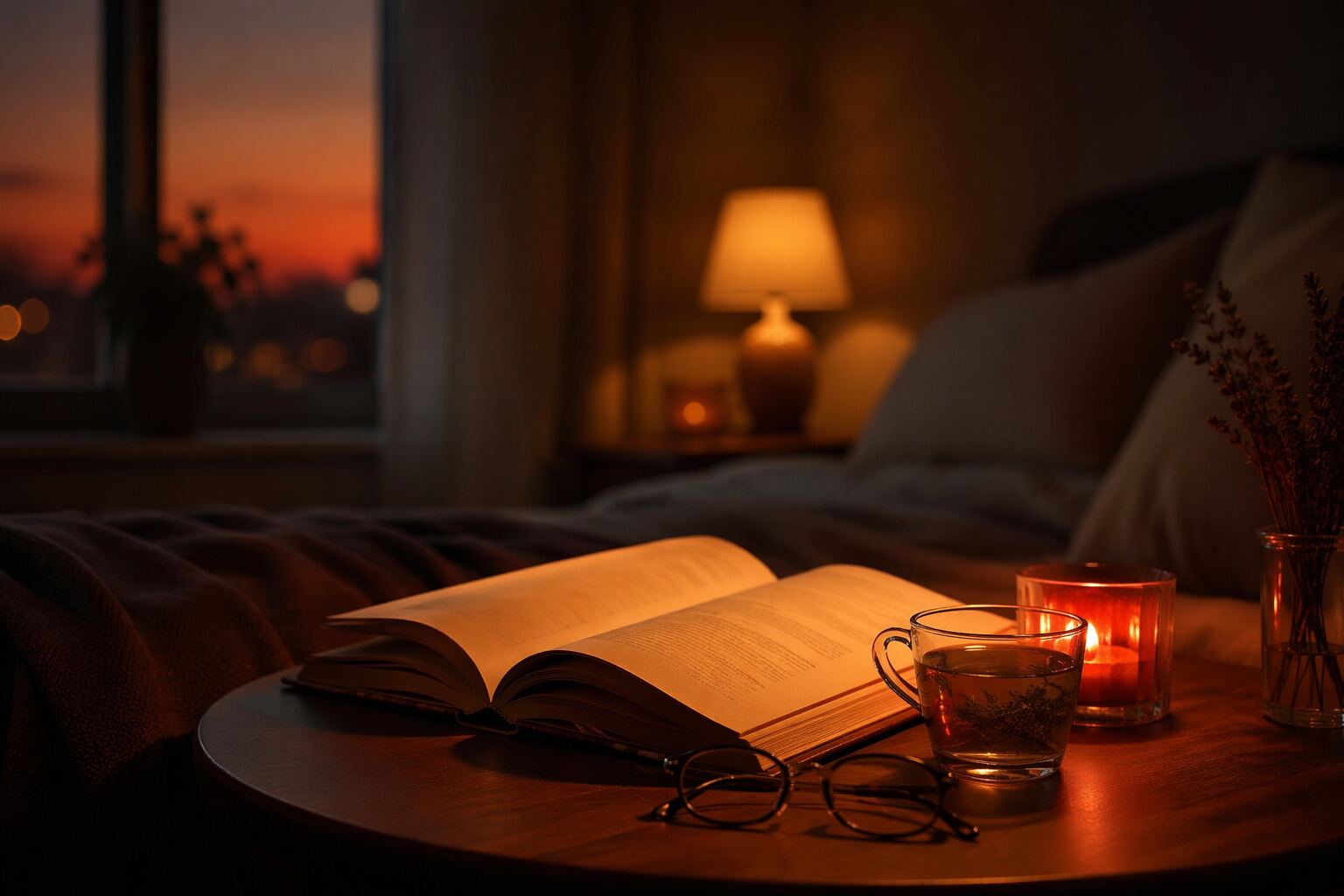
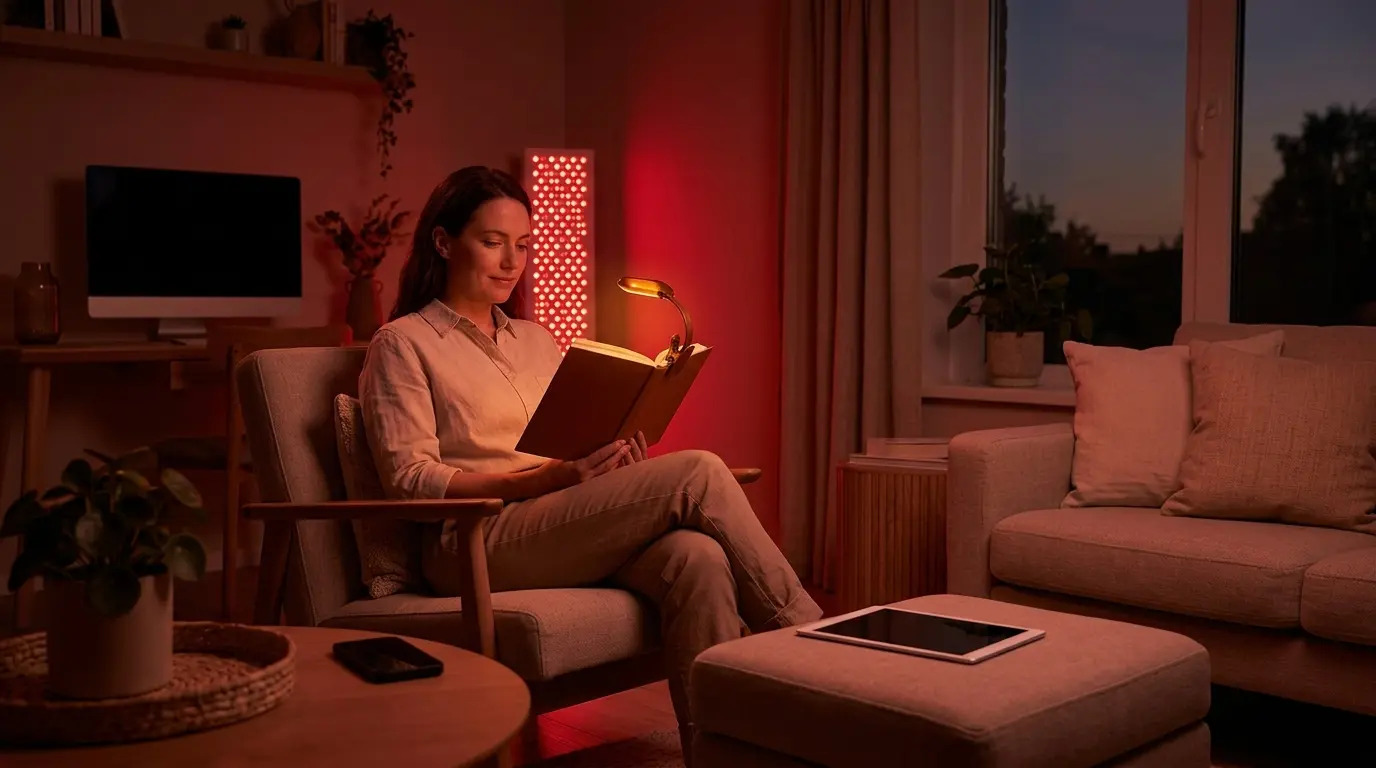
Set a timer for 15 minutes. The ideal window is 30 to 60 minutes before your target bedtime. If you go to bed at 22:30, start your session between 21:30 and 22:00. During the session, you can read a physical book, meditate, stretch gently or simply sit still. Avoid using screens during this time, because even a dimmed phone emits enough short-wavelength light to partially counteract the benefits.
Step 4: Combine with blue light blocking
For the best results, pair your red light session with blue light blocking glasses if you need to use screens at any point during the evening. After the 15-minute panel session, keep your room lighting red or amber until you fall asleep. Red bulbs with zero blue light emission are a practical solution for ambient bedroom lighting that will not undo your protocol.
Red light bulbs vs panels: which is better for your evening routine?
Both red light bulbs and therapy panels have a place in a well-designed red light at night routine, but they serve different purposes. The short answer is that ambient red bulbs protect your melatonin by replacing blue light sources, while panels deliver a concentrated therapeutic dose of red and near-infrared photons for photobiomodulation. Ideally, you use both.
Red light bulbs (such as the Mitochondriak E27 evening bulb) screw into standard lamp sockets and bathe an entire room in warm red light. They emit no blue wavelengths, which makes them an effortless way to keep your environment melatonin-friendly after sunset. Think of them as passive protection: they do not deliver a high-intensity therapeutic dose, but they prevent the damage that conventional LEDs cause.
Red and NIR therapy panels are active treatment devices. They output a much higher irradiance at specific wavelengths and are designed for targeted exposure at close range. A 15-minute panel session delivers measurable photobiomodulation effects, boosting ATP production, lowering oxidative stress and supporting local melatonin synthesis inside the mitochondria.
The practical recommendation is simple. Use red bulbs as your default evening room lighting from sunset onward. Add a dedicated panel session 30 to 60 minutes before bed. This two-layer approach gives you both passive circadian protection and active cellular therapy.
What are the most common mistakes to avoid?
Even a well-intentioned red light therapy sleep routine can fall short if you make one of these common errors. Most of them are easy to fix once you know what to look for.
Using too much brightness. Keeping overhead white or "warm white" lights on during or after your session exposes your retina to blue and green wavelengths that suppress melatonin. Switch all room lighting to red or amber spectrum after sunset, not just during the panel session itself.
Timing the session too early. A panel session at 18:00 is fine for recovery, but it will not help you fall asleep at 22:30. For sleep-specific benefits, place your 15-minute session within the 30 to 60 minute window before bed.
Scrolling on your phone immediately after. Checking social media or answering emails right after a red light session sends a burst of short-wavelength light to your retina, effectively resetting the melatonin signal you just built. If you must use a device, wear blue light blocking glasses and set the screen to maximum warmth.
Sitting too far from the panel. Irradiance drops with the square of the distance. At 60 cm, you receive roughly one quarter of the dose compared to 30 cm. Stay within 15 to 30 cm for a sleep-focused session.
Expecting instant results. The Zhao et al. study observed significant improvements after 14 consecutive nights. Give the protocol at least two weeks of consistent use before evaluating its effect on your sleep.
Build your own evening red light routine
A targeted panel session combined with red ambient lighting is one of the simplest, most science-backed ways to support deeper sleep and faster recovery. The Mitochondriak Maxi Upgraded covers the full therapeutic wavelength range (630 to 940 nm) and provides enough surface area for a comfortable half-body session.
Frequently asked questions
Can I use red light therapy every night before sleep?
Yes. Daily evening sessions are not only safe but recommended for building a consistent melatonin rhythm. The Zhao et al. (2012) study used 14 consecutive nightly sessions and observed cumulative improvements in sleep quality scores. There is no known risk of overexposure at the irradiance levels and session durations used in home panels.
How far should I sit from the panel during an evening session?
For a sleep-focused protocol, position yourself 15 to 30 cm from the panel surface. At this distance, you receive sufficient irradiance for photobiomodulation without discomfort. Moving beyond 60 cm reduces the effective dose to roughly one quarter of what you would receive at 30 cm, because irradiance decreases with the square of the distance.
Does red light therapy replace blue light blocking glasses?
Not entirely. A red light panel session boosts mitochondrial function and supports melatonin production, but it does not block blue light from other sources in your environment. If you use screens, overhead LEDs or other artificial lighting after sunset, blue light blocking glasses remain a valuable complement. The best approach is to combine both.
What is the best wavelength for sleep: 630 nm or 850 nm?
Both contribute, but through different mechanisms. 630 nm (visible red) is effective at the retinal level, where it avoids suppressing melatonin and may even encourage its synthesis. 850 nm (near-infrared) penetrates deeper into tissue and supports mitochondrial ATP production and cellular recovery during sleep. Using a panel that delivers both wavelengths simultaneously, such as Mitochondriak panels with their seven-wavelength range, gives you the benefits of each.
Sources and References
- Zhao, J. et al. (2012). Red light and the sleep quality and endurance performance of Chinese female basketball players. Journal of Athletic Training, 47(6), 673-678. [R]
- Figueiro, M. G. (2017). Light, sleep and circadian rhythms in older adults with Alzheimer's disease and related dementias. Neurodegenerative Disease Management, 7(2), 119-145. [R]
- Hamblin, M. R. (2017). Mechanisms and applications of the anti-inflammatory effects of photobiomodulation. AIMS Biophysics, 4(3), 337-361. [R]
- Sheppard, A. L. & Wolffsohn, J. S. (2018). Digital eye strain: prevalence, measurement, and amelioration. BMJ Open Ophthalmology, 3(1), e000146. [R]
- Reiter, R. J. et al. (2018). Melatonin Mitigates Mitochondrial Meltdown: Interactions with SIRT3. International Journal of Molecular Sciences, 19(8), 2439. [R]