.png)
Melanopsin
Melanopsin (gene OPN4) is a light-sensitive protein (photopigment) found in specialized ganglion cells of the retina called ipRGCs (intrinsically photosensitive retinal ganglion cells). Melanopsin does not see images. Its role is to "measure" the amount and color of light in your environment and, based on that, set your biological clock, regulate melatonin production, and control other non-visual responses of the body to light.
- What melanopsin is and where it is found in the eye
- How melanopsin "measures" light and why it is most sensitive to blue
- How melanopsin controls the circadian rhythm through the suprachiasmatic nucleus
- Why artificial blue light in the evening disrupts melatonin and sleep specifically through melanopsin
- What the difference is between melanopsin and other photoreceptors (rods and cones)
- How to protect melanopsin from the wrong light and why it matters
- What is melanopsin and where is it found?
- How does melanopsin work and what light does it respond to?
- What are ipRGC cells and why are they unique?
- How does melanopsin control the circadian rhythm?
- Why does melanopsin determine melatonin production?
- Why is artificial blue light in the evening a problem?
- What is the difference between melanopsin and rods or cones?
- How to protect the melanopsin system in practice?

What is melanopsin and where is it found?
Melanopsin is a photopigment, a protein capable of absorbing light and converting it into a nerve signal. It was discovered in 1998 in frogs (Xenopus laevis) and subsequently identified in the human eye as well. It is found exclusively in a small population of retinal ganglion cells formally known as intrinsically photosensitive retinal ganglion cells (ipRGCs).
These cells make up only approximately 1 to 3% of all retinal ganglion cells. Despite their small number, they have an enormous impact on the functioning of the entire organism. They are not part of the "classical" visual system. They are not responsible for what you see. They are responsible for how your body responds to light.
Melanopsin is encoded by the OPN4 gene. Lucio-Enriquez et al. (2025) showed in their review of human melanopsin polymorphisms that genetic variations in the OPN4 gene can influence individual light sensitivity, chronotype (whether you are a "morning lark" or a "night owl"), and susceptibility to sleep disorders (Lucio-Enriquez et al., 2025).
How does melanopsin work and what light does it respond to?
Melanopsin is most sensitive to light with a wavelength of approximately 480 nm, which corresponds to the blue-green spectrum of visible light. This wavelength is most strongly represented in nature during morning and midday sunlight, when the sky is clear and blue.
When photons of blue-green light strike melanopsin, they trigger a cascade of signals that travel from ipRGC cells through the retinohypothalamic tract (RHT) directly to the suprachiasmatic nucleus (SCN) in the hypothalamus. The SCN is the body's master "circadian pacemaker," the control node of the biological clock.
Importantly, melanopsin responds to light much more slowly than classical photoreceptors (rods and cones). It does not need a sharp image. It needs integrated information about the overall intensity and spectral composition of light over a longer period (seconds to minutes). This makes melanopsin ideal for measuring the daily light cycle, not for recognizing faces or reading text.
What are ipRGC cells and why are they unique?
Intrinsically photosensitive retinal ganglion cells (ipRGCs) are unique in that they are inherently sensitive to light on their own. Unlike classical ganglion cells, which merely relay signals from rods and cones, ipRGC cells contain their own photopigment (melanopsin) and can detect light independently.
Do and Yau (2010) described in their extensive review in Physiological Reviews that ipRGC cells exist in several subtypes (M1 through M5), each with slightly different properties and projections into the brain. The M1 subtype is the primary input to the SCN and the most important for circadian synchronization (Do & Yau, 2010).
ipRGC cells have dendrites that spread across a large area of the retina. Thanks to this, they can "collect" light from the entire visual field and create a reliable picture of the overall light level. That is why you do not need to look directly at the sun for melanopsin to register morning light. Simply being outside with your eyes open is enough.
How does melanopsin control the circadian rhythm?
Melanopsin is the primary "light sensor" of the circadian rhythm. The entire process works like this:
- Morning – sunlight rich in the blue component (~480 nm) hits the retina and activates melanopsin in ipRGC cells
- Signal to the SCN – ipRGC cells send a signal through the retinohypothalamic tract to the suprachiasmatic nucleus
- Clock reset – the SCN "resets" the biological clock for a new day, synchronizing it with the Earth's light cycle
- Hormone cascade – the SCN signals the pineal gland to suppress melatonin production (the darkness hormone) and promote cortisol and serotonin production (daytime hormones)
- Evening – as blue light intensity decreases, melanopsin stops signaling, the SCN "releases" the pineal gland, and melatonin production begins
Hatori and Panda (2010) emphasized that melanopsin is critical not only for circadian synchronization but also for mood regulation, attention, the pupillary light reflex (constriction of pupils in response to light), and even metabolic regulation (Hatori & Panda, 2010).
Put simply: melanopsin is the "light input" to your biological clock. If this input receives the right signals (morning sun, darkness at night), your entire body functions in sync. If it receives the wrong signals (artificial blue light at night), the clock gets thrown off.
Why does melanopsin determine melatonin production?
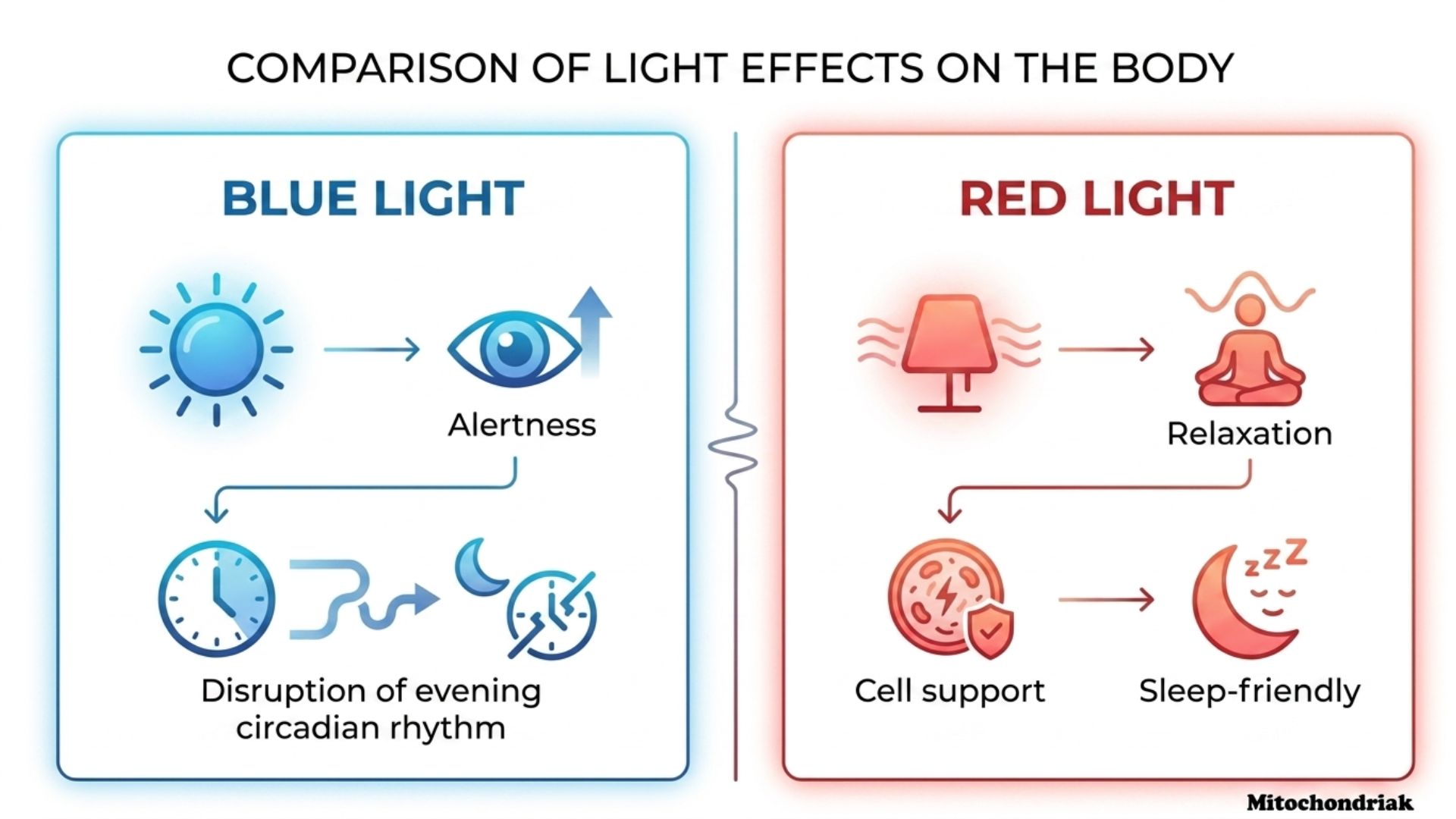
Melatonin is not just a "sleep hormone." It is a powerful antioxidant that concentrates directly inside mitochondria, where it protects the electron transport chain from oxidative damage. Its production, however, is strictly dependent on the light signal that comes through melanopsin.
The mechanism works as follows:
- When melanopsin detects blue-green light (~480 nm), it sends a signal to the SCN, which then inhibits melatonin production in the pineal gland
- When blue-green light disappears (sunset, darkness), melanopsin stops signaling and the SCN "permits" melatonin synthesis
- Melatonin begins to be secreted approximately 2 hours after sunset (if no artificial blue light is present)
The problem of the modern world: artificial blue light from screens, LED bulbs, and fluorescent lighting activates melanopsin even after sunset. Melanopsin cannot distinguish whether a blue photon comes from the sun or from a phone. To melanopsin, it is the same signal: "it is daytime, do not produce melatonin." The result is suppressed or delayed melatonin production, which leads to poorer sleep, lower mitochondrial protection, and in the long term, accelerated aging.
Why is artificial blue light in the evening a problem?
From melanopsin's perspective, the answer is simple: blue light after sunset is biological misinformation. Melanopsin interprets every photon in the ~460 to 490 nm range as a signal that it is daytime. Your body then:
- Suppresses melatonin – mitochondrial protection is lost, sleep quality deteriorates
- Maintains cortisol – the stress hormone stays elevated when it should be declining
- Disrupts the circadian rhythm – the biological clock shifts, creating social jet lag
- Inhibits cytochrome c oxidase – according to studies, blue light directly slows complex IV of the electron transport chain in mitochondria
A standard LED bulb (white, 4,000 to 6,500 K) has a strong peak precisely in the 450 to 480 nm range, exactly where melanopsin is most sensitive. The same is true for smartphone, tablet, and monitor displays. That is why minimizing blue light in the evening is one of the most important steps in light hygiene.
What is the difference between melanopsin and rods or cones?
The human eye contains three types of photoreceptors, each with a different function:
| Property | Rods | Cones | ipRGCs (melanopsin) |
|---|---|---|---|
| Function | Dim-light vision | Color vision, acuity | Measuring light intensity and spectrum |
| Count in the eye | ~120 million | ~6 million | ~3,000 to 5,000 |
| Photopigment | Rhodopsin | Photopsins (S, M, L) | Melanopsin (OPN4) |
| Peak sensitivity | ~498 nm (green) | 420/534/564 nm | ~480 nm (blue) |
| Response speed | Fast (ms) | Fast (ms) | Slow (seconds) |
| Signal destination | Visual cortex | Visual cortex | SCN, pineal gland, pretectum |
| Output | Image | Color image | Circadian rhythm, melatonin, pupil size |
The key difference: rods and cones serve vision. Melanopsin in ipRGC cells serves biological regulation. Even a completely blind person (without functional rods and cones), if their ipRGC cells are intact, can have a functional circadian rhythm. This shows just how fundamental melanopsin is to human biology.
How to protect the melanopsin system in practice?
Melanopsin is not something you "fix." It is a system you need to inform correctly. Give it the right light at the right time and it will take care of the rest:
Morning: maximize blue-green input
- Within 30 minutes of waking up, go outside and expose yourself to sunlight for at least 10 to 20 minutes
- Without sunglasses (but never look directly at the sun)
- Even an overcast sky provides sufficient blue light intensity for melanopsin (1,000 to 10,000 lux outdoors versus 100 to 300 lux indoors)
During the day: sufficient light input
- Work near a window, go for walks, spend time outside
- Indoor lighting is insufficient for melanopsin. That is why spending time outdoors during the day is so important
Evening: minimize blue input
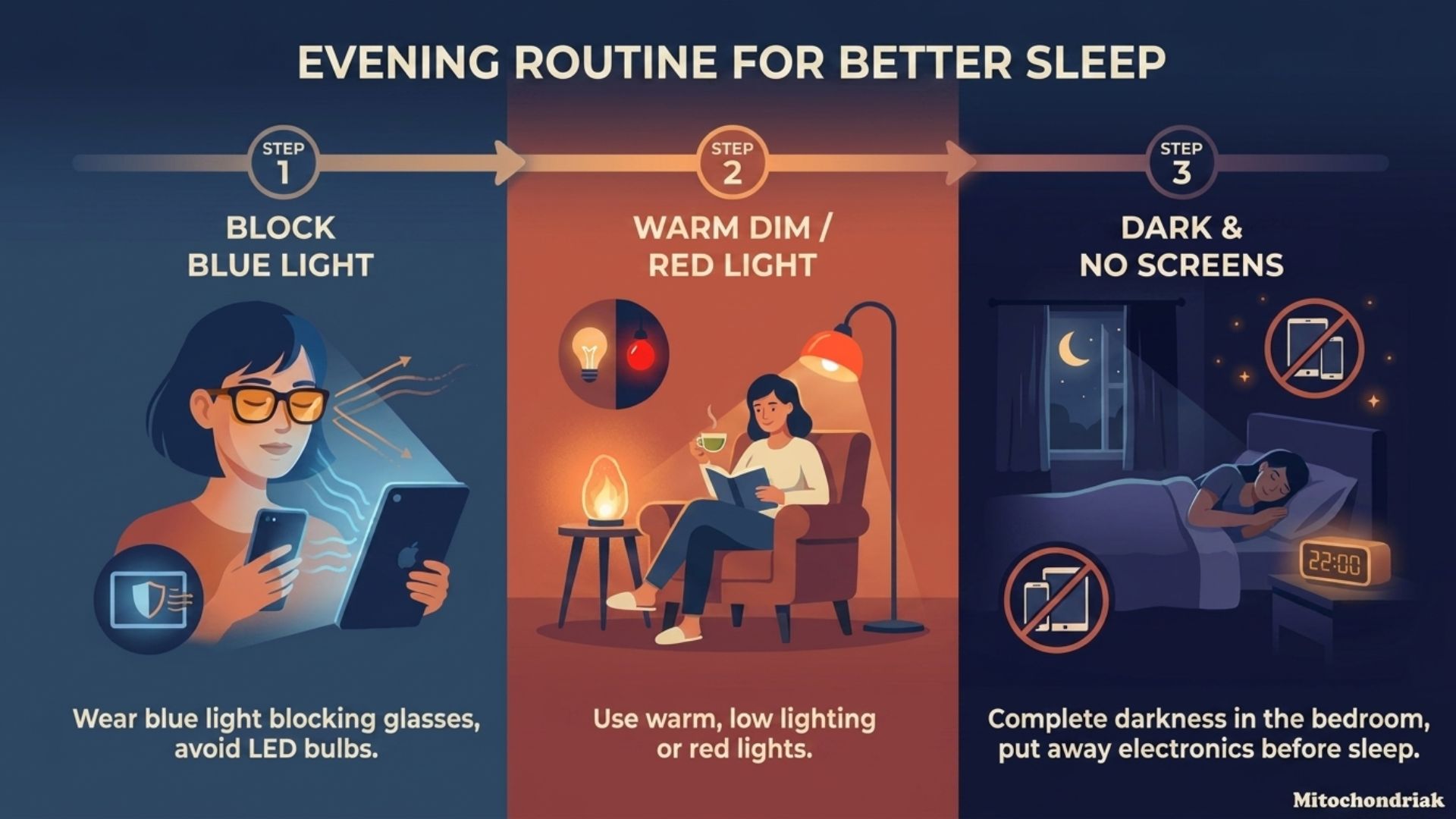
- After sunset, switch to red or amber lighting that does not activate melanopsin. Red light (above 600 nm) is "invisible" to melanopsin
- Use blue light blocking glasses if you must use screens in the evening
- Replace white LED bulbs in your bedroom and living room with red evening bulbs free of blue and green spectrum
At night: complete darkness
- Your bedroom should be completely dark. No standby LEDs, no street light through curtains
- If you need to get up at night, use a red night light that does not activate melanopsin and does not interrupt melatonin production
Related glossary terms
- Circadian rhythm – the biological rhythm that melanopsin sets according to the light cycle
- Melatonin – a hormone and mitochondrial antioxidant whose production melanopsin controls
- Mitochondria – cellular organelles protected by melatonin, whose production depends on melanopsin
- Photobiomodulation – red light therapy that does not activate melanopsin and therefore does not disrupt the circadian rhythm
- ATP – energy whose production is indirectly influenced by the quality of the circadian rhythm set by melanopsin
Protect your melanopsin in the evening
Mitochondriak® blue light blocking glasses block 100% of blue and green light, protecting the melanopsin system from artificial light after sunset. The result is undisturbed melatonin production, better sleep, and healthier mitochondria. Wear them 2 to 3 hours before bedtime.
- Melanopsin is a photopigment in ipRGC cells of the retina that measures the intensity and spectrum of light
- It is most sensitive to blue-green light (~480 nm) and signals the suprachiasmatic nucleus whether it is day or night
- Melanopsin controls the circadian rhythm, melatonin production, the pupillary reflex, and mood regulation
- Artificial blue light in the evening "tricks" melanopsin, suppresses melatonin, and disrupts sleep
- Red light (above 600 nm) is "invisible" to melanopsin and therefore does not disrupt the circadian rhythm
- Morning sunlight, red evening lighting, and blue light blocking glasses are the three pillars of protecting the melanopsin system
Sources and References
- Do, M. T. H., Yau, K. W. (2010). Intrinsically Photosensitive Retinal Ganglion Cells. Physiological Reviews, 90(4), 1547–1581. PMC4374737
- Hatori, M., Panda, S. (2010). The emerging roles of melanopsin in behavioral adaptation to light. Trends in Molecular Medicine, 16(10), 435–446. PMC2952704
- Pan, D. et al. (2023). Melanopsin-mediated optical entrainment regulates circadian rhythms in vertebrates. Communications Biology, 6, 1054. Nature s42003-023-05432-7
- Hughes, S. et al. (2016). Signalling by melanopsin (OPN4) expressing photosensitive retinal ganglion cells. Eye, 30, 247–254. Nature eye2015264
- Lucio-Enriquez, K. R. et al. (2025). Human melanopsin (OPN4) gene polymorphisms: a systematic review. Molecular Vision, 31, 101–115. PMC12186156
- Pickard, G. E., Sollars, P. J. (2010). Intrinsically Photosensitive Retinal Ganglion Cells. Reviews in the Neurosciences, 21(6), 441–458. PubMed 20596956