.png)
Looking for an affordable way to enjoy red and near-infrared light therapy at home, without needing a full-sized panel? An LED therapy bulb is the fastest entry point into photobiomodulation. In this article, we compare what is available on the market in 2026, which parameters actually matter, and which bulb is the best fit for your needs.
- Why most "infrared bulbs" on the market are not designed for therapy and how heating bulbs differ from therapeutic LED bulbs
- 5 specific parameters to evaluate quality (wavelengths, LED count, flicker, irradiance, socket type)
- A head-to-head comparison of the LED therapy bulb Mitochondriak® versus generic marketplace alternatives
- When a therapy bulb is a better choice than a panel and when it makes sense to invest more
- FAQ section with 7 most common questions about home therapy with a bulb
- Why are most infrared bulbs on the market not designed for therapy?
- How to choose an LED therapy bulb for red light therapy?
- Comparison: LED therapy bulb Mitochondriak® vs. generic bulbs
- When to choose a therapy bulb and when to choose a panel?
- Which device is best for your profile?
- Frequently Asked Questions
Why are most infrared bulbs on the market not designed for therapy?
Most "infrared bulbs" found on AliExpress, Temu, or in general electronics stores are heat-emitting IR bulbs. They radiate infrared heat at wavelengths above 1,000 nm, which warms the skin surface but does not penetrate into cells and does not stimulate mitochondria. They are designed for heating terrariums, bathrooms, or industrial drying, not for photobiomodulation.
A therapeutic LED bulb works on an entirely different principle. It contains LED diodes with precisely defined wavelengths in the 630 to 850 nm range, which are absorbed by the enzyme cytochrome c oxidase (CCO) in the mitochondria. The result is increased ATP production (cellular energy), reduced oxidative stress, and enhanced tissue regeneration.
Michael R. Hamblin of Harvard Medical School confirmed in his 2017 review that photobiomodulation has a positive effect on tissue regeneration, inflammation reduction, and collagen support when the correct wavelengths and dosing are applied (Hamblin, 2017).
The key phrase is "correct wavelengths." If a bulb does not have LED diodes with precise therapeutic wavelengths (630, 670, 760, 810, 830, 850 nm), the therapeutic effect is minimal or nonexistent. And that is the problem with most cheap alternatives on the market.
Three most common mistakes when choosing a "therapy bulb"
- Heat-emitting IR bulb instead of LED: a classic infrared bulb (e.g. Philips Infraphil) radiates thermal radiation above 1,000 nm, not therapeutic red light at 630 to 850 nm. It heats, but it does not stimulate mitochondria.
- Bulb with a single wavelength: cheap LED bulbs with one wavelength (e.g. only 660 nm) cover only surface tissues. They lack the NIR component that penetrates deeper into muscles and joints.
- Unknown flicker: most cheap LED bulbs have flicker above 10%, which puts stress on the nervous system during longer exposures. A therapeutic bulb should have flicker eliminated below 1%.
How to choose an LED therapy bulb for red light therapy?
When choosing an LED therapy bulb for home use, the decision should be based on five specific, measurable parameters. Not on marketing claims on the packaging, but on what the bulb actually emits.
1. Number and type of wavelengths
The more therapeutic wavelengths a bulb covers, the broader its biological effect. The ideal combination includes red light (630 to 670 nm) for surface tissues and near-infrared light (760 to 850 nm) for deeper structures. A 2016 study by de Freitas and Hamblin describes how different wavelengths activate different photoacceptors in cells, which is why combining multiple wavelengths produces a synergistic effect (de Freitas, Hamblin, 2016).
2. Number and power of LED diodes
More diodes mean higher irradiance (light power per cm²). For a therapeutic effect, you need at least 30 mW/cm² on the skin surface. A bulb with 3 to 5 small LED diodes simply cannot deliver a sufficient dose. A quality therapeutic bulb has at least 12 to 18 high-power LED diodes rated at 3 W per diode. The Mitochondriak® therapy bulb achieves up to 150 mW/cm² at a 15 cm distance.
3. Flicker
Flicker below 1% is the standard for therapeutic devices. Common LED bulbs have flicker of 10 to 30%, which the human eye does not directly see, but the brain processes as stroboscopic stress. During therapeutic exposure of 10 to 20 minutes daily, this is a relevant factor.
4. Socket type and compatibility
A therapeutic bulb should have a standard E27 socket so it can be used in a regular desk lamp, clip lamp, or floor lamp. No special holders or proprietary connectors needed.
5. Durability and cooling
High-power LED diodes generate heat. A quality bulb has an aluminum heatsink that dissipates heat away from the diodes and extends their lifespan. A plastic body without a heatsink is a warning sign.
Comparison: LED therapy bulb Mitochondriak® vs. generic bulbs
In 2026, several types of devices present themselves as "infrared therapy bulbs." The following table compares their key parameters.
| Parameter | Mitochondriak® LED therapy bulb | Generic LED bulb (marketplace) | Classic IR heating bulb |
|---|---|---|---|
| Wavelengths | 6 wavelengths: 630, 670, 760, 810, 830, 850 nm | Usually 1 to 2 (e.g. only 660 nm or 660 + 850 nm) | Broad spectrum above 1,000 nm (thermal radiation) |
| LED count | 18 pcs (3 W per diode) | Varies, typically 3 to 12 pcs | No LEDs, filament |
| Flicker | Eliminated (below 1%) | Not specified (typically 10 to 30%) | Low (filament) |
| Therapeutic effect | Yes, photobiomodulation (surface and deeper tissues) | Partial (depends on wavelengths) | No, only surface skin heating |
| Socket | E27 (standard) | Various (E27 or proprietary) | E27 or R7s |
| Cooling | Aluminum heatsink | Various (often plastic body) | Glass bulb (high heat) |
| Measured parameters | Yes, publicly available on the product page | Rarely or unverifiable | No (not designed for therapy) |
| Price | €114.50 | €15 to €60 | €5 to €20 |
What does the comparison tell us?
A classic IR heating bulb is completely unsuitable for red light therapy. Its wavelengths above 1,000 nm do not support photobiomodulation, and direct skin contact risks burns.
Generic LED bulbs from marketplaces are tempting in price, but most offer only 1 to 2 wavelengths, unknown flicker, and no measured parameters. The manufacturer often lists only wattage, not irradiance in mW/cm². Without measurable data, you have no idea what therapeutic dose you are actually receiving.
The LED therapy bulb Mitochondriak® stands out with its combination of 6 wavelengths (630, 670, 760, 810, 830, 850 nm), 18 high-power LED diodes, eliminated flicker, and publicly available measurements. At €99.50, it is the most affordable entry into serious home red and near-infrared light therapy.
When to choose a therapy bulb and when to choose a panel?
A therapy bulb and a therapy panel are not competitors. They are two different tools for different situations. The choice depends on the body area you want to cover, your budget, and how often you will use the therapy.
A therapy bulb is the better choice when:
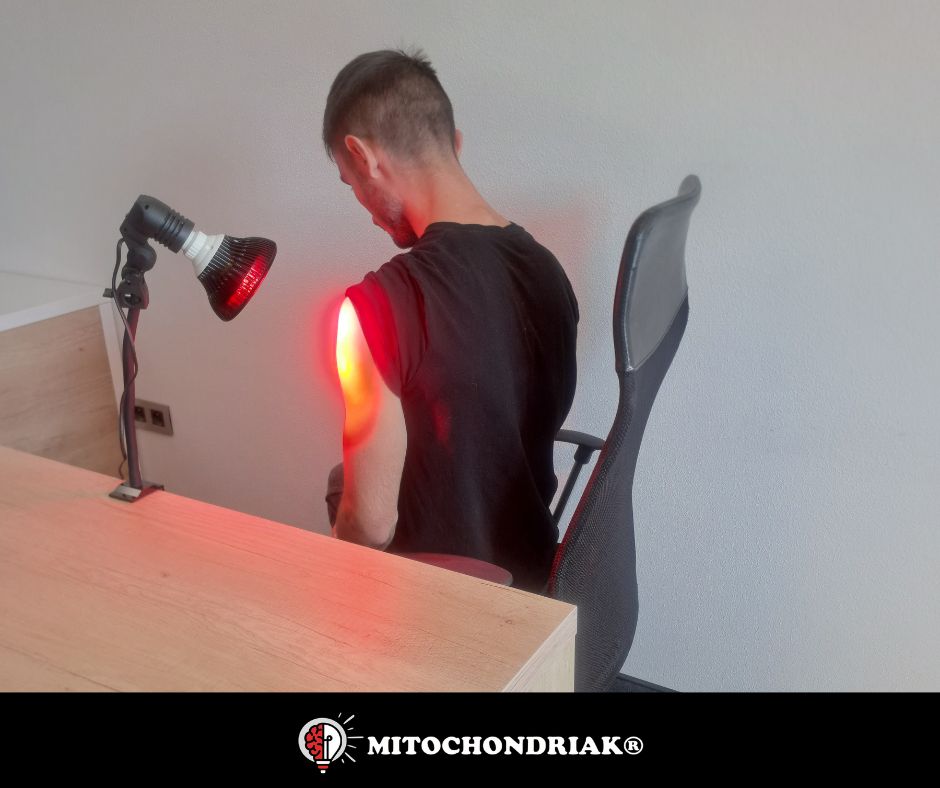
- You want localized therapy on one specific spot (knee, shoulder, face, joints, hair)
- You are starting with red light therapy and want to experience the effect before making a larger investment
- Your budget is under €100 and you want the best value for money
- You need a simple solution that fits into a desk lamp without a special stand
- You want a supplementary device alongside a panel for precise treatment of small areas
A therapy panel is the better choice when:
- You want to cover a larger body area (back, chest, full body)
- You need higher irradiance and shorter exposure times
- You plan regular therapy for the entire family
- You have specific health goals (post-exercise recovery, full mitochondrial support)
For reference: the LED therapy bulb Mitochondriak® at €99.50 covers the area of a single joint or part of the face. The Mitochondriak® mini at €270 covers a larger area and is portable, battery-powered. For half-body coverage, the Mitochondriak® Maxi Upgraded at €1,399 is the go-to device.
Which device is best for your profile?
Based on parameters, pricing, and customer feedback, here is a clear recommendation by user profile.
| User profile | Recommended device | Price | Why this one |
|---|---|---|---|
| Beginner, first contact with RLT | LED therapy bulb Mitochondriak® | €114.50 | Lowest price, 6 wavelengths, fits any desk lamp |
| Traveler, mobile therapy | Mitochondriak® mini | €270 | Battery-powered, portable, 12 LED diodes |
| Home therapy, whole family | Mitochondriak® Maxi Upgraded | €1,399 | Half body, stackable, touchscreen display |
| Joint pain, targeted therapy | LED therapy bulb + Mitochondriak® laser pulse | from €114.50 | Bulb for area coverage, laser for precise spot |
A 2013 study by Avci et al. confirms that even localized application of red light at the correct wavelengths stimulates collagen production, accelerates wound healing, and improves skin quality (Avci et al., 2013). This means that even a "small" therapy bulb can deliver measurable results with consistent use.
Shinhmar et al. from the UCL Institute of Ophthalmology (Glen Jeffery's laboratory) demonstrated in their 2020 study that brief exposure to 670 nm light improves mitochondrial function in the retina of older adults (Shinhmar et al., 2020). The LED therapy bulb Mitochondriak® includes the 670 nm wavelength as one of its six.
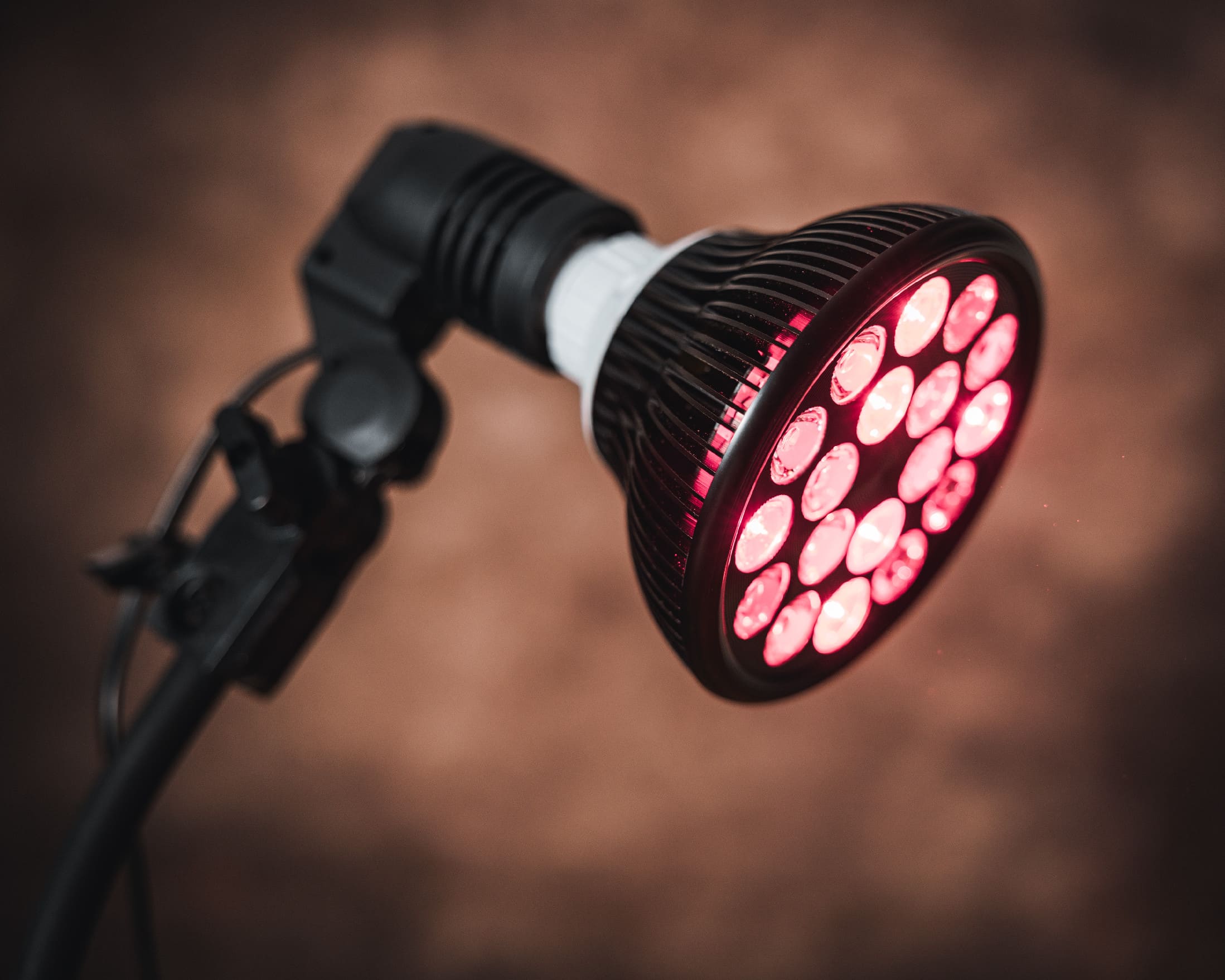
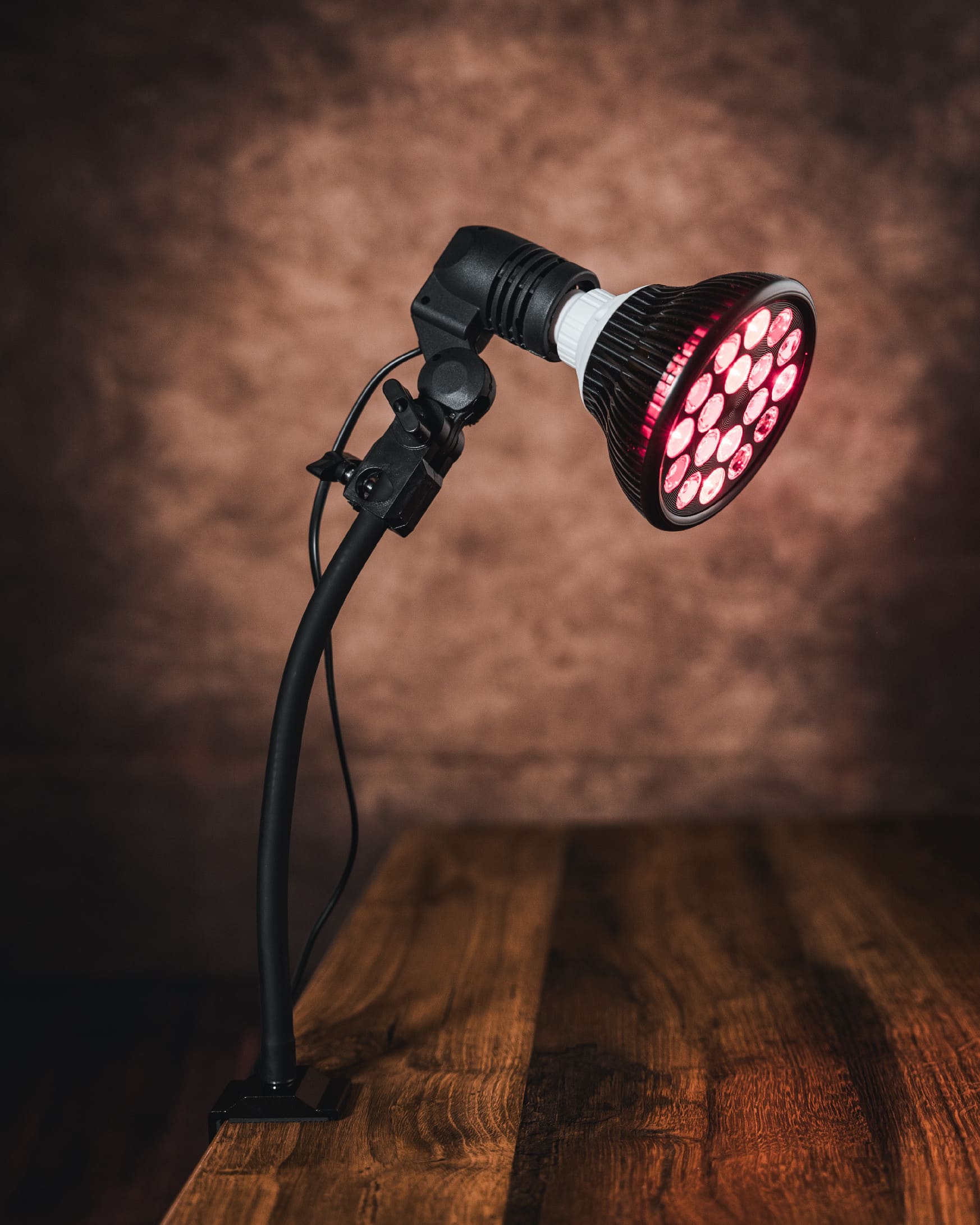
LED therapy bulb Mitochondriak®: 6 wavelengths for €114.50
18 high-power LED diodes, wavelengths 630, 670, 760, 810, 830, and 850 nm, eliminated flicker, aluminum heatsink, and standard E27 socket. The most affordable entry into red and near-infrared light therapy with measured parameters. The package includes a practical gooseneck socket holder.
Frequently Asked Questions
What is the difference between an LED therapy bulb and a classic infrared bulb?
A classic infrared bulb (e.g. a heating IR lamp) radiates thermal radiation at wavelengths above 1,000 nm. It warms the skin surface but does not penetrate into cells and does not stimulate mitochondria. A therapeutic LED bulb contains LED diodes with precisely defined wavelengths in the 630 to 850 nm range, which are absorbed by the enzyme cytochrome c oxidase (CCO). The result is increased ATP production, not heat.
How many wavelengths should a quality therapy bulb have?
At least 2 (red + NIR), ideally 4 or more. More wavelengths mean broader coverage of different tissue types. The LED therapy bulb Mitochondriak® contains 6 wavelengths (630, 670, 760, 810, 830, 850 nm), covering both surface and deeper structures. The more wavelengths, the more comprehensive the biological effect, because different photoacceptors in cells respond to different frequencies.
How long and from what distance should you use the therapy bulb?
The recommended distance is 15 to 30 cm from the treated area. Exposure time is 10 to 20 minutes per body area. At a shorter distance, irradiance is higher and the session can be shorter (10 minutes). Frequency: 3 to 5 times per week for general recovery, daily for acute issues. Initial results are visible after 2 to 4 weeks of consistent use.
Can the therapy bulb be used on the face and skin?
Yes. Red light at wavelengths of 630 nm and 670 nm supports collagen production, accelerates the healing of minor wounds, and improves skin quality. A study by Avci et al. (2013) confirms a stimulating effect on collagen and elastin at wavelengths in the 630 to 670 nm range. Use the bulb on the face from a distance of 10 to 15 cm, for 10 minutes, with your eyes closed.
Do I need a special lamp for the therapy bulb?
No. The LED therapy bulb Mitochondriak® has a standard E27 socket that fits most desk, clip, or floor lamps. The important thing is that the lamp has an adjustable mechanism to direct the light onto the treated area. Avoid lamps with fabric shades, as the bulb needs free airflow for cooling. The bulb comes with a practical gooseneck socket holder included in the package.
Is the therapy bulb safe for children?
Red and near-infrared light in the 630 to 850 nm range is considered safe for children as well. It is not UV radiation, it does not cause thermal burns, and it does not damage skin or eyes (although looking directly into the lit bulb is not recommended). For children, we recommend shorter exposures (5 to 10 minutes) and a greater distance (at least 20 cm or more). Always under adult supervision.
What is the lifespan of the therapy bulb?
LED diodes typically have a lifespan of 30,000 to 50,000 operating hours. With daily use of 20 minutes, that translates to more than 20 years. The aluminum heatsink of the Mitochondriak® therapy bulb ensures efficient heat dissipation, extending LED diode lifespan and maintaining stable light output throughout the entire operating period.
Sources and References
- Hamblin, M.R., 2017. Mechanisms and applications of the anti-inflammatory effects of photobiomodulation. PubMed
- de Freitas, L.F., Hamblin, M.R., 2016. Proposed Mechanisms of Photobiomodulation or Low-Level Light Therapy. PubMed
- Shinhmar, H. et al. (Jeffery lab, UCL), 2020. Optically improved mitochondrial function redeems aged human visual decline. PubMed
- Avci, P. et al., 2013. Low-level laser (light) therapy (LLLT) in skin: stimulating, healing, restoring. PubMed
- Mitochondriak®, Effects, Studies and Science behind light therapy. mitochondriak.com