
How much light does a red light therapy panel really deliver at the distance you will actually use it? At Mitochondriak Lab we measured the whole new generation of Mitochondriak® red light panels with two certified spectrometers, a solar meter and EMF meters: Office, Maxi, Profi and Advanced, plus the Mini and the LED red and NIR bulb. At the recommended 50 cm they deliver from 37.2 to 65.7 mW/cm² of true spectral irradiance, they also shine in the 940 nm band and they do not flicker (zero flicker). The numbers, charts, display photos and measurement reports are below.
- Results at a glance
- How did we measure the new generation?
- Which wavelengths do the panels really emit, and why 940 nm too?
- What is the irradiance at 30, 50 and 70 cm?
- How do the panels compare with the sun?
- What did the spectrometers show at 10 and 100 Hz pulsation?
- Do the new generation panels flicker?
- How much EMF do the new generation panels emit?
- Mini and LED bulb: how do they measure up close?
- Which panel should you choose, and at what distance?
- Frequently asked questions
Results at a glance
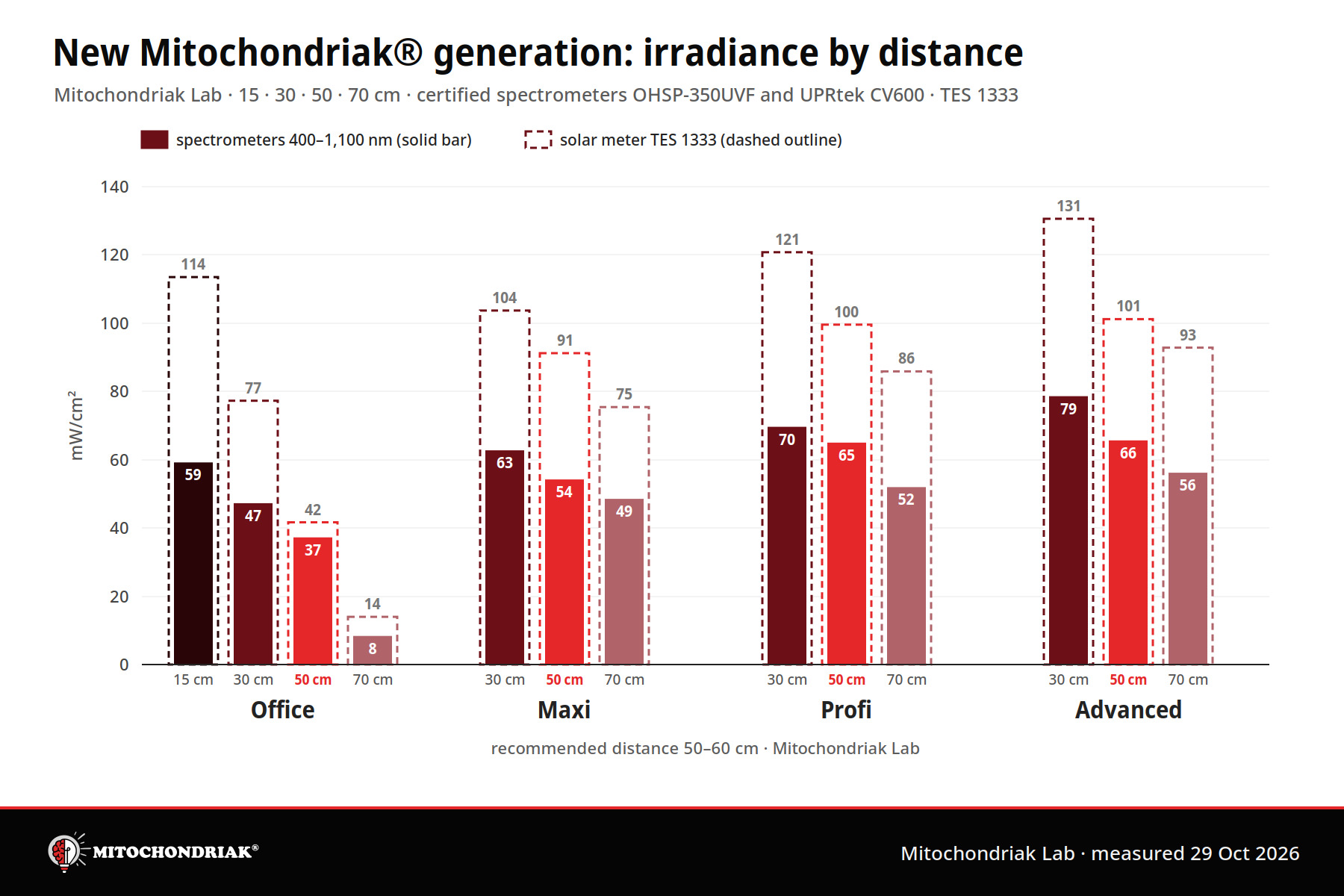
In short: all four large panels of the new generation shine with seven types of LED from 630 to 940 nm. At the recommended 50 cm they deliver 37.2 to 65.7 mW/cm² according to the spectrometers, while the solar meter reads 41.7 to 101.2 mW/cm². The panels do not flicker (zero flicker, flicker index 0.00) and the magnetic field at 30 cm is 0.1 µT, which is background level.
| Mitochondriak Lab, 29 Oct 2026 | 50 cm, spectrometers | 50 cm, solar meter | 30 cm, spectrometers | 30 cm, solar meter |
|---|---|---|---|---|
| Office | 37.2 mW/cm² | 41.7 mW/cm² | 47.3 mW/cm² | 77.3 mW/cm² |
| Maxi | 54.2 mW/cm² | 91.2 mW/cm² | 62.8 mW/cm² | 103.7 mW/cm² |
| Profi | 65.0 mW/cm² | 99.6 mW/cm² | 69.7 mW/cm² | 120.8 mW/cm² |
| Advanced | 65.7 mW/cm² | 101.2 mW/cm² | 78.6 mW/cm² | 130.6 mW/cm² |
| Flicker (all panels) | zero flicker: flicker index 0.00, fluctuation of 1.1 to 2.1%, like sunlight | |||
| Magnetic field at 30 cm | 0.1 µT (1 mG), background level | |||
How did we measure the new generation?
Because one number on the box is not enough. Most irradiance figures for red light panels on the market come from a solar meter, which tells you how much light arrives but not what kind of light it is. A solar meter is like the scale at the checkout: it shows the weight of your shopping. A spectrometer is the ingredients label: it shows how much of it is red, near infrared or blue. Your body does not read the quantity, it reads the kind of light. For us Mitochondriaks, light is both energy and information, so we measure both.
At Mitochondriak Lab on 29 October 2026 we measured each panel with five instruments at once:
- certified OHSP-350UVF spectrometer (230 to 900 nm): full spectrum, pulsation and flicker,
- a second certified spectrometer, UPRtek CV600, with a calibration certificate (380 to 780 nm): spectrum, pulsation and flicker,
- TES 1333 solar meter (400 to 1,100 nm): the common method behind most irradiance figures on the market,
- Cornet ED88 electrosmog meter: magnetic field, electric field and radio frequency radiation,
- GQ Multifield EMF meter (commonly called a 3-in-1 EMF meter): electric field, magnetic field and radio frequency radiation, both high and low frequency.
- Distances: Maxi, Profi and Advanced at 30, 50 and 70 cm, Office and the LED bulb at 15, 30, 50 and 70 cm, Mini at 5 and 10 cm. We measure the distance from the front of the panel.
- Why 30 cm too: panel irradiance is commonly quoted at 30 cm on the market, so we quote it there as well, so that you can compare. It is a comparison point for measurement. For using the large panels we recommend 50 to 60 cm.
- The 940 nm band: the spectrometers end at 900 nm. We determined the part above 900 nm from the spectrum and the solar meter, and we include it alongside the other bands in the tables, charts and data.
- Flicker: measured in continuous mode, with pulsation switched off. We measured pulsation separately at 10 and 100 Hz.
- Sun: with the same solar meter we also measured direct sunlight on 29 October 2026 at around 3 pm.
- Office: report (PDF), CSV, XLSX
- Maxi: report (PDF), CSV, XLSX
- Profi: report (PDF), CSV, XLSX
- Advanced: report (PDF), CSV, XLSX
- Mini: report (PDF), CSV, XLSX
- LED red and NIR bulb: report (PDF), CSV, XLSX

Which wavelengths do the panels really emit, and why 940 nm too?
The Office, Maxi, Profi and Advanced all have the same seven types of LED: 630, 670, 760, 810, 830, 850 and 940 nm. The Mini and the LED bulb have six types of LED: 630, 670, 760, 810, 830 and 850 nm. There are no blue or green LEDs in them; all of the light lies in the red and near infrared range.
So why don't you see seven separate peaks in the spectrum? Because the LEDs are not distributed 1:1, meaning each wavelength does not have the same number of diodes. We chose the ratio according to biological effectiveness and how the body absorbs light: more diodes where the body can use the light, fewer where it would mostly warm the skin. On top of that, each LED does not shine on a single line but in a band several tens of nanometers wide. Neighboring bands, such as 810, 830 and 850 nm, therefore overlap, and a less represented type merges with its stronger neighbor into one broader peak. The chart marks every type of LED the panel has. For the Maxi, the most prominent peaks are at 631, 670, 764, 816 and 856 nm plus the band around 940 nm; this complements the list of LEDs, it does not replace it.
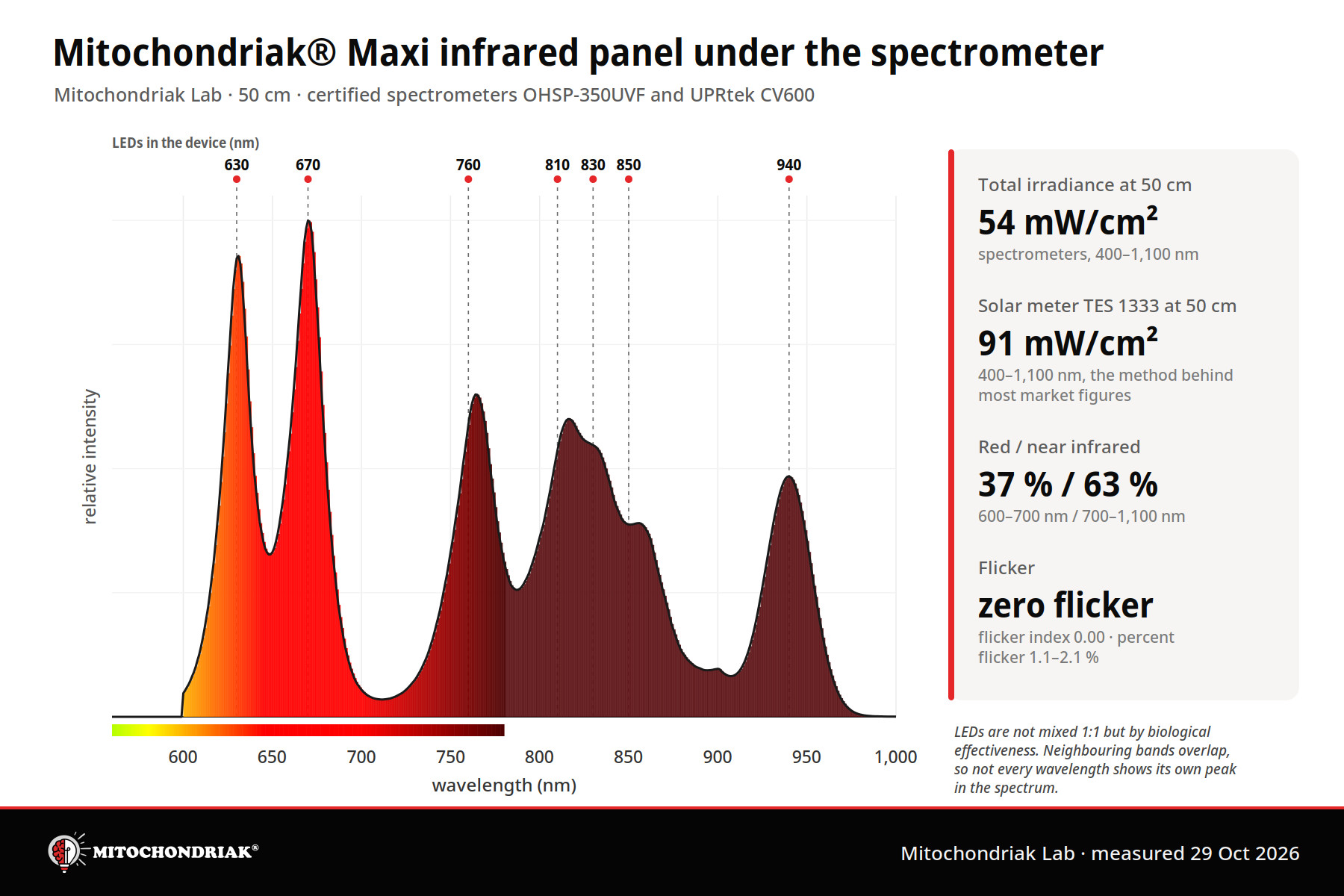
Red at 630 and 670 nm, near infrared from 760 to 850 nm. This is the light that mitochondria capture. In his review, Michael Hamblin of Harvard Medical School describes the enzyme cytochrome c oxidase as the main site where the cell absorbs red and near infrared light. According to the explanation he gives, light releases the inhibiting nitric oxide from the enzyme and the flow of electrons resumes [R]. For us Mitochondriaks, this is a flow of electrons and protons that produces ATP, CO₂, heat, light and water, and in our view making deuterium-depleted water is one of the main tasks of the mitochondrion.
830 and 850 nm reach deeper. Researchers at University College London measured that infrared light from the sun passes even through the chest of an adult, and they picked 830 to 860 nm as a prominent transmitted band [R]. That is exactly where the 830 and 850 nm LEDs shine. More in our article on how infrared light penetrates the entire body.
Why does the new generation also shine at 940 nm?
Because 940 nm is light that water notices. At 940 to 980 nm, water absorbs near infrared light many times more strongly than in the 800 to 900 nm band. This is shown by the optical constants of water that the whole field of optics relies on today [R]. And water in the body is not just filler. Next to hydrophilic surfaces it arranges itself into a layer that separates charge like a battery. In Gerald Pollack's laboratory at the University of Washington, this layer grew reversibly after irradiation, depending on the wavelength, and the authors conclude that water stores the energy of light as separated charge [R]. For us Mitochondriaks, water is a battery and infrared light is its charger.
At 50 cm the 940 nm band delivers 3.2 mW/cm² on the Office, 6.6 mW/cm² on the Maxi, 12.2 mW/cm² on the Profi and 13.5 mW/cm² on the Advanced. It is included in the total irradiance. Many panels on the market do not have it at all, so when you compare, look not only at the number of wavelengths but also at how much light actually arrives in each band. More in the article How many wavelengths should a red light infrared panel have.
What is the irradiance at 30, 50 and 70 cm?
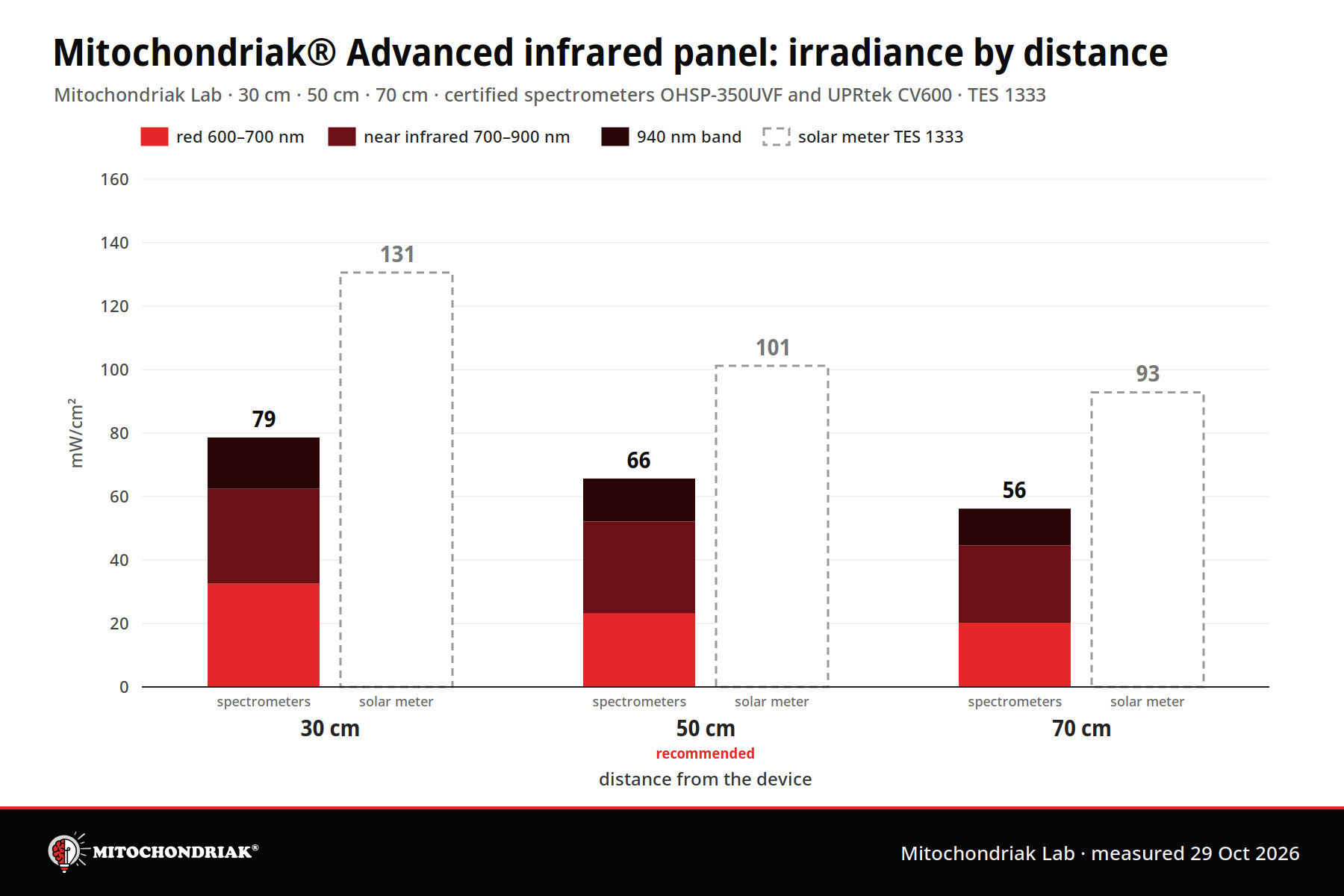
At the recommended 50 cm, the Office delivers 37.2, the Maxi 54.2, the Profi 65.0 and the Advanced 65.7 mW/cm² according to the spectrometers. The larger the panel, the more slowly irradiance drops with distance. With its 180 × 60 cm surface, the Advanced still delivers 56.2 mW/cm² at 70 cm. The Office has a narrow beam: between 50 and 70 cm its irradiance drops sharply, as both the spectrometers and the solar meter confirmed. So use the Office at 50 to 60 cm, no further.
| Mitochondriak Lab, mW/cm² | 15 cm | 30 cm | 50 cm, recommended | 70 cm |
|---|---|---|---|---|
| Office, spectrometers | 59.2 | 47.3 | 37.2 | 8.4 |
| Office, solar meter | 113.5 | 77.3 | 41.7 | 14.0 |
| Maxi, spectrometers | 62.8 | 54.2 | 48.5 | |
| Maxi, solar meter | 103.7 | 91.2 | 75.4 | |
| Profi, spectrometers | 69.7 | 65.0 | 52.0 | |
| Profi, solar meter | 120.8 | 99.6 | 85.9 | |
| Advanced, spectrometers | 78.6 | 65.7 | 56.2 | |
| Advanced, solar meter | 130.6 | 101.2 | 92.8 |
Spectrometers: 400 to 1,100 nm including the 940 nm band; the panels emit nothing below 600 nm. TES 1333 solar meter: 400 to 1,100 nm.
| Mitochondriak Lab, mW/cm² | Red 600 to 700 nm | Near infrared 700 to 1,100 nm | Of which 940 nm band |
|---|---|---|---|
| Office 15 cm | 20.9 | 38.3 | 5.2 |
| Office 30 cm | 23.3 | 24.0 | 4.1 |
| Office 50 cm | 18.0 | 19.2 | 3.2 |
| Office 70 cm | 4.4 | 4.0 | 0.7 |
| Maxi 30 cm | 27.9 | 34.8 | 7.6 |
| Maxi 50 cm | 20.0 | 34.2 | 6.6 |
| Maxi 70 cm | 19.3 | 29.2 | 5.9 |
| Profi 30 cm | 30.3 | 39.3 | 13.0 |
| Profi 50 cm | 24.6 | 40.4 | 12.2 |
| Profi 70 cm | 19.0 | 32.9 | 9.7 |
| Advanced 30 cm | 32.6 | 46.1 | 16.2 |
| Advanced 50 cm | 23.3 | 42.4 | 13.5 |
| Advanced 70 cm | 20.2 | 36.0 | 11.6 |
Why does a solar meter read higher than a spectrometer?
A solar meter is calibrated for sunlight, which has a continuous spectrum, not for the narrow bands of LEDs. With LEDs without a 940 nm band it therefore reads 1.6 to 1.8 times higher than the spectrometers. With the Maxi, Profi and Advanced the gap is even bigger, roughly 1.8 to 2.1 times, because the solar meter also sees the 940 nm band. On sunlight it measures just as it should, which is exactly why we used it to measure the sun as well. We give both numbers: the solar meter so you can compare with figures on the market, and the spectrometers, which show the true spectral irradiance. Most sellers only give the first number.

Why not closer, when there is more light there?
Because more light does not mean more effect. Researchers at Massachusetts General Hospital describe a biphasic response to red and infrared light: in experiments, low doses often had a better effect on cells and tissues than high ones [R]. At 50 cm you get most of the light you would get at 30 cm, and over a larger area of your body. Does that make sense to you? There is no need to press up against the panel.
How do the panels compare with the sun?
In red and near infrared light, the Maxi, Profi and Advanced at 50 cm deliver a dose comparable to or higher than the sun on 29 October 2026 at around 3 pm. At that time the same solar meter measured 915.6 W/m² in direct sunlight, i.e. 91.6 mW/cm². Based on the shape of the ASTM G173 reference solar spectrum [R], roughly 56.5 mW/cm² of that falls in the red and near infrared range of 600 to 1,100 nm.
- Maxi at 50 cm: 96% of this dose,
- Profi at 50 cm: 115%,
- Advanced at 50 cm: 116%.
This comparison is derived from our measurement, and the panels deliver this light without UV and without blue light. The Office shines on a smaller area and is intended more for one part of the body.
When day and night become equal, biology switches mode. In autumn, the sun at our latitude loses its UV while it keeps its red and infrared light, and that is exactly what the panel brings indoors, even on days when light is scarce outside. It does not replace the morning sun outdoors, though: your eyes and skin need daylight from the sky, so we take the sun first and the panel as a supplement. If you want UVB in a panel too, see our Maxi UVB red light panel spectrometer test.
What did the spectrometers show at 10 and 100 Hz pulsation?
That the pulsation is real. At 10 and 100 Hz, both spectrometers showed a light fluctuation of 96 to 100% and an index of about 0.46 to 0.47. So the LEDs really switch on and off (PWM) rather than just dimming slightly. Average irradiance with pulsation is therefore about half: with pulsation on, the Maxi delivers roughly 27 mW/cm² on average at 50 cm, of which about 60% is near infrared and 40% red.
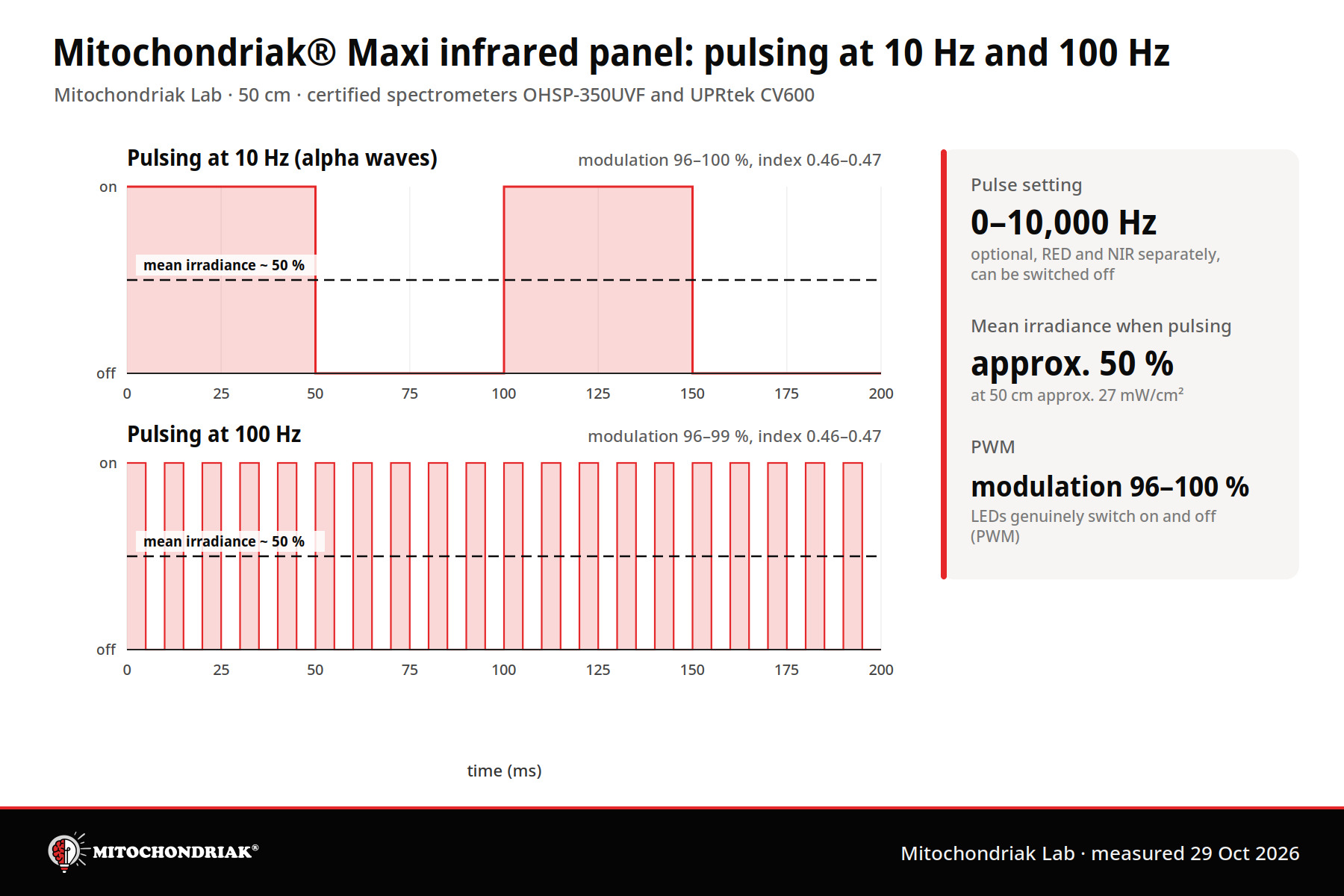
- Optional: you can switch pulsation off or set it freely from 0 to 10,000 Hz, decimals included, separately for red and for infrared light. It works the same way on the Maxi UVB.
- 10 Hz: lies within the brain's alpha wave band, commonly given as 8 to 12 Hz. It is an option for those who want to work with the frequency of light.
- Time: with pulsation on, you get roughly half the dose in the same time. If you want the same dose as in continuous mode, extend the session accordingly.
Why pulse at all? A review from Massachusetts General Hospital compared four decades of experiments with continuous and pulsed light in animals and humans and reports that pulsed light has different effects from continuous light [R]. Nature does not shine evenly either: light through leaves, across the surface of water or through clouds keeps changing. More in our glossary: pulsation.
Do the new generation panels flicker?
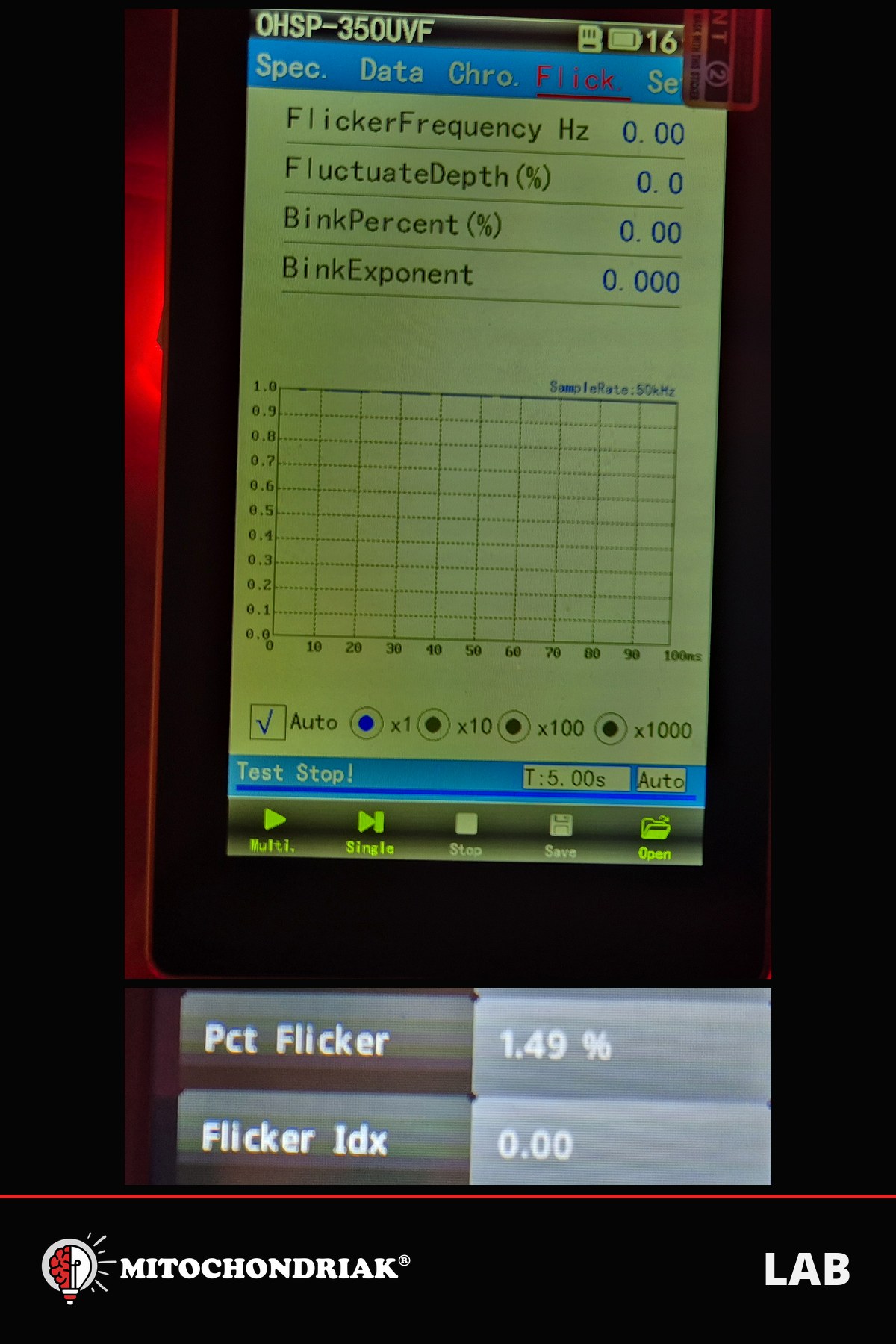
No. The new generation panels are flicker-free, in other words zero flicker: their light really does not flicker. Repeated measurements with two independent certified spectrometers confirm it. See the display photo below and the reports in the Downloads box.
- OHSP-350UVF shows a flicker frequency of 0 and a modulation depth of 0.0%.
- UPRtek CV600 shows a frequency of 1 Hz because it cannot display zero. This is not flicker but the lowest value the instrument can show.
- The percentage fluctuation is 1.1 to 2.1%. That is a very small fluctuation, similar to sunlight, which never shows zero on the same instruments either.
- The flicker index is 0.00.
In plain words: the panel's light stays as steady as sunlight. Technically: a flicker index of 0.00 and a fluctuation of up to 2.1% mean the light is not modulated. So our panels really do not flicker. We measured in continuous mode, with pulsation switched off.
Behind this are the drivers, the power supplies that feed the LEDs. We tested and selected them repeatedly so that the light stays stable. Cheap light sources can dip almost to zero, many times per second, even though the eye cannot see it. Mind the difference: flicker is an unwanted fluctuation that nobody chooses, while pulsation is a feature you switch on deliberately. More in our glossary: flicker.
How much EMF do the new generation panels emit?
We measured EMF with a Cornet ED88 electrosmog meter and a GQ Multifield EMF meter, commonly called a 3-in-1 EMF meter, which measures the electric and magnetic field as well as radio frequency radiation. At 30 cm the Cornet ED88 showed a magnetic field of 0.1 µT (1 mG), an electric field of 0 V/m and radio frequency radiation of 0.0001 mW/m². That is the background level of an ordinary home. From 30 cm, the EMF from the device is therefore not measurable, it is at background level, and even more so at the recommended 50 to 60 cm.
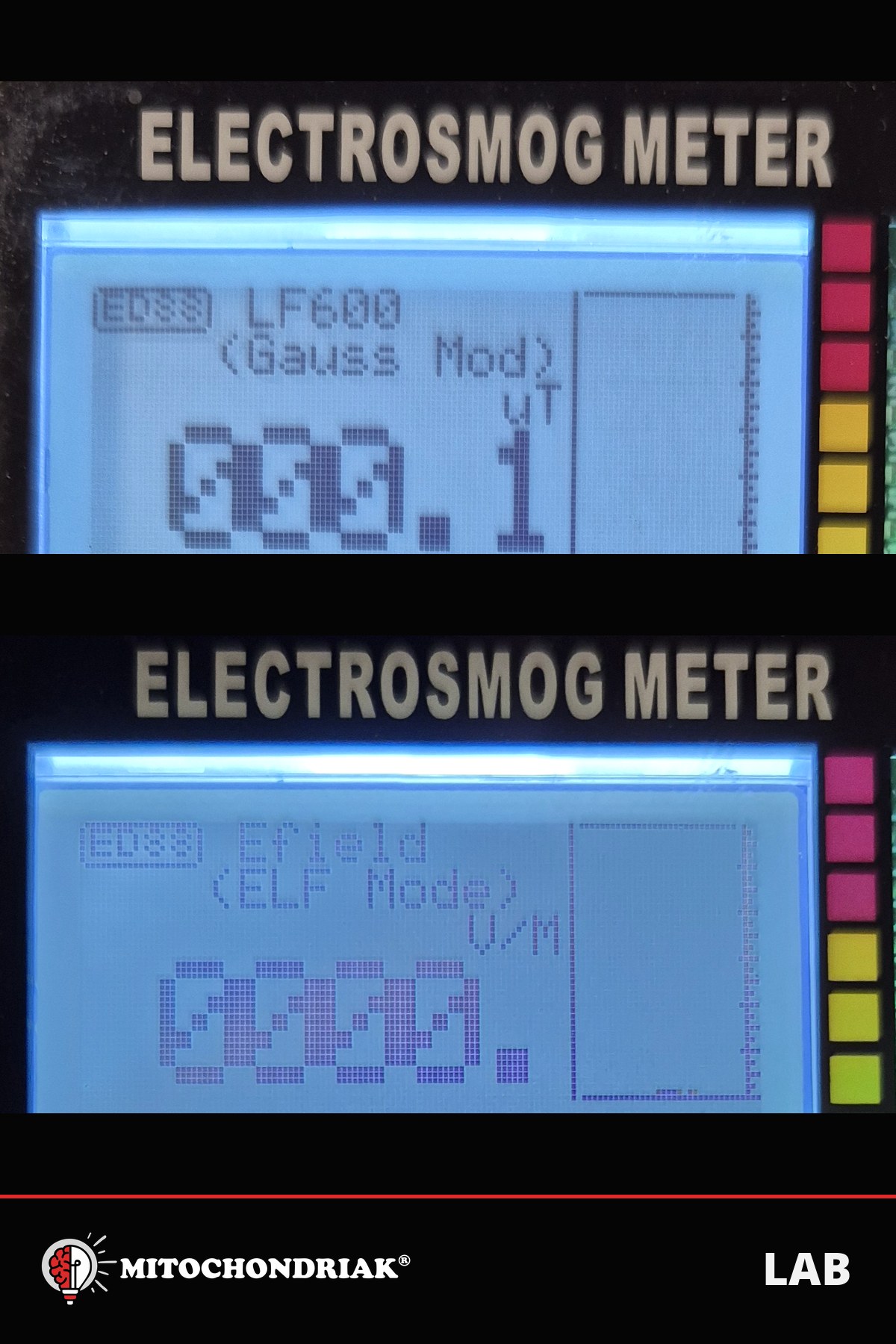
Electronics close to the body is a stimulus the eye cannot see, so we measure it as thoroughly as light. With the largest panel, the Advanced with 1,200 LEDs, and with the small Office the result is the same.
Mini and LED bulb: how do they measure up close?
The Mitochondriak® Mini panel runs on a battery and is used up close, directly on one area. At 5 cm it delivers 19.9 mW/cm² according to the spectrometers and 43.2 mW/cm² on the solar meter, and 11.7 mW/cm² at 10 cm. The Mitochondriak® LED red and NIR bulb shines on a smaller area, so we recommend using it at 30 cm or more: there it delivers 90.1 mW/cm² according to the spectrometers and 147.8 mW/cm² on the solar meter, and 46.1 mW/cm² at 50 cm. Both have six types of LED: 630, 670, 760, 810, 830 and 850 nm, they do not flicker (zero flicker) and their magnetic field is at background level.
| Mitochondriak Lab, mW/cm² | Spectrometers | Solar meter | Red / near infrared |
|---|---|---|---|
| Mini 5 cm | 19.9 | 43.2 | 7.3 / 12.6 |
| Mini 10 cm | 11.7 | 21.5 | 4.1 / 7.7 |
| LED bulb 15 cm | 120.4 | 204.4 | 39.2 / 81.2 |
| LED bulb 30 cm, recommended minimum | 90.1 | 147.8 | 32.2 / 57.9 |
| LED bulb 50 cm | 46.1 | 67.2 | 16.7 / 29.3 |
| LED bulb 70 cm | 24.3 | 35.9 | 8.7 / 15.5 |

Which panel should you choose, and at what distance?
It depends on how much of your body you want to light at once. The light is of the same kind in all of them; what differs is the area and the irradiance at a given distance.
| Model | Size, LEDs | At the recommended distance | Best for |
|---|---|---|---|
| Mini | 15 × 9.5 cm, 12 dual LEDs | up close: 19.9 mW/cm² at 5 cm | local use, travel, battery powered |
| LED bulb | 12 × 12 cm, 18 LEDs | at least 30 cm: 90.1 mW/cm² | local use, one body area |
| Office | 32 × 22 cm, 70 LEDs | 50 to 60 cm, no further: 37.2 mW/cm² | face, neck, part of the body, office, travel |
| Maxi | 90 × 30 cm, 300 LEDs | 50 to 60 cm: 54.2 mW/cm² | half the body |
| Profi | 120 × 42 cm, 560 LEDs | 50 to 60 cm: 65.0 mW/cm² | a larger part of the body at once |
| Advanced | 180 × 60 cm, 1,200 LEDs | 50 to 60 cm: 65.7 mW/cm² | the whole body at once |
- Distance: Office, Maxi, Profi and Advanced at 50 to 60 cm, or further. 30 cm is only a comparison point for measurement. Mini up close, the LED bulb at 30 cm or more.
- Time: start with 2 to 5 minutes at full intensity and extend the time gradually, usually 5 to 10 minutes for surface areas and 10 to 30 minutes for deeper ones.
- Eyes: keep them closed or wear protective glasses, and do not look into the LEDs.
- Touch display: on the Office, Maxi, Profi and Advanced you set everything directly on the panel: red and infrared intensity separately, pulsation, timer and preset programs.
You will find the full selection by goal and space in our red light therapy devices category.
Summary: what should you remember from the measurements?
We measured the new generation of Mitochondriak® red light panels with two certified spectrometers, a solar meter and EMF meters. At the recommended 50 cm the Office delivers 37.2, the Maxi 54.2, the Profi 65.0 and the Advanced 65.7 mW/cm² of true spectral irradiance in seven bands from 630 to 940 nm. Pulsation at 10 and 100 Hz really switches the LEDs on and off, and it can be turned off. The panels do not flicker (zero flicker) and EMF at 30 cm is at background level.
The order still applies, though: first the sun and the natural day, then light at home matched to the time of day, then the panel, and only last supplements. The biggest number on the box does not tell you how much light your skin receives; the spectrum, the distance and the time do. For us Mitochondriaks, light is information, and we would rather measure it than guess. We do not guess, we measure. The choice is yours.
Seven wavelengths from 630 to 940 nm, verified by two spectrometers. Choose the size by how much of your body you want to light at once.
Office Maxi Advanced All devicesFrequently asked questions
What is the irradiance of the Mitochondriak® Office, Maxi, Profi and Advanced panels?
At the recommended 50 cm, according to two certified spectrometers: Office 37.2, Maxi 54.2, Profi 65.0 and Advanced 65.7 mW/cm². The TES 1333 solar meter reads 41.7 to 101.2 mW/cm² for them. We measured at Mitochondriak Lab on 29 October 2026.
Which Mitochondriak® red light panel should you choose?
By the area you want to light at once. The Office (32 × 22 cm) for the face, neck or part of the body and for travel, the Maxi (90 × 30 cm) for half the body, the Profi (120 × 42 cm) for a larger part of the body and the Advanced (180 × 60 cm) for the whole body. All have the same seven wavelengths from 630 to 940 nm. The Mini is battery powered for local use up close.
Why does a solar meter read higher than a spectrometer on a red light panel?
A solar meter is calibrated for the continuous solar spectrum, not for the narrow bands of LEDs. With LEDs without a 940 nm band it reads 1.6 to 1.8 times more than the spectrometers, and even more with panels that have 940 nm. We give both numbers: the solar meter for comparison with figures on the market and the spectrometers as the true spectral irradiance.
At what distance should you use a red light panel?
Office, Maxi, Profi and Advanced at 50 to 60 cm, or further. 30 cm is only a comparison point for measurement, where irradiance is commonly quoted on the market. The Mini is used up close and the LED bulb at 30 cm or more. Start with 2 to 5 minutes and extend the time gradually.
Why does the new generation of red light panels also have 940 nm?
At 940 to 980 nm, water absorbs near infrared light many times more strongly than at 800 to 900 nm, and we see the water in the body as a battery that infrared light charges. At 50 cm the 940 nm band delivers 3.2 to 13.5 mW/cm² and is included in the total irradiance.
Do the new generation panels flicker?
No, they are zero flicker. Two independent certified spectrometers measured a flicker index of 0.00 and a fluctuation of 1.1 to 2.1%, similar to sunlight. The OHSP-350UVF shows a frequency of 0; the UPRtek CV600 shows 1 Hz only because it cannot display zero.
What is 10 Hz pulsation, and can it be switched off?
Pulsation is an optional feature: you switch it off or set it from 0 to 10,000 Hz, decimals included, separately for red and infrared light. At 10 and 100 Hz the spectrometers measured a fluctuation of 96 to 100%, meaning the LEDs really switch on and off, and an average irradiance of about half. 10 Hz lies within the brain's alpha wave band.
Do Mitochondriak® red light panels emit electrosmog (EMF)?
At 30 cm, EMF is at background level. We measured with a Cornet ED88 electrosmog meter and a GQ Multifield EMF meter (commonly called a 3-in-1 EMF meter). The Cornet ED88 showed a magnetic field of 0.1 µT (1 mG), an electric field of 0 V/m and radio frequency radiation of 0.0001 mW/m². From 30 cm, EMF from the device is at background level.
Sources and references
- Hashmi JT. 2010. Effect of pulsing in low-level light therapy doi.org
- Chai B. 2009. Effect of radiant energy on near-surface water doi.org
- Jeffery G. 2025. Longer wavelengths in sunlight pass through the human body and have a systemic impact which improves vision doi.org
- Hamblin MR. 2018. Mechanisms and Mitochondrial Redox Signaling in Photobiomodulation doi.org
- Hale GM. 1973. Optical constants of water in the 200-nm to 200-µm wavelength region doi.org
- Huang YY. 2009. Biphasic dose response in low level light therapy doi.org