
How much light does a red light therapy panel really deliver when you test it with a spectrometer instead of just a solar meter? At Mitochondriak Lab we measured the Mitochondriak® Maxi UVB infrared panel with two certified spectrometers, a solar meter and EMF meters. At the recommended 50 cm it delivers 49 mW/cm² of true spectral irradiance, UVB peaking at 299 nm, and practically no flicker. Numbers, charts and display photos are below.
- Why do we test infrared panels with a spectrometer, not just a solar meter?
- How did we measure the Maxi UVB?
- Which wavelengths does the Maxi UVB really emit?
- What is the real irradiance at 30, 50, 70 and 100 cm?
- How much UVB does the Maxi UVB give, and what does a UV index of 18 mean?
- How does the Maxi UVB compare with the October sun?
- Vitamin D in winter: a tablet, the sun or controlled UVB?
- Does the Maxi UVB flicker?
- How much EMF does the Maxi UVB emit?
- Which distance and session time should you choose?
- Frequently asked questions
Results at a glance
In short: the Mitochondriak® Maxi UVB infrared panel shines with nine types of LED, from UVB to near infrared. At the recommended 50 cm it delivers 49 mW/cm² according to the spectrometers and 79 mW/cm² according to the solar meter, of which 17 mW/cm² is red and 30 mW/cm² near infrared. UVB peaks at 299 nm, the flicker index is 0.00 and the magnetic field at 30 cm is 0.1 µT, background level.
| Maxi UVB (Mitochondriak Lab, 28 Oct 2026) | 30 cm, market comparison point | 50 cm, recommended distance |
|---|---|---|
| Total irradiance, spectrometers (230 to 1,100 nm) | 56 mW/cm² | 49 mW/cm² |
| Solar meter TES 1333 (400 to 1,100 nm) | 100 mW/cm² (1,004 W/m²) | 79 mW/cm² |
| Red (600 to 700 nm) | 18 mW/cm² | 17 mW/cm² |
| Near infrared (700 to 1,100 nm) | 36 mW/cm² | 30 mW/cm² |
| UVB (280 to 315 nm) | 78 µW/cm² | 74 µW/cm² |
| UV index (calculated from the spectrum, CIE) | 19 | 18 |
| 1 standard erythema dose (SED) | in about 3.5 min | in about 3.7 min |
| Flicker (all distances) | flicker index 0.00, modulation below 2%, practically flicker-free | |
| Magnetic field at 30 cm | 0.1 µT (1 mG), background level | |
Why do we test infrared panels with a spectrometer, not just a solar meter?
Because a solar meter tells you how much light arrives, but not what kind of light it is. Most panel irradiance figures on the market come from one. A spectrometer splits light into wavelengths and shows how much energy sits in UVB, UVA, blue, red and near infrared. Only then do you know what a panel delivers.
Why does that matter so much? Light is not only energy, it is also information. Your body does not read how much light lands on it, but what kind of light it is: UVB, from which your skin makes vitamin D, blue, which tells your inner clock that it is daytime, or red and near infrared light, which your mitochondria capture. What counts is the kind of light, not just the amount.
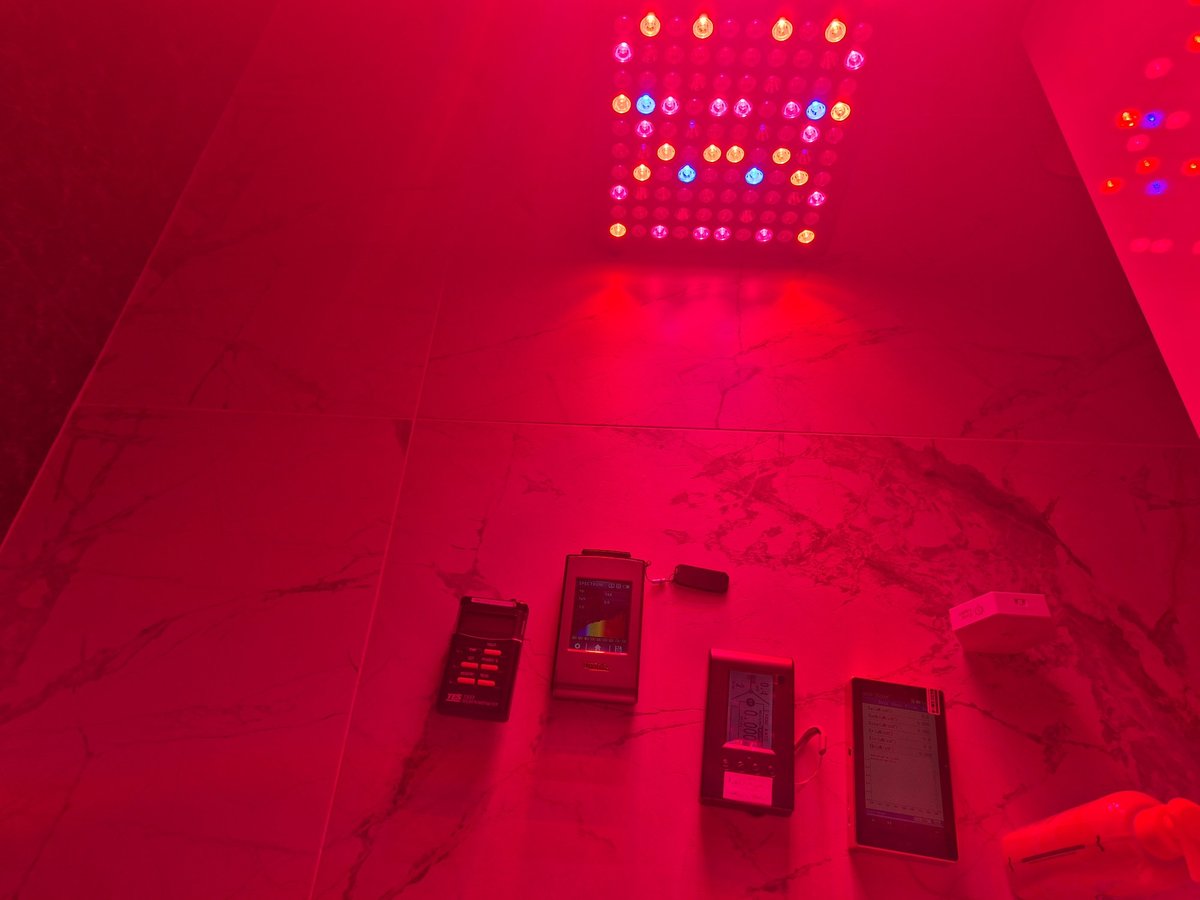
A solar meter is like a kitchen scale on which you put your whole shopping bag. It tells you the bag weighs three kilos, but not whether it holds vegetables or sugar. A spectrometer opens the bag and weighs each item separately. That is why, at Mitochondriak Lab, our measuring bench, we tested the Maxi UVB with five instruments at once:
- certified OHSP-350UVF spectrometer (230 to 900 nm): the full spectrum from UVB to near infrared, plus flicker,
- a second certified spectrometer, the UPRtek CV600, with its calibration certificate (380 to 780 nm): spectrum and flicker,
- TES 1333 solar meter (400 to 1,100 nm): the common method behind most irradiance figures on the market,
- Cornet ED88 electrosmog meter: magnetic field,
- triple EMF meter: magnetic field, electric field and radio frequency radiation.
Mitochondriak® is a Slovak manufacturer that measures its lights with instruments, not by the catalog, and publishes the results with photos of the displays. When we put our red bulbs and blue light blocking glasses under the spectrometer on 21 October, we promised to test our infrared panels the same way. Here are the Maxi UVB results. We do not guess, we measure.
How did we measure the Maxi UVB?
We measured the Maxi UVB at Mitochondriak Lab on 28 October 2026 between 15:01 and 15:04, at distances of 30, 50, 70 and 100 cm from the front of the panel. The OHSP-350UVF spectrometer measured in two series, the UPRtek CV600 and the solar meter in one. The values in the tables are the average of both OHSP series.
- Why 30 cm as well: the market commonly quotes panel irradiance at 30 cm, so we do too, for comparison. For use we recommend 50 to 60 cm.
- UV index: calculated from the measured spectrum using the CIE erythema action spectrum, standardized in ISO/CIE 17166 [R].
- UVB: measured with the OHSP-350UVF spectrometer and evaluated after subtracting the instrument background, which is standard practice.
- The part above 900 nm: the 850 nm LED spectrum continues beyond the spectrometer's range; we calculated this part, 0.5 to 0.7 mW/cm², from the spectrum.
- Flicker: measured in continuous mode, with pulsing switched off.
- The sun: on the same day at 14:20 we also measured the afternoon sun with the same solar meter.


Which wavelengths does the Maxi UVB really emit?
The Maxi UVB has 300 LEDs of nine types: 295, 380, 480, 630, 670, 760, 810, 830 and 850 nm. The spectrometer measured peaks at 299, 386, 480, 631, 671 and 766 nm and around 816 and 838 nm; the shoulder at 850 nm overlaps with the 830 nm band. So one panel delivers UVB, UVA, blue, red and near infrared.
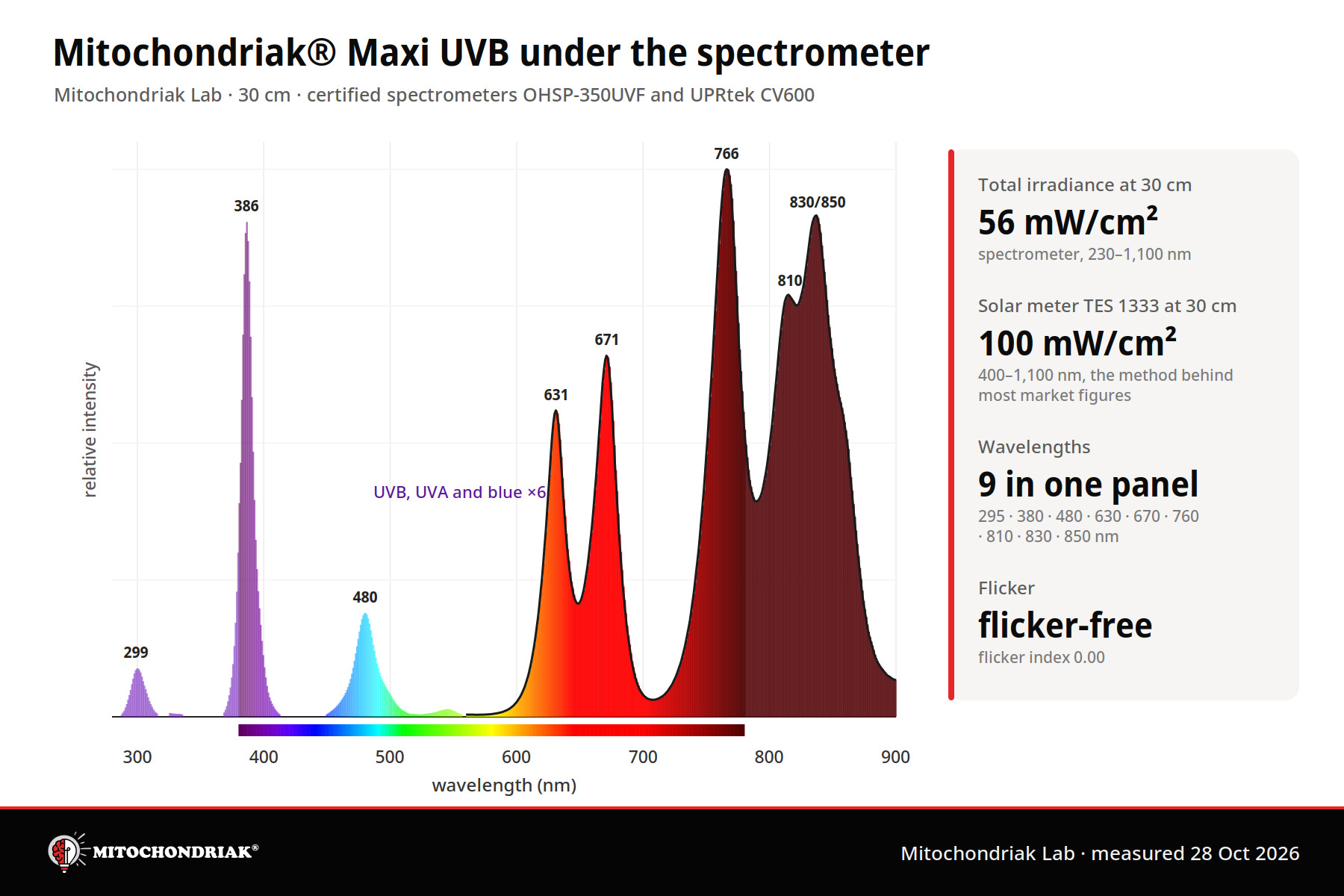
| Band | LED types | Measured peaks (Mitochondriak Lab) |
|---|---|---|
| UVB | 295 nm | 299 nm |
| UVA | 380 nm | 386 nm |
| Blue | 480 nm | 480 nm |
| Red | 630 and 670 nm | 631 and 671 nm |
| Near infrared | 760, 810, 830 and 850 nm | 766 nm, around 816 and 838 nm |
The choice of these bands follows a sunny day. In the morning, red and infrared light arrive first, then UVA builds up, and UVB peaks around midday. Blue sunlight never comes alone; red and infrared always come with it. The Maxi UVB brings the same components together in a single panel.
UVB 299 nm. The measured peak sits right in the 295 to 300 nm band, where human skin produces previtamin D3 most efficiently. This was shown in experiments in which samples of human skin were irradiated with narrow bands of UV light [R]. The action spectrum for previtamin D3 production in skin is now standardized by the International Commission on Illumination in CIE 174:2006 [R]. How your skin makes vitamin D is explained in our glossary.
UVA 386 nm and blue 480 nm. UVA arrives before UVB, and in our view it helps prepare the skin gradually for stronger sun. Blue at 480 nm lies in the range to which melanopsin is most sensitive, the pigment in the eye that tells your inner clock it is daytime. So switch on UV and blue during the day.
Red 631 and 671 nm and near infrared 766 to 850 nm. This is the light your mitochondria capture. In his review, Michael Hamblin of Harvard Medical School describes the enzyme cytochrome c oxidase in the mitochondrion as the main site where the cell absorbs red and near infrared light. In his explanation, light releases inhibitory nitric oxide from the enzyme and the flow of electrons resumes [R]. For us Mitochondriaks, this is a flow of electrons and protons that produces ATP, CO₂, heat, light and water, and in our view making deuterium-depleted water is one of the main tasks of the mitochondrion. We write more about it in our article on red light, mitochondria and ATP.
Near infrared 830 and 850 nm. Longer wavelengths reach deeper. Researchers at University College London found that infrared sunlight passes even through an adult's chest, and they selected 830 to 860 nm as a prominent transmitted band. In the laboratory they then shone this band on volunteers' chests for 15 minutes and, 24 hours later, measured better visual function, even in those whose eyes the light never reached [R]. The 830 and 850 nm LEDs of the Maxi UVB shine in exactly this band. Read more in our article on how infrared light penetrates the entire body.
What is the real irradiance at 30, 50, 70 and 100 cm?
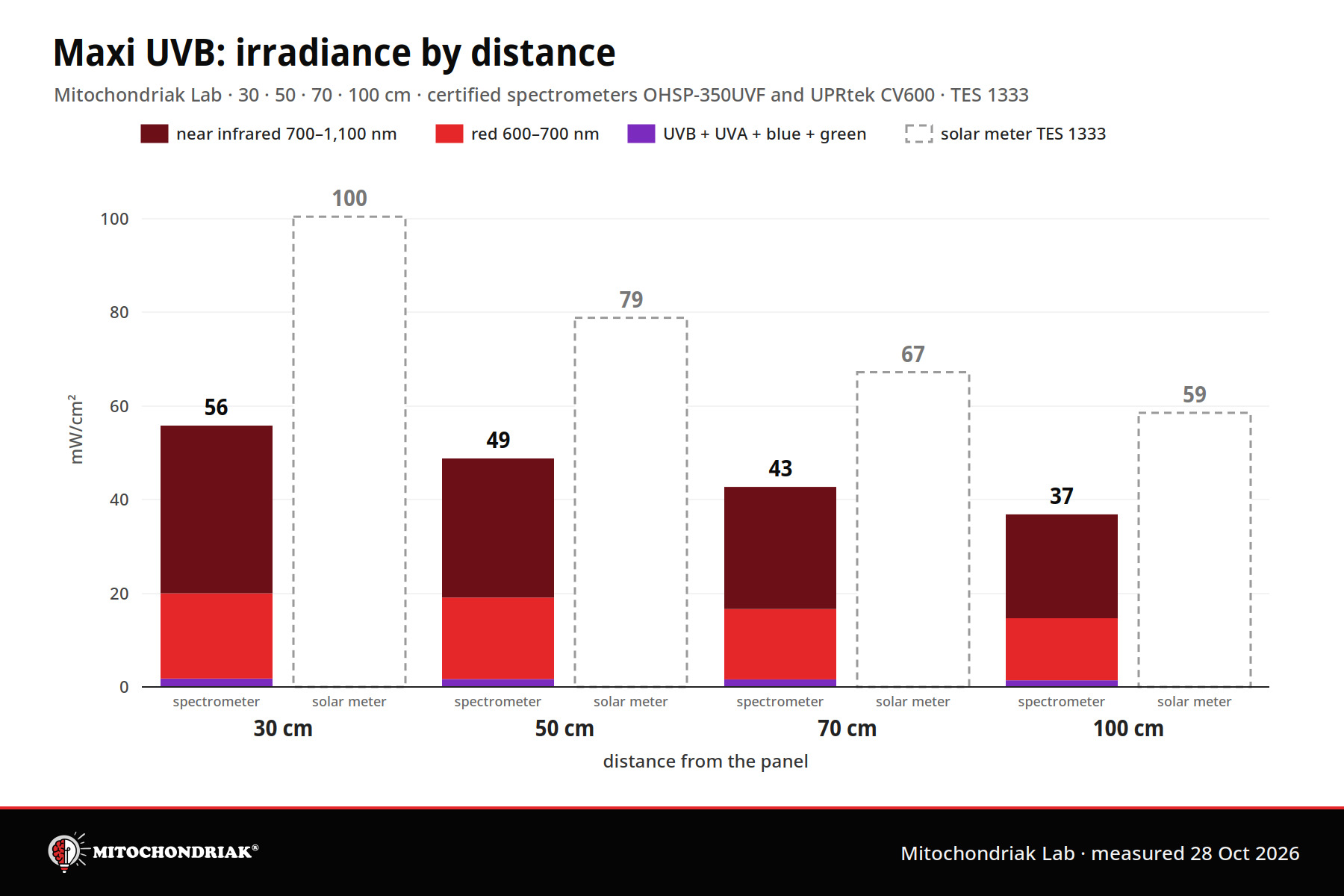
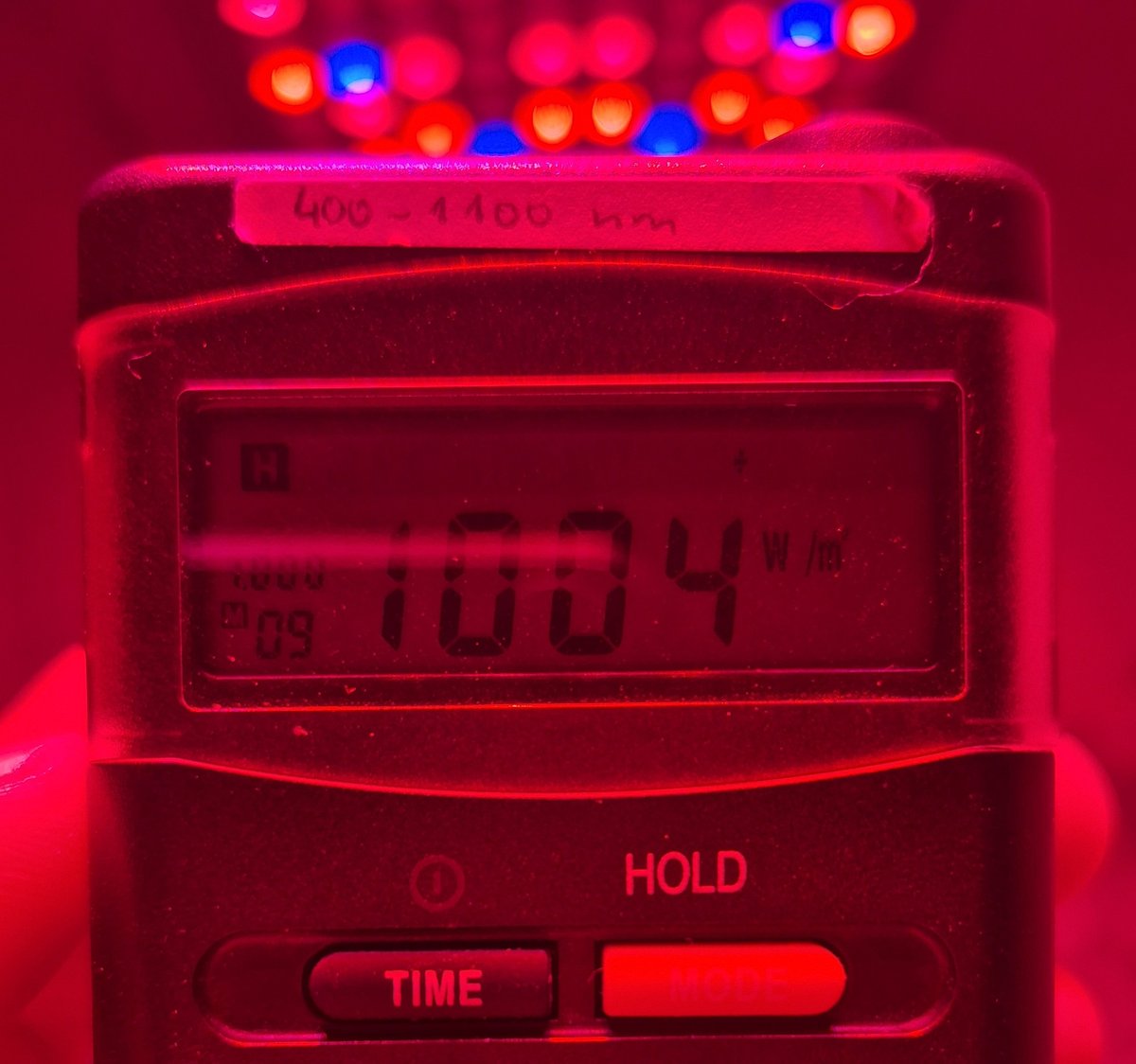
At the recommended 50 cm the Maxi UVB delivers 49 mW/cm² according to the spectrometers and 79 mW/cm² according to the solar meter. At 30 cm, where irradiance is commonly compared on the market, it is 56 mW/cm² from the spectrometers and 100 mW/cm² on the solar meter, that is 1,004 W/m². Both numbers are measured, but each tells you something different.
| Mitochondriak Lab, mW/cm² | 30 cm | 50 cm, recommended | 70 cm | 100 cm |
|---|---|---|---|---|
| Spectrometers, 230 to 1,100 nm | 56 | 49 | 43 | 37 |
| Solar meter TES 1333, 400 to 1,100 nm | 100 | 79 | 67 | 59 |
| Red, 600 to 700 nm | 18 | 17 | 15 | 13 |
| Near infrared, 700 to 1,100 nm | 36 | 30 | 26 | 22 |
| UVB, 280 to 315 nm | 0.078 | 0.074 | 0.056 | 0.039 |
| UVA, 315 to 400 nm | 0.84 | 0.66 | 0.54 | 0.49 |
| Blue, 400 to 500 nm | 0.57 | 0.66 | 0.71 | 0.63 |
| UV index (from the spectrum, CIE) | 19 | 18 | 14 | 10 |
| UPRtek CV600, 380 to 780 nm | 28.1 | 25.2 | 23.9 | 19.0 |
Values are the average of two measurement series with the OHSP-350UVF spectrometer. The panel has 300 LEDs of nine types, so at 30 cm the reading also depends on which LEDs the sensor faces: total irradiance up to 900 nm 54 to 57 mW/cm² plus another 0.7 mW/cm² above 900 nm, red 13 to 24 mW/cm², near infrared up to 900 nm 31 to 39 mW/cm², UVB 65 to 90 µW/cm² and UV index 17 to 22. The part above 900 nm is calculated from the spectrum. UVB of 0.078 mW/cm² at 30 cm equals 78 µW/cm². The UPRtek CV600 measures only the 380 to 780 nm band, which is why its number is lower.
Why does a solar meter read higher than a spectrometer?
A solar meter is calibrated for sunlight, which has a continuous spectrum, not for the narrow bands of LEDs. With an LED panel it therefore reads 1.6 to 1.8 times higher than the spectrometers. On sunlight it reads correctly, which is why we also used it on the sun. We give both: 100 mW/cm² on the solar meter for comparison with the market, and 56 mW/cm² from the spectrometers, the true spectral irradiance. Most sellers quote only the first number.
Why does irradiance fall so slowly with distance?
From 56 mW/cm² at 30 cm, 37 mW/cm² is still left at 100 cm. A panel is not a point source like a bulb: the light of 300 LEDs across a 91 × 30 cm surface overlaps as the distance grows. At 50 cm you get 49 mW/cm², most of what you see at 30 cm, and over a larger area of your body. Does that make sense to you? There is no need to press up against the panel.
More light does not mean more effect, either. Researchers at Massachusetts General Hospital describe a biphasic response to red and infrared light: in experiments, low doses often had a better effect on cells and tissues than high ones [R]. That is another reason we recommend 50 to 60 cm and build up session time gradually.
How much UVB does the Maxi UVB give, and what does a UV index of 18 mean?
At the recommended 50 cm the Maxi UVB delivers 74 µW/cm² of UVB and 0.66 mW/cm² of UVA; at 30 cm, 78 µW/cm² of UVB and 0.84 mW/cm² of UVA. From the measured spectrum, using the CIE erythema action spectrum, we calculated a UV index of 18 at 50 cm and 19 at 30 cm. At 50 cm the panel therefore delivers one standard erythema dose in about 3.7 minutes.

The UV index tells you how strongly UV acts on the skin. It is calculated from the spectrum weighted by the erythema action spectrum, a curve showing how easily each wavelength reddens the skin. The curve is standardized in ISO/CIE 17166, and the UV index that weather services report for the sun is calculated the same way.
Why is the number so high? Because the panel concentrates its UVB in a narrow band at 299 nm, where the skin is sensitive to UV. The sun spreads its UV across a wide band, and most of it is UVA. So with a panel, the UV index means minutes, not hours in the sun.
The dose shows this more clearly. The standard erythema dose, SED for short, is a standardized unit: 1 SED is 100 J/m² of erythemally weighted UV radiation. At 50 cm the Maxi UVB delivers it in about 3.7 minutes, at 30 cm in about 3.5 minutes. How many SED redden the skin varies from person to person, which is why the standard uses SED as a fixed unit instead of an individual dose [R].
Why do we never switch on UV without red and infrared light?
The morning sun brings red and infrared light first, UV only later. For us Mitochondriaks, that is the instruction manual: red and infrared light prepare the skin for UV.
Experiments support this too. French researchers exposed skin cells, fibroblasts, to infrared light from 700 to 2,000 nm in the laboratory, and the cells then withstood solar UV better; the protection lasted at least 24 hours. The authors point out that life on Earth receives infrared light every day before UV [R]. In a pilot study from Montreal with 15 participants, skin previously exposed five to ten times to red 660 nm LEDs reddened less after UVB [R]. That is why on the Maxi UVB we always switch on UV together with RED/NIR, never on its own.
How to start UV mode safely:
- Photosensitivity test: for the first few days, 30 seconds of UV on a small area of the body away from the face, for example the forearm, then watch the skin until the next day.
- Gradually: then start with 1 minute per body area away from the face and extend to a maximum of 5 minutes per body area.
- Distance: 50 to 60 cm for UV mode too; do not use the panel closer than 50 cm.
- Eyes: wear the protective goggles included in the box and do not look into the LEDs.
- Always with RED/NIR and during the day: switch on UV and blue only together with red and infrared light.
By extending the time gradually, your skin builds its own protection, which we call a solar callus, just as it does in the sun. If slight redness appears, shorten the next session. If you take medication that makes your skin more sensitive to light, or you are under medical treatment, talk to your doctor before using UV mode.
How does the Maxi UVB compare with the October sun?
In red and near infrared light, the Maxi UVB at 30 cm delivers a dose comparable to the afternoon October sun: 54 mW/cm² against roughly 56 mW/cm² in the 600 to 1,100 nm band. This is a calculation from the Mitochondriak Lab measurement and the reference solar spectrum. The difference is in UVB, which the sun in Slovakia, where we are based, barely has at the end of October.
When day and night become equal, biology switches mode. In autumn the sun at our latitude loses its UV, while it keeps its red and infrared light. Summer is when the body replaces worn parts; autumn and winter are service mode. The instrument confirmed that the October sun still has plenty of red and infrared: on 28 October at 14:20 the same solar meter measured 915.6 W/m² in the sun, that is 91.6 mW/cm² in the 400 to 1,100 nm band. A solar meter is calibrated for sunlight, so we can use this number directly.

A solar meter sees the whole 400 to 1,100 nm band at once. How much of it falls in the red and near infrared, we calculated from the shape of the ASTM G173 reference solar spectrum [R]: in the 600 to 1,100 nm band it is roughly 56 mW/cm². In the same band the Maxi UVB delivers 54 mW/cm² at 30 cm according to the spectrometers. At the recommended 50 cm you get 17 mW/cm² of red and 30 mW/cm² of near infrared.
UVB is a different story. Latitude and season change mainly the UVB part of the solar spectrum. In a classic experiment, samples of human skin and of 7-dehydrocholesterol, the substance from which skin makes vitamin D, were exposed to the winter sun on clear days. In Boston, at 42° N, no previtamin D3 formed from November to February; in Edmonton, Canada, at 52° N, from October to March [R]. Slovakia lies between the two. The Maxi UVB delivers UVB in these months as well: 74 µW/cm² at 50 cm.
For us Mitochondriaks, the Maxi UVB is controlled UVB for the months when the sun at our latitude does not provide it. It does not replace the morning sun outdoors: your eyes and skin need daylight from the sky, so the sun comes first and the panel is an indoor complement.
Vitamin D in winter: a tablet, the sun or controlled UVB?
The usual winter advice is vitamin D3 with K2 in a tablet, for almost everyone. We prefer a more natural route: from spring to autumn the sun, with gradual skin adaptation; in winter, food, and where the sun is missing, controlled UVB light. This is our approach, not a norm for everyone.
Why not a routine tablet? Your skin guards its own vitamin D production: further sunlight quickly breaks down the vitamin D3 formed in the skin into other substances. This was shown with human skin samples exposed to the sun in Boston [R]. For us, this is a safeguard that a tablet bypasses. So in winter we turn to food first: oily fish and seafood, which also bring DHA, and vitamin K2 from egg yolks, liver and fermented foods.
We designed the Maxi UVB to come as close as possible to the summer sun: red, near infrared, blue, UVA and UVB light in one panel, with UV always switched on together with RED/NIR. In this way it supports the natural production of vitamin D right in your skin. The Vitamin D program on the display switches on UV automatically.
What did our winter vitamin D pilot measurement show?
A spectrometer shows what a panel emits. What your skin makes of it, only your blood can show. In a Mitochondriak® pilot measurement, three independent volunteers used the Maxi UVB for 4 weeks, from 20 December to around 20 January, in Slovakia. The sun here provides almost no UVB in this period, so a rise from sunlight was ruled out. Their blood level of vitamin D, 25(OH)D, rose over that time by an average of 4 to 6 ng/ml, without a single vitamin D tablet.
- Protocol: once a day, the Vitamin D program on the front and back of the body. The program lasts 5 minutes, of which UVB shines for 3 minutes.
- No supplements: the volunteers took no vitamin D supplements.
- Blood test: for 1 to 2 days before the test they avoided foods high in vitamin D, and blood was taken fasting, 16 hours after the last meal.
Three minutes of UVB is no accident. At the recommended 50 cm the Maxi UVB has a UV index of 18 and delivers one standard erythema dose in about 3.7 minutes. So the program gives a short, controlled UVB dose, not hours in the sun. For us, this confirms what the spectrum shows: UVB peaking at 299 nm is turned into vitamin D by the skin even in the middle of winter. Start the Vitamin D program only after the photosensitivity test and your first shorter sessions, always at 50 to 60 cm and with protective goggles.
You can check it on yourself. The free Mitochondriak® app shows you, for any place and day, when the sun produces vitamin D, and for the Maxi UVB, depending on the body area exposed, how much your level may rise. Check your level with a blood test and repeat it after 21 to 28 days. If you have a diagnosed deficiency or your doctor has prescribed vitamin D, decide on the next steps together with your doctor and do not stop a prescribed supplement.
Read more in our articles How to get vitamin D in winter without sun and Vitamin D: why a tablet isn't enough.
Does the Maxi UVB flicker?
Practically not; the Maxi UVB is flicker-free. The UPRtek CV600 spectrometer showed a flicker index of 0.00 and modulation below 2% at all four distances, and the OHSP-350UVF spectrometer showed modulation of 0.0%. We measured in continuous mode, with pulsing switched off.
The flicker index takes the shape of the light wave into account, and 0 means no flicker. Percent flicker tells you how far the light drops within one cycle. Cheap light sources can drop almost to zero many times per second, unseen by the eye. We explain the terms in our glossary: flicker.
Mind the difference between flicker and pulsing. Pulsation from 0 to 10,000 Hz is a feature you switch on deliberately on the Maxi UVB, separately for red and for infrared light. Flicker is unwanted fluctuation nobody chooses.
How much EMF does the Maxi UVB emit?
At 30 cm the Cornet ED88 electrosmog meter showed a magnetic field of 0.1 µT (1 mG), the lowest reading of the instrument and the level of normal household background. Even at 15 cm the triple EMF meter measured only 0.4 mG (0.04 µT), an electric field of 0 V/m and radio frequency radiation, for example from Wi-Fi or Bluetooth, of 0.000 mW/cm².
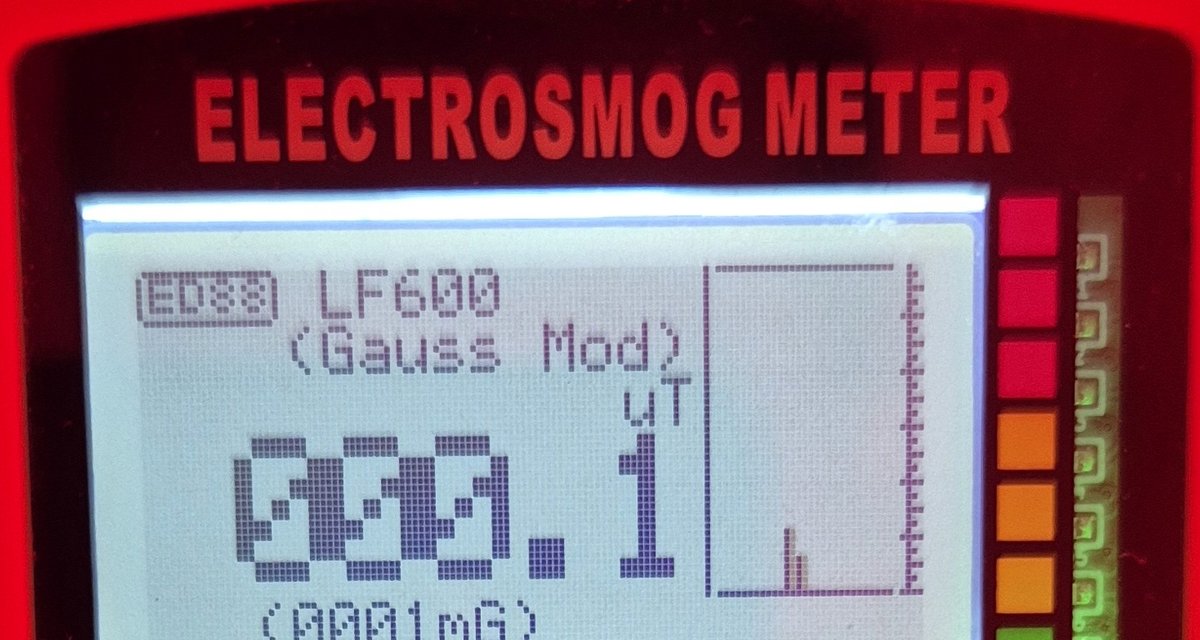
From 30 cm, the device's EMF is at background level. Electronics close to the body are a stimulus the eye cannot see, so we measure them as carefully as light. The 15 cm reading is only a measurement, not a recommended distance. Use the Maxi UVB at 50 to 60 cm.
Which distance and session time should you choose?
We recommend using the Maxi UVB at 50 to 60 cm, or further, for red and infrared light as well as for UV mode. Do not use the panel closer than 50 cm. 30 cm is only the market's comparison point. At 50 cm you get 49 mW/cm² according to the spectrometers, of which 17 mW/cm² is red, 30 mW/cm² near infrared and 74 µW/cm² UVB.
- Red and infrared light: start with 2 to 5 minutes at full intensity and extend the time gradually, usually 5 to 10 minutes for surface areas and 10 to 30 minutes for deeper ones. Keep your eyes closed or wear protective goggles.
- UV and blue: first a photosensitivity test for a few days, 30 seconds on a small area of the body away from the face. Then start with 1 minute per body area away from the face and build up gradually to a maximum of 5 minutes per body area. Always together with RED/NIR, with protective goggles, without looking into the LEDs and during the day.
The easiest way to keep 50 to 60 cm is the Mitochondriak® Maxi Floor stand, into which you simply slide the panel. You will also find the full routine on the product page.
Summary: what should you remember from the test?
We measured the Maxi UVB with two certified spectrometers, a solar meter and EMF meters. At the recommended 50 cm it delivers 49 mW/cm² of true spectral irradiance, of which 17 mW/cm² is red and 30 mW/cm² near infrared, and UVB peaking at 299 nm, in the band where skin makes previtamin D3 most efficiently. A UV index of 18 means that in UV mode we count minutes, not hours. In the winter pilot measurement with three volunteers, blood vitamin D levels rose by an average of 4 to 6 ng/ml in 4 weeks, without supplements. The panel is practically flicker-free, and the magnetic field at 30 cm is at background level.
A solar meter reads higher with LEDs, so we give both numbers: 100 mW/cm² at 30 cm for comparison with the market and 56 mW/cm² from the spectrometers. In red and infrared light the panel is comparable with the afternoon October sun, and on top of that it delivers UVB, which the sun at our latitude barely has at the end of October. The order still stands, though: first the sun and a natural day, then light at home that follows the time of day, then the panel, and only last of all supplements. The biggest number on the box does not tell you how much light your skin receives; the spectrum, the distance and the time do. Start at 50 to 60 cm, build up gradually and let a blood test show you what your skin makes of it. For us Mitochondriaks, light is information, and we would rather measure it than guess. The choice is yours.
UVB, red and near infrared light in one panel, verified with a spectrometer. You will find all the measured values on the product page too.
Mitochondriak® Maxi UVB infrared panel Mitochondriak® UV light therapy devicesFrequently asked questions
What is the irradiance of the Mitochondriak® Maxi UVB infrared panel?
At the recommended 50 cm it is 49 mW/cm² according to two certified spectrometers and 79 mW/cm² according to the TES 1333 solar meter. At 30 cm, where irradiance is commonly compared on the market, it is 56 mW/cm² from the spectrometers and 100 mW/cm² on the solar meter. We measured it at Mitochondriak Lab on 28 October 2026.
Does UVB from an infrared panel support vitamin D production in the skin?
The Maxi UVB has a measured UVB peak at 299 nm, in the 295 to 300 nm band where human skin produces previtamin D3 most efficiently. In this way it supports the natural production of vitamin D right in your skin. This is our approach, not a norm for everyone: you start with a 30 second photosensitivity test, extend the time gradually and check your level with a blood test.
Does the Maxi UVB raise blood vitamin D levels in winter too?
In our pilot measurement, yes. Three independent volunteers used the Vitamin D program once a day on the front and back of the body for 4 weeks, from 20 December to around 20 January (5 minutes, of which 3 minutes of UVB). Their blood 25(OH)D level rose by an average of 4 to 6 ng/ml. They took no vitamin D supplements, and at that time of year the sun in Slovakia provides almost no UVB.
Is UV from the panel safe, and how many minutes should you use it?
UV from the panel is strong, which is why we dose it in minutes. At 50 cm the Maxi UVB has a UV index of 18 and delivers one standard erythema dose in about 3.7 minutes. First, for a few days, a 30 second test on the forearm, then start with 1 minute per body area away from the face, up to a maximum of 5 minutes. Always at 50 to 60 cm, with protective goggles and together with red and infrared light.
At what distance should you use the Maxi UVB infrared panel?
At 50 to 60 cm, or further, for red and infrared light as well as for UV mode. 30 cm is only a comparison point for the measurement, where panel irradiance is commonly quoted on the market. Irradiance falls slowly with distance: at 50 cm you get 49 mW/cm², at 30 cm 56 mW/cm².
Does the Maxi UVB infrared panel flicker?
Practically not; it is flicker-free. The UPRtek CV600 spectrometer showed a flicker index of 0.00 and modulation below 2% at all four distances, and the OHSP-350UVF spectrometer modulation of 0.0%. We measured in continuous mode with pulsing switched off; pulsation from 0 to 10,000 Hz is a separate feature that you switch on deliberately.
Does the Maxi UVB emit electrosmog (EMF)?
From 30 cm, the EMF from the device is at background level. The Cornet ED88 electrosmog meter showed 0.1 µT (1 mG) at 30 cm, its lowest reading. Even at 15 cm the triple EMF meter measured only 0.4 mG (0.04 µT), an electric field of 0 V/m and radio frequency radiation of 0.000 mW/cm².
Does the Maxi UVB give as much light as the sun?
In the red and near infrared range of 600 to 1,100 nm, yes: 54 mW/cm² at 30 cm, while the afternoon sun on 28 October delivered roughly 56 mW/cm², according to a calculation from the Mitochondriak Lab measurement and the ASTM G173 reference spectrum. On top of that it gives UVB, which the sun in Slovakia barely has at the end of October. It does not replace the morning sun outdoors, though.
Sources and references
- Barolet D. 2008. LED photoprevention: reduced MED response following multiple LED exposures doi.org
- Jeffery G. 2025. Longer wavelengths in sunlight pass through the human body and have a systemic impact which improves vision doi.org
- Menezes S. 1998. Non-coherent near infrared radiation protects normal human dermal fibroblasts from solar ultraviolet toxicity doi.org
- Hamblin MR. 2018. Mechanisms and Mitochondrial Redox Signaling in Photobiomodulation doi.org
- MacLaughlin JA. 1982. Spectral character of sunlight modulates photosynthesis of previtamin D3 and its photoisomers in human skin doi.org
- Webb AR. 1988. Influence of season and latitude on the cutaneous synthesis of vitamin D3: exposure to winter sunlight in Boston and Edmonton will not promote vitamin D3 synthesis in human skin doi.org
- Webb AR. 1989. Sunlight regulates the cutaneous production of vitamin D3 by causing its photodegradation doi.org
- Huang YY. 2009. Biphasic dose response in low level light therapy doi.org