
Your afternoon coffee feels harmless, yet caffeine and sleep are tied together long after the cup is empty. In this guide you will learn how caffeine blocks your sleep signal, what the research shows about a coffee taken 6 hours before bed, and how to time your last cup so your nights stay deep and restful.
- Caffeine does not create energy. It blocks adenosine, the molecule that builds sleep pressure while you are awake.
- The caffeine half-life is measured in hours and varies a lot between people, so a midday coffee can still be active at bedtime.
- In a controlled study, caffeine taken even 6 hours before bed cut sleep by more than an hour.
- A simple rule for your last cup, why morning daylight should come before coffee, and where hidden caffeine hides.
- Why does coffee make you feel awake when your body is actually tired?
- How late is too late? What studies show about caffeine before bed
- Can you keep your coffee and still sleep deeply?
- When should you drink your first and last coffee of the day?
- Who should be extra careful with caffeine, and what mistakes are common?
- Summary: what should you remember?
- Frequently asked questions

Why does coffee make you feel awake when your body is actually tired?
Coffee makes you feel awake because caffeine blocks adenosine receptors in the brain. Adenosine builds up the longer you are awake and signals that it is time to rest. Caffeine does not remove that pressure or add any energy; it simply hides the signal for several hours, and the tiredness is still waiting underneath.
To understand caffeine and sleep, start with energy. Every cell runs on ATP, which your mitochondria produce from food and oxygen. When cells use ATP, it is broken down step by step, and one of the end products is adenosine. So adenosine is, quite literally, a record of the energy you spent during the day. The more you think, move and work, the more of it accumulates in the brain.
That rising level is what sleep researchers call sleep pressure. It works together with your internal clock: daylight in the morning sets the clock, and adenosine fills up hour by hour until, in the evening, both signals agree that it is time to sleep. If you want to see how these two systems shape your night, our guide to how sleep stages and the circadian rhythm work together explains it in depth.
Caffeine has a shape similar enough to adenosine to sit in the same receptors without activating them. Think of it as tape over the fuel gauge: the tank is still emptying, you just cannot read it. When the caffeine wears off, the accumulated adenosine hits the receptors all at once, which is why the famous afternoon crash feels so heavy.
Why does this matter more now than for our ancestors? For most of human history, tiredness arrived with sunset and nobody could switch it off. Today we combine indoor light, screens and a steady supply of coffee. And in the first days after the clock change on 25 October 2026, many people lean on extra cups to push through the adjustment, exactly when the body most needs clear signals.
How late is too late? What studies show about caffeine before bed
Research shows that caffeine affects sleep much longer than most people expect. In a controlled study, 400 mg of caffeine taken 0, 3 or even 6 hours before bedtime significantly disrupted sleep, and the dose taken 6 hours earlier still reduced total sleep time by more than one hour. A midafternoon coffee is therefore not automatically safe.
The key study comes from Christopher Drake and colleagues at the Henry Ford Hospital Sleep Disorders and Research Center in Detroit, published in 2013. Healthy adults who normally slept well took caffeine or a placebo at three different times: right at bedtime, 3 hours before and 6 hours before. Their sleep was measured objectively with a monitor at home. Every caffeine condition disturbed sleep compared with placebo, including the one taken 6 hours earlier. [R]
Keep the dose in mind: 400 mg is roughly what several strong coffees deliver, so a single small espresso is a smaller challenge. But the direction is clear. If your bedtime is 22:00, a large coffee at 16:00 is not as innocent as it feels.
Why can caffeine linger so long? The answer is the caffeine half-life, the time your body needs to clear half of a dose. It is counted in hours, not minutes, and it differs widely between people. Your genes influence how fast the liver breaks caffeine down, and so do pregnancy, some medications and smoking. Two people drinking the same cup at the same time can carry very different amounts of caffeine into bed.
What about coffee and deep sleep? Here we move from measured outcomes to mechanism. Adenosine is one of the drivers of the deepest, slow wave stage of sleep, so blocking it plausibly makes that stage lighter even when you fall asleep without trouble. Researchers also study whether evening caffeine shifts the internal clock itself. We treat both as a well grounded biological model rather than a precise number you can rely on.
Evening coffee rarely comes alone. It usually arrives with bright screens, and in one laboratory study evening exposure to an LED backlit computer screen affected circadian physiology and cognitive performance. [R] Caffeine hides your sleep pressure while artificial light confuses your clock, so the two together push the night in the same wrong direction. That is also why morning timing matters: as we describe in our article on why the first 30 minutes after waking set the scene for your day, daylight first and coffee second gives your body a cleaner signal.
Memory anchor: caffeine does not give you energy, it borrows alertness from tonight's sleep.
Can you keep your coffee and still sleep deeply?
Yes, for most healthy adults coffee and good sleep can coexist if timing does the work. Coffee in the first half of the day gives you alertness. The same cup late in the afternoon borrows from the night. Change the clock time of your last cup, not your love of coffee, and the trade-off becomes much smaller.
Moving your last cup earlier has a clear upside. In the Drake study, every caffeine condition, including the one taken 6 hours before bed, disturbed sleep compared with placebo. [R] So a later coffee does not just risk a slower start to the night. It can cost you a measurable part of it. Remove that late dose and you give your adenosine signal a fair chance to do its job by bedtime.
The limits are just as real. That study used a fairly high dose of 400 mg in healthy sleepers, and it did not test every person, every dose or every cup size. Your result depends on your caffeine half-life, your daily routine and how much light you get. Some people sleep fine after an afternoon espresso. Many others only think they do, because caffeine can make sleep lighter without making it harder to fall asleep.
There is also a ceiling to what timing alone can fix. If your mornings are spent indoors and your evenings under bright screens, the internal clock gets weak signals at both ends of the day. Why would a perfectly timed coffee rescue a day that has no real dawn and no real dusk? Caffeine timing is one lever. Light is the bigger one.
When should you drink your first and last coffee of the day?
Drink your first coffee after morning daylight, not instead of it, and finish your last caffeinated drink well over 6 hours before bed. Research shows 6 hours is still not a safe buffer for a strong dose, so our practical rule is simple: keep caffeine to the morning and early afternoon, and let the evening run on light and darkness.
Here is the order we use at Mitochondriak®, from the strongest signal to the smallest tool:
- Sun first. Within about 30 minutes of waking, step outside for natural light. It sets your internal clock and gives you a cleaner kind of alertness than any cup. Then enjoy your coffee.
- A cut-off time, not a feeling. Pick a clock time for your last cup and stick to it. If you go to bed at 22:00, think of the early afternoon as your limit, and earlier if you are sensitive. This is our practical rule built on the Drake finding, not a number from a single study.
- Check hidden caffeine. Black and green tea, cola and energy drinks, pre-workout supplements, dark chocolate and some pain relievers contain caffeine too. An evening workout with a pre-workout shake can undo a perfect coffee cut-off.
- Protect the evening. After sunset, dim the room, switch to warm or red light and keep screens to a minimum. Sleep in a dark, cool bedroom.
The timing matters even more in the days after the clock change on 25 October. Instead of an extra afternoon cup, get outside earlier in the morning and let daylight shift your clock. Our guide on adapting quickly after a clock change walks through this step by step.
For the evening part, light tools can replace what nature used to give us after sunset: firelight instead of bright white LEDs. Blue light blocking glasses Mitochondriak® with red lenses are made for screen time after dark, and blocking nocturnal blue light has been tested in a randomized controlled trial in adults with insomnia symptoms. [R] For more everyday habits, see our seven proven tips for better sleep.
Who should be extra careful with caffeine, and what mistakes are common?
People who clear caffeine slowly should be extra careful: pregnant women, people taking certain medications and anyone who notices lighter or broken sleep. The most common mistakes are counting only coffee, ignoring tea, cola, chocolate and pre-workout drinks, and treating the afternoon crash with another cup instead of daylight or a short walk.
Pregnancy slows how fast the body breaks down caffeine, so the same cup lasts longer. Some medications and contraceptives can also change caffeine clearance. If you are pregnant, take regular medication or live with a heart, anxiety or sleep condition, talk to your doctor about how much caffeine is right for you.
Watch out for these typical traps:
- The "it doesn't affect me" myth. Falling asleep easily does not mean your sleep is deep. Notice how rested you feel in the morning instead.
- Coffee as a replacement for morning light. Caffeine covers up sleep pressure, while daylight actually sets the clock.
- Stacking caffeine and screens late in the day. Both push the night in the same wrong direction.
- Reaching for sleep pills first. Before any synthetic melatonin, fix the basics: an earlier last cup, morning sun, an evening in dim red light and full darkness at night.
Summary: what should you remember?
Caffeine and sleep are linked through adenosine, the molecule that records the energy you spent during the day. Caffeine does not give you energy. It only covers up the signal, and because its half-life is long and very individual, a midday or afternoon cup can still be active at bedtime. A controlled study showed that a strong dose taken 6 hours before bed still cut sleep by more than an hour.
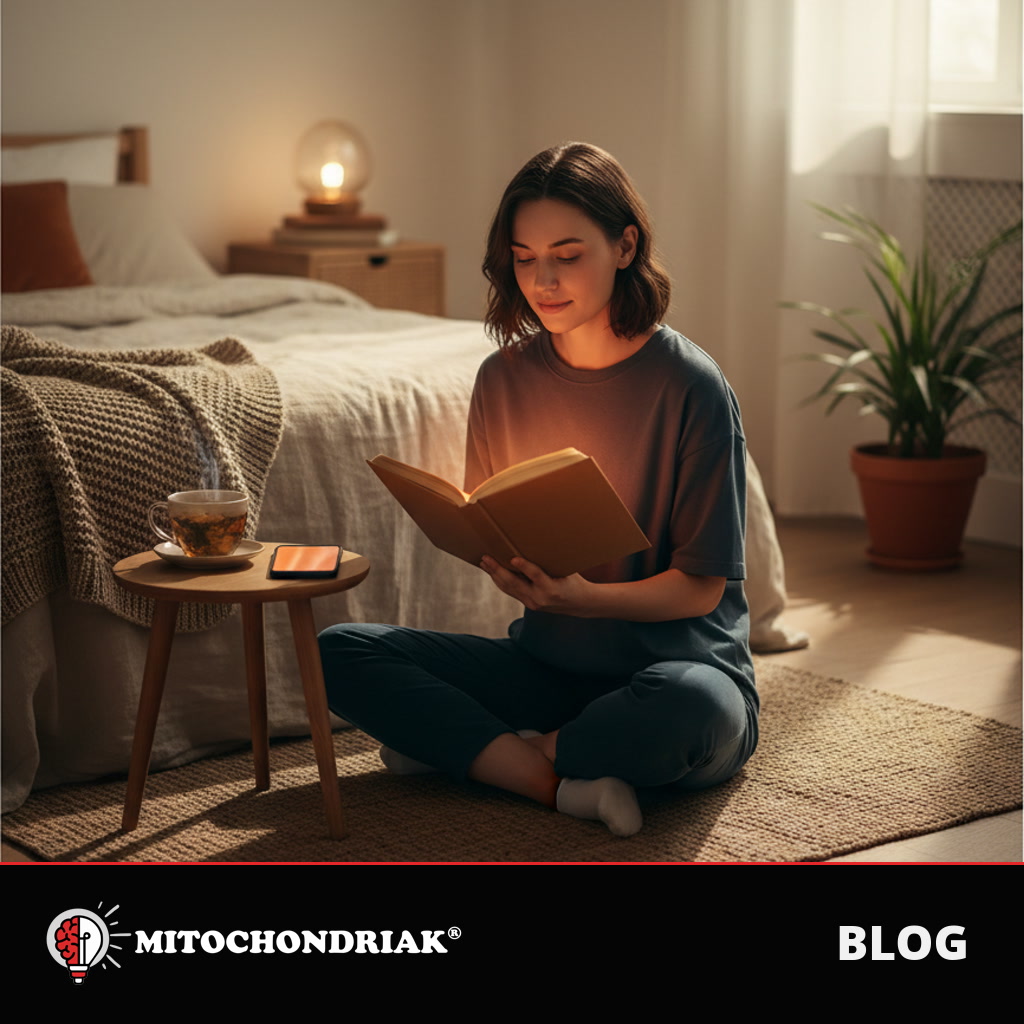
Try this for one week: go outside for daylight within 30 minutes of waking, have your coffee after that, set a fixed early afternoon cut-off for all caffeine, including tea, cola and pre-workout drinks, and spend your evenings in dim, warm or red light. Then notice when sleepiness arrives in the evening and how you feel in the morning. Your own nights are the best test of the rule.
Give your evenings a real dusk
Cutting caffeine early is half the job. The other half is an evening without bright white light. The Evening red bulb Mitochondriak® E27 brings warm red light back to your home after sunset, so your body can feel the tiredness it has earned.
Frequently asked questions
How many hours before bed should you stop caffeine?
More than 6 hours. In a controlled study, 400 mg of caffeine taken 6 hours before bedtime still reduced total sleep by over an hour. A practical rule is to keep all caffeine to the morning and early afternoon, and to stop even earlier if you are sensitive, pregnant or take medications that slow caffeine breakdown.
Does caffeine affect deep sleep?
It very likely does. Adenosine is one of the drivers of deep, slow wave sleep, and caffeine blocks its receptors. That is why you can fall asleep after a late coffee and still wake up less rested. Treat this as a well grounded biological model and judge it by how refreshed you feel in the morning.
Does coffee delay your body clock?
Evening caffeine is studied as a possible signal that shifts the internal clock later, but the strongest clock signal is still light. Morning daylight sets your clock earlier, while bright screens and caffeine late in the day push in the opposite direction. Keeping coffee in the morning, after daylight, keeps both signals aligned.
Is decaf OK in the evening?
For most people, yes. Decaf is not completely caffeine free, but it contains only a small amount compared with regular coffee. If you are very sensitive, keep even decaf to the afternoon. Also remember that tea, cola and chocolate desserts can contain more caffeine than an evening decaf.
Sources and references
- Cajochen. 2011. Evening exposure to a light-emitting diodes (LED)-backlit computer screen affects circadian physiology and cognitive performance pubmed.ncbi.nlm.nih.gov
- Drake, C.. 2013. Caffeine effects on sleep taken 0, 3, or 6 hours before going to bed pubmed.ncbi.nlm.nih.gov
- Shechter. 2018. Blocking nocturnal blue light for insomnia: A randomized controlled trial pubmed.ncbi.nlm.nih.gov