
Your body glows. Not as a figure of speech: living cells give off a faint light called biophotons, too weak for the eye but visible to sensitive cameras. This article explains where that light comes from, why it rises and falls in a daily rhythm and what it reveals about your mitochondria.
- Biophotons are an ultraweak light that living cells emit on their own, in a range from about 350 to 1300 nm.
- The light comes from oxidative metabolism, the same flow of electrons and oxygen that runs through your mitochondria.
- A camera study from Japan recorded the human body glowing in a daily rhythm.
- Why we see light, water and ATP as products of one and the same flow inside the mitochondrion.
- What this means for your everyday light environment, from morning sun to evening darkness.
- Why does a living body glow at all, and why should you care?
- What have scientists actually measured when they talk about biophotons?
- Can biophotons tell you anything useful about your own body?
- How can you support the flow that makes your cells glow?
- Which everyday habits disturb the flow, and who should be careful with light?
- Summary: what should you remember?
- Frequently asked questions
Why does a living body glow at all, and why should you care?
Biophotons are an extremely faint light that living cells emit on their own, known in research as ultraweak photon emission. It is far too weak for your eyes, yet sensitive cameras can record it. It arises during oxidative metabolism, the same flow of electrons and oxygen that gives you energy, so the glow is a window into how your cells work.
Where does your energy actually come from? Most people would say food. That is true, but only halfway. Plants capture sunlight and store it on the electrons of sugars and fats. When you eat, your cells release those electrons again, step by step, until they meet the oxygen you breathe. In other words, you live on stored sunlight, and a small part of it leaves your body as light again.
The place where this happens is the mitochondrion. Hydrogen from food is split into electrons and protons. The electrons travel along the respiratory chain (also called the electron transport chain, a series of protein complexes in the inner mitochondrial membrane) towards oxygen. The protons drive ATP synthase, a tiny rotating motor. At the end of the chain, oxygen and protons form metabolic water, the water your body makes itself rather than drinks. Alongside it come CO₂, heat, ATP and light.
Think of a blacksmith's forge. You do not need a thermometer to know the fire is working: the glow of the embers tells you. Biophotons are a similar sign. They are the faint glow of a flow that never stops while you are alive.
Why does this matter to you? Because light works in both directions. Life evolved under the sun, and your body reads incoming light as information. Light entering your eye hits melanopsin, a light sensitive pigment in the retina that tells your inner clock what time of day it is. At the same time, your cells produce light of their own. This interplay is one of the questions of quantum biology, a field that studies how effects at the level of electrons, photons and protons shape what happens in living tissue.
What have scientists actually measured when they talk about biophotons?
Researchers have shown that the human body emits light that cameras can image and that this emission follows a daily rhythm. Reviews of the field describe biophotons as arising from electronically excited molecules during oxidative metabolism, in a range from roughly 350 to 1300 nm. The light is real and measurable; its role in the body is still being explored.
The most striking evidence comes from Japan. Masaki Kobayashi and colleagues used a highly sensitive, cooled CCD camera in complete darkness and photographed healthy young men at several times of day. The body literally glowed, the face more than the rest of the body, and the emission was lower in the morning and higher in the afternoon. The authors connect this diurnal rhythm with changes in energy metabolism over the day. [R]
Where does the light come from inside the cell? Michal Cifra (Institute of Photonics and Electronics, Czech Academy of Sciences) and Pavel Pospíšil (Palacký University Olomouc) summarised the field in a detailed review. Biophotons arise from electronically excited states that form during oxidative metabolism, when reactive oxygen species react with lipids and proteins. The light spans from near UV through visible to near infrared, about 350 to 1300 nm, at an intensity of a few to hundreds of photons per second per square centimetre. [R]
That also explains the link between oxidative stress and light. The more oxidative reactions take place, the more excited molecules can relax by releasing a photon. The glow is therefore not random noise, but a trace of how intensely the cell is handling electrons and oxygen.
The German biophysicist Fritz-Albert Popp went a step further. He and his colleagues described a high coherence of this light, meaning it behaves in an ordered rather than chaotic way, and identified DNA as one of its important sources. [R] According to Popp, cells may use this ordered light for communication. That is his interpretation of the measurements, and it opened a whole field of research.
Are biophotons related to mitochondria? The flow that creates them is the same flow that runs through the respiratory chain. At its end, complex IV (cytochrome c oxidase, CCO) hands electrons to oxygen and water forms. Researchers have proposed a model in which this water is deuterium depleted water (DDW, water with less heavy hydrogen), and a theoretical calculation suggests that deuterium briefly slows the rotor of ATP synthase. On the light side, Andrei Sommer and colleagues showed in the laboratory that 670 nm red light reduced the resistance of a thin water layer on water attracting surfaces. From this they concluded that light can ease the work of the ATP synthase motor by loosening the water around it. [R]
When we put these findings together, the picture is clear to us. For us Mitochondriaks, the mitochondrion is not just an ATP factory. One of its main jobs, despite what textbooks usually teach, is producing deuterium depleted water, and ATP, CO₂ and light come from the same flow of electrons and protons. Put simply, your body takes in light, turns it into flow and gives some of it back as light.
Can biophotons tell you anything useful about your own body?
Biophotons give you a new way of seeing your body: as a system that runs on a flow of electrons and gives part of it back as light. That view helps with everyday choices about light, darkness and timing. Biophotons are not a home test or a therapy target. You cannot measure them or turn them up yourself.
Start with the measurement itself. The glow of the human body is about a thousand times weaker than anything your eye can see. To record it, researchers need a completely dark room, a cooled scientific camera and long exposure times. No app, wearable or home device can show you your own biophotons, so treat any product that promises this with healthy distrust.
The real value lies elsewhere. The light comes from the same flow that produces your energy, your metabolic water and your heat. That flow does not run at a constant speed. It follows signals from your environment: daylight, darkness, temperature and the time you eat. The Japanese camera study showed that the glow itself rises and falls over the day. So what does the glow really reflect? For us, it reflects a body that keeps time with the sun.
That is the practical lesson. You cannot steer the photons directly, but you can shape the signals that keep the flow in your mitochondria orderly. The interpretation of biophotons as a language between cells comes from Popp and his school, and we present it as their view. The link between light, water and the work of mitochondria is the chain we build on, and it leads straight to your daily routine.

How can you support the flow that makes your cells glow?
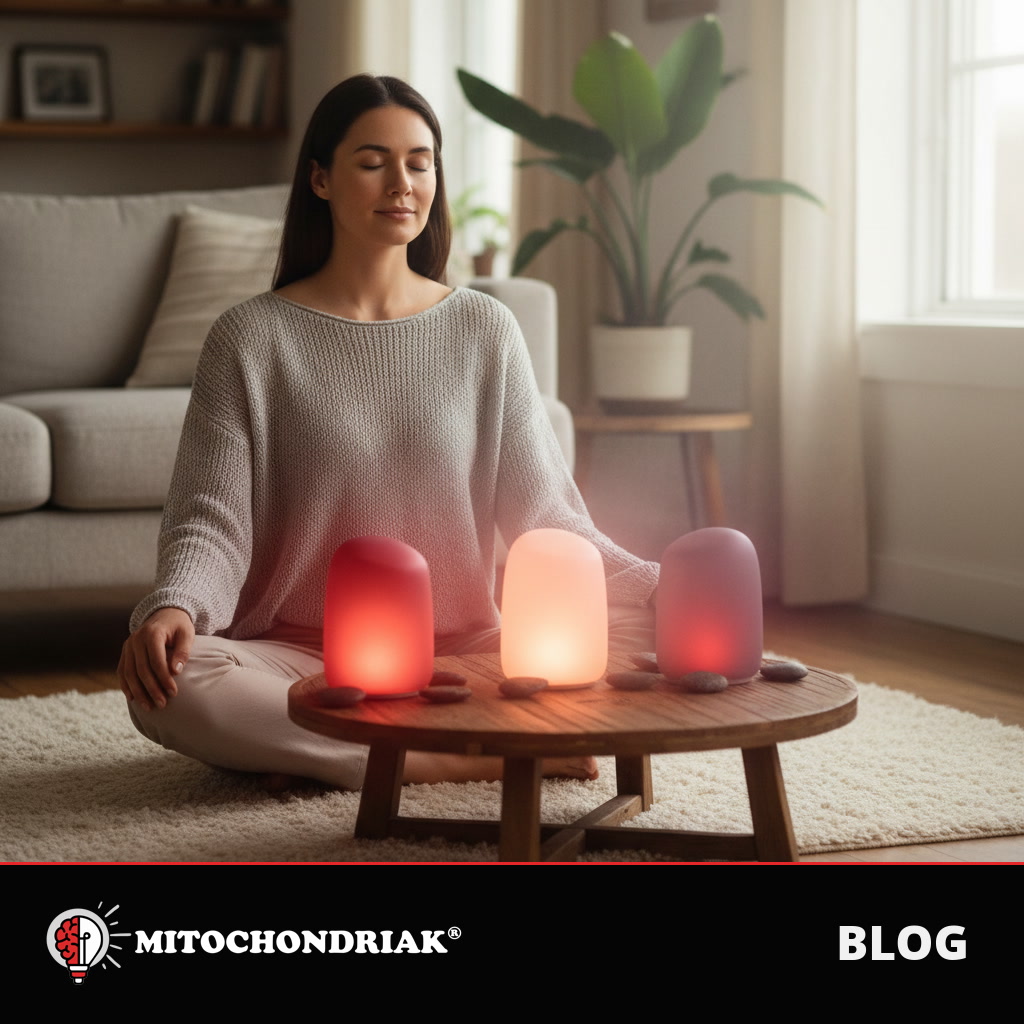
Support the flow in the same order nature does. Natural daylight comes first, especially in the morning. Next come darkness after sunset and sensible timing of meals and sleep. Only then do indoor tools make sense, to replace the red and near infrared light that indoor life is missing. This order matters more than any single gadget.
Here is how we put it into practice as Mitochondriaks:
- Morning light within 30 minutes of waking. Step outside, even on a cloudy day. Early sunlight is rich in red and near infrared light and gentle on the skin. Leave the sunglasses at home; your eye needs the full signal to tell your inner clock what time it is. Sunglasses make sense only on snow, when driving into the sun or when working with lasers or welding.
- Daylight during the day. Take breaks outside and build up your time in the sun gradually, day after day. Getting burned is never the goal.
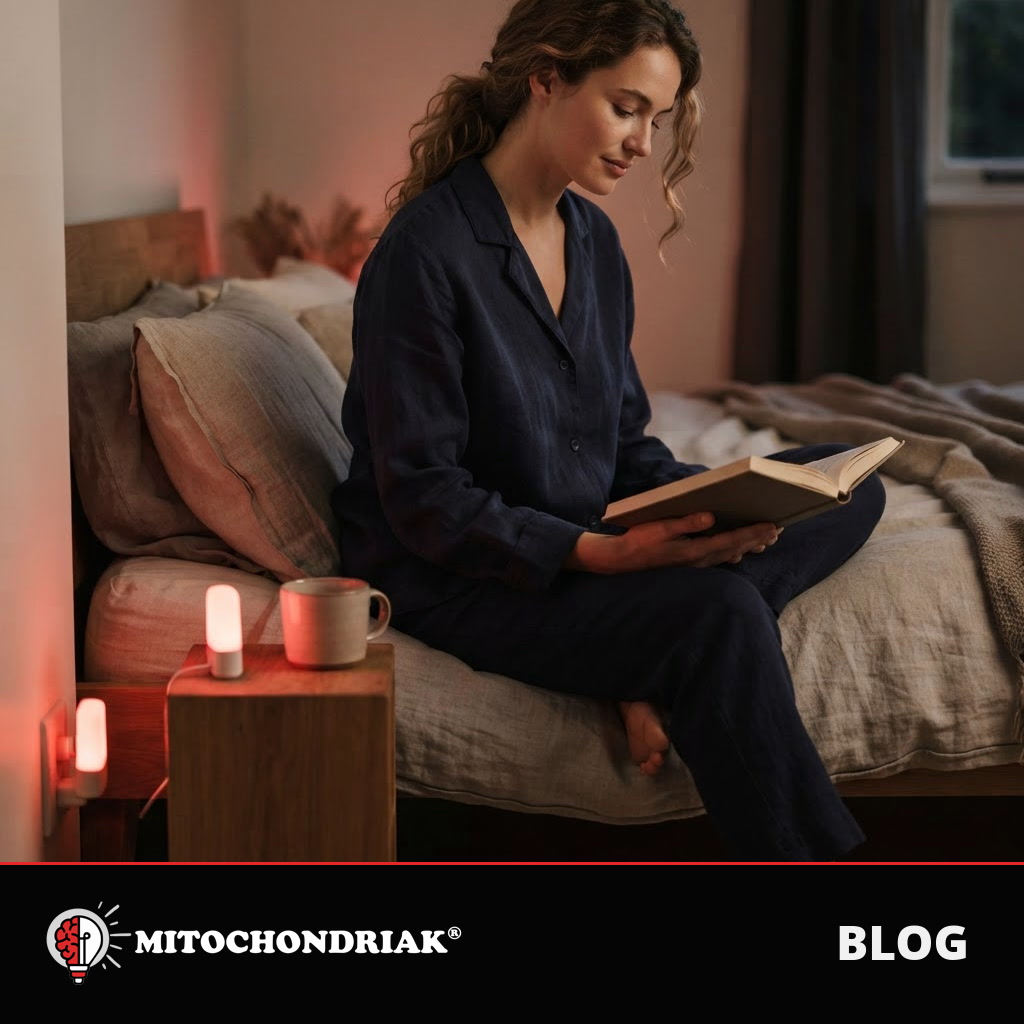
- Darkness in the evening. After sunset, dim the room and switch white LEDs for warm red light, for example an Evening red bulb Mitochondriak® E27. Sleep in a fully dark bedroom.
- Food during daylight. Eat while it is light outside rather than late at night. When sunlight is scarce in winter or in an office, we favour fish and seafood for DHA.
- Indoor light tools when the sun is missing. In autumn, winter or on long office days, a panel from our red light therapy devices can add red and near infrared light at home. Always follow the distance and session length stated on the product page.
Why does the order matter so much? Because a panel cannot undo a night spent in front of a bright screen. If you want the full background on how red and near infrared light interact with your cells, read our guide to what red light therapy is and how it works.
Which everyday habits disturb the flow, and who should be careful with light?
The biggest disruptor is artificial blue light after sunset: white LEDs, phones and laptops. Sunlight always brings blue together with infrared and UV, while artificial light delivers blue on its own, at the wrong time. Other common mistakes are wearing sunglasses outdoors by default, chasing extremes in the sun and expecting a gadget to measure biophotons.
Evenings at the screen are the hardest part for most people. If you cannot avoid them, glasses designed for evening use that block blue and green light, such as Blue light blocking glasses Mitochondriak®, help keep the signal of night intact. Put them on after sunset, not during the day, when your eyes need full daylight.
A few situations need extra care. Some medications make the skin more sensitive to light, and certain conditions, such as lupus or bipolar disorder in combination with bright light, call for an individual approach. If you take medication or are being treated for a health condition, talk to your doctor before changing your light routine or starting sessions with a panel.
Finally, keep your expectations honest. Supporting your light environment is about giving your body the signals it evolved with, not about chasing a quick result. Consistency over weeks counts far more than one big effort.
Summary: what should you remember?
Your body emits light. Biophotons are an ultraweak glow that arises during oxidative metabolism, the same flow of electrons and oxygen that runs through your mitochondria. Cameras have recorded this glow on the human body and shown that it follows a daily rhythm. For us Mitochondriaks, light, water and ATP are products of one flow, which is why the quality of light around you matters so much.
You cannot measure your biophotons at home, but you can shape the signals behind them. Try this for one week: go outside for morning light within 30 minutes of waking, switch to warm red light after sunset and sleep in full darkness. Then notice when sleepiness arrives in the evening and how you feel in the morning. Your body will show you what fits. The choice is yours.
Bring red and near infrared light back indoors
When autumn, winter or office days keep you away from the sun, a full body panel adds the red and near infrared light your cells evolved with. The Mitochondriak® Maxi Upgraded is designed for home use and covers a large part of the body in one session.
Frequently asked questions
What are biophotons?
Biophotons are an extremely faint light that living cells emit spontaneously, also called ultraweak photon emission. They arise when electronically excited molecules formed during oxidative metabolism release their energy as photons. The light spans roughly 350 to 1300 nm, from near UV through visible to near infrared, and is far too weak for the human eye.
Does the human body really emit light?
Yes. A Japanese research team photographed healthy young men with a highly sensitive cooled camera in total darkness and recorded the body glowing. The face glowed more than the rest of the body, and the emission changed over the day, lower in the morning and higher in the afternoon. The authors link this rhythm with energy metabolism.
Where do biophotons come from in a cell?
Biophotons come from oxidative metabolism. When reactive oxygen species react with lipids, proteins and other molecules, some of them end up in an excited state. As they return to their normal state, they release a photon. Popp and colleagues also identified DNA as an important source of this light.
Are biophotons related to mitochondria?
Yes. The flow of electrons towards oxygen that drives oxidative metabolism runs mainly through the respiratory chain in your mitochondria. For us Mitochondriaks, the mitochondrion produces deuterium depleted water, and ATP, CO₂ and light are further products of the same flow. Biophotons are the visible trace of that work.
Can biophotons be measured at home?
No. Measuring biophotons requires a completely dark laboratory, cooled scientific cameras or photomultipliers and long exposure times, because the intensity is only a few to hundreds of photons per second per square centimetre. No consumer device or app can record them, so be careful with products that claim to.
Does red light from a panel influence the flow that produces biophotons?
Andrei Sommer showed in the laboratory that 670 nm red light eased the resistance of thin water layers and concluded that light can ease the work of ATP synthase. For us, a panel brings back red and near infrared light missing indoors. If you take light sensitive medication, check with your doctor first.
Sources and references
- Kobayashi M. 2009. Imaging of ultraweak spontaneous photon emission from human body displaying diurnal rhythm pubmed.ncbi.nlm.nih.gov
- Cifra M. 2014. Ultra-weak photon emission from biological samples: definition, mechanisms, properties, detection and applications pubmed.ncbi.nlm.nih.gov
- Sommer AP. 2015. Light Effect on Water Viscosity: Implication for ATP Biosynthesis pubmed.ncbi.nlm.nih.gov
- Popp FA. 1984. Biophoton emission. New evidence for coherence and DNA as source pubmed.ncbi.nlm.nih.gov