
.png)
Deuterium, ATP synthase and deuterium-depleted water may sound like concepts from nuclear physics, yet they are closely connected to the way your mitochondria produce ATP, metabolic water and energy for life. Red and near-infrared light enter this story because they interact with mitochondria and the water surrounding their molecular machinery.
- ATP synthase is a microscopic rotary motor that uses a proton gradient to support ATP production.
- Metabolic water is created during cellular respiration inside mitochondria.
- Deuterium is a heavier isotope of hydrogen that behaves differently from ordinary light hydrogen.
- Red and near-infrared light can interact with mitochondria, cytochrome c oxidase and interfacial water.
- The 760 nm wavelength belongs to one of the historically described action regions of photobiomodulation.
- Why are deuterium and mitochondrial water important?
- How do mitochondria produce ATP?
- What is ATP synthase?
- How do mitochondria create metabolic water?
- What is deuterium?
- What is deuterium-depleted water?
- How does red light affect mitochondria and water?
- Why do Mitochondriak® devices include 760 nm?
.png)
Why are deuterium and mitochondrial water important?
Mitochondria do more than recycle ATP. They process electrons, protons and oxygen within an extremely precise molecular geometry. One of the products of this process is water created directly inside the cell, close to the structures that require it.
Terms such as deuterium, ATP synthase and deuterium-depleted water may be unfamiliar, but they form an important part of the perspective behind the Mitochondriak® project. We do not look at red light as an isolated wellness trend. Our central compass has always been the mitochondrion.
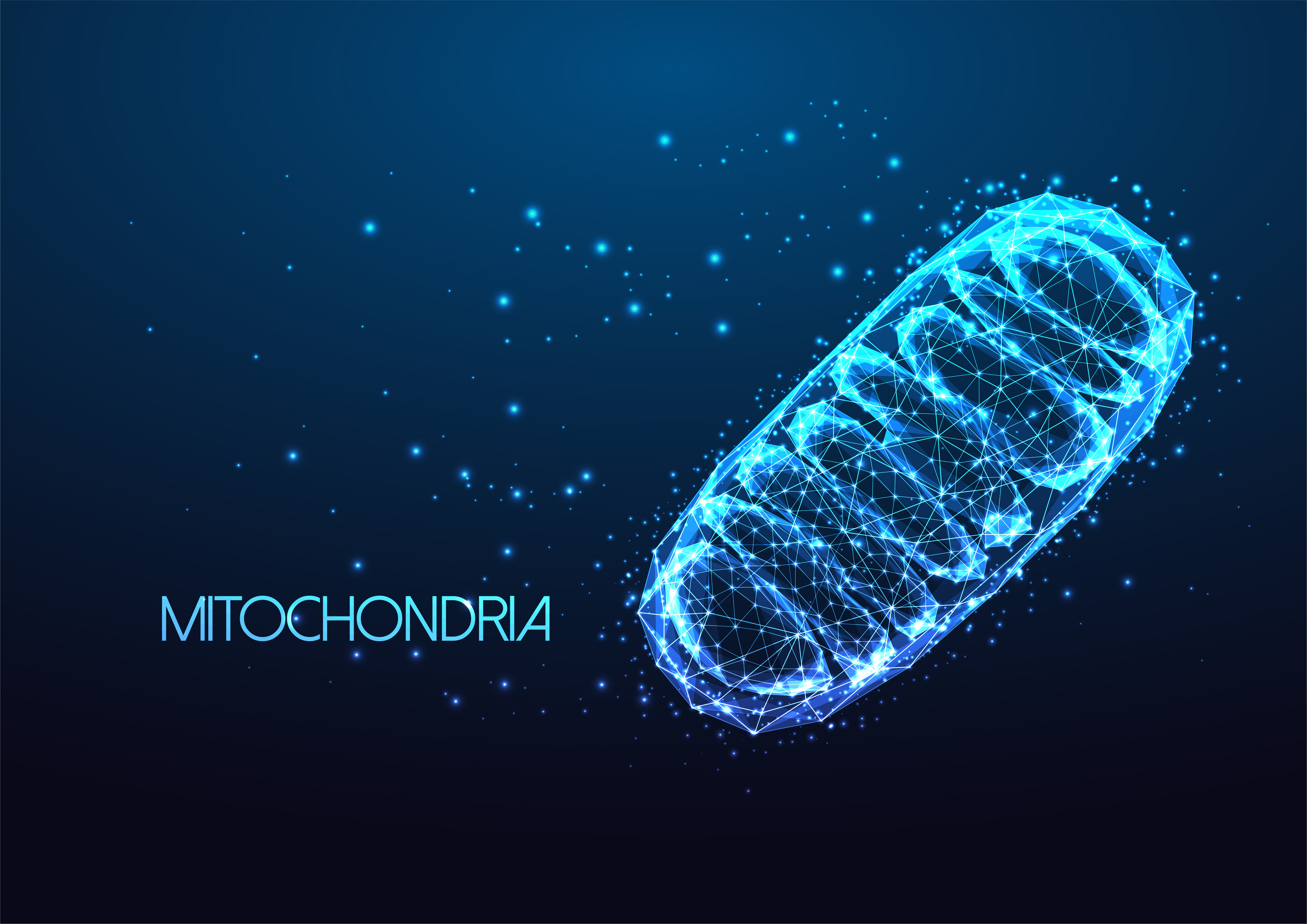
Mitochondria evolved from ancient bacteria and now live within almost every cell of your body. They help transform energy from food into a form that can be used for movement, thought, repair, digestion and countless other processes.
This topic also connects naturally with our article explaining what mitochondria are and how they produce energy.
How do mitochondria produce ATP?
Mitochondria produce most cellular ATP through oxidative phosphorylation. Electrons derived from nutrients move through the respiratory chain, while protons are transferred across the inner mitochondrial membrane. The resulting electrochemical gradient powers ATP synthase.
Cellular respiration begins when nutrients such as fats, carbohydrates and proteins are broken down. Their energy is gradually transferred into electrons and hydrogen-containing molecules. Mitochondria then use these components together with oxygen.
The process ultimately contributes to the formation of:
- ATP, the reusable chemical energy currency of the cell
- Carbon dioxide, which is transported to the lungs and exhaled
- Metabolic water, which is produced during the reduction of oxygen
- Heat, which helps maintain body temperature
Imagine eating a substantial meal or mobilising stored body fat. Your mitochondria do not simply burn this material like a bonfire. They dismantle it in carefully controlled steps and transfer electrons and protons through machinery measured in nanometres.
What is ATP synthase?
ATP synthase is a rotary molecular motor embedded in the inner mitochondrial membrane. Protons flowing through the enzyme drive rotation of its components, allowing it to combine adenosine diphosphate and phosphate into adenosine triphosphate, or ATP.
The simplest metaphor is a hydroelectric turbine. Water passing through a dam turns a turbine and generates electricity. Inside mitochondria, a stream of protons moves through ATP synthase and drives the production of ATP.
The analogy is not perfect, but it makes the core principle easy to visualise. ATP synthase converts an electrochemical gradient into mechanical rotation and then into chemical energy.
The movement is extraordinarily small, yet it supports almost everything you experience as life. Every muscle contraction, nerve signal and act of cellular repair requires ATP to be available and continually recycled.
That is why ATP should not be imagined as energy stored once and used later. It is closer to a rapidly circulating currency that your cells spend and regenerate every second.
How do mitochondria create metabolic water?
Metabolic water is formed at the end of the mitochondrial respiratory chain. Oxygen accepts electrons and combines with protons, producing water near complex IV and the inner mitochondrial membrane. This water is generated inside the biological system rather than arriving directly from a glass or tap.
Yes, your body really creates water. Animals consume water, but they also produce it metabolically. This is especially noticeable in animals adapted to dry environments, although the same chemistry occurs continuously in humans.
Water created within mitochondria is located precisely where electron transfer, proton movement, membrane potential and ATP production take place. Its local structure and physical properties therefore matter.
Water near proteins and biological membranes does not always behave like a random pool of liquid. Molecules can become more organised at interfaces, and this organisation may influence viscosity, proton transfer and the movement of molecular machinery.
.png)
What is deuterium?
Deuterium is a stable, naturally occurring isotope of hydrogen. Ordinary hydrogen has one proton in its nucleus, while deuterium contains one proton and one neutron. This makes deuterium approximately twice as heavy as ordinary hydrogen at the atomic level.
Hydrogen is one of the most fundamental elements in nature. Stars use it, water contains it, organic molecules contain it and mitochondria process hydrogen derived from food.
The letter H in H2O represents hydrogen. Most of that hydrogen is the light isotope called protium, but a small fraction naturally occurs as deuterium.
Deuterium should not be confused with heavy water. Deuterium is the isotope itself. Heavy water is water in which both ordinary hydrogen atoms have been replaced by deuterium.
Deuterium is chemically similar to ordinary hydrogen, but its additional neutron changes its mass and can alter the speed of chemical reactions.
This is known as a kinetic isotope effect. Bonds involving deuterium can behave differently from bonds involving light hydrogen. In biological systems, where timing, distance and molecular geometry are extremely precise, even a small difference in mass can matter.
What can deuterium do inside biological systems?
Deuterium can slow or alter reactions that depend on hydrogen transfer. Experimental studies using elevated deuterium concentrations have reported changes in cellular morphology, division and energy metabolism, although these conditions should not be confused with ordinary natural exposure.
For a non-specialist, the central point is simple:
- Light hydrogen is smaller and lighter.
- Deuterium contains an additional neutron and is heavier.
- Hydrogen transfer is essential to mitochondrial respiration.
- ATP synthase and the respiratory chain operate within highly precise molecular dimensions.
From the Mitochondriak perspective, mitochondria do not merely generate ATP. They also help discriminate between different hydrogen isotopes as hydrogen moves through metabolism and proton pathways.
Deuterium is not a poison that must be completely eliminated. It is a natural part of water and organic matter. The issue is the balance between light hydrogen and heavier hydrogen within biological reactions.
What is deuterium-depleted water?
Deuterium-depleted water contains a lower concentration of deuterium than ordinary natural water. In the context of metabolism, the term is also used to describe water created from hydrogen that has undergone biological isotope discrimination.
One useful metaphor is a very fine filter. A conventional filter separates particles according to size. Mitochondrial structures operate differently, but their narrow channels, hydrogen-bond networks and precise geometry can favour certain isotopes and restrict others.
ATP synthase is not a household water filter. It is a proton-driven rotary enzyme. Nevertheless, its narrow proton pathways help explain why the physical difference between light hydrogen and deuterium may become biologically relevant.

Water with a lower proportion of deuterium is slightly lighter at the molecular level. The original Mitochondriak perspective emphasises that internally produced water supports hydration close to membranes, enzymes and mitochondrial machinery.
This is also why cellular hydration cannot be reduced to the number of litres you drink. Hydration depends on electrolytes, membranes, proteins, mitochondrial function and the ability to create and organise water within tissues.
How does red and near-infrared light affect mitochondria and water?
Red and near-infrared photons can interact with mitochondrial chromophores and alter cellular signalling. Cytochrome c oxidase, water and other light-sensitive structures have been proposed as important parts of this response, which can influence respiration, membrane potential and ATP production.
One well-known study published in Scientific Reports examined how 670 nm light affected interfacial water near a nanoscopic rotary motor. The researchers reported reduced viscosity and faster motor rotation after irradiation.
The experiment did not use living human mitochondria, so it should not be interpreted as direct proof of a clinical outcome. It does, however, support a physical mechanism through which red light can alter water close to molecular machinery.
Photobiomodulation research has also investigated cytochrome c oxidase, nitric oxide, reactive oxygen species and downstream transcriptional responses. The biological response is not caused by one switch alone. It is a coordinated redox and signalling process.
You can explore the broader mechanism in our guide to red light therapy, its science and biological effects.
.png)
Why do Mitochondriak® devices include the 760 nm wavelength?
The 760 nm wavelength belongs to one of the action regions described in early photobiomodulation research. Tiina Karu identified several peaks across the red and near-infrared spectrum that were associated with redox-active centres of cytochrome c oxidase.
Karu described action regions near 620, 680, 760 and 820 nm. These peaks were connected with different oxidation states of copper centres within cytochrome c oxidase.
This is one reason why Mitochondriak® devices were designed around multiple wavelengths instead of relying on only one red and one near-infrared wavelength. Sunlight is broad and biologically complex. An LED panel cannot reproduce sunlight, but a wider and carefully selected spectrum can move closer to its biological diversity.
Different Mitochondriak models use different combinations of red, near-infrared and, in selected devices, ultraviolet wavelengths. The exact spectrum depends on the particular model.
The main idea remains the same: light should not be treated as a generic source of brightness. Wavelength, timing, intensity, distance and biological context all matter.
Explore light designed around mitochondrial biology
Mitochondriak® red light devices combine selected red and near-infrared wavelengths to support a broader photobiomodulation spectrum.
View red light therapy devices
What is the main point to remember?
Your mitochondria are not simple batteries. They are dynamic molecular systems that coordinate electrons, protons, oxygen, water, membrane potential, redox signalling and ATP synthase within an extraordinarily precise geometry.
ATP is essential, but it is not the whole story. Mitochondria also produce metabolic water. Deuterium introduces another layer because its additional neutron changes the physical behaviour of hydrogen-dependent reactions.
Red and near-infrared light can interact with this system through multiple pathways, including mitochondrial chromophores, redox centres and interfacial water. This is why we look at light as biological information rather than merely illumination.
We are not trying to hack nature or imitate sunlight. We are trying to understand its principles and get closer to the light environment under which human biology evolved.
Frequently asked questions
What is ATP in simple terms?
ATP is a molecule that transfers usable chemical energy inside cells. Your cells continually break ATP down and rebuild it. Mitochondria recycle most ATP through oxidative phosphorylation, allowing muscles, nerves, organs and repair processes to function.
Does the human body really produce water?
Yes. Mitochondria produce metabolic water during cellular respiration. At the end of the respiratory chain, oxygen accepts electrons and combines with protons. This reaction forms water directly inside the cell, close to the inner mitochondrial membrane.
Is deuterium the same as heavy water?
No. Deuterium is a heavy isotope of hydrogen. Heavy water is a water molecule in which ordinary hydrogen has been replaced by deuterium. Natural water contains a small amount of deuterium without being classified as heavy water.
Why is deuterium heavier than ordinary hydrogen?
Deuterium has one proton and one neutron in its nucleus. Ordinary hydrogen usually contains only one proton. The additional neutron approximately doubles the atomic mass and can change the speed of reactions involving hydrogen transfer.
Does ATP synthase remove all deuterium?
No biological system removes every deuterium atom. ATP synthase and related proton pathways may contribute to isotope discrimination because deuterium is heavier and behaves differently from light hydrogen. Deuterium remains a natural component of water and metabolism.
How can red light influence ATP production?
Red and near-infrared light can be absorbed by mitochondrial and cellular structures. Research has examined cytochrome c oxidase, nitric oxide, redox signalling and interfacial water as possible mechanisms that can influence respiration and ATP availability.
Why is 760 nm included in Mitochondriak® devices?
The 760 nm region was identified among historical action peaks in photobiomodulation research. It has been associated with redox-active centres of cytochrome c oxidase and therefore complements other red and near-infrared wavelengths used in selected Mitochondriak® devices.
Sources and references
- Yaglova NV, et al. Emerging role of deuterium/protium disbalance in cell cycle and apoptosis. International Journal of Molecular Sciences. 2023. Open the review
- Sommer AP, et al. Red light reduces the viscosity of interfacial water and increases the rate of ATP synthesis. Scientific Reports. 2015. Open the study
- Wong-Riley MTT, et al. Photobiomodulation directly benefits primary neurons functionally inactivated by toxins: role of cytochrome c oxidase. Journal of Biological Chemistry. 2005. Open the study
- Karu TI. Primary and secondary mechanisms of action of visible to near infrared radiation on cells. Journal of Photochemistry and Photobiology B. 1999. Open the paper
- Nature Education. Mitochondria and cellular energy metabolism. Open the educational resource