.png)
Redox
The word redox is short for reduction-oxidation. These are two inseparable chemical processes in which electrons are transferred between molecules. Oxidation means the loss of electrons, reduction means their gain. In the context of mitochondria and human health, redox balance is one of the most important indicators of whether your cells are functioning properly or heading toward disease. If a mitochondrion has good redox, ATP is produced naturally. If not, the body starts looking for alternative pathways.
- What exactly redox means and why it is always a paired process
- How redox reactions drive the electron transport chain and ATP production
- What the NAD+/NADH ratio is and why it is a key health indicator
- How oxidative stress arises from disrupted redox balance
- Why red and infrared light restores redox balance
- Which habits maintain a healthy redox state of mitochondria
- What is redox and why is it always a paired process?
- How do redox reactions drive mitochondria?
- What is the NAD+/NADH ratio and why is it so important?
- What is oxidative stress and when does redox go off balance?
- How does the body maintain redox balance?
- How does red light restore redox balance?
- How does redox relate to fatigue, aging, and disease?
- How to support a healthy redox state?
What is redox and why is it always a paired process?
Redox is short for reduction (gain of electrons) and oxidation (loss of electrons). These two processes always occur simultaneously: when one molecule loses an electron (is oxidized), another must accept it (is reduced). There is no oxidation without reduction and vice versa. That is why we refer to redox reactions as one inseparable whole.
A simple example: when iron rusts, iron atoms lose electrons (oxidation) and oxygen accepts them (reduction). In biology it is more sophisticated, but the principle is the same. In mitochondria, electrons are transferred from nutrients (food) through a series of enzyme complexes all the way to oxygen, producing ATP and metabolic water.
Nolfi-Donegan et al. (2020) emphasized in their review that the mitochondrial electron transport chain is the most important redox machinery in the human body, where oxidative phosphorylation and the production of reactive oxygen species (ROS) are mutually dependent (Nolfi-Donegan et al., 2020).
How do redox reactions drive mitochondria?
The entire electron transport chain is a series of redox reactions. Electrons are transferred from molecules with a lower redox potential (NADH, FADH₂) to molecules with a higher redox potential (oxygen). With each transfer, energy is released and used to pump protons across the inner mitochondrial membrane.
Here is a simplified overview of the redox flow in mitochondria:
- NADH donates electrons to complex I – NADH is oxidized to NAD+ (loses electrons). Complex I is reduced (accepts electrons).
- Electrons pass through coenzyme Q, complex III, and cytochrome c – a series of redox reactions, with protons pumped at each step.
- Cytochrome c oxidase (complex IV) transfers electrons to oxygen – oxygen is reduced and combines with protons to form water.
- The proton gradient drives ATP synthase – protons return through the rotary motor and ATP is produced.
This entire process is governed by the redox potential of individual carriers. Electrons always "flow" toward a higher potential (greater "affinity" for electrons), much like water flows downhill. Oxygen has the highest redox potential, which is why it is the final electron acceptor.
What is the NAD+/NADH ratio and why is it so important?
NAD+ (nicotinamide adenine dinucleotide, oxidized form) and NADH (reduced form) are the most important redox cofactors in the cell. Their ratio (NAD+/NADH ratio) is one of the most sensitive indicators of metabolic health.
Xiao et al. (2018) described in their highly cited review that NAD+ serves as an electron acceptor during glycolysis and the Krebs cycle, while NADH donates electrons to the electron transport chain through complex I. The NAD+/NADH ratio thus directly determines how efficiently mitochondria produce ATP (Xiao et al., 2018).
When the NAD+/NADH ratio is high (the oxidized form predominates):
- The electron transport chain has enough "empty" NAD+ to accept new electrons
- Metabolism runs efficiently
- Mitochondria produce ATP smoothly
- SIRT1 (sirtuins) is activated, key proteins for longevity and DNA repair
When the ratio drops (too much NADH accumulates):
- The chain gets "clogged" because there is nowhere to donate electrons
- Electrons "leak" and react with oxygen to form ROS (free radicals)
- Oxidative stress develops
- ATP production declines
Walker and Bhattacharjee (2018) emphasized that the cycle between NAD+ and NADH is critical for multiple steps of glycolysis, the Krebs cycle, and oxidative phosphorylation, meaning the NAD+/NADH ratio effectively governs all of cellular energetics (Walker & Bhattacharjee, 2018).

What is oxidative stress and when does redox go off balance?
Oxidative stress occurs when the production of reactive oxygen species (ROS) exceeds the body's antioxidant capacity. ROS (superoxide, hydrogen peroxide, hydroxyl radical) are generated as byproducts of the electron transport chain. In small amounts they are beneficial (serving as signaling molecules). In excess they damage DNA, proteins, and lipids.
Xu et al. (2025) described in an extensive review in Nature Signal Transduction and Targeted Therapy that mitochondria are central hubs regulating oxidative stress, inflammation, and aging, and that their dysfunction contributes to the entire spectrum of chronic diseases (Xu et al., 2025).
Redox balance goes off when:
- Chronic stress – excessive cortisol increases the metabolic burden on mitochondria
- Lack of sleep – missing nighttime regeneration and melatonin (a mitochondrial antioxidant)
- Artificial blue light after sunset – inhibition of cytochrome c oxidase, disruption of the circadian rhythm
- Lack of movement – poor mitochondrial biogenesis
- Toxin burden – heavy metals, pesticides, medications damaging ETC complexes
- Excessive intake of processed carbohydrates – NADH accumulates faster than the chain can process it
How does the body maintain redox balance?
Your body has a sophisticated antioxidant defense system that maintains redox balance:
- Endogenous antioxidants (the body produces them itself): glutathione (the most important intracellular antioxidant), superoxide dismutase (SOD), catalase, thioredoxin
- Melatonin – concentrates directly in mitochondria and protects the electron transport chain from nighttime oxidative damage
- Exogenous antioxidants (from food): vitamin C, vitamin E, carotenoids, polyphenols
- Nrf2 pathway – the master "switch" of the antioxidant response. When activated by mild stress or light (hormesis), the cell increases production of protective enzymes
It is important to understand that the goal is not to eliminate all ROS. A moderate amount of ROS is a signal for adaptation (exercise, photobiomodulation, cold). The goal is to keep ROS within a range where they are beneficial, not destructive. That is precisely what a healthy redox does.
How does red light restore redox balance?
Red and near-infrared light (photobiomodulation) is one of the most effective tools for restoring redox balance in mitochondria. The mechanism works on multiple levels:
1. Unblocks cytochrome c oxidase
Nitric oxide (NO) competitively inhibits complex IV. When CCO is blocked, electrons accumulate in the chain and leak onto oxygen, generating excessive ROS. Photons of red light (our devices emit 630 and 670 nm) and NIR light (760, 810, 830, 850, and 940 nm) dissociate NO from the binuclear center of CCO, unblocking the chain and normalizing electron flow.
2. Restores the NAD+/NADH ratio
When the electron transport chain works more efficiently, NADH is oxidized back to NAD+ more quickly. The NAD+/NADH ratio increases, which activates sirtuins and improves overall metabolic efficiency.
3. Activates the Nrf2 pathway through a mild ROS signal
Shivappa et al. (2025) described that photobiomodulation alters redox balance, releases NO, and increases mitochondrial membrane potential. The short-term, mild increase in ROS after PBM serves as a hormetic signal that activates Nrf2 and strengthens endogenous antioxidant defense (Shivappa et al., 2025).
4. Improves metabolic water production
A more efficient complex IV produces more deuterium-depleted metabolic water (DDW), which helps ATP synthase and further improves redox balance.
Hamblin (2018) summarized in his landmark review that photobiomodulation is essentially a redox therapy: it changes the redox state of CCO, restores electron flow, and normalizes cellular signaling (Hamblin, 2018).
How does redox relate to fatigue, aging, and disease?
Disrupted redox balance is a common denominator of many conditions:
- Chronic fatigue: a low NAD+/NADH ratio means less ATP. Cells lack the energy for basic functions. You feel exhausted even when you are "doing nothing."
- Aging: with age, NAD+ production declines and the efficiency of the electron transport chain drops. ROS accumulate, mitochondrial DNA is damaged. Redox shifts toward oxidative stress.
- Neurodegenerative diseases: Parkinson's, Alzheimer's, and ALS share a common foundation in mitochondrial dysfunction and disrupted redox.
- Metabolic syndrome: excess NADH from chronic overeating (especially carbohydrates) overwhelms the electron transport chain. Mitochondria cannot keep up, ROS rise, and inflammation becomes chronic.
- Cancer: cancer cells switch to aerobic glycolysis (the Warburg effect), bypassing mitochondria. Their redox is fundamentally altered.
That is why caring for redox balance is one of the pillars of mitohacking. It is not about "eating antioxidants" (that is an oversimplification). It is about creating conditions in which mitochondria produce the right amount of ROS, efficiently recycle NAD+, and keep electron flow smooth.
How to support a healthy redox state?
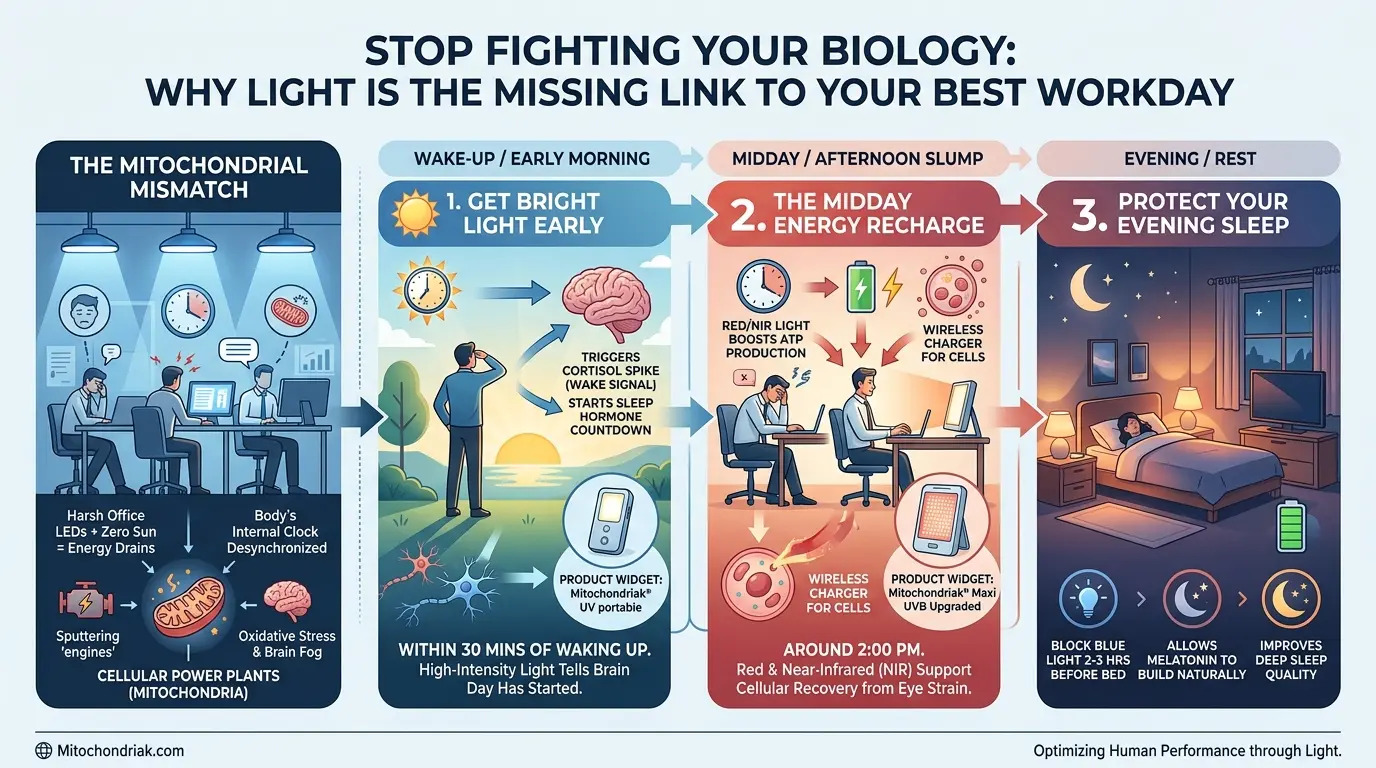
Redox balance is not something you "fix" with a single pill. It is the result of a set of habits that daily create an environment for optimal mitochondrial function:
- Morning sunlight – red and infrared wavelengths from the sun stimulate CCO and set the circadian rhythm of mitochondria
- Red and NIR light therapy – targeted photobiomodulation with wavelengths of 630, 670, 760, 810, 830, and 850 nm restores the redox state of CCO and improves electron flow
- Quality sleep in darkness – nighttime melatonin is the most powerful mitochondrial antioxidant that protects the electron transport chain
- Minimizing blue light after sunset – protects CCO from inhibition and supports melatonin production
- Movement – exercise generates mild oxidative stress (hormesis), which activates Nrf2 and stimulates mitochondrial biogenesis
- Seasonal diet with adequate fats – fats are the most efficient fuel for the electron transport chain and produce more NAD+ per molecule
- Grounding – free electrons from the Earth help neutralize excessive ROS
- Intermittent fasting – increases the NAD+/NADH ratio and activates sirtuins and autophagy
Related glossary terms
- Mitochondria – the primary site of redox reactions and ATP production in the cell
- ATP – energy produced as a result of redox reactions in the electron transport chain
- Photobiomodulation – light therapy that restores the redox state of CCO
- Circadian rhythm – the biological rhythm influencing cyclical redox activity of mitochondria
- Melatonin – the most powerful mitochondrial antioxidant protecting redox balance at night
Restore redox balance with light
Mitochondriak® panels emit wavelengths of 630, 670, 760, 810, 830, 850, and 940 nm. These wavelengths specifically stimulate cytochrome c oxidase, restore electron flow in the electron transport chain, and normalize the redox state of mitochondria. Just 10 to 20 minutes per day for more ATP and less oxidative stress.
- Redox is a paired process of electron transfer: oxidation (loss) and reduction (gain) always occur simultaneously
- The electron transport chain in mitochondria is the most important redox machinery in the body, where electrons flow from NADH to oxygen
- The NAD+/NADH ratio is a key indicator of metabolic health; when it drops, oxidative stress accumulates
- Oxidative stress occurs when ROS exceed antioxidant capacity; it is the common denominator of fatigue, aging, and chronic disease
- Red and NIR light (630, 670, 760, 810, 830, 850 nm) restores redox by unblocking CCO, increasing NAD+/NADH, and activating Nrf2
- A healthy redox is the result of combining the right light, sleep, movement, seasonal nutrition, and grounding
Sources and References
- Nolfi-Donegan, D., Braganza, A., Bhatt, S. S. (2020). Mitochondrial electron transport chain: Oxidative phosphorylation, oxidant production, and methods of measurement. Redox Biology, 37, 101674. PMC7767752
- Xiao, W., Wang, R. S., Handy, D. E., Loscalzo, J. (2018). NAD(H) and NADP(H) Redox Couples and Cellular Energy Metabolism. Antioxidants & Redox Signaling, 28(3), 251–272. PMC5737637
- Walker, M. A., Bhattacharjee, R. N. (2018). NAD(H) in mitochondrial energy transduction. Biochemical Journal, 475(5), 935–952. PMC7112453
- Xu, X. et al. (2025). Mitochondria in oxidative stress, inflammation and aging. Signal Transduction and Targeted Therapy, 10, 99. Nature s41392-025-02253-4
- Shivappa, P. et al. (2025). From light to healing: photobiomodulation therapy in medical practice. Lasers in Medical Science, 40, 123. PMC12751248
- Hamblin, M. R. (2018). Mechanisms and Mitochondrial Redox Signaling in Photobiomodulation. Photochemistry and Photobiology, 94(2), 199–212. PubMed 29164625