.png)
Longevity
Longevity is not just about reaching an old age. It is about living those years in good health, with energy, a clear mind, and a functional body. At Mitochondriak®, we understand longevity as the result of long-term care for mitochondria, the cellular power plants that determine whether your body ages fast or slow.
- What longevity is and why it is not just about the number of years
- What role mitochondria play in the aging process
- What the "hallmarks of aging" are and why mitochondrial dysfunction is one of them
- How light, circadian rhythm, and melatonin influence the rate of aging
- Why photobiomodulation is one of the most promising anti-aging tools
- What specific habits support longevity from a mitohacking perspective
- What is longevity and why is it not just about how long you live?
- What is the difference between healthspan and lifespan?
- What are the "hallmarks of aging" and where do mitochondria fit in?
- Why are mitochondria the key to longevity?
- How does light affect the rate of aging?
- Why is circadian rhythm a pillar of longevity?
- What longevity tools do we use at Mitochondriak®?
- What longevity is not?

What is longevity and why is it not just about how long you live?
Longevity literally means "a long life." In the context of modern science and biohacking, however, the term encompasses much more. Longevity is the ability of the organism to maintain its functionality, vitality, and resilience against disease throughout its entire life, not merely its extension.
Living to 90 while bedridden is not longevity. Living to 90 with energy, a clear mind, a functional musculoskeletal system, and the ability to enjoy life, that is longevity. And this is precisely where mitochondria enter the picture.
We "Mitochondriacs" believe that natural light is the key to a healthy and long life. This is not just a slogan. It is the conclusion reached by decades of research in cellular biology, chronobiology, and quantum biology.
What is the difference between healthspan and lifespan?
In the discussion about longevity, you will encounter two key terms:
- Lifespan – the total number of years a person lives. In Europe, the average lifespan is approximately 78 to 82 years depending on the country.
- Healthspan – the number of years lived in full health, without chronic diseases, medication dependency, or loss of independence. On average, healthspan is 10 to 15 years shorter than lifespan.
The goal of true longevity is not to add years to life, but to add life to years. The ideal is for healthspan to come as close to lifespan as possible, meaning you remain healthy and functional for as long as possible, not merely alive.
From a mitohacking perspective, the gap between healthspan and lifespan is directly proportional to the state of your mitochondria. The better your mitochondria function, the slower you age and the longer you remain healthy.
What are the "hallmarks of aging" and where do mitochondria fit in?
In 2013, Carlos Lopez-Otin and colleagues published a landmark paper in the journal Cell identifying 9 hallmarks of aging. In 2023, they expanded this framework to 12 hallmarks that together form the biological foundation of aging (Lopez-Otin et al., 2023).
Mitochondrial dysfunction is one of the 12 hallmarks of aging, and according to a growing number of scientists, it may even be the "mother" of all the others. Somasundaram et al. (2024) emphasized in their review that mitochondrial dysfunction significantly influences aging because mitochondria regulate cellular energy, oxidative balance, and calcium levels (Somasundaram et al., 2024).
Here is an overview of the 12 hallmarks of aging and how mitochondria relate to each of them:
- Genomic instability – DNA damage, including mitochondrial DNA (mtDNA) damage
- Telomere attrition – mitochondrial oxidative stress accelerates telomere shortening
- Epigenetic alterations – mitochondrial metabolites influence the epigenome
- Loss of proteostasis – mitochondria regulate protein quality
- Deregulated nutrient sensing – directly linked to mitochondrial metabolism
- Mitochondrial dysfunction – the central hallmark of aging
- Cellular senescence – dysfunctional mitochondria accelerate it
- Stem cell exhaustion – depends on mitochondrial fitness
- Altered intercellular communication – mitochondria produce signaling molecules
- Disabled macroautophagy – mitophagy (recycling of mitochondria) is a key component
- Chronic inflammation – dysfunctional mitochondria drive it
- Dysbiosis – the gut microbiome-mitochondria axis is interconnected
Virtually all 12 hallmarks of aging have a direct or indirect connection to mitochondria. That is why caring for mitochondria is the most effective longevity strategy.
Why are mitochondria the key to longevity?
Mitochondria are not just "cellular power plants." They are the control center of cellular energetics, signaling, and the decision of whether a cell will live, repair itself, or die (apoptosis). As we age, several problems accumulate within mitochondria:
Decline in ATP production
The electron transport chain loses efficiency. Complexes I through IV gradually decrease their activity, leading to lower ATP production. Cells have less energy for repair, regeneration, and routine functions. The result: fatigue, slower healing, and loss of muscle mass.
Increase in oxidative stress
A dysfunctional electron transport chain produces more reactive oxygen species (ROS) than the body can neutralize. Excessive ROS damage proteins, lipids, and DNA, including mitochondrial DNA, which is particularly vulnerable because it lacks protective histones.
Decline in mitophagy
Mitophagy is the process by which the cell recycles damaged mitochondria and replaces them with new ones. With age, this "cleanup" mechanism slows down. Damaged mitochondria accumulate and continue producing ROS, creating a vicious cycle.
Decline in melatonin
Melatonin is not just a sleep hormone. It is a powerful mitochondrial antioxidant that concentrates directly inside mitochondria and protects the electron transport chain. With age, melatonin levels decline, making mitochondria more vulnerable.
How does light affect the rate of aging?
From a longevity perspective, light is a double-edged sword. The right light at the right time slows aging. The wrong light at the wrong time accelerates it.
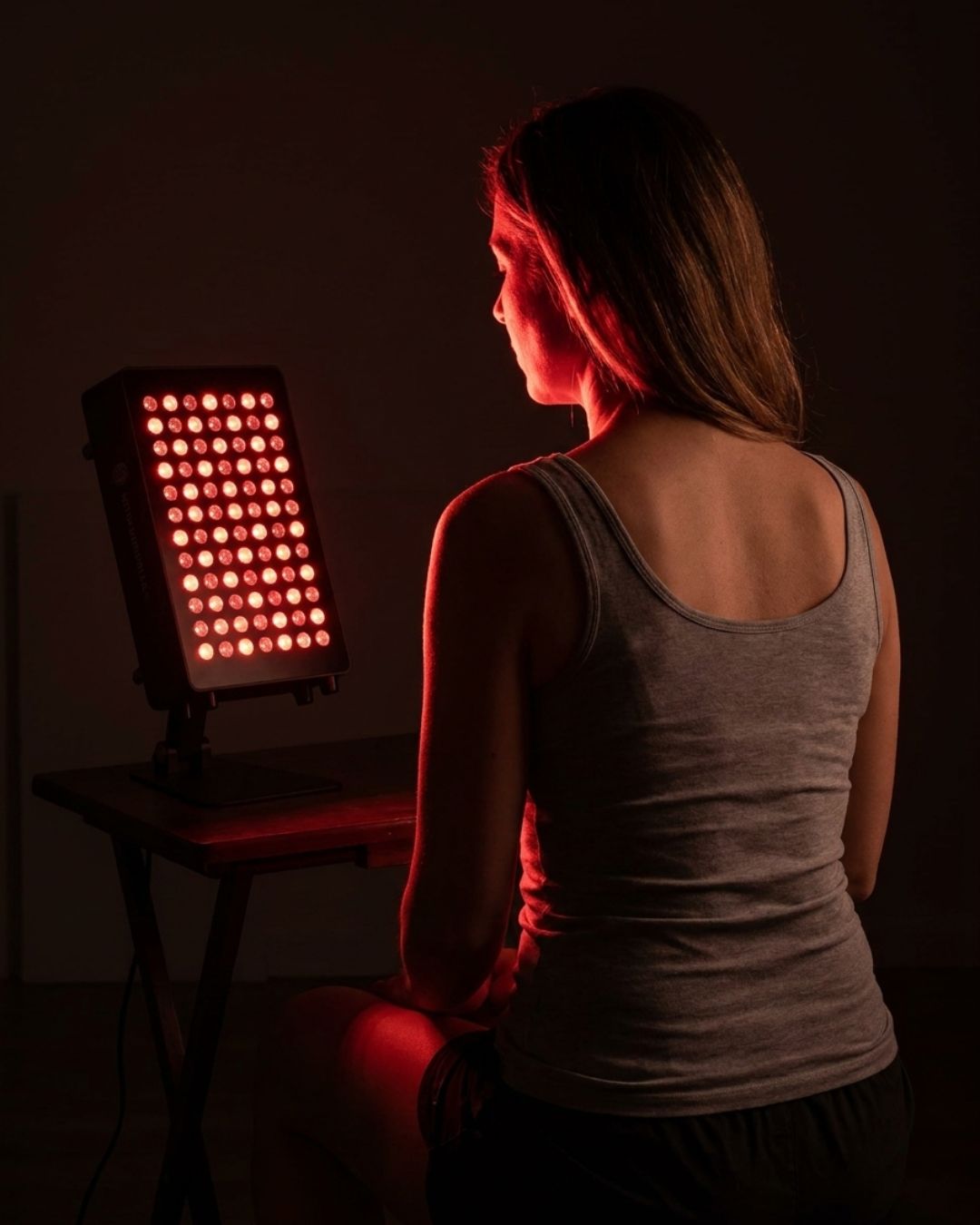
Red and infrared light slow aging
Mitrofanis (2018) showed in his review study that photobiomodulation slows aging of the central nervous system by improving neuronal survival and function and reducing neuroinflammation (Mitrofanis, 2018). Couturaud et al. (2023) demonstrated that LED photobiomodulation can reverse visible signs of skin aging, including wrinkles, pigmentation spots, and loss of elasticity (Couturaud et al., 2023).
The mechanism is clear: red and NIR light stimulate cytochrome c oxidase in complex IV of the electron transport chain, increase ATP production, reduce oxidative stress, and trigger an adaptive cellular response (hormesis). All of these processes directly slow the hallmarks of aging.
Artificial blue light accelerates aging
Chronic exposure to blue light from screens and LED lighting after sunset inhibits melatonin production, disrupts the circadian rhythm, and according to studies directly impairs mitochondrial function. It is one of the greatest yet least discussed accelerators of aging in modern society.
Why is circadian rhythm a pillar of longevity?
Acosta-Rodriguez et al. (2021) showed in a study published in Nature Communications that circadian rhythm directly influences lifespan. Mice with disrupted circadian rhythms lived shorter lives and had higher rates of metabolic diseases. Conversely, interventions supporting circadian synchronization (time-restricted eating, regular light-dark cycles) extended healthy life (Acosta-Rodriguez et al., 2021).
The circadian rhythm governs when mitochondria produce ATP, when mitophagy occurs, when melatonin is synthesized, and when DNA repair mechanisms are activated. If this rhythm is disrupted (night shifts, jet lag, constant blue light, nighttime eating), all of these processes suffer and aging accelerates.
From a longevity perspective, synchronizing the circadian rhythm with the Earth's light-dark cycle is one of the most effective and at the same time least expensive interventions you can make.
What longevity tools do we use at Mitochondriak®?
Longevity is not about a single miracle supplement. It is about a set of habits and decisions that daily create an environment in which mitochondria can function optimally. Here are the main tools that we at Mitochondriak® consider the pillars of longevity:
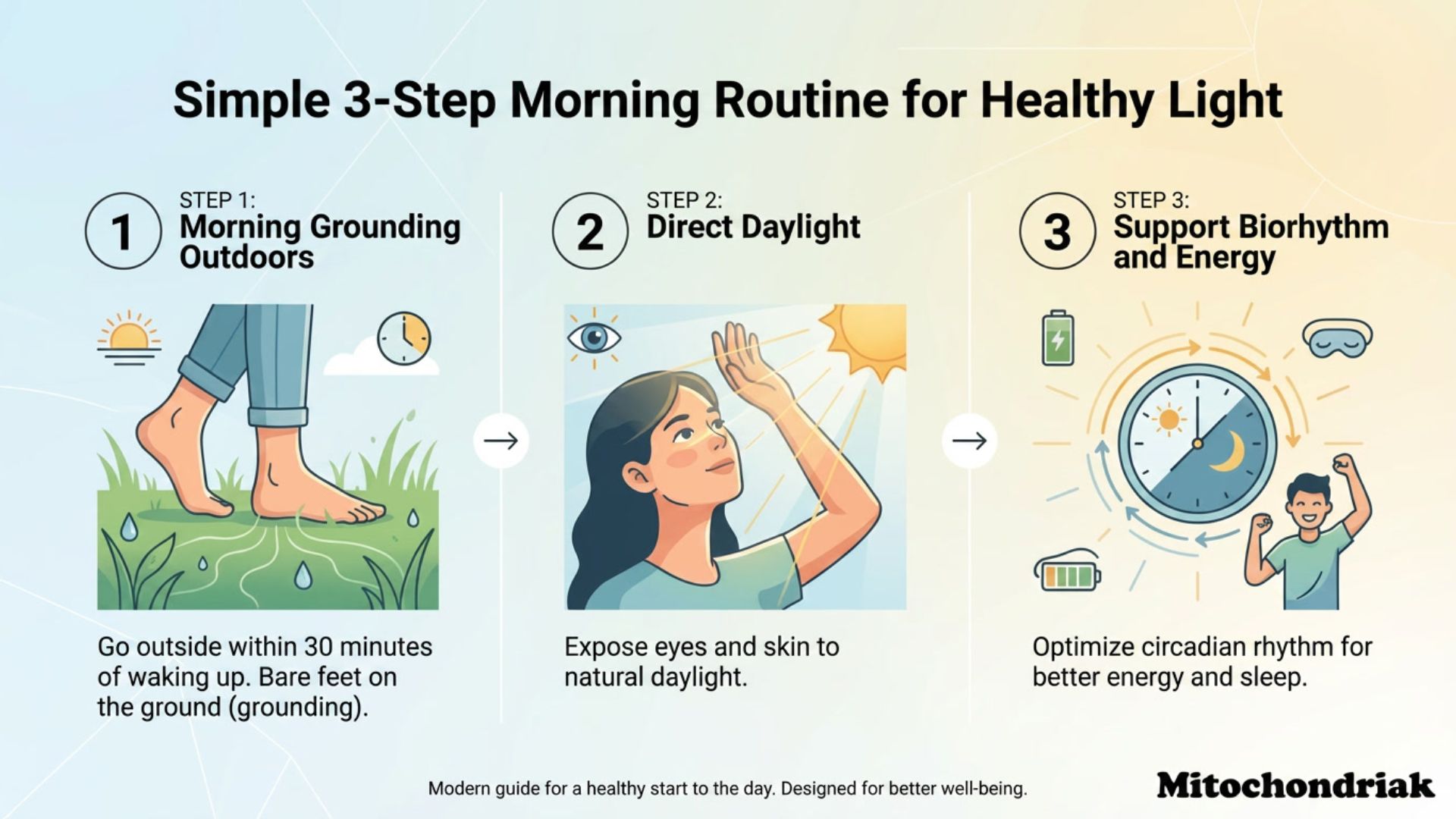
- Morning sunlight – sets the circadian rhythm, stimulates mitochondria through red and infrared wavelengths, supports vitamin D and melanin production
- Red and infrared light therapy – targeted photobiomodulation stimulating the electron transport chain, increasing ATP and reducing oxidative stress. Dozens of studies confirm its anti-aging effect on skin, brain, and muscles
- Minimizing blue light after sunset – protecting melatonin and the circadian rhythm. Blue light blocking glasses, red evening bulbs, turning off screens
- Grounding (earthing) – supplying free electrons, reducing chronic inflammation, supporting the parasympathetic nervous system. Walking barefoot or wearing grounded barefoot shoes
- Quality sleep in complete darkness – maximizing nighttime melatonin production, which protects mitochondria from oxidative damage
- Seasonal eating – eating in alignment with the season and geographic latitude, minimizing deuterium, supporting mitochondrial metabolic flexibility
- Movement and exposure to temperature changes – stimulating mitochondrial biogenesis, activating autophagy and mitophagy
- Time-restricted eating – synchronizing food intake with the circadian rhythm, supporting autophagy
None of these tools works in isolation. Longevity is the result of their synergistic action, the combination of the right light, the right nutrition, the right movement, and the right environment at the right time.
What longevity is not?
The topic of longevity has become popular in recent years, which also brings with it many oversimplifications and myths. Here is what longevity, from our perspective, is not:
- It is not about supplements as the first step. NMN, resveratrol, metformin, and other "longevity molecules" have potential, but without functional foundations (light, sleep, nutrition, movement) their effect is minimal. Fundamentals always come first.
- It is not about fear of aging. Aging is a natural process. Longevity is about making that process happen gracefully, not about stopping it.
- It is not only for the wealthy. The most effective longevity tools are free: sunlight, sleep, grounding, movement, seasonal eating. Technology is a complement, not the foundation.
- It is not anti-aging cosmetics. Creams and serums work on the surface. True longevity works from the inside, at the level of mitochondria and cellular energetics.
At Mitochondriak®, we understand longevity as an equation: Light + Water = Energy. When mitochondria receive the right light and produce quality metabolic water, energy flows, cells regenerate, and the body ages more slowly. It is that simple. And that hard to maintain in the modern world.
Related glossary terms
- Mitochondria – the cellular organelles whose function directly determines the rate of aging
- ATP – the energy currency whose declining production is one of the hallmarks of aging
- Photobiomodulation – light therapy with proven anti-aging potential
- Circadian rhythm – the biological rhythm whose synchronization extends healthy life
- Melatonin – a mitochondrial antioxidant whose levels decline with age, accelerating aging
Longevity starts with mitochondria
Mitochondriak® panels stimulate the electron transport chain in your mitochondria with wavelengths backed by hundreds of scientific studies. Red and infrared light increases ATP production, reduces oxidative stress, and according to research slows multiple hallmarks of aging. Just 10 to 20 minutes per day.
- Longevity is about extending healthy life (healthspan), not just total age (lifespan)
- Mitochondrial dysfunction is one of the 12 hallmarks of aging and, according to scientists, their common denominator
- Red and NIR light stimulate mitochondria and, according to studies, slow multiple hallmarks of aging
- Circadian rhythm directly influences the length of healthy life; its disruption accelerates aging
- Melatonin is a key mitochondrial antioxidant whose levels decline with age
- The most effective longevity tools are free: morning sunlight, sleep in darkness, grounding, seasonal nutrition
Sources and References
- Lopez-Otin, C., Blasco, M. A., Partridge, L. et al. (2023). Hallmarks of aging: An expanding universe. Cell, 186(2), 243–278. PubMed 36599349
- Somasundaram, I. et al. (2024). Mitochondrial dysfunction and its association with age-related disorders. Frontiers in Physiology, 15, 1384966. PMC11250148
- Acosta-Rodriguez, V. A. et al. (2021). Importance of circadian timing for aging and longevity. Nature Communications, 12, 2862. PMC8129076
- Mitrofanis, J. (2018). Does photobiomodulation influence ageing? Aging, 10(10), 2628–2629. PMC6188498
- Couturaud, V. et al. (2023). Reverse skin aging signs by red light photobiomodulation. Skin Research and Technology, 29(7), e13391. PMC10311288
- Hamblin, M. R. (2018). Mechanisms and Mitochondrial Redox Signaling in Photobiomodulation. Photochemistry and Photobiology, 94(2), 199–212. PMC5844808