
.png)
Infrared light therapy and red light look almost identical on paper, yet they behave very differently once they hit your skin. Red light works mostly at the surface, while near infrared light reaches deeper tissue. This guide explains the real difference, honest penetration depth numbers, and which wavelength you actually need.
- The real difference between red light (roughly 630 to 670 nm) and near infrared light (roughly 810 to 940 nm), and why one number on a box tells you almost nothing.
- Honest penetration depth ranges, with the caveat that published figures vary widely by measurement method.
- Which wavelengths lean toward skin and surface goals versus deeper joint, muscle and brain applications.
- Whether you really need both red and near infrared in one panel, or whether a single band is enough for your goal.
- How to use infrared light therapy safely, and who should be cautious.
- What should you know about red light vs near infrared, and why does it matter?
- What is the main difference and when should you choose each option?
- How do you choose the right option for your goal?
- How do you approach red light vs near infrared safely in practice?
- What should you watch out for and who should be careful?
- Summary: what should you remember?
- Frequently asked questions

What should you know about red light vs near infrared, and why does it matter?
Infrared light therapy uses invisible near infrared wavelengths, typically in the range of 810 to 940 nm, to deliver light energy into your tissue. Unlike red light, which you can see as a warm glow, near infrared light is invisible to the human eye but penetrates deeper. Both belong to the wider field of photobiomodulation, where specific wavelengths influence how your cells produce energy.
The mechanism is simpler than most marketing suggests. When red and near infrared photons reach your cells, they are absorbed by an enzyme called cytochrome c oxidase (CCO), which sits inside your mitochondria. Michael R. Hamblin of Harvard Medical School describes this as a primary photoacceptor in the cell. Once the light hits it, mitochondria tend to produce more ATP, the fuel that powers every cellular process from wound healing to muscle repair. [R]
This matters because most of us live indoors, under lighting that contains almost none of these frequencies. Natural sunlight is rich in red and near infrared light, but a typical office or bedroom is not. A quality panel from the red light therapy devices range is essentially a way to give your cells a concentrated dose of the specific wavelengths they are built to use, without waiting for the right weather.
The confusion starts when people treat "red light" and "infrared" as interchangeable. They are not. The wavelength decides how deep the light travels and, in practice, what kind of problem it is best suited for. That single distinction is what the rest of this article unpacks. If the term is new to you, our glossary entry on NIR gives a quick definition before you read on.
What is the main difference and when should you choose each option?
The main difference is penetration depth. Red light in the 630 to 670 nm range is absorbed strongly near the surface, so it favours skin and shallow tissue. Near infrared light in the 810 to 940 nm range scatters less and reaches deeper structures like muscle, joints and, at the higher end, even brain tissue. Choose red for surface goals and near infrared for depth.
Here is the honest caveat that most product pages skip. Published penetration figures vary enormously depending on how they were measured, which tissue was used and whether the study was done on living tissue or a lab sample. You will see numbers ranging from a few millimetres to several centimetres for the same wavelength. Treat the ranges below as directional guidance, not laboratory-precise promises.
| Wavelength | Type | Relative penetration | Typical focus |
|---|---|---|---|
| 630 nm | Red (visible) | Shallow | Skin surface, fine lines, tone |
| 670 nm | Red (visible) | Shallow to moderate | Skin, collagen, superficial tissue |
| 760 nm | Near infrared (invisible) | Moderate | Transitional, water-related effects |
| 810 nm | Near infrared (invisible) | Deeper | Brain, nerves, deeper tissue |
| 830 nm | Near infrared (invisible) | Deeper | Joints, muscle, recovery |
| 850 nm | Near infrared (invisible) | Deep | Muscle, deep recovery |
| 940 nm | Near infrared (invisible) | Deep | Deep tissue, circulation |
The practical rule is straightforward. If your goal sits at the surface, such as skin rejuvenation or supporting collagen production, red wavelengths do the heavy lifting. A 2023 systematic review and meta-analysis of LED studies found red light useful for acne and near infrared devices useful for skin rejuvenation, which reflects how surface tissue responds to these frequencies. [R]
If your target is deeper, near infrared earns its place. Research on musculoskeletal pain and muscle recovery consistently uses near infrared wavelengths precisely because they reach the tissue that needs it. Leal-Junior and colleagues documented benefits of photobiomodulation for muscle recovery and performance, an application that depends on light reaching muscle rather than stopping at the skin. [R] At the deepest end, Salehpour and colleagues reviewed how much red and near infrared light, including 810 nm, passes through the scalp and skull towards brain tissue, and found that in humans only a small and highly variable fraction gets through. [R]
This is also where the old idea behind the original version of this article, that infrared light can support the eyes, still holds a grain of truth. A 2021 review by Markoulli and colleagues examined red and near infrared light for dry eye disease, showing that these wavelengths are also being researched beyond skin and muscle. [R] The key is that no single wavelength does everything, which is exactly why the question of combining them comes up so often. We tackle how to make that choice for your own goal in the next section.
How do you choose the right option for your goal?
Start with the depth of your target tissue, not the marketing on the box. If your goal is skin, fine lines or collagen, red light around 630 to 670 nm is your primary tool. If your goal reaches into joints, muscle or deeper recovery, near infrared around 810 to 850 nm is what you need. Most people benefit from both, but the balance depends on your priority.
The most common practical question is whether you need a panel with both red and near infrared wavelengths, or whether a single band is enough. The honest answer depends on how varied your goals are. If you only care about facial skin, a red-only device covers you. But if you also want support for muscle recovery, stiff joints or general regeneration, a combined panel saves you from buying two devices.
This is why most quality full-body devices combine multiple wavelengths across the red and near infrared spectrum rather than betting on a single number. A panel that spans several wavelengths lets one session serve both surface and deeper goals. If you want a structured walk-through of what actually matters when comparing devices, our guide on how to choose the best red light therapy panel breaks down wavelengths, irradiance and safety in detail.
Here is a simple way to map your goal to the wavelength band that carries the most weight:
- Skin tone, fine lines, superficial collagen: red light, roughly 630 to 670 nm, where absorption near the surface is strongest.
- Acne and inflammatory skin concerns: red light, since surface tissue responds well to these frequencies. [R]
- Muscle recovery and athletic performance: near infrared, which reaches muscle rather than stopping at the skin. [R]
- Joints, stiffness and deep tissue: near infrared around 830 nm, chosen for its deeper reach.
- Cognitive and neurological interest: near infrared near 810 nm, a wavelength often used in brain research. [R]
For most home users who want one device to cover the widest range of goals, a combined full-body panel from the red light therapy devices range is the pragmatic choice. It removes the need to guess which single wavelength will matter most a year from now.
How do you approach red light vs near infrared safely in practice?
In practice, effective use comes down to three things: distance, session length and consistency. For a classic mains-powered panel, keep a distance of at least 30 cm from your body, run sessions of roughly 10 to 20 minutes, and treat the target area several times per week. Regular short sessions beat occasional long ones.
Distance matters for two separate reasons. First, it controls how much light energy actually reaches your tissue, since intensity drops sharply as you move away from the panel. Second, with a classic corded panel there is a sound argument for keeping a sensible gap because electromagnetic exposure is higher right at the surface of a mains-powered device. For that reason we never recommend sitting closer than 30 cm to a classic panel, even when a product photo shows someone leaning in. A comfortable working range for full-body sessions is typically 30 to 60 cm, and larger panels such as the Maxi are used from a bit further back.
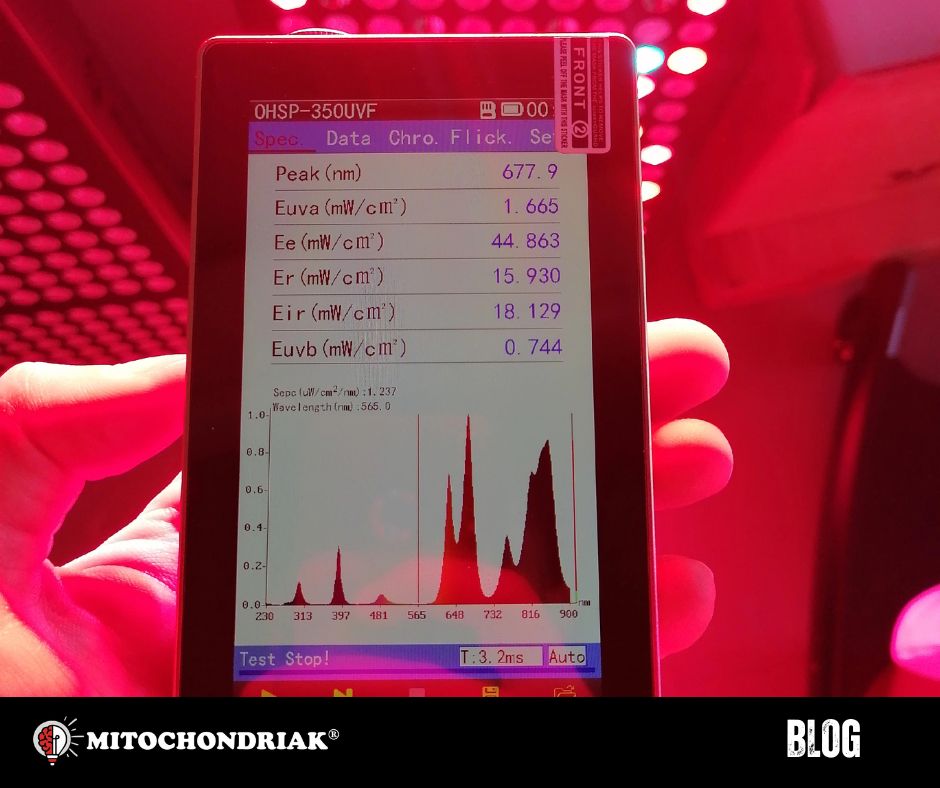
Do not confuse two things you may read online. An intensity measurement taken at 15 cm is a technical reading of irradiance, not a recommended therapy distance. A one-off skin sensitivity test held briefly closer is also not your everyday protocol. Your normal working distance stays at 30 cm or more for a classic panel.
Session length depends on the wavelength band and your goal. Skin-focused red light sessions tend to be shorter, while deeper near infrared work for muscle and joints often uses slightly longer exposure to let the light reach and act on the target tissue. The general mechanism is the same in both cases: photons are absorbed by cytochrome c oxidase in your mitochondria, nudging cells to produce more ATP. [R]
Consistency is the factor most people underestimate. Photobiomodulation is not a single dramatic event but a cumulative process. Whether you are chasing skin improvements or supporting recovery, a routine of short, frequent sessions over weeks tends to outperform sporadic marathon exposures. Set a realistic schedule you can actually keep, then let the wavelengths do their slow, steady work.
What should you watch out for and who should be careful?
Red and near infrared light therapy is generally well tolerated, but a few groups should be cautious. If you are pregnant, have a photosensitising condition or take photosensitising medication, or have any active skin lesion or cancer in the treatment area, talk to a doctor before starting. This article is educational and not a substitute for medical advice.
The most important practical caution concerns your eyes. While the older version of this article leaned heavily on eye benefits, the honest position is more measured. There is documented research on red and near infrared light for specific conditions like dry eye disease, but that is done under controlled protocols. [R] For general home use, do not stare directly into a bright panel. Bright near infrared is invisible, which means your natural blink reflex does not protect you, so close your eyes or use eye protection during facial sessions.
Two more sensible habits round this out. First, do not chase intensity by pressing closer to a classic panel to feel more heat, because that raises electromagnetic exposure and does not improve results. Second, be realistic about claims. If a source promises a cure, a guaranteed outcome or a precise penetration figure with no caveat, treat it with suspicion. Published penetration depths vary by measurement method, and any honest device or article should say so.
Summary: what should you remember?
The single most useful takeaway is that wavelength decides depth. Red light around 630 to 670 nm works mostly at the surface, so it suits skin, tone and collagen goals. Near infrared light around 810 to 940 nm reaches deeper into muscle, joints and even brain tissue, which is why it dominates research on recovery and neurological applications. Neither band is better in absolute terms; they simply do different jobs.
The second thing to remember is honesty about numbers. Anyone quoting an exact penetration depth without a caveat is overselling, because published figures vary widely by tissue and measurement method. What is consistent is the underlying mechanism: both red and near infrared photons are absorbed by cytochrome c oxidase in your mitochondria, encouraging more ATP production. [R] If your goals span both surface and depth, a combined panel from the red light therapy devices range is the most practical answer, used sensibly from at least 30 cm and applied consistently over time.
Frequently asked questions
What is the difference between red light and near infrared light?
Red light, roughly 630 to 670 nm, is visible and absorbed strongly near the surface, so it favours skin and shallow tissue. Near infrared light, roughly 810 to 940 nm, is invisible and reaches deeper into muscle, joints and even brain tissue. Both work through the same cellular mechanism, but the wavelength decides how deep the light travels.
How deep does near infrared light actually penetrate into tissue?
Honestly, it depends. Published figures range from a few millimetres to several centimetres for the same wavelength, because results vary by tissue type and measurement method. [R] As a directional guide, near infrared in the 810 to 940 nm range reaches deeper than red light, which is why research on muscle recovery and neurological effects relies on it.
Do you need both red and near infrared wavelengths in one panel?
It depends on your goals. If you only want facial skin support, a red-only device is enough. But if you also care about muscle recovery, joints or general regeneration, a combined panel covers both surface and deeper targets in one session. For varied goals, a combined full-body panel is usually the more practical choice.
Is infrared light therapy the same as photobiomodulation?
Infrared light therapy is one part of the wider field of photobiomodulation. Photobiomodulation covers how specific wavelengths of red and near infrared light influence cellular energy production. Infrared therapy refers specifically to using the invisible near infrared band, typically 810 to 940 nm, to reach deeper tissue.
Can red and near infrared light really help the eyes?
There is documented research on red and near infrared light for specific conditions such as dry eye disease, carried out under controlled protocols. [R] For general home use, however, you should not stare into a bright panel. Close your eyes or use eye protection during facial sessions, since invisible near infrared does not trigger your blink reflex.
How close should I sit to a red light panel?
For a classic mains-powered panel, keep a distance of at least 30 cm, with a typical working range of 30 to 60 cm for full-body sessions and a bit further for larger panels. A 15 cm figure you may see online is usually an intensity measurement or a brief sensitivity test, not a recommended everyday therapy distance.
Sources and references
- Leal-Junior, E. C.. 2015. Effect of phototherapy (low-level laser therapy and light-emitting diode therapy) on exercise performance and markers of exercise recovery: a systematic review with meta-analysis pubmed.ncbi.nlm.nih.gov
- Salehpour, F.. 2019. Penetration Profiles of Visible and Near-Infrared Lasers and Light-Emitting Diode Light Through the Head Tissues in Animal and Human Species: A Review of Literature pubmed.ncbi.nlm.nih.gov
- Ngoc, L. T. N.. 2023. Utilization of light-emitting diodes for skin therapy: Systematic review and meta-analysis pubmed.ncbi.nlm.nih.gov
- Markoulli, M.. 2021. Photobiomodulation (low-level light therapy) and dry eye disease pubmed.ncbi.nlm.nih.gov
- Hamblin, M. R.. 2017. Mechanisms and applications of the anti-inflammatory effects of photobiomodulation pubmed.ncbi.nlm.nih.gov