.png)
Red light therapy hair growth is one of the most searched non-invasive approaches to thinning hair, and for good reason. Clinical trials show that specific red and near-infrared wavelengths can stimulate dormant follicles, increase hair density and even earn FDA clearance for pattern baldness. Here is what the science actually says.
- How red light therapy stimulates hair follicles at the cellular level through mitochondria and ATP production.
- Which wavelengths (around 650 nm and 800 to 850 nm) have the strongest clinical support for hair regrowth.
- What peer-reviewed studies and meta-analyses reveal about real-world results and FDA-cleared devices.
- Realistic expectations: what red light can and cannot do for different types of hair loss.
- Practical, safe protocols for using red light therapy on the scalp at home.
- What is red light therapy hair growth and why does it matter?
- How does red light therapy hair growth work according to research?
- What benefits and limits can you realistically expect?
- How do you use red light therapy hair growth safely in practice?
- What should you watch out for and who should be careful?
- Summary: what should you remember?
- Frequently asked questions
What is red light therapy hair growth and why does it matter?
Red light therapy for hair growth is the use of low-intensity red and near-infrared light to stimulate hair follicles and encourage new growth. It works by delivering specific wavelengths of light to the scalp, where they are absorbed by cells and converted into cellular energy. This is a non-invasive, drug-free approach backed by a growing body of clinical research.
You may see this method described by several names, and they largely overlap. Low-level laser therapy (LLLT), low-level light therapy, and photobiomodulation (PBM) all refer to the same underlying principle: using light doses that stimulate tissue rather than heat or damage it. Whether the light comes from a laser diode or an LED panel, the biological target is the same, namely the follicle and its energy-producing machinery.
Why does this matter so much for people losing their hair? Because most hair loss treatments fall into two camps. The first is pharmaceutical, such as minoxidil and finasteride, which work but require daily commitment and can carry side effects. The second is surgical transplantation, which is effective but invasive and expensive. Red light therapy sits in a different category entirely. It targets the biological environment of the follicle without chemicals or incisions, which is exactly why it has become one of the most searched hair-loss topics online.
It is important to be honest about expectations from the start. Red light therapy is not a magic wand, and it is not equally effective for every cause of hair loss. Where the evidence is strongest is in androgenetic alopecia, the most common form of pattern hair loss affecting both men and women. In these cases, several randomized controlled trials and meta-analyses have documented measurable improvements in hair density and thickness. We will look at exactly what that research shows in the next section, and where its limits lie later on.
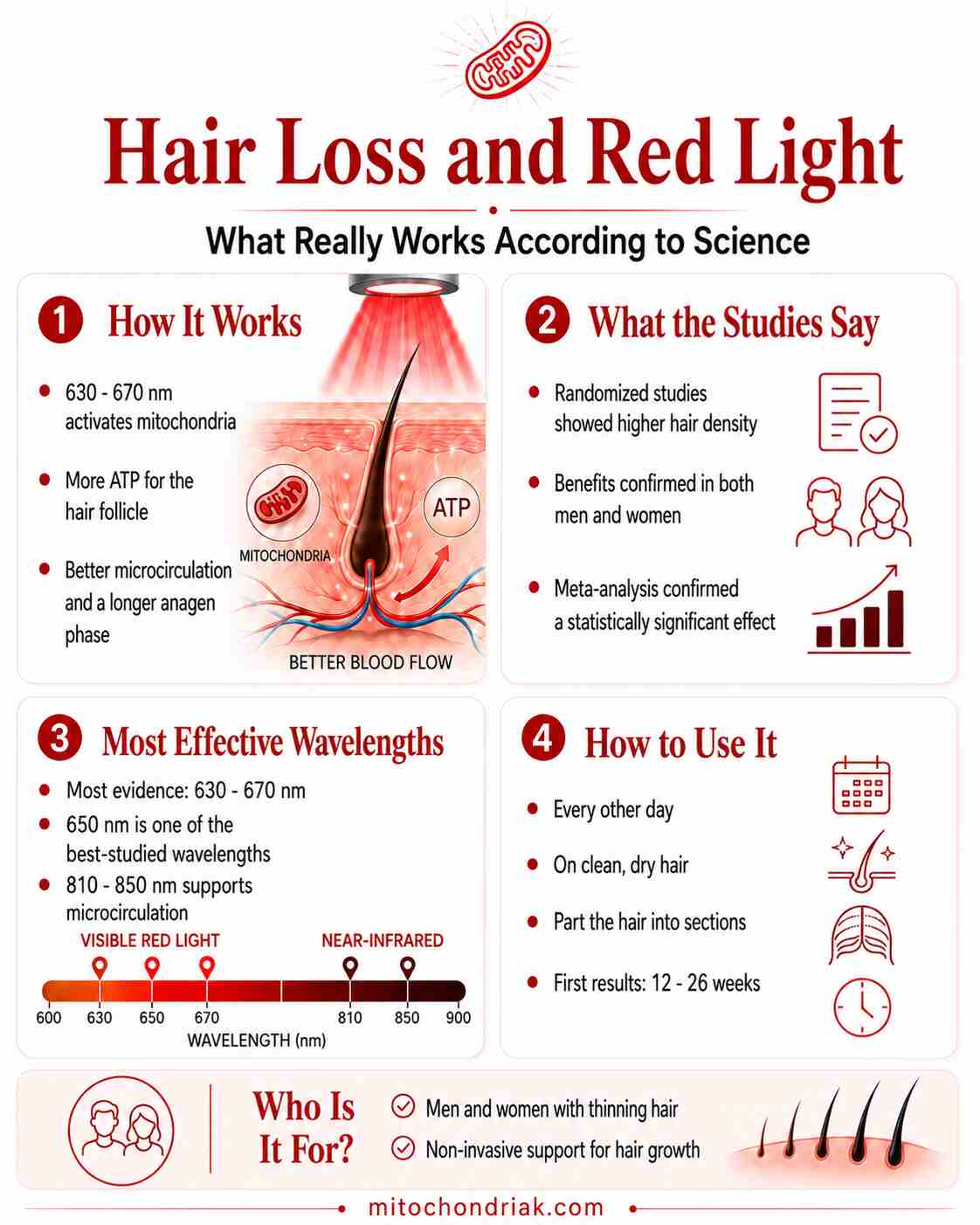
If you want a broader overview of how light affects the body, our article on hair loss and red light and what really works according to science is a useful companion piece. This article, by contrast, goes deeper into the mechanisms, the clinical evidence, and the practical protocols.
How does red light therapy hair growth work according to research?
According to research, red light therapy works primarily through photobiomodulation. Red and near-infrared photons are absorbed by an enzyme in the mitochondria called cytochrome c oxidase (CCO). This boosts the production of ATP, the cell's energy currency, which reinvigorates hair follicle cells, extends the growth phase, and improves the local scalp environment. The result can be thicker, denser hair.
To understand this properly, it helps to zoom in to the level of a single cell. Every hair follicle is powered by mitochondria, the tiny structures inside cells that generate energy. When light in the therapeutic window reaches these mitochondria, cytochrome c oxidase absorbs the photons and its activity increases. As Michael R. Hamblin of Harvard Medical School has extensively documented, this cascade raises ATP output and modulates reactive oxygen species and nitric oxide signalling, which together create conditions favourable for cellular repair and proliferation. [R]
For hair specifically, this cellular boost translates into several concrete effects. Follicles spend more time in the active anagen (growth) phase and less time in the resting telogen phase. The dermal papilla cells, which orchestrate the hair cycle, become more active. Local blood circulation to the scalp tends to improve, delivering more nutrients and oxygen to the follicle. And because photobiomodulation has documented anti-inflammatory effects, it may help calm the low-grade inflammation that surrounds miniaturizing follicles in androgenetic alopecia.
The wavelengths that reach the follicle matter enormously, and this is where the research becomes specific. The most studied and clinically validated range for hair sits around 650 nm in the red spectrum, which is why the majority of FDA-cleared home devices are built around this figure. Longer near-infrared wavelengths in the 800 to 850 nm range penetrate more deeply and are often combined with red light to reach follicles that sit below the skin surface. A 2022 systematic review and meta-analysis by Zhang and colleagues examined photobiomodulation across different wavebands and confirmed that carefully chosen wavelengths produce measurable improvements in hair count. [R]
It is worth noting a distinction that often confuses consumers. When you see general advice about which wavelengths to look for in any device, the value you will most often want is 670 nm rather than 660 nm. The 660 nm figure is common in the industry largely because it was studied early and the LEDs are inexpensive, not because it is biologically superior. A wavelength declared as 670 nm still covers the neighbouring band around 660 nm, because every LED emits across a small range rather than a single perfect point, so it remains an accurate and honest recommendation.
This is also where the quality of a device becomes decisive. A panel that lists a single impressive-sounding number tells you very little. What actually determines whether light reaches your follicles is the combination of correct wavelengths, verified irradiance measured from a realistic distance, and consistent output. This is one of the reasons a well-engineered red and near-infrared panel differs so much from a cheap novelty light, and we will return to what to look for when choosing a device later in this guide.
What benefits and limits can you realistically expect?
Realistically, you can expect modest but measurable improvements in hair density and thickness, most reliably in early-stage androgenetic alopecia. Red light therapy will not regrow hair on a completely bald, scarred scalp, and it works best as a long-term maintenance tool rather than a one-time fix. The best results appear with consistent use over several months.
The strongest evidence comes from pattern hair loss. A 2021 systematic review and meta-analysis by Gentile and Garcovich analysed randomized controlled trials of low-level light therapy for hair loss and found consistent, statistically significant increases in hair count compared with sham treatment. [R] A separate 2021 meta-analysis by Lueangarun and colleagues focused specifically on FDA-approved, home-use devices for pattern hair loss and confirmed that these devices produce meaningful gains in hair density when used as directed. [R]
It helps to be concrete about what "improvement" looks like. In most trials, participants did not grow entirely new hairlines. Instead, existing miniaturized follicles were revived, so hairs became thicker, darker and more numerous per square centimetre. This is why photographs taken before and after several months of consistent use can look striking, while a single week of use produces nothing visible at all. Hair biology is slow, and the follicle cycle simply cannot be rushed.
Now for the limits, which matter just as much. Red light therapy is most effective on active but weakening follicles. Where a follicle has already died and been replaced by scar tissue, as happens in scarring alopecias or on a scalp that has been smooth and shiny for many years, no amount of light will bring it back. The therapy stimulates what is still alive; it does not resurrect what is gone. This is the single most important expectation to set honestly.
Different types of hair loss also respond differently. Beyond androgenetic alopecia, some evidence suggests benefit for telogen effluvium, the temporary shedding triggered by stress, illness or hormonal shifts, because improving the follicle's energy environment can help the cycle normalize. For autoimmune conditions such as alopecia areata the picture is far less clear and red light should never replace medical treatment. If you are unsure of your diagnosis, that is a conversation for a dermatologist, not a light panel.
Finally, remember that red light therapy is often additive rather than exclusive. In several studies the largest gains appeared when light was combined with proven treatments such as minoxidil. Think of it as one supportive pillar in a broader strategy, not a standalone replacement for everything else. For the wider context on light and the body, our guide to the benefits of red light therapy is a useful companion.
How do you use red light therapy hair growth safely in practice?
In practice, effective scalp protocols involve exposing the thinning areas to red light for roughly 10 to 20 minutes per session, around three to five times per week, over a period of several months. Consistency matters far more than intensity. With a classic wall-mounted panel, keep the scalp at a distance of at least 30 to 60 cm, never closer.
Let us break down the key parameters, because getting them right is what separates a working protocol from wasted time. Frequency is the most important variable. Follicles respond to a steady, repeated stimulus, so a realistic rhythm of three to five sessions per week, sustained for at least three to four months, tends to outperform sporadic marathon sessions. Skipping weeks resets your progress more than most people expect.
The second variable is duration and dose. Most home protocols land in the range of 10 to 20 minutes per treated area. More is not automatically better; photobiomodulation follows a biphasic dose response, meaning there is an optimal window beyond which extra exposure adds no benefit and can even reduce the effect. Sticking to the manufacturer's recommended session length is the safest approach, and you should always verify the exact protocol on the product page for your specific device.
The third variable is distance and device type, and here safety comes first. For classic mains-powered panels such as the Mitochondriak® Maxi Upgraded or the compact Infrapanel Mitochondriak® mini, we recommend keeping the scalp at least 30 to 60 cm away. This is partly about even light coverage and partly about minimizing electromagnetic field exposure that is higher very close to a corded panel. Never treat from a few centimetres away just because a source somewhere quotes a shorter figure; that figure usually refers to an intensity measurement, not a therapeutic distance.
Beyond these three variables, a few practical habits help. Apply light to clean, dry, product-free skin, since heavy oils and styling products can sit on the scalp and scatter light. Part the hair so the light actually reaches the skin rather than only the hair shafts. And treat the whole thinning region evenly rather than fixating on one spot. If you use a broader panel for full-body sessions, positioning it toward the scalp for part of the session is a simple way to combine benefits.
Support your hair-growth routine with a verified panel
Effective scalp treatment depends on correct wavelengths, honest irradiance and consistent output. That is exactly what our red and near-infrared panels are engineered to deliver, so the light actually reaches your follicles.
What should you watch out for and who should be careful?
Red light therapy for hair is considered very safe, with a strong track record and minimal side effects. The most common issues are mild, temporary scalp warmth or slight redness. However, a few groups should be cautious, and certain devices and expectations deserve scrutiny before you buy or commit to a protocol.
On the safety side, the reassuring news is that low-level light therapy does not use ionizing radiation, does not tan or burn the skin at correct doses, and has been used in dermatology for years. As Hamblin's work on the anti-inflammatory mechanisms of photobiomodulation makes clear, the therapy modulates cellular signalling rather than damaging tissue. [R] Reported adverse events in hair-loss trials are rare and minor, which is a major reason the approach has become so popular.
That said, some people should talk to a doctor first. If you take medication that increases light sensitivity (photosensitizing drugs), if you have an active scalp condition such as severe psoriasis, an infection or an unexplained lesion, or if you are pregnant, it is sensible to get personalized advice before starting. Anyone with a diagnosed autoimmune hair-loss condition should treat red light as a possible complement, never a substitute for medical care.
The bigger real-world risk is not physical harm but wasted money and false hope. The market is flooded with cheap devices that quote impressive numbers on the box but deliver weak, poorly controlled light in the wrong wavelengths. A device that cannot document its actual irradiance from a realistic distance is a red flag. So is any product promising to regrow a fully bald scalp, or dramatic results in a couple of weeks, because that contradicts everything we know about follicle biology.
Watch out, too, for the temptation to over-treat. Because sessions feel pleasant and harmless, some people assume doubling the time will double the results. As the biphasic dose response shows, that is not how photobiomodulation works, and excessive exposure can blunt the effect. Follow the protocol, stay patient, and judge progress over months, not days. If you want help evaluating a specific device against these criteria, our guide to the science and health benefits of red light therapy covers the fundamentals in more depth.
Summary: what should you remember?
Red light therapy is one of the few non-invasive, drug-free approaches to hair loss with genuine scientific backing. The evidence is strongest for androgenetic alopecia, where multiple randomized controlled trials and meta-analyses have documented real, measurable gains in hair density and thickness. It works by delivering red and near-infrared light to the scalp, where mitochondria absorb the photons, ATP production rises, and weakening follicles are pushed back toward the active growth phase.
The practical takeaways are simple. Choose a device built around clinically supported wavelengths around 650 nm, often paired with deeper-penetrating near-infrared light in the 800 to 850 nm range, and insist on honest irradiance data rather than marketing numbers. Treat consistently, roughly three to five times a week for 10 to 20 minutes, keep a classic panel at least 30 to 60 cm from the scalp, and give it several months. Set realistic expectations: red light revives what is still alive, it does not resurrect dead follicles, and it works best alongside other proven treatments rather than instead of them. Used that way, it is a safe, evidence-based pillar of a long-term hair-care strategy.
Frequently asked questions
Does red light really help with hair growth?
Yes, for the right type of hair loss. Multiple randomized controlled trials and meta-analyses show that red and near-infrared light produce statistically significant increases in hair count and thickness in androgenetic alopecia, the most common pattern baldness. It works best on active but weakening follicles and cannot regrow hair where the follicle has already died. Results require consistent use over several months, not days.
How long does it take to see results from red light therapy for hair?
Most people need at least three to four months of consistent use before visible changes appear, and the fullest results often take six months or longer. This reflects the natural hair growth cycle, which simply cannot be rushed. Because follicles are revived gradually, before-and-after photographs across several months look far more convincing than any short-term snapshot. Patience and consistency are the deciding factors.
What wavelength is best for red light therapy hair growth?
The most studied and clinically validated wavelength for hair sits around 650 nm in the red spectrum, which is why most FDA-cleared home devices are built around it. Deeper-penetrating near-infrared light in the 800 to 850 nm range is often combined with red light to reach follicles below the surface. When comparing devices, a declared 670 nm figure is an accurate, honest choice that still covers the nearby 660 nm band.
Is red light therapy for hair safe?
Red light therapy is considered very safe. It does not use ionizing radiation, does not burn or tan the skin at correct doses, and has a long track record in dermatology. Reported side effects in hair-loss trials are rare and mild, typically brief scalp warmth or slight redness. People on photosensitizing medication, with active scalp conditions, or who are pregnant should seek personalized medical advice before starting.
How often should I use red light therapy on my scalp?
A realistic protocol is three to five sessions per week, each lasting roughly 10 to 20 minutes on the thinning areas, sustained for several months. Consistency matters far more than intensity, and skipping weeks sets back progress. More is not better: photobiomodulation follows a biphasic dose response, so over-treating adds no benefit. Always confirm the exact session length recommended for your specific device.
What should I look for in a red light therapy device for hair growth?
Prioritise verified wavelengths around 650 nm, ideally combined with near-infrared light, and honest irradiance data measured from a realistic distance rather than a single impressive-sounding number. A quality panel delivers consistent, well-controlled output so the light actually reaches your follicles. Be sceptical of cheap devices that promise dramatic regrowth in weeks or claim to restore a fully bald scalp, as those claims contradict follicle biology.
Sources and references
- Avci. 2013. Low-level laser light therapy in skin: stimulating, healing, restoring pubmed.ncbi.nlm.nih.gov
- Wunsch. 2014. A controlled trial to determine the efficacy of red and near-infrared light treatment in patient satisfaction, reduction of fine lines, wrinkles, skin roughness and collagen density increase pubmed.ncbi.nlm.nih.gov
- Hamblin. 2017. Mechanisms and applications of the anti-inflammatory effects of photobiomodulation pubmed.ncbi.nlm.nih.gov
- Gentile & Garcovich. 2021. The Effectiveness of Low-Level Light/Laser Therapy on Hair Loss pubmed.ncbi.nlm.nih.gov
- Lueangarun. 2021. A Systematic Review and Meta-analysis of Randomized Controlled Trials of United States Food and Drug Administration-Approved, Home-use, Low-Level Light/Laser Therapy Devices for Pattern Hair Loss: Device Design and Technology pubmed.ncbi.nlm.nih.gov
- Zhang. 2022. Photobiomodulation Therapy With Different Wavebands for Hair Loss: A Systematic Review and Meta-Analysis pubmed.ncbi.nlm.nih.gov