.png)
Incandescent light bulbs are old technology by energy-efficiency standards, but their light is surprisingly interesting from a biological perspective. Unlike most modern LEDs, a tungsten filament produces a smooth continuous spectrum with substantial infrared output, while usually delivering much less short-wavelength blue light. So is replacing every incandescent bulb with LED really an upgrade for your light environment?
- How incandescent light bulbs actually work and why tungsten creates a continuous spectrum.
- Why incandescent and LED bulbs can look similarly bright while sending very different biological light signals.
- What research shows about incandescent light, melanopsin, melatonin and circadian rhythm.
- Why infrared output makes incandescent lighting fundamentally different from most white LEDs.
- When an incandescent bulb makes sense for a home office, living room or evening environment, and when it does not.
- What are incandescent light bulbs and how do they work?
- What is the difference between incandescent and LED light bulbs?
- Why does the spectrum of a light bulb matter?
- Do incandescent light bulbs really emit infrared light?
- Are incandescent light bulbs better for circadian rhythm and sleep?
- Do incandescent bulbs make sense during the day and in a home office?
- When are incandescent bulbs not the best choice?
- How should you choose biologically appropriate indoor lighting?
- Frequently asked questions

What are incandescent light bulbs and how do they work?
Incandescent light bulbs produce light by sending electric current through a tungsten filament until it becomes extremely hot and begins to glow. This process, called incandescence, creates broad thermal radiation rather than assembling white light from several narrow spectral components. The result is a smooth spectrum extending through visible light and strongly into infrared wavelengths.
The principle is beautifully simple. Electricity heats tungsten to thousands of kelvin. At that temperature, the filament behaves approximately like a thermal radiator. It emits relatively little short-wavelength blue light, more orange and red light, and a large amount of radiation beyond the range our eyes can see.
That invisible part is mostly infrared light and heat.
This is also why incandescent bulbs are considered inefficient by conventional lighting metrics. A large proportion of the electrical energy does not become visible lumens. From an energy-efficiency perspective, that is a disadvantage.
But biology does not measure a light source in lumens alone.
Your eyes contain rods and cones for vision, but also intrinsically photosensitive retinal ganglion cells containing melanopsin. These cells help inform the brain about environmental light and time of day. Melanopsin has peak sensitivity close to 480 nm, in the blue part of the spectrum. This retinal pathway communicates with the suprachiasmatic nucleus, the central circadian clock in the brain.[R]
So two bulbs producing enough light to read a book can look acceptable to your visual system while presenting very different information to your circadian system.
What is the difference between incandescent and LED light bulbs?
The fundamental difference is how the light is created. An incandescent bulb heats a filament and produces broad thermal radiation. A typical white LED creates light electronically, commonly using a short-wavelength LED source together with phosphors that transform part of that output into longer visible wavelengths. The spectral shape is therefore different even when both sources appear "white."
| Feature | Incandescent bulb | Typical white LED |
|---|---|---|
| Light generation | Heated tungsten filament | Semiconductor and phosphor system |
| Spectral shape | Smooth and continuous | Depends strongly on LED design and phosphors |
| Blue component | Generally relatively low | Can be pronounced, especially in cool white LEDs |
| Infrared output | High | Usually very low |
| Energy efficiency | Low | High |
| Heat output | High | Lower |
| Circadian effect | Usually lower melanopic stimulation at comparable household conditions | Highly dependent on spectrum, color temperature and brightness |
This distinction matters because visual brightness and biological stimulation are not identical quantities.
In 2020, Sean Cain and colleagues at Monash University measured real evening light exposure in homes. Nights dominated by incandescent lighting had an average melanopic illuminance of 10.3 mlux, compared with 19.7 mlux for LED dominated homes. In other words, energy-efficient lighting produced almost twice the melanopic stimulation on average in that real-world sample.[R]
But there is an important nuance.
LED technology itself is not automatically biologically "bad." A warm, dim LED with carefully designed spectral output can have a much smaller circadian effect than a bright cool LED. Spectrum, intensity, timing, duration and distance all matter.
That distinction is exactly what makes a spectrum-first approach more useful than simply asking whether LED or incandescent technology is "better."
Why does the spectrum of a light bulb matter?
Your visual system sees brightness and color, while your non-visual photoreceptive system also reads spectral information as a signal of biological time. This means that lux alone cannot fully describe what a light source is doing. A bulb's spectral power distribution tells you where its energy actually sits across different wavelengths.
Think about sunset.
The sun does not suddenly switch from a 5000 K ceiling lamp to darkness. Its spectrum, intensity and direction change progressively. The environment becomes warmer, dimmer and increasingly dominated by longer wavelengths.
Your biology evolved inside this daily transition.
Modern electric lighting can flatten it. We spend the day indoors under relatively dim artificial illumination, then continue exposing ourselves to bright electric light long after natural sunset. Instead of a strong day and a dark night, the nervous system receives something closer to a long, weak, artificial twilight.
Nayantara Santhi and colleagues at the Surrey Sleep Research Centre demonstrated that the spectral composition of evening light affected the evening rise of melatonin, sleepiness and sleep onset. Their findings also showed substantial differences in sensitivity between individuals.[R]
This is why the question "How many lumens does this bulb have?" is incomplete.
A better set of questions is:
- What wavelengths does the source produce?
- How much short-wavelength blue light reaches the eyes?
- How warm or cool is the spectrum?
- Does the source contain meaningful red and infrared output?
- How bright is it at eye level?
- At what time of day are you using it?
Do incandescent light bulbs really emit infrared light?
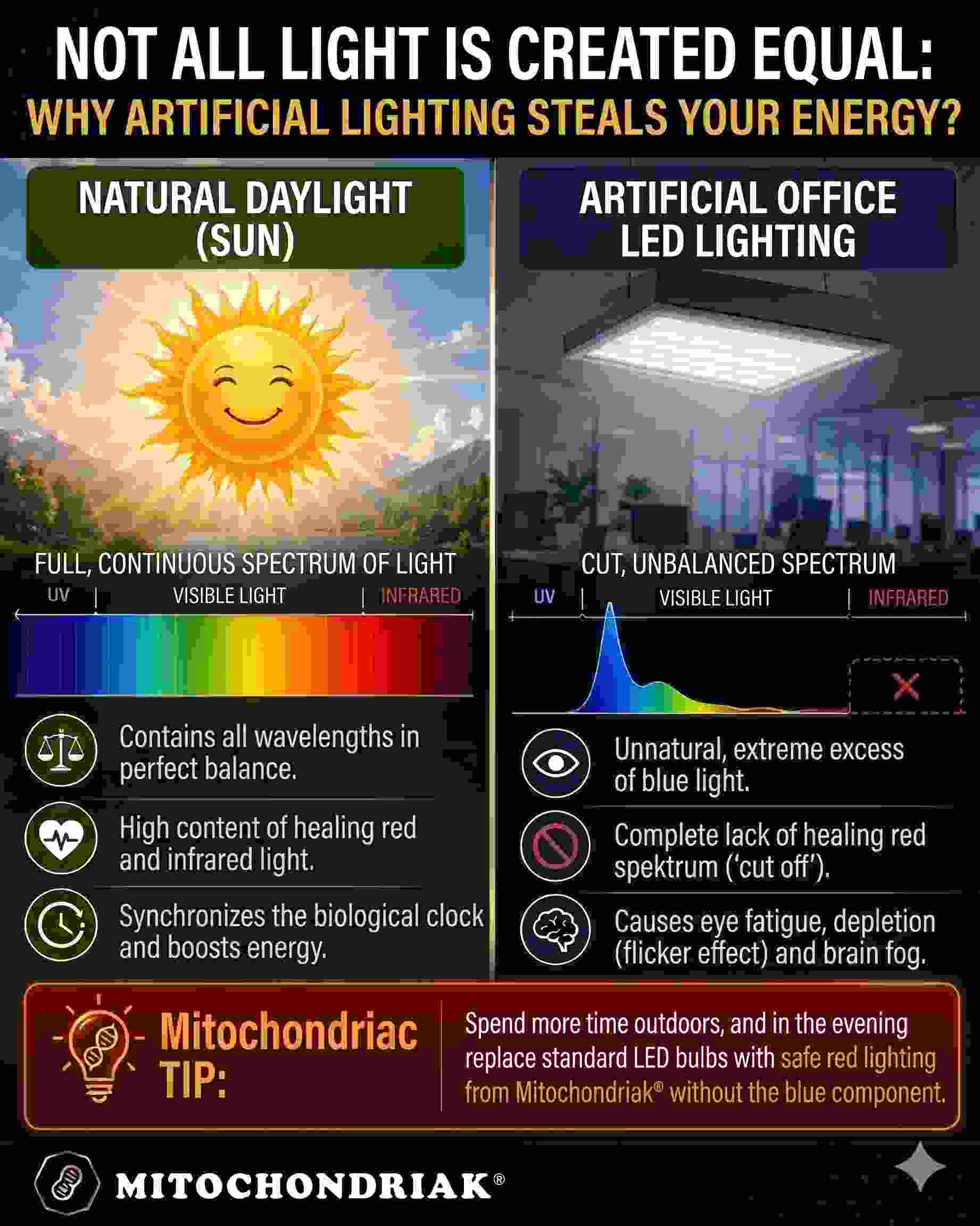
Yes. Infrared radiation is a major part of the output of a tungsten incandescent filament. The filament is a hot thermal emitter, so its radiation does not stop at the edge of human vision. It extends beyond visible red wavelengths into the infrared region, where our eyes no longer create an image but physical energy is still present.
This is one of the most overlooked differences between incandescent and LED lighting.
Modern lighting efficiency is usually optimized around visible photons. If the objective is maximum lumens per watt, producing radiation that humans cannot see looks wasteful. Evolution, however, did not build us under a lumen-per-watt optimization algorithm. Natural sunlight contains visible light alongside large amounts of infrared radiation.
That does not mean an ordinary incandescent bulb should be described as a red light therapy device.
This distinction matters.
Photobiomodulation uses controlled red and near-infrared wavelengths, irradiance and exposure conditions. A household incandescent bulb emits broad thermal radiation, but the dose reaching tissue at normal room distances is neither equivalent to nor standardized like a therapeutic panel.
So the scientifically responsible conclusion is:
- incandescent bulbs really do emit substantial infrared radiation,
- their spectrum is fundamentally different from most white LEDs,
- their infrared output can enrich an indoor light environment,
- but a household bulb is not a substitute for a calibrated photobiomodulation device.
This distinction is particularly useful for Mitochondriaks. More infrared in the environment can be interesting, but dose, wavelength and context still matter.
Are incandescent light bulbs better for circadian rhythm and sleep?
Compared with many cool white LED sources, traditional incandescent bulbs can create a substantially weaker melanopic signal because they emit less short-wavelength blue light. That makes them interesting for late afternoon and evening environments. However, they still produce visible light, so dimness and timing remain essential. Darkness during sleep remains the biological endpoint.
A particularly relevant 2026 Scientific Reports study analyzed 52 household lamps, including LED, compact fluorescent and incandescent sources. Researchers calculated their estimated melatonin suppression based on measured spectral characteristics.
The median values were striking:
- Cool white LED: 12.3% estimated melatonin suppression
- Cool white CFL: 12.1%
- Warm white LED: 3.6%
- Warm white CFL: 2.6%
- Traditional incandescent: 1.5%
The researchers attributed the low value for incandescent lamps to their relatively low irradiance in the short-wavelength range from approximately 380 to 500 nm.[R]
There is another useful result in the same study. Tunable LED lamps became dramatically less melanopically stimulating as their color temperature was reduced, with estimated suppression falling from around 10% at 5700 K to approximately 0.1% at 2100 K.
So the lesson is not "old bulb good, LED bad."
The lesson is spectrum first.
Joshua Gooley and colleagues at Brigham and Women's Hospital and Harvard Medical School had already shown how powerful ordinary room lighting can be. Compared with dim light below 3 lux, room light below 200 lux before bedtime delayed melatonin onset in 99% of participants and shortened melatonin duration by roughly 90 minutes.[R]
Shadab Rahman, Melissa St Hilaire and Steven Lockley later demonstrated that removing more short-wavelength light from evening illumination significantly reduced melatonin suppression compared with conventional fluorescent lighting at the same 50 lux visual illuminance.[R]
This gives us a practical hierarchy for evenings:
- Darkness during sleep remains the goal.
- Before bed, lower the total intensity of artificial light.
- Prefer warmer sources with less short-wavelength output.
- If you want to minimize blue and green light even further, dedicated red evening lighting is a more specific tool.
If you want to understand the mechanism in more depth, read our guide to blue light, melanopsin and sleep.
Do incandescent bulbs make sense during the day and in a home office?
Yes, but as supplementary lighting rather than a replacement for daylight. During the biological day, outdoor light should remain your strongest signal. If you work indoors for hours, however, an incandescent bulb can add warm continuous visible light and infrared radiation to an environment otherwise dominated by screens and LED lighting.
This is where context becomes important.
Blue light during the day is not the enemy. Natural morning and daytime blue light is part of the solar signal that tells your brain it is daytime. Trying to eliminate all blue light from morning to evening would be biologically backwards.
The better strategy is to create contrast:
- Morning: go outside and get natural daylight into your eyes.
- Daytime: work close to a window whenever possible and take regular outdoor light breaks.
- Indoor work: supplement an LED-heavy environment with warmer, broader-spectrum lighting if useful.
- Late afternoon: progressively reduce intensity and short-wavelength artificial light.
- Evening: transition toward dim warm, amber or red illumination.
- Sleep: darkness.
For a complete workday setup, see our home office circadian lighting protocol.
We have also previously covered the more specific question of incandescent bulbs during the day and visual comfort. That article focuses specifically on the eyes. This guide looks at the bigger picture: spectrum, infrared light, LED comparison and circadian biology.
When are incandescent bulbs not the best choice?
Incandescent bulbs are not universally superior to LEDs. Their main disadvantages are energy consumption, heat generation, lower luminous efficacy and shorter service life compared with quality LED lighting. If your goal is illuminating a large room efficiently for many hours, a carefully selected LED can be the more practical solution.
This matters because good biological lighting should never become ideology.
A quality warm LED used at low intensity in the evening may create less melanopic stimulation than a badly chosen bright source of another technology. The 2026 lamp study demonstrates exactly that: spectrum can be tuned.
Incandescent bulbs also become hot. They need a compatible fitting and enough ventilation around the glass. They should not be placed against heat-sensitive materials or used in fixtures that are not rated for their wattage.
And there is another important limitation: incandescent light is not sunlight.
The filament produces a broad continuous spectrum weighted strongly toward red and infrared wavelengths, but sunlight has a much broader and dynamic spectral composition, vastly greater daytime intensity and additional wavelength regions that an ordinary household incandescent bulb does not reproduce.
The hierarchy therefore remains simple:
Sunlight first. Artificial light second.
We use indoor lighting to make an unnatural environment less unnatural, not to convince ourselves that a bulb can replace the sky.
How should you choose biologically appropriate indoor lighting?
Choose lighting according to biological time, not only according to electrical efficiency or visual brightness. During the day, prioritize sunlight and strong natural daytime signals. As evening approaches, reduce both intensity and melanopic stimulation. Instead of looking for one perfect bulb for twenty-four hours, create different light environments for day and night.
For an incandescent supplementary source, the Incandescent daylight Bulb Mitochondriak® Warm Spectrum E27 - Vintage ST64 40W uses a classic tungsten filament and is designed specifically as supplementary indoor lighting.
Its verified parameters include:
- 40 W power
- E27 base
- 1800 to 2000 K very warm light
- 120 lm luminous output
- broad continuous output extending from the visible region into infrared
- dimmable operation
- 2500 hour specified lifetime
Because its luminous output is intentionally modest, it is not designed to flood an entire room with daytime illumination. It works best as a complementary source next to a desk, monitor, reading area or relaxation zone.

The broader principle is more important than any single product.
Your home should not have the same spectral environment at 10 AM and 10 PM.
During the day, seek light. In the evening, progressively remove it. Give your retina, brain and circadian clock the contrast they evolved to expect.
For more on that larger system, continue with our guide to circadian rhythm and how to optimize it.
Bring a warmer spectrum back indoors
If most of your day happens under LEDs and in front of screens, you do not necessarily need another brighter lamp. Sometimes the missing piece is a different spectrum. Mitochondriak® incandescent lighting adds a warm continuous tungsten spectrum with substantial infrared output as a simple supplementary source for your desk, living room or relaxation area.
Frequently asked questions about incandescent light bulbs
Are incandescent light bulbs better than LED bulbs?
Incandescent bulbs are not universally better. LEDs win on energy efficiency and lifespan, while incandescent bulbs offer a smooth continuous spectrum, much more infrared output and typically less short-wavelength blue light. For biologically conscious indoor lighting, the better choice depends on time of day, brightness, spectrum and the task.
Do incandescent light bulbs emit infrared light?
Yes. A tungsten filament is heated until it glows, producing broad thermal radiation across visible wavelengths and strongly into the infrared. That infrared-rich output is one reason incandescent bulbs feel warm. However, a household incandescent bulb should not be confused with a calibrated red or near-infrared photobiomodulation device.
Are incandescent light bulbs better for sleep?
They can be a better evening option than many cool white LEDs because their spectrum contains less short-wavelength light that strongly stimulates melanopsin. But brightness still matters. Dim warm light is more sleep-friendly than bright warm light, and darkness remains the correct biological signal during sleep.
Do incandescent light bulbs contain blue light?
Yes, but usually much less relative blue output than cool white LED lighting. An incandescent filament emits a continuous spectrum rather than a narrow blue pump plus phosphor output. This is why incandescent light looks warmer, especially at lower color temperatures, but it is not completely blue-light free.
Can I use an incandescent light bulb in a home office?
Yes, especially as supplementary light rather than the only daytime light source. Place your desk near a window first, use outdoor daylight as the main biological daytime signal, and use a warm incandescent bulb to add continuous visible and infrared output in an LED-dominated workspace.
Are incandescent bulbs full spectrum?
They produce a broad continuous spectrum, but calling them equivalent to full-spectrum sunlight is misleading. Sunlight contains a much wider and time-varying spectral profile, including ultraviolet and far greater daytime intensity. Incandescent bulbs are better described as continuous-spectrum thermal light sources weighted toward red and infrared wavelengths.
What color temperature is best for evening lighting?
For evening use, lower and warmer color temperatures generally reduce short-wavelength stimulation compared with cool white light. A recent lamp comparison found markedly lower estimated melatonin suppression from traditional incandescent and very warm lighting than from cool white LED sources. Intensity and timing still matter as much as color temperature.
Sources and references
- Cain SW et al. (2020). Evening home lighting adversely impacts the circadian system and sleep. Scientific Reports. Scientific Reports
- Gooley JJ et al. (2011). Exposure to room light before bedtime suppresses melatonin onset and shortens melatonin duration in humans. Journal of Clinical Endocrinology & Metabolism. PubMed PMID 21193540
- Rahman SA, St Hilaire MA, Lockley SW. (2017). The effects of spectral tuning of evening ambient light on melatonin suppression, alertness and sleep. Physiology & Behavior. PubMed PMID 28472667
- Santhi N et al. (2012). The spectral composition of evening light and individual differences in the suppression of melatonin and delay of sleep in humans. Journal of Pineal Research. PubMed PMID 22017511
- Terán E et al. (2026). Home lighting, blue-light filtering, and their effects on melatonin suppression. Analysis of 52 incandescent, LED and compact fluorescent lamps. Scientific Reports. PubMed PMID 41565717
- Foster RG et al. (2020). Circadian Photoentrainment in Mice and Humans. Review of retinal photoreception and melanopsin sensitivity close to 480 nm. PMC7408241