.png)
Circadian rhythm is the biological system that governs your sleep, energy, and mood throughout the entire day. If you work from home, you are missing the daylight exposure of a typical office, and your internal clock can easily fall out of sync. In this article, we will show you how to use the right light to set up a productive day and quality sleep, all without leaving your home.
- Why working from home weakens your circadian rhythm and what the research says
- How morning light boosts productivity, focus, and energy throughout the day
- Why typical LED lighting at home is not a substitute for natural daylight
- A specific light protocol for remote workers from morning to evening
- How red light therapy helps compensate for the lack of sunlight when working from home
- What is the circadian rhythm and why does working from home disrupt it?
- How does morning light affect your work performance?
- Why is artificial light in your home office a problem?
- How to set up a light protocol when working from home?
- What impact does evening light have on sleep quality?
- How can red light therapy help you when working from home?
- Frequently asked questions
What is the circadian rhythm and why does working from home disrupt it?
Circadian rhythm is an internal biological cycle lasting approximately 24 hours that regulates the sleep/wake cycle, hormone production, body temperature, and metabolism. This rhythm is synchronised primarily by light entering the eyes, where specialised photoreceptors (melanopsin-containing retinal ganglion cells) signal to the brain what time of day it is. Without the correct light signal, the entire system falls out of alignment. If you would like to learn more about how the circadian rhythm works and the mechanisms behind it, read our detailed article on how our internal clock works.
When you work in an office, your body receives light signals automatically. You step outside in the morning, commute to work, and sit near large windows. These signals tell your brain: "It is daytime, be active." When working from home, this mechanism often fails. You wake up, walk a few metres to your desk, and spend the entire day in a room where light intensity often reaches only 100 to 300 lux, while outdoor daylight delivers 2,000 to 10,000 lux even on an overcast day.
A study published in 2022 examined the differences in light exposure between people working from home and those commuting to the office. The results showed that remote workers were exposed to significantly lower daylight intensity, which was associated with poorer sleep quality and greater daytime fatigue. [R]
Working from home, then, does not disrupt the circadian rhythm on its own. The problem lies in the environment in which it takes place: insufficient bright daylight in the morning, excessive blue light from screens in the evening, and a lack of outdoor movement. If you do not address these factors consciously, your mitochondria miss the correct light signals for energy production, and your body cannot tell when it is time for performance and when it is time for rest.
How does morning light affect your work performance?
Morning light is the most powerful synchroniser of the circadian rhythm. Exposure to bright light within the first 30 to 60 minutes after waking triggers a drop in melatonin, raises cortisol levels, and sets the entire hormonal system into active mode. Without this signal, the body "wakes up" slowly and performance declines.
Research that investigated the effect of daylight in residential settings on circadian synchronisation demonstrated that increasing light intensity in living spaces improved circadian phase, sleep quality, vitality, and mental health among participants. Even simply increasing light intensity during the morning hours proved effective. [R]
If you work from home, you often do not receive morning light at a sufficient intensity. The consequences are felt throughout the entire day:
- Slower energy ramp-up in the morning, because melatonin declines gradually rather than rapidly
- Reduced concentration during the late morning hours, when it should be at its peak
- Increased cravings for sugar and food as compensation for missing energy
- A shift in circadian phase, leading to later bedtimes and more difficult wake-ups
The solution is simple: within the first hour after waking, spend at least 10 to 20 minutes outdoors. Even a cloudy morning provides several times more lux than any interior. If the weather is not inviting, position your desk by an east- or south-facing window and maximise your contact with natural light.
Why is artificial light in your home office a problem?
Standard LED lighting found in homes has a significantly different spectrum compared to sunlight. Most LED bulbs produce a narrow peak of blue light around 450 nm and lack the red and infrared component that the sun provides in abundance. For the circadian rhythm, this means the brain still receives a strong "daytime" signal from the blue spectrum, but the body does not receive the compensating red and infrared light that supports regeneration and mitochondrial function.
According to a review on the effects of light on circadian rhythms, sleep, and mood, light rich in short-wavelength (blue) spectrum during the day increases alertness, but evening exposure to the same light suppresses melatonin production and shifts the circadian phase. [R]
In a home office, the typical scenario looks like this: you sit at a monitor all day, which emits blue light. After work, you switch on the television or scroll through your phone. Your eyes are flooded with blue light from morning to night, while natural, broad-spectrum light was barely present during the day. The body loses its ability to distinguish day from night.
Another issue is flicker, which cheap LED bulbs produce. Although the eye does not consciously perceive it, the brain registers it and responds with increased stress and fatigue. After a full day under such lights, you feel exhausted even though you "only" sat and worked.
What to do about your home office lighting?
The first step is to maximise natural daylight. Work near a window, open the curtains, and go outside during your lunch break. The second change involves your light sources. Instead of standard cool LED bulbs, consider supplementing your lighting with a bulb that delivers a continuous spectrum with a high proportion of infrared radiation. This is precisely the function of the Incandescent daylight Bulb Mitochondriak® Warm Spectrum E27, a classic tungsten-filament bulb that produces warm amber light at a colour temperature of approximately 1,800 to 2,000 K. Thanks to its continuous spectrum, including the infrared component, it is an ideal complement to your main lighting, particularly when working at a computer.
How to set up a light protocol when working from home?
A proper light protocol for remote work has three phases: morning, daytime, and evening. Each phase requires a different type of light so that your circadian rhythm receives the right signals at the right time. Here is a step-by-step guide for setting up your light environment.
Morning phase (6:00 to 9:00): activation
Immediately after waking, you need bright, high-intensity light. Ideally, step outside for 10 to 20 minutes, because even an overcast sky delivers several thousand lux. If that is not possible, open your blinds fully and sit near a window. Morning light suppresses residual melatonin production, triggers the cortisol peak, and sets your circadian system to a 24-hour cycle.
Researchers have confirmed that morning exposure to bright light is the most effective way to keep circadian clocks synchronised, especially for people working from home. [R]
Daytime phase (9:00 to 17:00): productivity
During the working part of the day, you should have sufficient light with the broadest possible spectrum. Work near a window, or supplement your lighting with a full-spectrum bulb such as the Incandescent daylight Bulb Mitochondriak® Warm Spectrum E27, which simply screws into any desk lamp with an E27 fitting and can be placed next to your monitor. Every 1 to 2 hours, take a light break: step onto your balcony or into your garden for at least 5 minutes.
If your workspace does not have adequate access to daylight, consider placing a therapeutic panel on your desk. Mitochondriak® Office is designed precisely for these situations. Thanks to its compact dimensions (32 x 22 cm), it fits on a desk or beside a monitor and delivers red and near-infrared light with wavelengths of 630, 670, 760, 810, 830, 850, and 940 nm, which your body simply does not receive during a day spent indoors.
Evening phase (after 18:00): preparing for sleep
Two to three hours before bedtime, you should minimise exposure to blue and green light. A 2014 study demonstrated that the light intensity people typically generate at home in the evening can shift the circadian phase and delay the onset of sleep. [R]
Practical steps:
- Replace your evening bulbs with red LED bulbs free of blue and green light
- Wear Stylish Blue light blocking glasses Mitochondriak® if you are still working at a screen
- Lower your screen brightness and enable night mode (but note that night mode alone does not block enough blue light)
- If you need to use lighting, opt for candles, firelight, or red bulbs
The Evening red bulb Mitochondriak® E27 is the ideal solution for the evening hours. The bulb emits no blue or green light, is flicker-free, and produces a pleasant warm red glow that does not suppress melatonin production.
What impact does evening light have on sleep quality?
Evening light is the most common reason for poor sleep among remote workers. When you stay in the same environment after finishing work, your brain does not receive a signal that the working day is over. Light from your monitor, LED ceiling lights, and phone continues suppressing melatonin, even when you think you are "just relaxing."
Research confirms that daytime sunlight improves sleep not only through direct synchronisation of circadian rhythms, but also by supporting vitamin D production, which plays a role in regulating sleep mechanisms. [R] People who do not get enough sun during the day (typically those on remote work) therefore face an increased risk of sleep problems.
The key to better sleep when working from home is the contrast between daytime and evening light. During the day, you need as much bright, broad-spectrum light as possible. In the evening, you need as little light as possible, and if you do use lighting, only the red spectrum, which does not suppress melatonin.
In practice, this means:
- Morning and daytime: maximise exposure to daylight (window, balcony, walk)
- Late afternoon (16:00 to 18:00): gradually reduce the intensity of your lighting
- Evening (after 18:00 to 19:00): switch to red lighting, put on blue light blocking glasses
- Before bed (1 to 2 hours): minimise all light, ideally using only candles or red night lighting
This contrast-based protocol mimics the natural light cycle in which the human body evolved over hundreds of thousands of years: bright sun during the day, fire and darkness in the evening. Your mitochondria and circadian system are evolutionarily calibrated for precisely this pattern.
How can red light therapy help you when working from home?
Red and near-infrared light therapy (photobiomodulation) is an effective way to compensate for the lack of natural light that remote workers face daily. Red light in the range of 630 to 670 nm and near-infrared light from 810 to 940 nm penetrates the skin and stimulates mitochondria directly within cells, thereby supporting ATP (cellular energy) production.
For people working from home, red light therapy offers several specific benefits:
- Compensating for the missing infrared spectrum: the sun naturally emits a large amount of infrared light that penetrates deep into tissues. Indoors, this spectrum is minimal because windows block most infrared radiation
- Supporting energy and focus: stimulating mitochondria increases ATP production, which translates into higher mental performance
- Eye recovery: after a full day at a screen, red light helps release tension in the eye muscles
- Supporting the circadian rhythm: red and near-infrared light does not suppress melatonin, so you can safely use it even during the evening hours
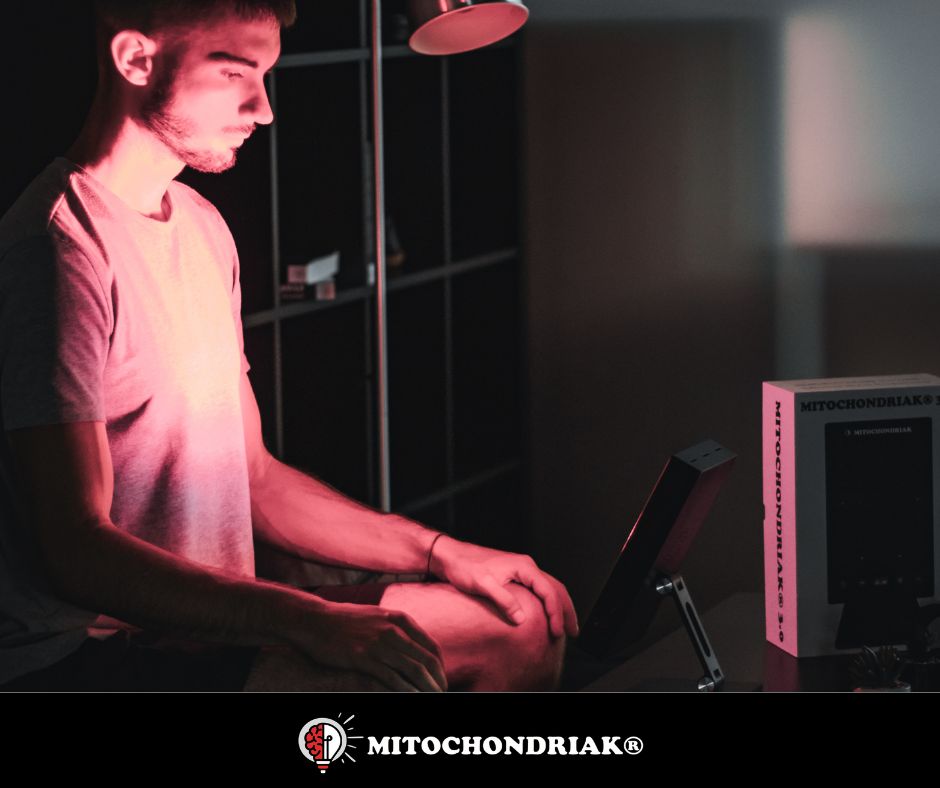
Mitochondriak® Office with a touch display is designed precisely for this purpose. Its compact size allows placement directly on your desk. The panel features 7 wavelengths (630, 670, 760, 810, 830, 850, and 940 nm), covering both the red and near-infrared spectrum validated by research. You can use it during work to supplement the missing light spectrum, or after work as a regenerative therapy session.
A complete light protocol for working from home
Based on scientific findings and practical experience, we have put together a comprehensive protocol that will help you set up your light environment so that your circadian rhythm functions optimally, even without an office.
Step 1: Morning reset (immediately after waking)
Step outside for 10 to 20 minutes. Do not wear sunglasses; let the light enter your eyes naturally. If it is overcast, go outside anyway. An overcast sky still delivers 2,000 to 5,000 lux, which is many times more than any interior. This exposure triggers the melatonin drop and sets your circadian clock.
Step 2: Work by the window during the day
Place your desk near a window. If your window does not face east or south, supplement your lighting with an Incandescent daylight Bulb Mitochondriak® Warm Spectrum E27 in a desk lamp. Every 60 to 90 minutes, take a 5-minute break outside or on a balcony.
Step 3: Midday light break
Eat lunch outside or by an open window. 20 to 30 minutes outdoors around midday significantly increases your total daily light exposure and supports vitamin D production (during summer months).
Step 4: Afternoon therapy (optional)
If you have been indoors all day, use red light therapy to supplement the missing infrared spectrum. Mitochondriak® Office on your desk or beside your monitor will deliver the light your body misses because windows block it.
Step 5: Evening transition (after 18:00)
Switch your home lighting to red bulbs. Put on your blue light blocking glasses if you are still using a screen. Avoid bright LED lighting in the bathroom and kitchen, where people tend to keep lights at full brightness even before bed.
Step 6: Sleep in darkness
Your bedroom should be completely dark. No LED indicator lights, no street light coming through curtains. If you wake during the night and need light (for example, to use the bathroom), use the Red night light Mitochondriak® with motion sensor, which does not activate the circadian system.
Light setup for a healthy home office
If you work from home and want to set up your light environment according to the circadian rhythm, we recommend the following combination of Mitochondriak® products:
- Mitochondriak® Office for your desk, to supplement red and near-infrared spectrum during the day
- Incandescent daylight Bulb Mitochondriak® Warm Spectrum E27 for a desk lamp, delivering a continuous spectrum with an infrared component while you work
- Evening red bulb Mitochondriak® E27 for your bedroom and living room, providing evening lighting without blue light
- Stylish Blue light blocking glasses Mitochondriak® for evening screen use
Frequently asked questions
Is night mode on a monitor enough to protect the circadian rhythm?
No, night mode (Night Shift, f.lux) significantly reduces but does not completely eliminate blue light. Moreover, it does not block green light, which also suppresses melatonin. For full circadian protection in the evening, we recommend combining night mode with blue light blocking glasses that filter both wavelength ranges.
How many lux do I need in the morning to synchronise my circadian rhythm?
Research suggests that a minimum of 1,000 to 2,500 lux for 20 to 30 minutes in the morning significantly helps synchronise circadian clocks. Outdoor light, even on a cloudy day, meets this threshold. Indoor lighting typically reaches only 100 to 500 lux, which is not enough.
Can I use an infrared panel while working at my computer?
Yes, the Mitochondriak® Office is designed specifically for use at a work desk. Red and near-infrared light does not suppress melatonin and is not distracting. You can keep the panel switched on at your desk beside the monitor, supplementing the missing light spectrum throughout your working day.
How long before bed should I stop using white LED light?
Ideally 2 to 3 hours before your planned bedtime. Studies show that even normal domestic lighting intensity in the final hours before bed can shift circadian phase and reduce sleep quality. Switch to red bulbs or candles instead.
Is working from home worse for the circadian rhythm than an office?
Not automatically, but often yes. It depends on how much daylight you get. If you work at home by a window, go outside in the morning, and limit blue light in the evening, you can actually maintain a better circadian rhythm than under fluorescent lights in an office. The problem arises when you spend the entire day in a dim interior without any contact with natural light.
Does red light help with seasonal depression caused by lack of light?
Red and near-infrared light therapy is not a replacement for full-spectrum light therapy used in seasonal affective disorder. However, it does help compensate for the lack of infrared spectrum, supports mitochondrial function, and boosts cellular energy production. For a comprehensive approach, combine morning daylight exposure with red light therapy.
What is the benefit of an incandescent bulb when working from home?
An incandescent bulb produces a continuous light spectrum with a high proportion of infrared radiation, which is precisely what standard LED sources do not offer. When placed in a desk lamp, it supplements the missing warm and infrared spectrum, reduces eye fatigue, and creates a more comfortable visual environment. It is suitable as a supplementary daytime light source, not as a primary one.
Sources and references
- Aries MBC et al. (2022). The relationship of light exposure to sleep outcomes among home workers. Building and Environment. [R]
- Nagare R et al. (2021). Access to Daylight at Home Improves Circadian Alignment, Sleep, and Mental Health. International Journal of Environmental Research and Public Health. [R]
- Yuan RK et al. (2020). Tips for circadian sleep health while working from home. Southwest Journal of Pulmonary, Critical Care & Sleep. [R]
- Blume C et al. (2019). Effects of light on human circadian rhythms, sleep and mood. Somnologie. [R]
- Burgess HJ, Molina TA (2014). Home Lighting Before Usual Bedtime Impacts Circadian Timing. Photochemistry and Photobiology. [R]
- de Menezes-Júnior LAA et al. (2025). The role of sunlight in sleep regulation. Sleep Medicine Reviews. [R]