.png)
Biohacking is the practice of using targeted, measurable changes in your environment and habits to improve how your body works. This guide gives you a plain definition, a beginner-friendly path, and an honest split between evidence-backed and speculative hacks, all built around one hub your mitochondria that quietly decides whether any of it works.
- Biohacking is a systematic, data-driven approach to self-improvement, not a random collection of gadgets.
- Beginners should start with free, foundational hacks such as morning light, sleep timing, and grounding before touching supplements or devices.
- The strongest evidence sits with circadian light exposure, sleep hygiene, and photobiomodulation, while many advanced hacks remain speculative.
- Your mitochondria convert every input into usable energy, so they ultimately decide whether a biohack helps or does nothing.
- You will get a tiered path from beginner to advanced, plus honest warnings about who should be careful.
- What is biohacking and why does it matter?
- How does biohacking work according to research?
- What benefits and limits can you realistically expect?
- How do you use biohacking safely in practice?
- What should you watch out for and who should be careful?
- Summary: what should you remember?
- Frequently asked questions

What is biohacking and why does it matter?
Biohacking is the deliberate use of small, measurable interventions in diet, environment, light, movement, and technology to influence your own biology. In plain terms, it means treating your body like a system you can observe, adjust, and improve, rather than a fixed machine you simply hope keeps running. It matters because most modern health problems are lifestyle-driven, and small changes often compound into large results.
The word carries baggage. For some it means expensive gadgets and cold plunges; for others it means questionable supplements and biohacking gurus. The reality is calmer. At its core, biohacking for beginners is about identifying the biggest, cheapest levers first, testing them on yourself, and keeping what actually works. It is less about hacking and more about paying attention.
What separates real biohacking from noise is measurement. If you change something and never track sleep, energy, mood, or a simple marker, you are guessing. That is why we like a boring definition: biohacking is self-experimentation with feedback. You change one input, you observe the output, and you decide whether to continue.
This framing also protects you from marketing. When a product promises to "optimize" everything, ask what it actually changes at the level of your cells. Almost every credible biohack ends up affecting the same place: the energy factories inside your cells. That is where the story of biohacking really begins, and it is why we will keep returning to your mitochondria throughout this guide.
How does biohacking work according to research?
According to research, the most reliable biohacks work by supporting your body's natural regulatory systems, especially your circadian rhythm and your mitochondria. Instead of forcing an outcome, they restore inputs your biology already expects, such as bright morning light, dark evenings, movement, and contact with the earth. The effect is measurable in sleep, mood, and metabolic markers across large human studies.
Start with light, because it is the master signal. A cross-sectional and longitudinal analysis of over 400,000 UK Biobank participants found that more time spent in outdoor daylight was associated with better mood, easier waking, and healthier circadian-related outcomes (Burns, 2021). This is the scientific backbone behind a simple, free habit: get outside early. If you want the full mechanism, see our explainer on how the circadian rhythm actually works.
The next layer is light hygiene at the cellular level. Red and near-infrared wavelengths are absorbed by an enzyme called cytochrome c oxidase (CCO) inside your mitochondria, which can influence how efficiently cells produce energy. A tripled-blinded randomized clinical trial in patients with fibromyalgia reported measurable changes in circadian blood pressure variation, pain pressure threshold, and tissue elasticity after whole-body photobiomodulation (Navarro-Ledesma, 2022). For a deeper mechanistic view, read how red and near-infrared light works at a cellular level.
Even more striking, a controlled human study showed that light stimulation of mitochondria reduced blood glucose levels after a meal, directly linking a light-based biohack to a hard metabolic marker (Powner and Jeffery, 2024). This is exactly the kind of evidence that separates a real intervention from a trend: a clear input, a measurable output, and a plausible mechanism.
Grounding, or earthing, is a second research thread worth understanding honestly. Early work proposed that direct contact with the earth's surface electrons could influence inflammation and sleep (Chevalier, 2012). A study of grounding during sleep tracked cortisol rhythm alongside subjective reports of sleep, pain, and stress (Ghaly, 2004), and later randomized and pilot trials examined effects on pain, quality of life, and sleep in specific populations (Chevalier, 2019; Lin, 2022). The evidence base is smaller and earlier-stage than the light literature, so we treat grounding as promising rather than proven, and we will be explicit about that distinction later.
The common thread across all of this research is not a gadget. It is your mitochondria. Whether the input is daylight, red light, movement, or contact with the ground, the downstream question is always the same: did your cells produce energy more efficiently and did your internal clock get a clearer signal? That is why, as the next sections will show, your mitochondria ultimately decide the result.
What benefits and limits can you realistically expect?
Realistically, you can expect better sleep, steadier daytime energy, improved mood, and small but measurable metabolic gains, mostly from the foundational, evidence-backed hacks. What you should not expect is a shortcut around a bad diet, chronic stress, or no sleep. Biohacking amplifies a decent baseline; it rarely rescues a broken one, and the biggest wins are usually the cheapest.
Let us be honest about the tiers, because this is where most beginners waste money. The evidence-backed foundation costs little and delivers the most. Morning outdoor light is associated with better mood and circadian outcomes across more than 400,000 people (Burns, 2021), and consistent sleep timing improves nearly every marker you care about. These are not glamorous, but they work, which is exactly why we tell every beginner to master them before buying anything.
The intermediate layer is where devices earn their place, and where the science is strongest for our own category. Photobiomodulation with red and near-infrared light has human trial data behind it: a tripled-blinded randomized clinical trial in fibromyalgia patients found measurable changes in pain pressure threshold and tissue elasticity (Navarro-Ledesma, 2022), and a controlled study showed light stimulation of mitochondria lowering post-meal blood glucose (Powner and Jeffery, 2024). If you want to understand what actually happens inside the cell, our guide to red and near-infrared light at the cellular level covers the CCO mechanism in detail.
The advanced and speculative layer deserves caution. Grounding sits here as promising but early-stage: sleep and cortisol work is intriguing (Ghaly, 2004; Chevalier, 2012) and some randomized and pilot trials report benefits for pain and sleep (Chevalier, 2019; Lin, 2022), yet the studies are small. Peptides, nootropic stacks, and extreme fasting protocols often have far thinner human evidence than the marketing suggests. The realistic limit is simple: the further you climb the pyramid, the more you pay and the weaker the proof becomes.
How do you use biohacking safely in practice?
In practice, you use biohacking safely by changing one variable at a time, tracking a simple output, and building from free foundational hacks upward. Start with light and sleep, add movement and grounding, and only then invest in devices. This order protects your wallet, keeps your data clean, and ensures that when something works, you actually know why it worked.
Here is a practical, tiered path any beginner can follow without special equipment:
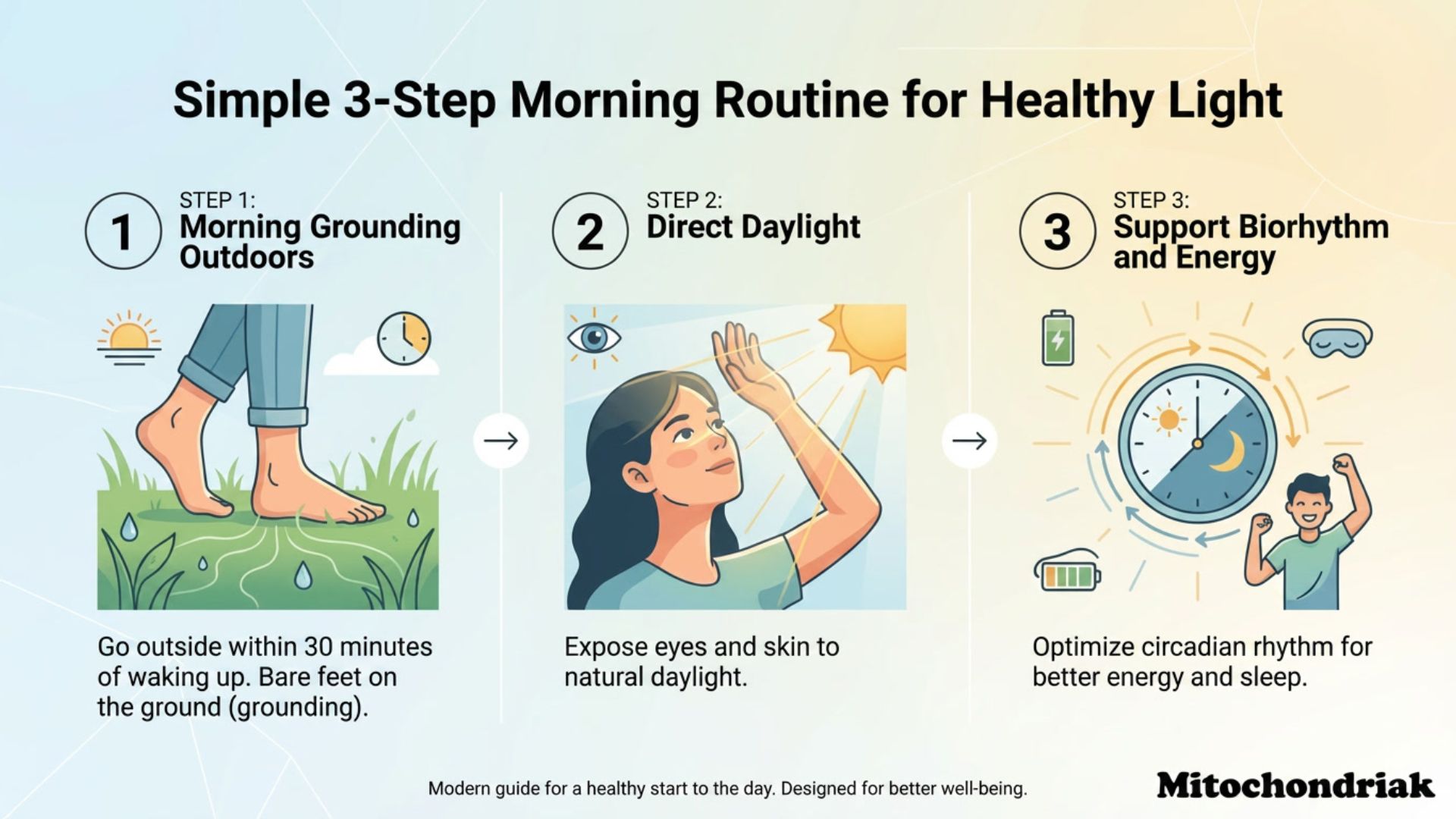
- Week 1 to 2, light first. Get 10 to 30 minutes of outdoor daylight within an hour of waking. This anchors your circadian rhythm and is the single highest-return habit in this entire guide. Our deep dive on how to optimize your circadian rhythm explains the timing details.
- Week 2 to 3, protect the evening. Reduce bright and blue-heavy light after sunset so your melatonin can rise on schedule. Screen habits matter here, as we explain in how screens disrupt your circadian rhythm.
- Week 3 to 4, move and ground. Add daily walking and, if it appeals to you, barefoot contact with grass or soil. Grounding is early-stage science (Chevalier, 2012), so treat it as a low-cost experiment, not a cure.
- Week 4 and beyond, add targeted tools. Only now consider photobiomodulation devices, once your foundation is solid and you have a baseline to compare against.
When you reach the tool stage, choose deliberately rather than impulsively. If you are weighing a full-body device, our comparison of how to choose a red light panel as a beginner versus a biohacker walks through the practical trade-offs. For classic mains-powered panels such as the Mitochondriak® Maxi Upgraded, always keep a therapeutic distance of at least 30 cm, and typically 30 to 60 cm, both for even coverage and to reduce EMF exposure at close range. Never treat closer than 30 cm with a classic panel.
Safety in biohacking is mostly about restraint. Do not stack five new interventions in one week, do not chase extreme protocols you read about online, and do not ignore how you actually feel in favour of a wearable's number. The whole point is a calmer, more energetic body, not a new source of anxiety.
Ready to build a light-first biohacking routine?
The strongest, best-evidenced biohacks all revolve around light and your mitochondria. If you want to bring that signal indoors, our curated tools make it simple to start with the foundation and add targeted red-light support when you are ready.
What should you watch out for and who should be careful?
You should watch out for overpriced gadgets with no human trials, aggressive protocols that ignore recovery, and the temptation to change everything at once. People who are pregnant, managing a chronic illness, taking medication that affects light sensitivity, or dealing with an eye condition should be especially careful and speak to a qualified clinician before starting light-based or fasting-based hacks.
The most common beginner mistake is skipping the free foundation to buy the expensive tool. A panel cannot compensate for chronic sleep deprivation, and a supplement cannot replace daylight. If your mitochondria are already strained by poor sleep, sugar overload, and no morning light, layering advanced hacks on top rarely produces the promised transformation. Fix the base first.
Be equally sceptical of certainty. Any source claiming a single hack will "cure" a condition is selling something. The honest position, and the one supported by the research above, is that most benefits are modest, cumulative, and highly individual. Grounding, in particular, is promising but under-studied, and speculative peptide or hormone protocols can carry real risks without proper supervision. When in doubt, choose the intervention with the strongest human evidence and the lowest cost, which almost always points you straight back to light, sleep, and movement.
Summary: what should you remember?
Biohacking is not a shopping list of gadgets. It is a disciplined, measurable approach to giving your body the inputs it already expects, then observing what changes. The evidence is clearest for the cheapest interventions: morning daylight, protected evenings, consistent sleep, and movement. Devices like red-light panels have genuine human-trial support, but they belong on top of a solid foundation, not instead of one. Grounding and most advanced protocols remain promising rather than proven, so treat them as experiments and keep your expectations honest.
The reason we keep returning to one theme is simple. Every credible biohack, from daylight to photobiomodulation, ultimately routes through the same place: the energy factories inside your cells. Your mitochondria take each input and decide whether it becomes usable energy and a clearer circadian signal. That is why the same protocol helps one person and does nothing for another, and it is why supporting mitochondrial health is the throughline of everything we do. Start small, change one thing, measure it, and let your own results, not the marketing, tell you what deserves a permanent place in your routine.
Frequently asked questions
What is biohacking and where should a beginner actually start?
Biohacking is self-experimentation with feedback: you change one input, measure the output, and keep what works. A beginner should start with the free foundation before any gadget. Get 10 to 30 minutes of outdoor light within an hour of waking, keep consistent sleep and wake times, protect the evening from bright blue light, and add daily movement. Only after these habits are stable does it make sense to invest in devices or supplements.
Which biohacks have real evidence behind them?
The strongest human evidence sits with light and sleep. Outdoor daylight is linked to better mood and circadian outcomes in over 400,000 people (Burns, 2021), and red or near-infrared photobiomodulation has randomized trial support for pain and metabolic markers (Navarro-Ledesma, 2022; Powner and Jeffery, 2024). Consistent sleep timing underpins all of it. Grounding is promising but early-stage, and many advanced peptide or fasting protocols have far thinner human data than the marketing implies.
Why do mitochondria decide whether a biohack works for you?
Your mitochondria convert every input, whether daylight, red light, food, or movement, into usable cellular energy called ATP. If they function well, a biohack can translate into more energy and clearer signalling; if they are already strained, the same intervention often does little. Because mitochondrial health varies between people and days, the identical protocol can transform one person and barely register for another. Supporting mitochondrial function is therefore the common denominator of successful biohacking.
Do I need expensive equipment to biohack effectively?
No. The highest-return biohacks are essentially free: morning sunlight, dark evenings, steady sleep, walking, and time outdoors. These target your circadian rhythm and mitochondria directly, which is where most measurable benefits come from. Equipment such as a red-light panel can add value later, but it works best on top of a solid foundation. Buying a device while skipping sleep and daylight is the classic beginner mistake that wastes money and blurs your results.
How is biohacking different from just having healthy habits?
The difference is measurement and iteration. Healthy habits are general advice you follow; biohacking treats those habits as experiments you track. You change one variable, observe sleep, energy, mood, or a simple marker, and decide whether to keep it. This feedback loop turns vague wellness into personalised data. In practice most biohacks are healthy habits done deliberately, which is why the boring foundations of light, sleep, and movement outperform exotic interventions for almost everyone.
Is grounding or earthing scientifically proven?
Grounding is promising but not firmly proven. Early work suggested contact with the earth's surface electrons might influence inflammation and sleep (Chevalier, 2012), and small studies tracked cortisol, sleep, and pain with mixed but encouraging results (Ghaly, 2004; Chevalier, 2019; Lin, 2022). However, the trials are small and early-stage compared with the light literature. Treat grounding as a low-cost experiment worth trying, not a guaranteed therapy, and keep your expectations grounded in the modest evidence available.
Sources and references
- Ghaly. 2004. The biologic effects of grounding the human body during sleep as measured by cortisol levels and subjective reporting of sleep, pain, and stress pubmed.ncbi.nlm.nih.gov
- Chevalier. 2019. The effects of grounding on bodyworkers' pain and overall quality of life: a randomized controlled trial pubmed.ncbi.nlm.nih.gov
- Burns. 2021. Time spent in outdoor light is associated with mood, sleep, and circadian rhythm-related outcomes: A cross-sectional and longitudinal study in over 400,000 UK Biobank participants pubmed.ncbi.nlm.nih.gov
- Lin. 2022. Grounding the body improves sleep quality in patients with mild Alzheimer's disease: a pilot study pubmed.ncbi.nlm.nih.gov
- Navarro-Ledesma. 2022. Changes in Circadian Variations in Blood Pressure, Pain Pressure Threshold and the Elasticity of Tissue after a Whole-Body Photobiomodulation Treatment in Patients with Fibromyalgia: A Tripled-Blinded Randomized Clinical Trial pubmed.ncbi.nlm.nih.gov
- Powner & Jeffery. 2024. Light stimulation of mitochondria reduces blood glucose levels pubmed.ncbi.nlm.nih.gov
- Gaétan Chevalier. 2012. Earthing: Health Implications of Reconnecting the Human Body to the Earth's Surface Electrons pmc.ncbi.nlm.nih.gov
- Chevalier. 2013. Earthing the human body reduces blood viscosity, a major factor in cardiovascular disease pmc.ncbi.nlm.nih.gov