.png)
Biohacking
Biohacking is the intentional and conscious optimization of your own biology through changes in lifestyle, environment, diet, and technology. If you have ever changed the lighting in your home, started walking barefoot, tried red light therapy, or adjusted your diet according to the season, you have already been biohacking. At Mitochondriak®, however, we take it a step further and talk about mitohacking, which is biohacking focused on what matters most inside the cell: mitochondria.
- What biohacking is and where the term comes from
- What categories of biohacking exist and which ones are safe
- Why at Mitochondriak® we talk about mitohacking, not just biohacking
- What specific mitohacking tools we use (light, grounding, sleep, nutrition)
- What science says about the effectiveness of biohacking approaches
- How to start biohacking without unnecessary investment
- What is biohacking and where does it come from?
- What categories of biohacking exist?
- Why do we talk about mitohacking, not just biohacking?
- What are the pillars of mitohacking?
- How does light affect your biology?
- What does science say about biohacking?
- How to start biohacking simply and for free?
- What biohacking is not?
What is biohacking and where does it come from?
Biohacking is an approach in which a person consciously intervenes in their own biology with the goal of improving health, performance, energy, sleep, or overall quality of life. The term was coined by combining the words biology and hacking (in the sense of a creative intervention in a system). It first gained wider use in the DIY biology (do-it-yourself biology) community in the early 2010s.
Gangadharbatla (2020) described biohacking in his exploratory study as an approach based on the idea that what we put into the body (food, light, movement, information) has a direct impact on what we get out of it, namely our "outputs" in the form of energy, mood, cognitive abilities, and health (Gangadharbatla, 2020).
These used to be ordinary mornings for our grandparents: wake up with the sun, walk barefoot in the garden, eat seasonally and locally, go to sleep after sunset. Today we call it "biohacking." In reality, it has always been about one thing: creating conditions in which the body functions the way evolution designed it to.
What categories of biohacking exist?
Biohacking is not a single homogeneous approach. It encompasses a broad spectrum of practices, from simple lifestyle changes to advanced technological interventions. It can be divided into several main categories:
Lifestyle biohacking
The most accessible and most effective form. It includes optimizing sleep, light hygiene, diet, movement, grounding, and exposure to cold or heat. It requires no special equipment. All it takes is understanding how your body responds to its environment and then adjusting that environment. This is where most of what we do at Mitochondriak® falls.
Nutritional biohacking
Targeted dietary adjustments based on an understanding of biochemical processes. This includes seasonal eating, working with the deuterium content of foods, time-restricted eating (intermittent fasting), eliminating industrially processed foods, and supporting mitochondrial function through the right fats, minerals, and trace elements.
Technological biohacking
Using devices and technologies to support biology. This includes infrared panels for photobiomodulation, blue light blocking glasses, grounding aids, measurement devices (HRV monitors, glucose sensors, Oura Ring), and similar tools. These technologies are not a replacement for the basics (light, sleep, movement) but a complement to them.
DIY biology and grinder hacking
More advanced and sometimes controversial forms, such as chip implantation, genetic experiments, or home laboratory work. These forms are not part of what we promote at Mitochondriak®. We mention them only for completeness, so the difference between safe, evidence-based biohacking and risky practices is clear.
Why do we talk about mitohacking, not just biohacking?
Conventional biohacking often focuses on symptoms: better sleep, more energy, less stress. Mitohacking goes deeper. It asks: why do I sleep poorly? Why do I lack energy? And the answer almost always leads to mitochondria.
Mitohacking is biohacking focused on optimizing mitochondrial function. Mitochondria are organelles in every cell that produce ATP (energy), metabolic water, heat, and signaling molecules. When mitochondria work properly, the body has energy, recovers well, sleeps soundly, and resists disease. When they malfunction, problems begin.
Jaroslav Lachky, founder of Mitochondriak®, summed it up simply: "Biohacking without understanding mitochondria is like fixing a car without looking under the hood."
Mitohacking focuses on three fundamental inputs that mitochondria need for optimal function:
- The right light at the right time (morning sunlight, red and NIR light, minimizing blue light in the evening)
- The right water (metabolic water from the electron transport chain, low deuterium)
- The right environment (grounding, temperature, seasonality, minimal electromagnetic pollution)
What are the pillars of mitohacking?
At Mitochondriak®, we distinguish several pillars on which effective mitohacking stands. Each of them directly influences the function of mitochondria and the electron transport chain:
Light hygiene
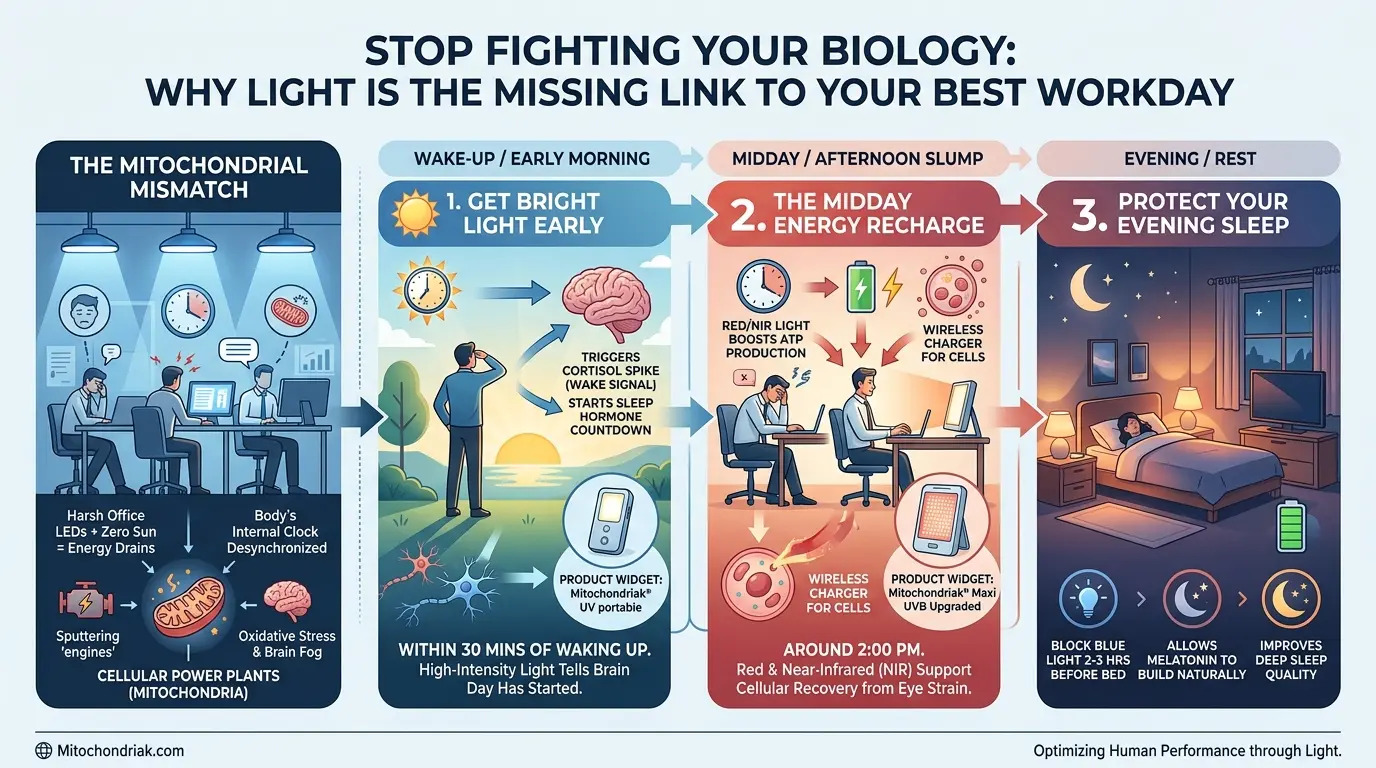
Light is the strongest environmental signal for the circadian rhythm and mitochondrial function. Morning sunlight (rich in red and infrared wavelengths) sets the biological clock via the suprachiasmatic nucleus and stimulates cytochrome c oxidase in mitochondria. Evening blue light from screens disrupts this process and inhibits the production of melatonin.
Red and infrared light therapy
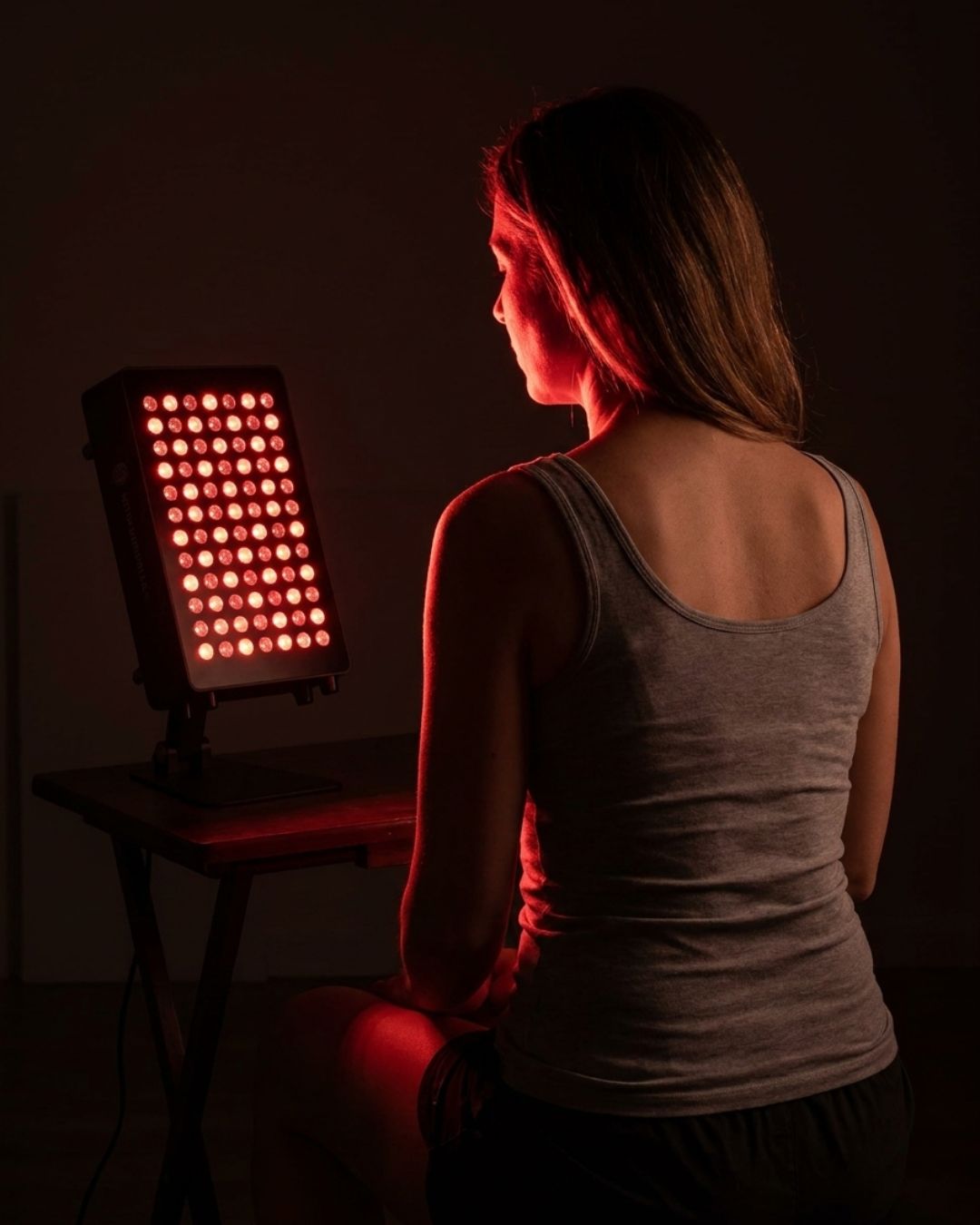
Photobiomodulation is the targeted application of red (630 to 660 nm) and near-infrared (830 to 850 nm) light, which directly stimulates complex IV of the electron transport chain. Michael Hamblin from Harvard Medical School described in his review study (2018) how red light increases ATP production, reduces oxidative stress, and triggers an adaptive cellular response (Hamblin, 2018).
Grounding (earthing)
Direct conductive contact of the body with the Earth's surface supplies free electrons that act as natural antioxidants. Grounding reduces inflammation, normalizes cortisol, and supports the parasympathetic nervous system.
Seasonal and circadian eating
Eating what grows in the given season and geographic zone. Minimizing industrially processed foods, sugar, and foods with high deuterium content. Supporting the body with fats, collagen, organ meats, and seasonal vegetables.
Quality sleep in darkness
Nighttime melatonin concentrates specifically in mitochondria, where it protects the electron transport chain from oxidative damage. Sleeping in complete darkness, without blue and green light, is one of the most effective biohacks of all.
Movement and exposure to temperature changes
Regular movement in fresh air, walking barefoot, cold showers, or cold exposure. These stimuli maintain metabolic flexibility and stimulate the creation of new mitochondria (mitochondrial biogenesis).
How does light affect your biology?
Light is the most important tool for any biohacker, and for a mitohacker especially. It is not just about "seeing." Light is information for every cell in your body.
Morning sunlight contains a high proportion of red and infrared wavelengths (600 to 1,000+ nm). These wavelengths penetrate the skin, activate cytochrome c oxidase in mitochondria, and set the circadian rhythm through melanopsin receptors in the retina.
Artificial blue light from LED lighting, monitors, and phones has the opposite effect, especially after sunset. It inhibits melatonin production, disrupts the circadian rhythm, and according to a study by Lunova et al. (2020) directly slows the activity of cytochrome c oxidase in mitochondria.
Red light therapy (photobiomodulation) allows you to precisely deliver to your mitochondria the exact wavelengths that stimulate the electron transport chain. It is one of the few biohacks that has hundreds of peer-reviewed studies behind it and a clearly described mechanism of action.
What does science say about biohacking?
Biohacking as a term is relatively new, but the individual practices that fall under it have decades of research behind them:
- Photobiomodulation: More than 6,000 peer-reviewed studies on PubMed confirm the effects of red and NIR light on mitochondrial function, inflammation reduction, wound healing, and cognitive function (Hamblin, 2018).
- Circadian rhythm and light: The 2017 Nobel Prize in Physiology or Medicine was awarded to Hall, Rosbash, and Young for discovering the molecular mechanisms of the circadian rhythm. Light is its primary regulator.
- Grounding: Peer-reviewed studies (Oschman 2015, Chevalier 2012, Sinatra 2023) have demonstrated reduced inflammation, normalized cortisol, and improved sleep quality.
- Intermittent fasting: Hundreds of studies confirm positive effects on autophagy, insulin sensitivity, and mitochondrial biogenesis.
- Cold exposure: Activation of brown adipose tissue, increased norepinephrine, and stimulation of mitochondrial thermogenesis are well documented.
Lakhan (2025) emphasized in his PMC review that the growing body of peer-reviewed research, together with advances in digital health regulation, has enabled the transition of some biohacking approaches from the fringe into mainstream medicine (Lakhan, 2025).
How to start biohacking simply and for free?
Biohacking does not have to cost a single cent. The most effective biohacks are free and accessible to everyone:
- Go outside within 30 minutes of waking up and expose yourself to sunlight for at least 10 to 15 minutes. Without sunglasses (but never look directly at the sun).
- Walk barefoot on grass, soil, or sand for at least 15 to 20 minutes a day. If your environment does not allow it, try grounded barefoot shoes.
- Minimize artificial light in the evening. After sunset, reduce screen brightness, turn on a night filter, or use blue light blocking glasses.
- Eat seasonally and locally. Limit industrially processed foods, seed oils, and sugars. Include quality fats, eggs, fish, and seasonal vegetables.
- Go to sleep in darkness. No LED indicator lights, no standby lights, no phones in the bedroom. Complete darkness supports maximum melatonin production.
- Finish your shower with 30 seconds of cold water. Gradually increase the duration. Cold stimulates mitochondrial biogenesis and increases norepinephrine.
Only after you have mastered these basics does it make sense to invest in technologies such as infrared panels for red light therapy, HRV sensors, or advanced nutritional supplements.
What biohacking is not?
Biohacking is not:
- A replacement for medical care. If you have a diagnosed condition, biohacking is a complement, not an alternative to treatment.
- Buying supplements without understanding the basics. No capsule can replace morning sunlight, quality sleep, and movement. Supplements make sense only when the fundamentals are in place.
- A fashion trend. The practices we now call biohacking have existed for thousands of years. Our ancestors did them intuitively. We have simply forgotten them.
- Risky experiments. Responsible biohacking is based on evidence, gradual progression, and listening to your own body. Not on implants, unverified substances, or extreme protocols.
At Mitochondriak®, we believe that the best biohacking is the one that mirrors the evolutionary environment in which the human body developed: sunlight, earth under your feet, seasonal food, darkness at night, and community.
Related glossary terms
- Mitochondria – the cellular organelles that mitohacking primarily targets
- ATP – the energy currency whose production biohacking optimizes
- Photobiomodulation – a scientifically supported biohack using red and NIR light
- Circadian rhythm – the biological rhythm whose optimization is the foundation of biohacking
- Melatonin – a hormone and mitochondrial antioxidant whose production biohacking supports
Biohacking tools by Mitochondriak®
From infrared panels for red light therapy, to grounded barefoot shoes, to blue light blocking glasses and red evening bulbs. Everything you need for effective mitohacking in one place.
- Biohacking is the conscious optimization of your own biology through changes in lifestyle, environment, and technology
- Mitohacking is biohacking focused on mitochondria, the core of cellular energy production
- The most effective biohacks are free: morning sunlight, grounding, sleeping in darkness, seasonal nutrition
- Red light therapy is the most scientifically supported technological biohack, with more than 6,000 studies
- Biohacking is not a fashion trend but a return to evolutionary principles we have forgotten
- Supplements and technology make sense only when the fundamentals (light, sleep, movement, nutrition) are in place
Sources and References
- Gangadharbatla, H. (2020). Biohacking: An exploratory study to understand the factors influencing the adoption of embedded technologies within the human body. Heliyon, 6(5), e03931. PMC7226663
- Hamblin, M. R. (2018). Mechanisms and Mitochondrial Redox Signaling in Photobiomodulation. Photochemistry and Photobiology, 94(2), 199–212. PMC5844808
- Lakhan, S. E. (2025). The Evolution of Do-It-Yourself Brain Hacking: From Fringe to Mainstream. Cureus, 17(5). PMC12228941
- Abeltino, A. et al. (2024). Digital Biohacking Approach to Dietary Interventions: A Comprehensive Strategy for Healthy and Sustainable Weight Loss. Nutrients, 16(14), 2259. PMC11243021
- Hall, J. C., Rosbash, M., Young, M. W. (2017). Nobel Prize in Physiology or Medicine 2017 – discovery of molecular mechanisms controlling the circadian rhythm. nobelprize.org