.png)
A red light therapy lamp and a full-size panel can look like solutions to the same problem, yet they deliver very different results. The gap comes down to coverage area, irradiance and how many wavelengths the device actually emits. This guide shows you when a compact lamp is enough and when a multi-wavelength panel is the smarter long-term choice.
- The real difference between a red light therapy lamp and a full-size therapy panel.
- How coverage area, irradiance and wavelength count shape your results.
- Why the number of wavelengths matters more than one big marketing number.
- When a compact lamp is the right pick and when a panel wins.
- How to choose, use and troubleshoot your device safely at home.
- What is a red light therapy lamp and why does it matter?
- What is the main difference and when should you choose each option?
- How do you choose the right option for your goal?
- How do you use a red light therapy lamp safely in practice?
- What should you watch out for and who should be careful?
- Summary: what should you remember?
- Frequently asked questions

What is a red light therapy lamp and why does it matter?
A red light therapy lamp is a compact device, usually a bulb or a small handheld unit, that emits red and near-infrared light to stimulate your cells. It matters because it delivers the same underlying mechanism as a large panel, but from a smaller light source aimed at one body part at a time.
The science behind both device types is identical. Fotóny of red and near-infrared light are absorbed by the enzyme cytochrome c oxidase (CCO) inside your mitochondria, which supports the production of ATP, the energy currency of every cell. This process, called photobiomodulation, is the reason these lights are studied for skin, recovery and inflammation. Researcher Michael R. Hamblin (Harvard Medical School) has published extensively on how photobiomodulation influences anti-inflammatory pathways at the cellular level.
Where a lamp shines is convenience and targeting. If you want to treat a single knee, a shoulder or a patch of skin on your face, a lamp such as the LED RED and NIR bulb Mitochondriak® screws into a standard fixture and points exactly where you need it. It is small, portable and low-cost, which makes it an easy entry point into infrared light therapy devices.
The trade-off is scale. A lamp lights up a small circle, so treating your back, both legs or your whole torso means moving the device around repeatedly. That is fine for spot treatment, but it becomes impractical when your goal is full-body coverage. Understanding this limitation is the first step in deciding between a lamp and a panel. If you want the deeper cellular story, our explainer on how photobiomodulation works at a cellular level covers the mechanism in detail.
What is the main difference and when should you choose each option?
The main difference is coverage and power density. A lamp treats a small area with one or two wavelengths, while a red light therapy panel covers a large surface with many diodes and, in the case of Mitochondriak®, 7 to 9 wavelengths. Choose a lamp for targeted spots and a panel for whole-body sessions.
Let us break down the three factors that actually decide your results.
Coverage area. A single bulb-style lamp typically covers a small circle, enough for a knee, wrist or the face. A full panel such as the Mitochondriak® Maxi Upgraded covers a large section of the body at once, so you can treat your whole back or front in a single session rather than repositioning a lamp ten times.
Irradiance and measurement. Irradiance is the amount of light energy hitting your skin. The honest way to report it is with two measurements, not one marketing number. Mitochondriak® panels publish both a solarmeter reading (over 120 mW/cm² from 15 cm) and a spectrometer reading (roughly 55 to 60 mW/cm² from 30 cm). Asking a manufacturer for both readings, from several distances, is one of the best filters when comparing red light panels.
Wavelength count. Here is where most lamps fall short. Many budget devices emit a single wavelength, often marketed as one impressive number. Mitochondriak® does not pick wavelengths to look good on a label. Each wavelength (typically 630, 670, 810, 830, 850 and 940 nm depending on the model) is chosen for a documented biological effect, and together they form a synergistic whole. This is exactly why we recommend looking for a device with several proven wavelengths rather than a single big figure. Our guide on how many wavelengths a panel should have explains why this combination outperforms single-wavelength lamps.
So when should you choose each? Pick a lamp if you have a specific, small area to treat, a limited budget or a need for portability. Pick a panel if you want full-body sessions, higher combined power and the broadest wavelength coverage for the widest range of goals. For a smaller footprint that still behaves like a real panel, the Infrapanel Mitochondriak® mini bridges the gap between the two.
How do you choose the right option for your goal?
Match the device to your treatment area and long-term intent. If you only need to target one small spot occasionally, a red light therapy lamp is enough. If you want full-body sessions, faster coverage and the widest wavelength range, a multi-wavelength panel is the more efficient and future-proof choice.
To make this concrete, compare both device types side by side across the four factors that actually influence results. The table below uses Mitochondriak® factual specifications as the panel reference point, so you can see the practical gap between a compact lamp and a full panel.
| Factor | Red light therapy lamp | Multi-wavelength panel |
|---|---|---|
| Coverage area | Small circle (knee, face, wrist) | Large surface (whole back or front) |
| Wavelengths | Often 1 to 2 wavelengths | 7 to 9 wavelengths |
| Irradiance | Lower combined output | Over 120 mW/cm² from 15 cm (solarmeter) |
| Best for | Spot treatment, portability, budget | Full-body goals, versatility, long term |
Think about your goal first. For localised recovery, such as a sore knee or shoulder, a lamp does the job affordably. For skin, collagen and full-body wellness, where you want to treat larger areas consistently, a panel saves time and delivers a broader wavelength profile. Research by Alexander Wunsch (2014) on red and near-infrared treatment for skin roughness and collagen density showed measurable results when the correct wavelengths were applied to the skin, which is exactly the kind of goal where broad wavelength coverage helps. [R]
Budget is the second factor. Lamps are the low-cost entry point, while panels are a larger investment that pays off if you use them regularly for multiple goals. If you are still weighing specific models, our five criteria for choosing a red light panel walks through the practical checklist step by step.
Ready for full-body, multi-wavelength coverage?
If your goal goes beyond a single spot, a full panel gives you 7 to 9 documented wavelengths and enough irradiance to treat large areas in one session. Explore the complete Mitochondriak® range and find the model that matches your goals.
How do you use a red light therapy lamp safely in practice?
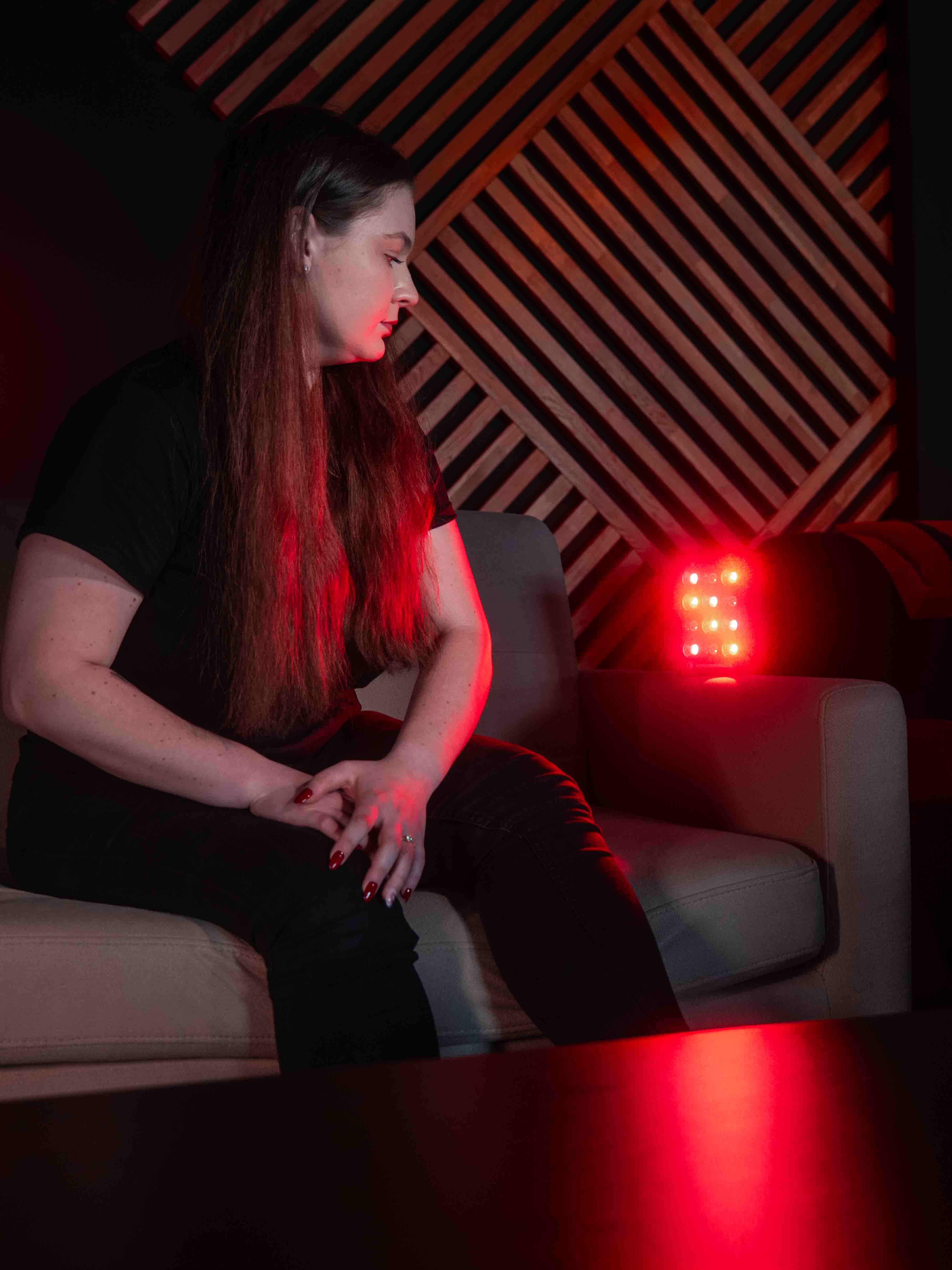
Position the device at the manufacturer-recommended distance, keep sessions to roughly 10 to 20 minutes and treat the same area consistently rather than for hours at once. Consistency over several weeks matters far more than long single sessions, and the exact distance depends on whether you use a bulb-style lamp or a full panel.
Start with distance, because it drives both safety and effectiveness. For classic mains-powered Mitochondriak® panels such as the Mitochondriak® Maxi Upgraded, keep a therapeutic distance of at least 30 cm, and typically around 30 to 60 cm depending on the model. Never place yourself closer than 30 cm to a classic panel, because electromagnetic field (EMF) exposure is higher in the immediate vicinity of a corded device. Any closer measurement you see quoted is an intensity reading, not a recommended treatment distance.
Next, plan your session length and frequency. Most home users do well with sessions of 10 to 20 minutes per area, several times per week. A bulb-style lamp is naturally suited to short, targeted sessions on one body part, while a panel lets you cover a larger area in the same time window. The photobiomodulation effect on your mitochondria does not improve by simply doubling your exposure time, so more is not always better.
Finally, keep it simple and repeatable. Clean skin, no thick creams blocking the light, eyes comfortable (close them or look away from the direct beam), and a routine you can actually stick to. Anti-inflammatory and recovery benefits from photobiomodulation, described in detail by Michael R. Hamblin (Harvard Medical School) in 2017, build up with regular use. [R] If you are new to devices altogether, our beginner guide to choosing an infrared panel is a helpful starting point.
What should you watch out for and who should be careful?
Watch out for single-wavelength marketing claims, unverified irradiance numbers and devices with no clear specifications. People who are pregnant, taking photosensitising medication, or managing a specific medical condition should speak to a healthcare professional before starting any light therapy.
The biggest red flag when shopping is a single impressive number with no context. A device advertising only one wavelength or a single irradiance figure at an unstated distance tells you very little. As covered earlier, honest manufacturers publish irradiance at multiple distances and list every wavelength their device emits. Skin research by Pinar Avci and colleagues (2013) highlights that specific red and near-infrared wavelengths drive specific skin repair mechanisms, which is exactly why the wavelength profile matters. [R]
On the safety side, red and near-infrared light therapy is generally well tolerated, but it is not for everyone. If you are pregnant, taking medication that increases light sensitivity, have an active skin cancer or a serious eye condition, get medical advice first. Protect your eyes from prolonged direct exposure, and never treat directly over recent injections, active infections or undiagnosed skin lesions without professional guidance. When in doubt, err on the side of caution and shorter sessions.
Summary: what should you remember?
The choice between a red light therapy lamp and a full panel is not about which one is universally better, but about which one matches your goal. A lamp is a compact, affordable, portable tool for treating one small area at a time. It uses the same underlying photobiomodulation mechanism as a panel, so for a single sore knee or a patch of facial skin, it is a perfectly reasonable starting point.
A multi-wavelength panel earns its place when your ambitions grow. Full-body coverage, higher combined irradiance and 7 to 9 documented wavelengths make it the more versatile and future-proof investment. Rather than chasing a single big marketing number, look for honest irradiance readings at multiple distances and a wavelength profile chosen for real biological effects. If you know you want that breadth of coverage, exploring the full Mitochondriak® red light therapy device range is the logical next step, and our guide on wavelengths, irradiance and safety can help you compare models with confidence.
Frequently asked questions
Is a red light therapy lamp as effective as a panel?
For a single small area, a good red light therapy lamp can be just as effective as a panel because both use the same photobiomodulation mechanism. The difference is coverage, not the underlying science. A lamp treats one spot at a time, while a panel treats a large area at once with more wavelengths and higher combined irradiance, which makes it more efficient for full-body goals.
What is the best red light therapy lamp for home use?
The best red light therapy lamp for home use is one with clearly stated wavelengths, honest irradiance figures and a form factor that suits your target area. A bulb-style device like the LED RED and NIR bulb Mitochondriak® fits a standard fixture and works well for targeted spot treatment on knees, shoulders or the face.
How many wavelengths does a red light device need?
There is no single magic number, but more documented wavelengths generally mean more versatility. Many budget lamps emit only one or two wavelengths, while Mitochondriak® panels combine 7 to 9 wavelengths, each chosen for a specific biological effect. This synergistic profile is why panels tend to outperform single-wavelength lamps across a wider range of goals.
How close should I sit to a red light therapy panel?
For classic mains-powered Mitochondriak® panels, keep a therapeutic distance of at least 30 cm, typically around 30 to 60 cm depending on the model. Do not sit closer than 30 cm to a corded panel, because EMF exposure is higher in the immediate vicinity. Any smaller figure you see is an intensity measurement, not a recommended treatment distance.
How long should a red light therapy session last?
Most home users do well with sessions of roughly 10 to 20 minutes per area, several times per week. Consistency over several weeks matters more than long single sessions. Photobiomodulation effects on your mitochondria do not simply improve by extending exposure indefinitely, so longer is not automatically better.
Can I use a red light therapy lamp on my face?
Yes. A compact lamp is well suited to facial use because it targets a small area precisely. Keep your eyes closed or look away from the direct beam, use clean skin without thick creams blocking the light, and stick to short, regular sessions. If you have a specific skin condition or take photosensitising medication, check with a healthcare professional first.
Sources and references
- Avci. 2013. Low-level laser light therapy in skin: stimulating, healing, restoring pubmed.ncbi.nlm.nih.gov
- Wunsch. 2014. A controlled trial to determine the efficacy of red and near-infrared light treatment in patient satisfaction, reduction of fine lines, wrinkles, skin roughness and collagen density increase pubmed.ncbi.nlm.nih.gov
- Hamblin. 2017. Mechanisms and applications of the anti-inflammatory effects of photobiomodulation pubmed.ncbi.nlm.nih.gov