.png)
The summer solstice is the longest day of the year, and it is a perfect natural cue to reset your circadian rhythm. With more daylight than on any other day, you can use timed light exposure to sharpen your energy, mood and sleep, without a single supplement.
- Why the summer solstice is the ideal day to recalibrate your circadian rhythm.
- How much morning light you need and when to get it for a strong cortisol awakening response.
- How to use midday sun safely and what it does for your vitamin D and energy.
- How to protect melatonin and sleep when the sun sets late in the evening.
- A simple step-by-step summer solstice light routine you can follow from morning to night.
What does the summer solstice mean for your body clock?
The summer solstice, around June 21, is the day with the most daylight of the entire year. For your body clock, this matters because light is the primary signal that sets your circadian rhythm. The longer photoperiod gives you a wider, brighter window to anchor your internal timing.
Deep inside your brain sits a tiny cluster of cells called the suprachiasmatic nucleus (SCN), the body's master clock. It receives light information directly from special cells in your eyes and uses it to coordinate hormones, body temperature and your sleep-wake cycle. As researcher Robert Y. Moore described, the SCN truly is a clock for all seasons, adjusting to the changing length of day and night throughout the year. [R]
This is why the solstice is such a useful anchor point. Seasonal shifts in day length measurably affect both sleep and mood in healthy people, so deliberately working with the longest day, rather than ignoring it, gives your rhythm a clean, strong reference signal. [R] If you want the full background on how this timing system operates, our article on how your internal clock works breaks it down step by step.
How should you use morning light on the longest day?
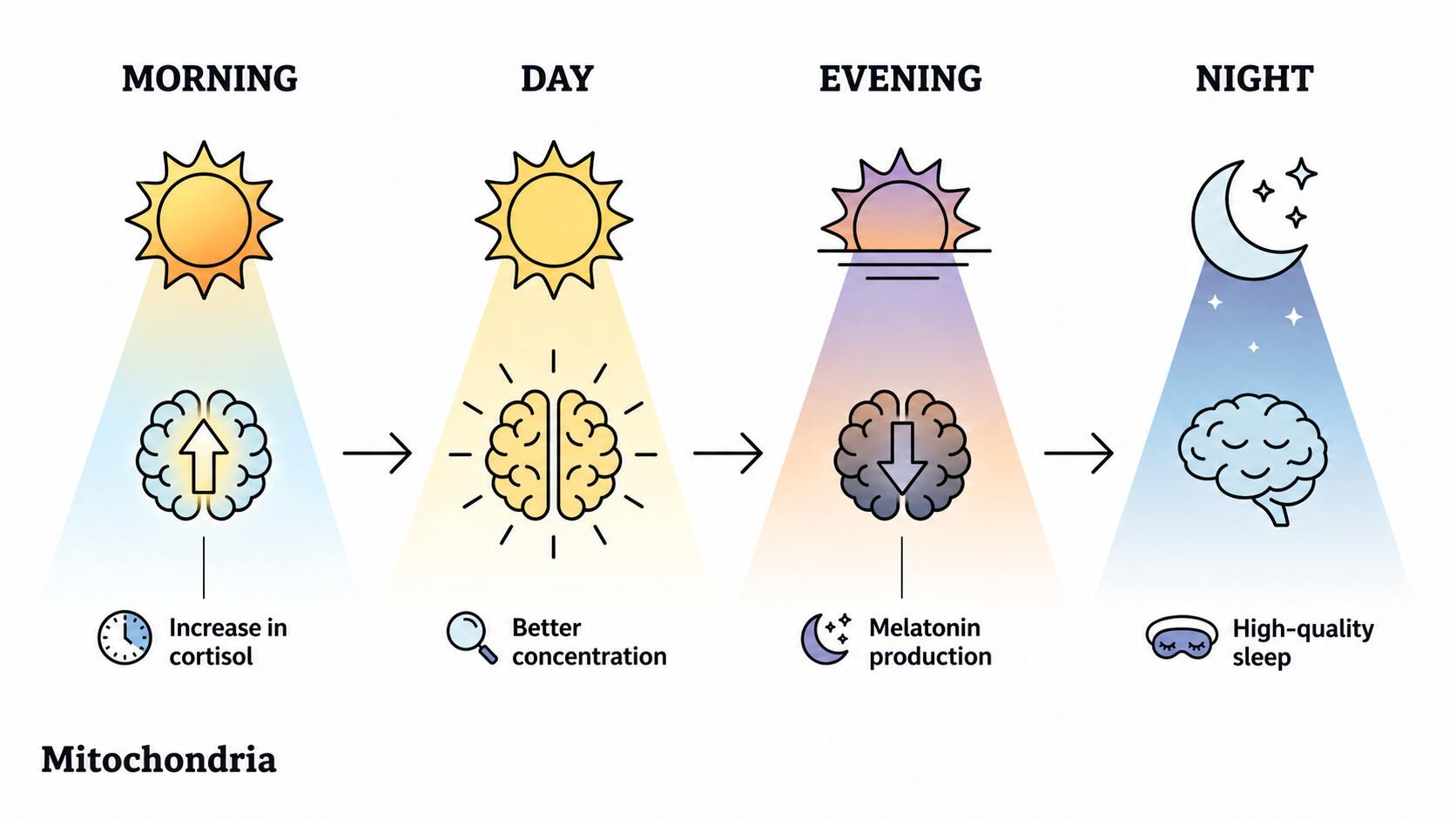
Step outside within the first 30 to 60 minutes after waking and get 10 to 30 minutes of natural outdoor light. Morning light is the single most powerful cue for setting your clock, and bright light early in the day supports a healthy cortisol rise that wakes you up and energises the morning. [R]
That morning cortisol peak is not a bad thing. It is your natural wake-up switch. Bright outdoor light shortly after waking helps reinforce this rhythm so that cortisol is high when it should be and low later in the day. On the solstice, sunrise comes early, which makes it easier to catch genuinely bright light soon after you get up. To understand why these first minutes are so decisive, see our deep dive on cortisol and morning light.
How much morning light and when?
Aim for outdoor light, not light through a window. Even on a cloudy day, outdoor brightness is many times higher than typical indoor lighting. On a clear solstice morning, 10 minutes can be plenty; on an overcast day, lean towards 20 to 30 minutes. The key rule is simple: get the light into your eyes early, without staring directly at the sun, and let the rest of your day follow.
Should you make the most of midday sun in summer?
Yes, but with awareness rather than fear. Midday sun on the solstice is at its strongest, and short, sensible exposure supports vitamin D production and daytime energy. The goal is gradual, comfortable exposure that builds tolerance, not a long session that leaves you red and burnt.
Around midday, the sun is high enough for your skin to produce vitamin D efficiently, which matters for mood, immunity and bone health. Light and feeding cycles are two of the strongest synchronisers of the body's clocks, as circadian researcher Satchin Panda from the Salk Institute has shown in his work on metabolism and timing. [R] Getting outside at midday, even for a short walk or lunch break, reinforces a strong daytime signal that contrasts cleanly with darkness later on.
Listen to your skin. Build sun exposure gradually across the early summer rather than chasing a long, intense solstice session, and step into shade before any redness appears. This common-sense, adaptation-first approach lets you enjoy the longest day while still respecting your skin.

How do you protect your sleep when the sun sets late?
On the solstice, the sun sets late and twilight lingers, which can delay melatonin release and push back your sleep. The fix is to dim and warm your light environment in the evening, so your brain still receives the "night is coming" signal even when it is bright outside.
Your circadian phase is highly sensitive to the timing of light. Carefully timed bright light can shift your melatonin rhythm and clock by hours, which is exactly why late-evening brightness is a problem if you want to fall asleep on time. [R] On the longest day, you simply have to be more deliberate about creating darkness once the useful daylight is over.
Dimming artificial blue light after sunset
In the last 2 to 3 hours before bed, lower overhead lighting and switch screens to warm, dim modes. The most effective single step is to block the short-wavelength light that suppresses melatonin. A pair of quality Blue light blocking glasses Mitochondriak® let you keep using bright rooms and screens in the evening while still protecting your sleep signal. For the full picture on why this works, read our complete guide to blue light, melatonin and better sleep.
What does a simple summer solstice light routine look like?
A solstice routine is just three timed light touchpoints: bright light in the morning, real daylight at midday, and dim, warm light in the evening. Done consistently, this anchors your circadian rhythm and tells your body exactly when to be alert and when to wind down.
Here is a simple, full-day template you can adapt to your own schedule:
- Within 30 to 60 minutes of waking: step outside for 10 to 30 minutes of natural light, no sunglasses, without staring at the sun.
- Midday: get outdoors for a short walk or lunch break and let some sensible sun reach your skin, stepping into shade before any redness.
- Late afternoon: keep moving and stay in natural light where you can, reinforcing the strong daytime signal.
- 2 to 3 hours before bed: dim the lights, warm your screens, and use blue light blocking glasses if the room is still bright.
- Bedtime: keep the bedroom as dark and cool as possible, even when twilight is long.
You do not need perfect conditions or expensive gear to benefit. The summer solstice simply gives you the clearest natural contrast of the year between day and night, and a routine like this lets you put that contrast to work for steadier energy, mood and sleep.
Protect your sleep through the bright summer evenings
Long solstice evenings are wonderful, but late light can quietly delay your melatonin and your sleep. Blocking artificial blue light in the last hours before bed is the simplest way to keep your rhythm on track, which is exactly why we developed our blue light blocking glasses.
Frequently asked questions
What is the summer solstice and why does it matter for circadian rhythm?
The summer solstice, around June 21, is the longest day of the year, with the most daylight and the shortest night. It matters for your circadian rhythm because light is the main signal that sets your body clock. The long photoperiod gives you a clear, strong reference point to anchor your internal timing.
How much morning light do I need on the longest day?
Aim for 10 to 30 minutes of natural outdoor light within the first 30 to 60 minutes after waking. On a clear solstice morning, around 10 minutes can be enough, while an overcast morning calls for 20 to 30 minutes. Get the light into your eyes outdoors, not through a window, and never stare directly at the sun.
Should I avoid the sun at midday in summer?
You do not need to avoid it entirely. Short, sensible midday exposure supports vitamin D production and a strong daytime signal for your clock. The key is gradual adaptation: build your tolerance across early summer, enjoy brief exposure, and step into shade before your skin turns red.
How do I protect my sleep when it stays light late in the evening?
Create your own darkness once the useful daylight is over. In the last 2 to 3 hours before bed, dim overhead lighting, warm your screens, and consider blue light blocking glasses if the room is still bright. Keep your bedroom dark and cool so melatonin can rise on time even during long twilight.
Does the longest day really affect mood and energy?
Yes. Seasonal changes in day length measurably influence sleep and mood in healthy people. A longer photoperiod with more bright daytime light can support steadier energy and mood, provided you also protect the evening so the extra light does not push your sleep later.
Sources and references
- PubMed PMID 11413909 pubmed.ncbi.nlm.nih.gov
- PubMed PMID 12893736 pubmed.ncbi.nlm.nih.gov
- PubMed PMID 17307229 pubmed.ncbi.nlm.nih.gov
- PubMed PMID 27102774 pubmed.ncbi.nlm.nih.gov
- PubMed PMID 9789966 pubmed.ncbi.nlm.nih.gov