.png)
Blue light from phones, tablets, and LED lighting is one of the most common reasons you struggle to fall asleep. In this article, you will find 7 science-backed answers on how blue light affects your sleep, melatonin, and circadian rhythm, and what you can do about it starting tonight.
- Why blue light from screens suppresses melatonin and disrupts your sleep cycle
- How many minutes before bedtime you should put your phone away, according to research
- How blue light blocking glasses affect sleep quality
- Practical steps to adjust your evening lighting at home
- Why night mode on your phone is not enough and what actually works
- What is blue light and why is it a problem after sunset?
- How does blue light suppress melatonin?
- How long before bed should you put away your screen?
- Is night mode on your phone enough?
- Do blue light blocking glasses really help?
- What lighting should you choose for the evening?
- 7 steps to eliminate blue light before bed
What is blue light and why is it a problem after sunset?
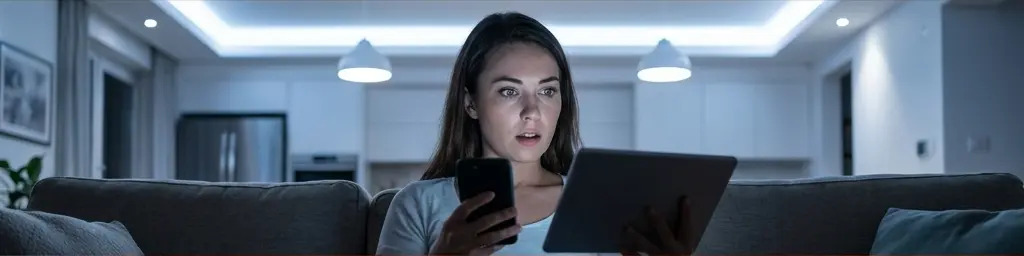
Blue light is visible light with a wavelength of approximately 380 to 500 nm, and it is a natural part of the solar spectrum. During the day it is beneficial, as it boosts alertness and regulates wakefulness. The problem begins after sunset, when your body is preparing for sleep, but artificial sources of blue light disrupt this process.
The main sources of artificial blue light are smartphones, tablets, laptops, televisions, and LED bulbs with a high colour temperature (above 4,000 K). According to a review by Silvani et al. (2022), blue light from electronic devices has the greatest impact on melatonin suppression and reduced sleep quality. [R]
How does blue light suppress melatonin?
Blue light suppresses melatonin production by stimulating specialised light-sensitive cells in the retina, known as intrinsically photosensitive retinal ganglion cells (ipRGCs). These cells contain the photopigment melanopsin, which is most sensitive to blue light at around 480 nm.
When melanopsin detects blue light, it sends a signal to the suprachiasmatic nucleus (SCN) in the hypothalamus, the master clock of the circadian rhythm. The SCN then suppresses melatonin production in the pineal gland. As a result, the body receives a "it's daytime" signal, even though it is dark outside. A study by Sanchez-Cano et al. (2025) confirmed that blue LED light had a significantly stronger suppressive effect on melatonin compared to red LED light, particularly in younger participants. [R]
How long before bed should you put away your screen?
According to available research, you should limit screen exposure at least 60 to 120 minutes before your planned bedtime. Two or more hours in front of a screen in the evening can seriously disrupt the onset of melatonin needed for falling asleep.
If it is not possible to put screens away entirely, it is important to at least reduce display brightness and use protective measures, such as blue light blocking glasses. Research by Lee et al. (2018) showed that in children, the suppressive effect of blue light on melatonin is even more pronounced than in adults, meaning parents should be especially diligent. [R]

Is night mode on your phone enough?
Night mode reduces the amount of blue light on the display, but on its own it is not enough to fully protect your circadian rhythm. Even an orange-tinted display still emits enough light to affect melanopsin in the retina.
Night mode is better than nothing, but a combination of several measures is more effective: reduce screen brightness to a minimum, shorten screen time, put on glasses with a red filter, and switch your indoor lighting to red bulbs with no blue spectrum. It is precisely this combination that delivers the best results for quality sleep.
Do blue light blocking glasses really help?
Yes, blue light blocking glasses can speed up melatonin onset and shorten the time needed to fall asleep. A systematic review by Hester et al. (2021) analysed 24 studies focusing on sleep and found substantial evidence that glasses with a blue filter worn in the evening reduce sleep latency, that is, the time from lying down to actually falling asleep. [R]
What matters most is the colour and quality of filtration. Glasses with a yellow or orange filter block only part of the blue spectrum. Red glasses that block 100% of both blue and green light are, according to available data, the most effective, as they eliminate the entire spectrum of light that affects melanopsin. A newer meta-analysis by Luna-Rangel et al. (2025) confirmed that evening use of blue light blocking glasses accelerates the onset of melatonin secretion and improves actigraphic sleep parameters. [R]
What lighting should you choose for the evening?
Evening lighting should not contain any blue spectrum. Ideally, after sunset you should switch to red or amber bulbs that do not emit wavelengths below 550 nm, and therefore do not suppress melatonin.
A study by Terán et al. (2026) tested tunable LED lighting in households and found that properly adjusted evening lighting was able to reduce estimated melatonin suppression from 10% to nearly zero. [R] Replacing standard LED bulbs with red evening bulbs is one of the simplest and most effective steps you can take for your sleep.
Traditional incandescent (tungsten) bulbs are also a good option, as their spectrum contains significantly less blue light compared to standard LEDs. If you have lamps with a small E14 socket in your bedroom or living room, a simple swap for the Evening red bulb Mitochondriak® E14 can significantly improve your light hygiene.
7 steps to eliminate blue light before bed
Here is a practical guide you can start applying tonight. Each step reduces the blue light burden and supports your natural melatonin production.
- Put your phone and tablet away 2 hours before bed, or at least switch them to aeroplane mode and place them out of reach.
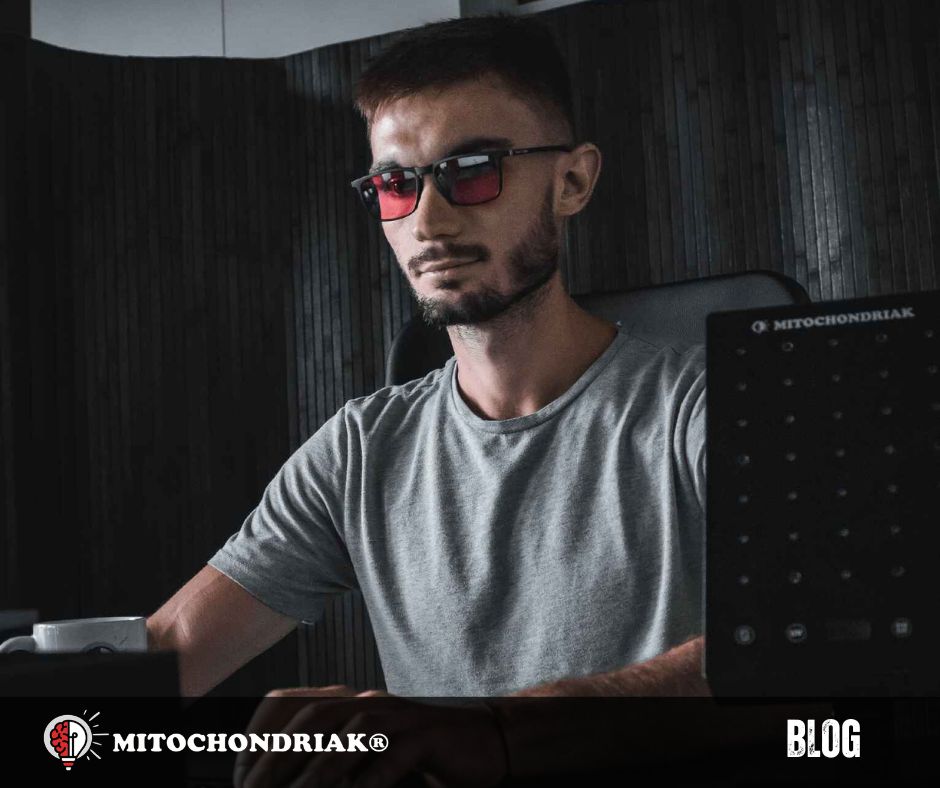
- Put on red glasses after sunset. Stylish Blue light blocking glasses Mitochondriak® block 100% of blue and green light.
- Replace the bulbs in your bedroom with red evening bulbs free of blue spectrum.
- Reduce the brightness of all screens to a minimum and activate night mode as a supplementary measure.
- Watch television with red glasses or limit viewing time as much as possible.
- Create an evening routine without screens, such as reading a book, taking a walk, or stretching under red light.
- Expose yourself to direct daylight in the morning within 30 minutes of waking up. Morning light, rich in blue spectrum, resets your circadian rhythm and improves the evening onset of melatonin.
Protect your sleep from blue light
If you want to start simply and effectively, try the Stylish Blue light blocking glasses Mitochondriak® (€49,90) together with the Evening red bulb Mitochondriak® E14 (€25,95). This combination eliminates blue light from both your interior and screens, helping your body produce melatonin the way nature intended.
Frequently asked questions
Is blue light harmful during the day as well?
During the day, blue light is natural and beneficial. Sunlight contains blue spectrum that increases alertness, improves mood, and synchronises the circadian rhythm. It only becomes a problem after sunset, when it disrupts the body's preparation for sleep.
Does blue light affect children's sleep more than adults'?
Yes, children are more sensitive. Research has shown that blue LED light suppresses melatonin more strongly in children and simultaneously inhibits the increase in sleepiness during night-time hours. [R] Parents should be particularly diligent about limiting screen time before bed.
Is wearing blue light blocking glasses enough to improve sleep?
Glasses are an effective tool, but the best results come from a combination of measures. Wearing red glasses in the evening, combined with replacing indoor lighting with red bulbs and reducing screen time, provides the most comprehensive protection for your circadian rhythm.
What is the difference between yellow and red glasses?
Yellow glasses block only part of the blue spectrum, while red glasses block 100% of both blue and green light. Since melanopsin in the retina responds to light in the range of approximately 420 to 530 nm, red glasses provide more complete protection.
Can red light actually help with better sleep?
Red light with a wavelength above 600 nm does not suppress melatonin, making it ideal lighting for the evening hours. Moreover, research suggests that red light therapy may actively support the production of mitochondrial melatonin within cells.
Sources and references
- Silvani MI et al. (2022). The influence of blue light on sleep, performance and wellbeing in young adults. Front Physiol. PMC9424753
- Sanchez-Cano A et al. (2025). Comparative Effects of Red and Blue LED Light on Melatonin. Int J Environ Res Public Health. PMC12113466
- Lee S et al. (2018). Melatonin suppression and sleepiness in children exposed to blue-enriched white LED lighting. Physiol Rep. PMC6295443
- Luna-Rangel FA et al. (2025). Efficacy of blue-light blocking glasses on actigraphic sleep outcomes: a systematic review and meta-analysis. PMC12668929
- Hester L et al. (2021). Evening wear of blue-blocking glasses for sleep and mood disorders: a systematic review. Chronobiol Int. DOI
- Terán E et al. (2026). Home lighting, blue-light filtering, and their effects on melatonin suppression. PMC12827953