.png)
Red light therapy has become one of the best-documented recovery tools for athletes in recent years. It stimulates mitochondria in fatigued muscles, reduces delayed onset muscle soreness (DOMS) and accelerates the return to training. In this article we compare the two main protocols, pre-workout preconditioning and post-workout recovery, and show which device fits whole-body sessions and which is best for local application.
- Mechanism: how red and near infrared light speed up muscle repair through ATP and cytochrome c oxidase.
- Preconditioning vs. recovery: which protocol works for whom and when to use it.
- Scientific evidence: meta analyses from PubMed confirming reductions in DOMS and inflammation.
- Whole body vs. local: when to reach for a large panel and when a portable device is enough.
- Practical protocol: distance, time and frequency according to Mitochondriak® recommendations.
- How does red light help with post workout recovery?
- Is it better to use red light before or after a workout?
- What scientific evidence supports red light for muscle recovery?
- Which infrared panel is best for post workout recovery?
- How often and how long should you use red light for recovery?
- Does red light also support muscle growth, not just recovery?
How does red light help with post workout recovery?
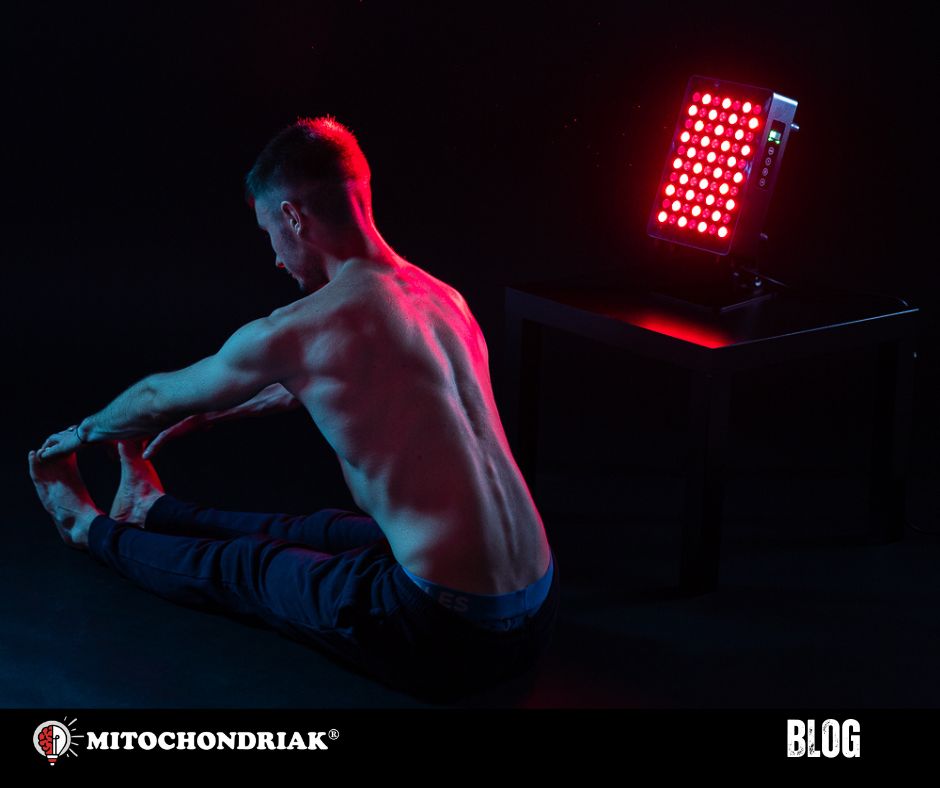
Red and near infrared light in the range of roughly 630 to 940 nm penetrates the skin into muscle tissue, where it binds to cytochrome c oxidase in the mitochondria. The result is higher ATP production, lower oxidative stress and inflammation, and therefore faster recovery of damaged muscle fibres after a workout.
After a demanding strength or endurance session, microtears form in the muscles, inflammatory markers (CK, IL 6, TNF α) accumulate and cellular energy capacity drops. This is exactly where photobiomodulation steps in: it deliberately fires up the mitochondria, which need energy to repair the damaged tissue.
The mechanism works in three steps:
- Activation of cytochrome c oxidase: photons displace nitric oxide that blocks the respiratory chain and restore electron flow.
- Increase in ATP: more available cellular energy means faster protein synthesis and rebuilding of the muscle's contractile apparatus.
- Reduction of inflammation and oxidative stress: fewer ROS and pro inflammatory cytokines shorten the time during which you feel sore after training.
This is exactly the mechanism behind red light therapy for muscle pain, working not only as an analgesic, but as a biological stimulator of repair.
Is it better to use red light before or after a workout?
Both strategies work, but they serve different purposes. Preconditioning (lighting 5 to 30 minutes before a workout) increases performance and endurance and protects muscles from damage. The recovery protocol (lighting after a workout) speeds up repair, reduces DOMS and dampens inflammation. The best results are achieved by athletes who use both protocols.
Preconditioning, charging the mitochondria before the load
Before a workout or competition, red light preloads the mitochondria so they have more available energy during the actual performance. A 2025 meta analysis showed that pre exercise PBMT significantly improved muscular endurance measured by maximum number of repetitions in healthy young adults, with comparable effects for laser and LED. [R]
Recovery, dampening DOMS and inflammation after performance
After training, light accelerates repair and reduces delayed onset muscle soreness (DOMS). A 2025 systematic review published in PMC confirmed that photomodulation therapy significantly reduces muscle pain and improves strength recovery compared with placebo. [R]
Comparison table
| Criterion | Before workout | After workout |
|---|---|---|
| Main effect | Higher performance, muscle protection | Reduced DOMS, tissue repair |
| Duration | 5 to 15 minutes | 10 to 20 minutes |
| Suitable for | Competitive athletes, strength performance | Anyone who trains regularly |
| Frequency | Before a key performance | 3 to 5 times a week |
What scientific evidence supports red light for muscle recovery?
The scientific support for photobiomodulation (PBM) in sports is now strong. There are dozens of randomised studies, several meta analyses and a comprehensive review by Cleber Ferraresi and Michael R. Hamblin (Harvard Medical School), which concluded that PBM can increase muscle mass after training, reduce inflammation and oxidative stress in muscle biopsies. [R]
Key findings from research
- LED therapy after DOMS: a review by Ferraresi et al. (2016, PMC) summarised that LED light reduces muscle damage, pain and atrophy while increasing recovery, muscle mass and athletic performance. [R]
- Acute effects of PBMT: an April 2025 meta analysis confirmed that PBMT improves muscular endurance in healthy young adults, with comparable effects for laser and LED. [R]
- PBMT vs. cryotherapy: a review in the Journal of Sport Rehabilitation compared 5 studies and all of them favoured PBMT over cryotherapy as a more effective tool for restoring muscle performance after exercise.
- Effect on DOMS: a 2025 Bayesian network meta analysis ranked photomodulation among the most effective modalities for relieving delayed onset muscle soreness out of 11 tested interventions. [R]
Research has confirmed that the combination of red light at 630 to 670 nm and near infrared at 810 to 850 nm has a synergistic effect on muscle recovery. This very combination is the foundation of every Mitochondriak® infrared panel, which additionally include 760 and 940 nm for broader coverage of the cytochrome c oxidase absorption peaks.
Which infrared panel is best for post workout recovery?
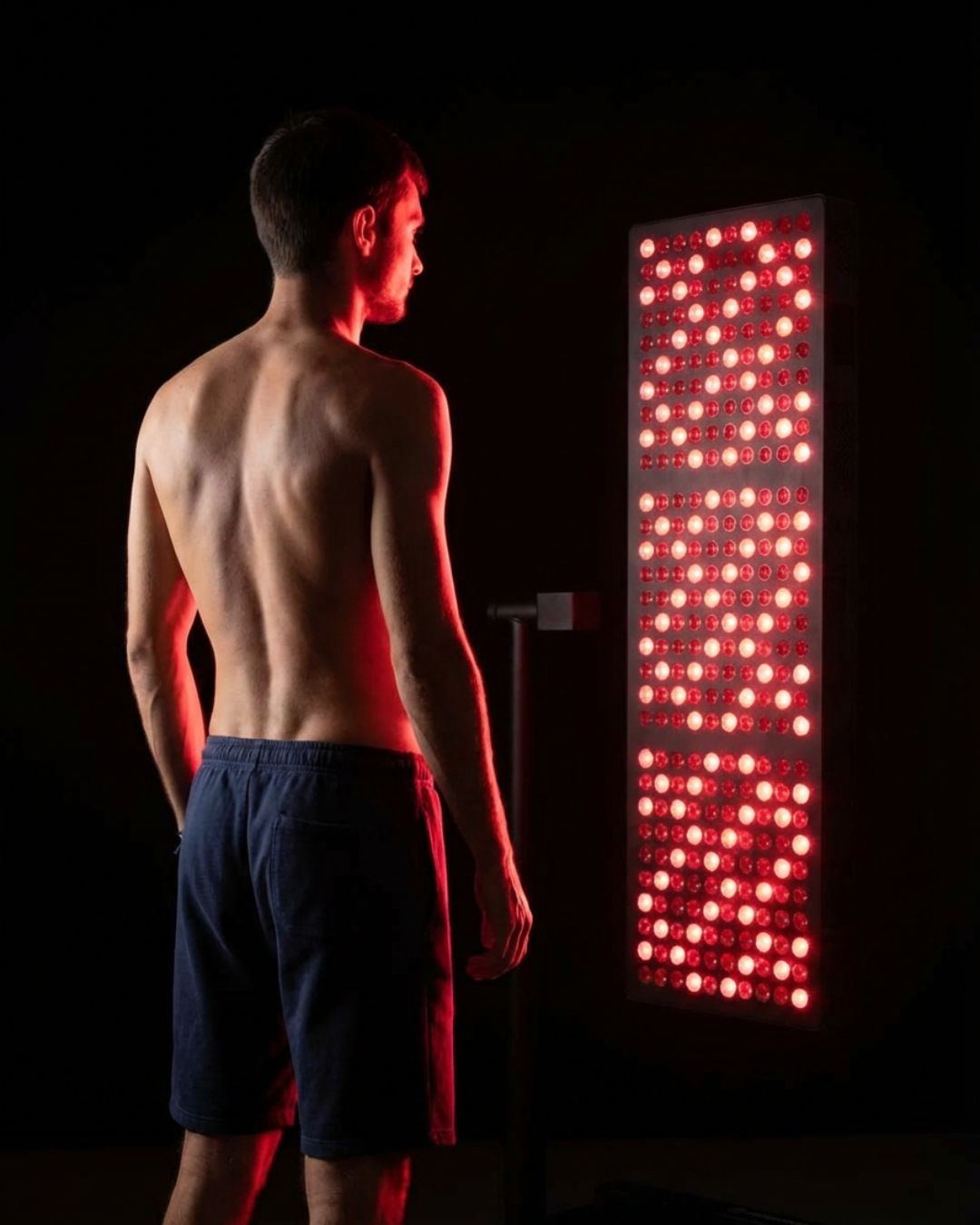
It depends on which sport you do and how many muscle groups you need to treat. For full body sports (CrossFit, running, kettlebell, conditioning) a whole body panel is ideal. For local pain (knee, shoulder, elbow, Achilles) a portable smaller panel or therapy bulb is enough. For clinics and fitness studios a professional setup is optimal.
Whole body solution, Mitochondriak® Maxi Upgraded
The most versatile solution for an athlete at home. Mitochondriak® Maxi Upgraded features 300 LED diodes and 7 wavelengths (630, 670, 760, 810, 830, 850 and 940 nm), so it covers the entire absorption spectrum of mitochondria. In just 2 sessions you can light up the whole body, and thanks to pulsation and a touchscreen display you can set the protocol exactly to your needs.
Advanced solution, Mitochondriak® Office Upgraded
For those who train daily and want maximum effect, or for offices and smaller spaces, Mitochondriak® Office Upgraded is an optimal choice. It offers 7 wavelengths from 630 to 940 nm and advanced features such as a quiet mode, intensity selection and pulsation. Mitochondriak® is one of the few manufacturers that includes the 760 nm wavelength in its panels, thereby covering the entire cytochrome c oxidase absorption spectrum.
Local solution, Infrapanel Mitochondriak® mini
If you are dealing with one specific joint or muscle (such as runner's knee, tennis elbow, or a sore shoulder), the portable Infrapanel Mitochondriak® mini is an ideal helper. It runs on battery, fits into a bag, and you can take it to the gym, to work or on travels.
Targeted solution, Torch Mitochondriak® pulse
For very targeted work (acupuncture points, deep lying tendons, breakouts after heavy sweating) the Torch Mitochondriak® pulse is suitable, a pocket sized, battery operated red light torch with a carry case that fits easily into your training bag.
How often and how long should you use red light for recovery?
The optimal protocol for post workout recovery is 10 to 20 minutes per target area, 3 to 5 times a week, at the distance recommended by the manufacturer (most commonly 15 to 60 cm depending on the panel). The ideal timing is within 6 hours after training, when the recovery response is strongest. Always shine directly on bare skin — clothing reduces effectiveness.
Practical 7 day protocol for a recreational athlete
- Monday (strength training): 15 minutes after the workout on the whole body (Maxi or Office).
- Tuesday (recovery day): 10 minutes locally on sore spots (mini panel).
- Wednesday (cardio): 10 minutes before training (preconditioning).
- Thursday (recovery): rest, or morning light to support the circadian rhythm.
- Friday (strength training): 15 minutes after the workout.
- Saturday (long run, hike): 5 to 10 minutes before plus 15 minutes after performance.
- Sunday: passive recovery, 10 minutes on the whole body.
⚠️ Important: Specific distance and time values vary across models. Always check the FAQ and manual for your specific Mitochondriak® panel, and in the case of chronic pain or injury, consult the protocol with a doctor or physiotherapist.
Unlike cryotherapy or common NSAID medications, red light does not suppress the body's natural adaptive response. It does not block inflammation entirely, but modulates it so that muscles repair faster. That is why it has been embraced not only by professional athletes, but also by the broader community of biohackers.
Does red light also support muscle growth, not just recovery?
Yes, there is evidence that combining strength training with photobiomodulation increases muscle hypertrophy more than training alone. Ferraresi et al. demonstrated that in trained subjects who received LED therapy before and after workouts, muscle mass grew significantly more than in the control group without light.
The mechanism is logical: more available ATP and lower inflammation mean that the body can invest more energy into muscle protein synthesis and less into repair. Cumulatively this shows up as more volume and strength. Combined with quality nutrition, sufficient sleep and exposure to morning sunlight, you get a complete recovery package that used to be available only to professional teams.
Choose a device that fits your training
Whether you are a recreational runner, a CrossFitter or a hobby strength athlete, in our Mitochondriak® red light therapy devices selection you will find a solution for whole body use (Maxi, Office), for local recovery (mini) and for targeted application (Torch pulse). All models come with a 30 day money back guarantee, free worldwide shipping over €90 and our customer support is ready to help.
Frequently asked questions
Does red light help with muscle soreness (DOMS)?
Yes. A 2025 systematic review confirmed that photomodulation significantly reduces DOMS and improves strength recovery compared with placebo. The best effect comes from application within 6 hours after training on the target muscle group.
Should I use it before or after a workout?
Both is optimal. Before training, light increases endurance and protects muscles; after training, it speeds up repair. If you have to choose just one option, for most recreational athletes the post workout recovery protocol makes more sense.
Is it enough to shine through a t-shirt, or does it need bare skin?
Always on bare skin. Even thin clothing reflects and absorbs a large portion of the light, which lowers the therapy's effectiveness. Ideally use it in underwear or without it, depending on the size of the panel and the target area.
How many times a week should I use red light?
3 to 5 times a week is enough for a noticeable effect. Daily use is not harmful, but it brings only a slightly increased benefit. Consistency matters more than intensity.
Does it work better than ice baths after training?
According to comparative studies, yes. PBMT demonstrably outperforms cryotherapy in restoring muscle performance after exercise. Icing dampens pain, but it also suppresses the body's natural adaptive response.
Can I combine red light with protein, creatine or BCAAs?
Yes, without interactions. Photobiomodulation works on a physical level (light to mitochondria), while supplements act metabolically. The combination can speed up recovery even more.
Will red light also help with an old injury?
For chronic or recurring problems, often yes, but the effect is not immediate. Expect 4 to 8 weeks of regular use. For an acute injury, always consult a physiotherapist first.
Sources and references
- Ferraresi C., Huang Y.Y., Hamblin M.R. (2016). Photobiomodulation in human muscle tissue: an advantage in sports performance? PMC5167494
- Ferraresi C. et al. (2016). Effects of Light-Emitting Diode Therapy on Muscle Hypertrophy, Gene Expression, Performance, Damage and DOMS. PMC5026559
- Systematic Review (2025). Effects of Photomodulation Therapy for Delayed Onset Muscle Soreness. PMC12286287
- Meta analysis (2025). A systematic review and meta-analysis of the acute effects of photobiomodulation therapy on muscular endurance. PubMed 40205065
- Bayesian Network Meta Analysis (2025). Differences in the Effectiveness of Different Physical Therapy Modalities in the Treatment of DOMS. PMC12178262