.png)
Melatonin is your body's natural signal that it's time to sleep, and the single biggest factor controlling it is light. By managing your evening light environment, you can help your body produce more melatonin naturally, without supplements. This guide gives you practical, science-backed steps to raise melatonin in the evening and finally sleep better.
- Why melatonin matters and how light and darkness control its release every evening.
- How blue light from screens and overhead LEDs suppresses melatonin, and what the research shows.
- The realistic benefits and limits of optimizing your evening light environment.
- A step-by-step evening light protocol, from a digital sunset to red and amber lighting.
- Who should be cautious and common mistakes to avoid.
What is this about and why does it matter?
Raising melatonin naturally in the evening means optimizing your light environment so your body can produce this sleep hormone on its own schedule. Melatonin release is triggered by darkness and suppressed by light, so the goal is simple: dim, warm light after sunset and avoid bright blue light before bed. No pills required.
Melatonin is often called the "hormone of darkness." It is produced primarily by the pineal gland in your brain, but it doesn't work alone. A tiny cluster of cells in the hypothalamus called the suprachiasmatic nucleus (SCN) acts as your body's master clock, reading light signals from your eyes and telling the pineal gland when to start and stop production.
Why does this matter so much? Because melatonin does far more than make you drowsy. It helps you fall asleep faster, deepens sleep quality, and synchronizes your entire circadian rhythm, the 24-hour internal cycle that governs hormones, metabolism, and repair. When evening melatonin is chronically suppressed, sleep suffers, and so does daytime energy.
The problem for most of us is modern indoor living. Bright artificial light in the hours before bed sends a "still daytime" signal to your brain, delaying melatonin and pushing your natural sleep window later and later. The good news is that this is one of the most fixable factors in your entire sleep routine. If you want a deeper look at melatonin itself, our article on how melatonin is made by mitochondria and controlled by light explains the biology in detail.
Throughout this guide we focus on the lever you can control most easily every single night: the light around you. Adjusting your evening lighting is inexpensive, fast to implement, and works with your biology rather than against it.
What does the research say?
Research shows that light exposure, especially blue wavelengths in the 450 to 490 nm range, is the strongest external controller of melatonin timing. Specialized cells in your retina detect this light and signal the SCN to keep melatonin suppressed. Remove that blue-rich light in the evening and melatonin can rise naturally, on schedule.
The science behind this is well documented. Researchers at Harvard Medical School, including Joshua J. Gooley and Steven W. Lockley, showed that even ordinary room light in the hours before bedtime suppresses melatonin, delays its onset and shortens its nightly duration. [R]
Harvard Health Publishing has summarized this issue clearly, noting that blue light has a "dark side": while beneficial during daytime, exposure in the evening is particularly effective at suppressing melatonin and disrupting sleep compared to warmer wavelengths. [R] This is why the color and intensity of your evening light matters more than most people realize.
There are two practical mechanisms at play here. First, reducing blue light removes the suppression signal, allowing your pineal gland to release melatonin. Second, choosing warm red and amber light in the evening provides functional illumination without significantly triggering the light-sensitive retinal cells responsible for melatonin suppression. In other words, you can still see, read, and move around comfortably without paying the sleep penalty.
Circadian research also suggests that consistent, well-timed melatonin signaling matters for more than sleep alone. Emerging evidence also suggests red light therapy may play a supportive role: a recent systematic review and meta-analysis of photobiomodulation found potential benefits for sleep quality, although the evidence is still limited. [R]
The core takeaway from the research is reassuring. You are not trying to force your body to do something unnatural. You are simply removing an artificial obstacle, evening blue light, and letting a system that evolved over millions of years work the way it was designed to. Our guide to how blue light and screens disrupt your circadian rhythm covers the mechanism in more depth if you want the full picture.
What benefits and limits can you realistically expect?
Realistically, optimizing your evening light can help you fall asleep faster, feel naturally sleepy at a consistent time, and improve sleep depth. It works with your biology to protect melatonin, not create it artificially. The benefits are meaningful but gradual, and they build over days to weeks of consistent evening habits.
The most immediate change most people notice is a return of natural evening drowsiness. When you stop flooding your eyes with blue-rich light after sunset, your pineal gland can release melatonin on its intended schedule. This often shows up as feeling genuinely tired around your target bedtime instead of wired and alert late into the night.
Over time, the benefits extend beyond falling asleep. Because melatonin helps synchronize your whole circadian rhythm, a well-protected evening signal tends to improve wake-up quality, morning alertness, and the consistency of your sleep-wake times. Circadian research suggests that stable, well-timed melatonin signaling may matter for broader physiological health, not just sleep onset.
It is important to set honest expectations, though. Light hygiene is a foundation, not a cure. If your sleep problems stem from an untreated medical condition, chronic pain, high stress, caffeine late in the day, or a sleep disorder such as sleep apnea, adjusting your lighting alone will not solve them. In those cases, evening light optimization becomes one supportive piece of a larger plan.
There are also individual differences. Some people are highly sensitive to evening light and see dramatic changes within a few nights. Others, particularly those with deeply ingrained late-night screen habits, need a couple of weeks of consistency before the effect becomes obvious. Melatonin timing shifts gradually, so patience matters.
Finally, keep the role of red light therapy in perspective. Emerging evidence suggests red light may support sleep quality when used appropriately in the evening, but the research is still developing. [R] The strongest, most reliable lever remains simple: remove evening blue light and replace it with warm, dim illumination.
How do you put this into practice safely?
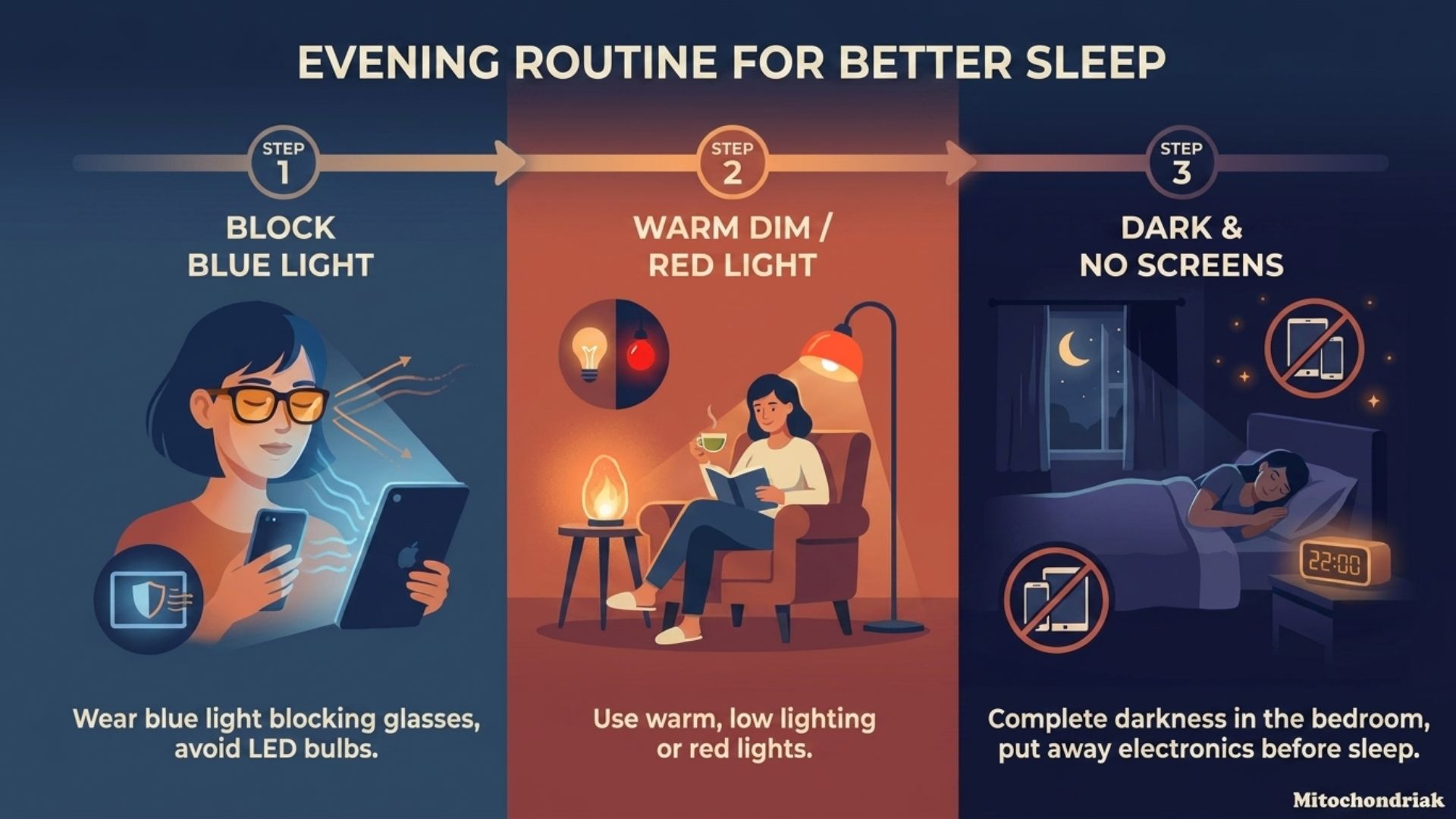
In practice, you create a "digital sunset" roughly 2 to 3 hours before bed: dim overhead lights, switch to warm red or amber bulbs, put on blue light blocking glasses, and reduce screen brightness. The goal is to signal darkness to your brain gradually, letting melatonin rise on its own. Here is a step-by-step evening protocol.
Step 1: Start your digital sunset 2 to 3 hours before bed. Pick a consistent time each evening and treat it as a boundary. This is when you begin dimming bright overhead lighting and shifting your environment toward warmer, lower-intensity light. Consistency is the single most important factor, because your circadian clock responds to regular signals.
Step 2: Kill or filter blue light from screens. If you must use devices, enable night mode, reduce brightness, and keep screens at arm's length. A more reliable option is to wear Blue light blocking glasses Mitochondriak®, which block blue and green wavelengths that suppress melatonin. For a full breakdown of how these work, see our complete guide to blue light blocking glasses.
Step 3: Switch your rooms to warm evening lighting. Replace bright white bulbs in the spaces you use at night with warm, blue-free options. An Evening red bulb Mitochondriak® E27 gives you comfortable, functional light in living areas without the melatonin penalty of standard LEDs. For hallways and bathrooms, a red night light with motion sensor lets you move around at night without a jarring burst of bright light.
Step 4: Keep intensity low. Beyond color, sheer brightness matters. Use lamps instead of overhead lights, favor candlelight-level illumination, and light your space from below eye level where possible. Dim, warm, low light most closely mimics the natural signal of dusk that your ancestors evolved with.
Step 5: Make the bedroom truly dark. When it's time to sleep, aim for a room that is dark, cool, and quiet. Even small amounts of light leaking from electronics or windows can nudge melatonin down, so blackout curtains and covering LED indicators help.
Build your evening light environment
The easiest way to raise melatonin naturally is to give your eyes warm, blue-free light after sunset. Our circadian lighting range, from evening red bulbs to blue light blocking glasses, is designed to make a healthy evening routine effortless.
What should you watch out for and who should be careful?
The most common mistake is inconsistency: doing a perfect digital sunset one night and scrolling on a bright phone the next. Your circadian clock responds to repeated signals, so an occasional slip won't ruin things, but nightly bright blue light will keep melatonin suppressed no matter what else you do.
Watch out for hidden light sources. Bright bathroom lights during a nighttime trip, a glowing TV, or a phone check in bed can all deliver enough blue-rich light to blunt melatonin. This is where warm, low-intensity options like a motion-sensor night light earn their place, letting you handle nighttime needs without resetting the whole process.
Do not treat evening light optimization as a replacement for medical care. If you experience persistent insomnia, loud snoring, gasping during sleep, or excessive daytime sleepiness, these can signal an underlying disorder. The American Academy of Sleep Medicine recommends light management as part of good sleep hygiene, but persistent problems warrant professional evaluation. [R]
A few groups should take extra care. People with certain eye conditions or those recovering from eye surgery should follow their doctor's guidance on light exposure. Anyone taking medication that affects sleep or alertness, and shift workers with irregular schedules, may need a tailored approach rather than a standard evening protocol. When in doubt, consult a healthcare professional.
Summary: what should you remember?
Raising melatonin naturally in the evening comes down to one core principle: manage your light, and your biology does the rest. Melatonin is released in response to darkness and suppressed by light, especially blue wavelengths. By dimming and warming your evening environment, you remove the artificial obstacle that keeps most people wired at night and let your pineal gland do its job on schedule.
The practical formula is simple and repeatable. Start a digital sunset 2 to 3 hours before bed, cut or filter blue light from screens with night modes and blue light blocking glasses, switch your rooms to warm red and amber lighting, keep overall intensity low, and make your bedroom genuinely dark. None of this requires supplements, and all of it works with the way your body evolved to function.
Be patient and consistent, keep your expectations realistic, and remember that light hygiene is a powerful foundation rather than a cure for every sleep issue. Combined with sensible sleep habits, optimizing your evening light is one of the most effective and affordable changes you can make for better, more restorative sleep.
Frequently asked questions
How long before bed should I start reducing blue light?
Aim to begin your digital sunset about 2 to 3 hours before bedtime. This gives your body enough of a dark, blue-free window for melatonin to rise naturally. If a full 3 hours isn't realistic, even 60 to 90 minutes of warm, dim light and reduced screen exposure before bed is meaningfully better than bright light right up until you close your eyes.
Does red light help melatonin production, or just avoid harming it?
Primarily, warm red and amber light helps by not suppressing melatonin the way blue light does, so it lets your natural release continue. There is also emerging evidence that red light therapy may support sleep quality when used appropriately in the evening, though this research is still developing. For everyday use, the main benefit is that red light gives you functional illumination without the sleep penalty of standard bright white lighting.
Can I just take a melatonin supplement instead?
Supplements are a separate approach and are not a substitute for good light hygiene. Optimizing your evening light supports your body's own natural melatonin rhythm, which is generally the more sustainable foundation. If you are considering supplements, discuss timing and dosage with a healthcare professional, and still address bright evening light, since supplements won't fix a suppression signal you keep sending your brain every night.
Do blue light blocking glasses really work for sleep?
Quality blue light blocking glasses reduce the blue and green wavelengths most responsible for suppressing melatonin, which is why they're a practical tool for evenings when you still need screens. They work best as part of a broader routine that also includes warm lighting and lower overall brightness. Consistency matters more than any single tool, so wearing them nightly during your digital sunset will give the most noticeable results.
Sources and references
- Joshua J. Gooley. 2011. Exposure to room light before bedtime suppresses melatonin onset and shortens melatonin duration in humans pubmed.ncbi.nlm.nih.gov
- W. M. Vital de Azevedo. 2026. Photobiomodulation and sleep quality: systematic review and meta-analysis pubmed.ncbi.nlm.nih.gov
- American Academy of Sleep Medicine. 2017 (updated periodically). American Academy of Sleep Medicine (AASM) Sleep Hygiene Guidelines aasm.org
- Harvard Health Publishing. 2012. Blue light has a dark side health.harvard.edu