.png)
Sleeping in warmer weather is a challenge for many people, especially when temperatures in May and June start climbing above 20 °C. If you find it harder to fall asleep, wake up sweating, or feel unrested in the morning, it is not just your imagination. Behind it all lies thermoregulation, melatonin, and your light environment.
- Why your body needs a core temperature drop of 1 to 1.5 °C in order to fall asleep
- How bedroom heat disrupts melatonin production and deep sleep quality
- Practical tips for preparing your bedroom for warm nights without air conditioning
- Why evening red light is the most effective "sleep hack" in summer
Why is it harder to fall asleep in a warm environment?
To fall asleep, your body must lower its core temperature by approximately 1 to 1.5 °C. Under normal conditions, this drop begins about two hours before bedtime and is controlled by circadian clocks in the hypothalamus. [R] When your bedroom is too warm, however, the body cannot dissipate excess heat through the skin fast enough, which significantly delays the onset of sleep.
Research shows that a higher ambient temperature increases wakefulness, shortens deep sleep (slow wave sleep) and REM sleep. [R] The result is restless nights, sweating, and morning fatigue, even if you spent enough hours in bed.
The problem intensifies in May and June as daylight hours get longer. More daylight means a later sunset and higher air temperatures that drop more slowly after dark. Your body receives mixed signals about when it is time to sleep.
How does temperature affect melatonin and the circadian rhythm?
Melatonin is not just a "sleep hormone" but also a key regulator of body temperature. When melatonin levels begin to rise in the evening, the body dilates blood vessels in the extremities (hands and feet), channelling heat away from the core to the surface. [R] This mechanism is essential for sleep onset.
The problem arises when bedroom temperature exceeds 24 to 25 °C. The body simply has nowhere to release the heat because the surrounding air is too warm. Even with adequate melatonin, thermoregulation fails and you toss and turn in bed. Research confirms that elevated body temperature during the night is associated with insomnia and reduced parasympathetic activity. [R]
And here comes another factor: blue light from screens. If you look at your phone or TV in the evening, you suppress melatonin production at the very time your body needs it most. In summer, this effect is even worse because you go to bed later and spend more time in front of screens before sleep. We wrote about how the circadian rhythm controls your internal clock in a separate article.

How to prepare your bedroom for warm nights?
The key to better sleep in warmer weather is not necessarily air conditioning. All it takes is understanding what your body needs and adjusting your environment with a few simple steps.
- Cross ventilate before bed. Open windows on opposite sides of your home for 20 to 30 minutes before bedtime. Cross airflow lowers the temperature more effectively than a single open window.
- Switch your bed linen. Linen or cotton sheets wick moisture better than synthetic fabrics. Avoid heavy duvets.
- Take a lukewarm shower. Not cold, but lukewarm. A cold shower paradoxically triggers your body to produce more heat to warm itself up. Lukewarm water helps dilate blood vessels and draw heat away from the core.
- Keep your bedroom in complete darkness. Blackout curtains not only block morning light but also help maintain a lower temperature by preventing the sun from overheating the room during the day.
- Get morning sun exposure. Morning sunlight within 30 minutes of waking is the strongest natural signal for quality nighttime sleep. It sets your circadian clock so that melatonin begins to rise at the right time.
If you are looking for more tips on improving your sleep, check out our Better Sleep page for a comprehensive guide.
Red light and glasses: your best allies before bed
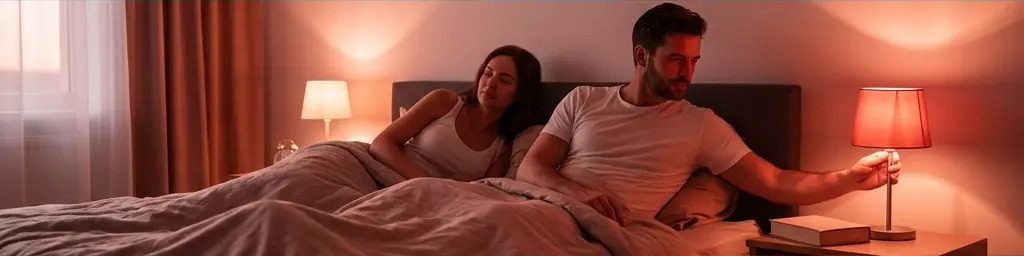
Evening red light is one of the most effective tools for quality sleep, particularly in summer. Unlike white or blue LEDs, red light does not contain wavelengths that suppress melatonin. On the contrary, a study on elite female athletes demonstrated that 14 days of red light exposure improved sleep quality and serum melatonin levels. [R]
In practical terms, if you replace standard LED lighting with Mitochondriak® red evening bulbs 2 to 3 hours before bed, you give your body a clear signal: "it is time to produce melatonin and cool down." Mitochondriak® red bulbs contain zero blue or green spectrum and are flicker free, so your eyes and brain receive a clean, harmless light signal.
If you work with screens in the evening, Mitochondriak® blue light blocking glasses are essential protection. Unlike standard "blue light" filters, our red glasses block the entire spectrum of blue and green light, providing maximum protection for nighttime melatonin production.

Struggling to fall asleep in the heat? Try light hygiene from Mitochondriak®
Red bulbs and blue light blocking glasses are the simplest step toward deeper sleep even on hot summer nights.
- To fall asleep, your body needs to lower its core temperature by 1 to 1.5 °C. Bedroom heat blocks this process.
- Melatonin regulates not only sleep but also thermoregulation, which is why its nighttime production is critical.
- Blue light from screens in the evening suppresses melatonin, and this is especially problematic in summer.
- Morning sunlight, a lukewarm shower, cross ventilation, and linen bedding can help even without air conditioning.
- Mitochondriak® red bulbs and blue light blocking glasses are the most effective tools for protecting evening melatonin production.
Sources and references
- Harding, E. C., Franks, N. P., & Wisden, W. (2020). Sleep and thermoregulation. Current Opinion in Physiology, 15, 7–13. [R]
- Okamoto-Mizuno, K., & Mizuno, K. (2012). Effects of thermal environment on sleep and circadian rhythm. Journal of Physiological Anthropology, 31(1), 14. [R]
- Bigalke, J. A., et al. (2023). Core body temperature changes before sleep are associated with nocturnal parasympathetic activity. Journal of Applied Physiology. [R]
- Kräuchi, K. (2006). Thermoregulatory effects of melatonin in relation to sleepiness. Chronobiology International, 23(1-2), 475–484. [R]
- Zhao, J., Tian, Y., Nie, J., Xu, J., & Liu, D. (2012). Red light and the sleep quality and endurance performance of Chinese female basketball players. Journal of Athletic Training, 47(6), 673–678. [R]
- Harding, E. C., Franks, N. P., & Wisden, W. (2019). The Temperature Dependence of Sleep. Frontiers in Neuroscience, 13, 336. [R]