.png)
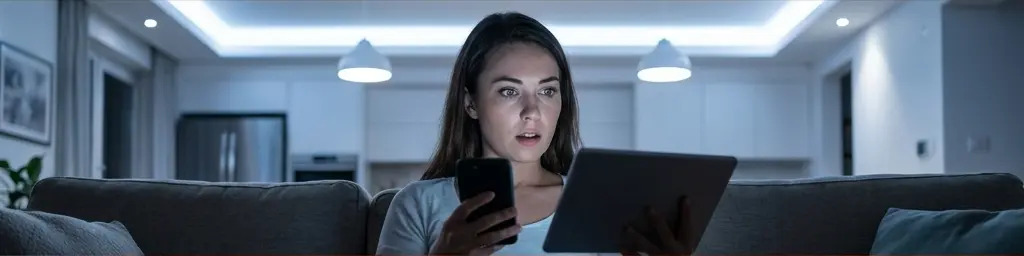
Blue light from screens poses the same threat in summer as it does in winter, even if you spend all day outdoors. Longer days and more natural sunlight do not mean that evening hours in front of a monitor, TV, or phone are safe. In fact, the contrast between daytime sun and evening artificial light is even sharper in summer, and both your eyes and circadian rhythm will feel the consequences.
- Why summer sunlight cannot offset the negative impact of blue light from screens on evening melatonin and sleep
- How blue light from LED displays disrupts the circadian rhythm after sunset, even during the longest days of the year
- What studies say about the effects of screens on eyes, visual fatigue, and nocturnal melatonin secretion
- Why night mode on your phone is not enough and which solutions actually work
- How to set up evening light hygiene in summer using blue light blocking glasses and red lighting
- 1. Why does summer sunlight not protect your eyes from screen blue light?
- 2. How does blue light from displays affect your eyes and brain?
- 3. Blue light and melatonin in summer: why are longer days paradoxically riskier?
- 4. What do studies say about screens, sleep, and the circadian rhythm?
- 5. Is night mode or a screen filter enough? The answer may surprise you
- 6. Children and screens in summer: a bigger risk than you think
- 7. How to set up evening light hygiene in summer
- 8. Why are blue light blocking glasses the most effective solution?
- 9. Frequently asked questions
Why does summer sunlight not protect your eyes from screen blue light?
Summer sunlight is incredibly beneficial for the body, but its presence during the day never cancels out the negative effects of artificial blue light you expose yourself to after sunset. These two types of light exposure operate independently and within different time windows.
Sunlight contains the full spectrum of wavelengths, including red, infrared, and ultraviolet components. This spectrum is natural for the human body, and our eyes have adapted to it over the course of evolution. Blue light from the sun arrives in the context of the full spectrum and during daytime, when the body expects it.
Screens, LED bulbs, and LCD displays, however, emit isolated blue light with a peak around 450 nm, without the balancing red and infrared components. When you expose yourself to this type of light after sunset, the brain receives a false signal that it is still daytime. And this is precisely where the problem arises, one that summer sunlight will not fix.
You can spend the entire day outdoors in the sun, building your solar callus, strengthening your circadian rhythm with morning light, and producing vitamin D. However, if you sit down in front of a screen at 10 pm without any protection, you are partially undermining all of those daytime benefits. The body simply cannot "store" daytime light exposure as a reserve for the evening.
How does blue light from displays affect your eyes and brain?
Blue light from screens affects both the eyes and the brain through two distinct mechanisms: direct impact on the retina, and indirect influence on the circadian system via specialised light sensitive cells in the eye.
The retina contains intrinsically photosensitive retinal ganglion cells (ipRGCs), which house the photopigment melanopsin. These cells do not serve vision; instead, they sense light intensity and spectrum for the biological clock. Melanopsin is most sensitive to blue light in the 460 to 490 nm range, which almost precisely matches the peak emission of modern LED displays.
When blue light from a screen reaches these cells after sunset, the suprachiasmatic nucleus in the hypothalamus (the body's master biological clock) receives the signal: "It is daytime, do not produce melatonin." The result is suppressed evening melatonin, delayed onset of sleepiness, and disruption of the entire circadian cycle.
Beyond the circadian effects, prolonged screen viewing causes digital eye strain. Common symptoms include dry eyes, blurred vision, headaches, and tension in the forehead area. In summer, when hours of intense sunlight alternate with hours in front of a screen, the eyes can perceive this contrast even more acutely.

Blue light and melatonin in summer: why are longer days paradoxically riskier?
In summer, melatonin production naturally shifts to later hours because the sun sets later. This means the window for melatonin synthesis shortens. If you introduce artificial blue light from a screen into this already narrower window, the result is a melatonin deficit that manifests in reduced sleep quality, impaired recovery, and lower energy the following day.
Think of it this way: in June across most of Europe, the sun sets around 20:45 to 21:00. The body naturally begins producing melatonin roughly 1.5 to 2 hours after sunset, so around 22:30 to 23:00. But if you are sitting in front of a screen from 21:00 onwards, melatonin onset is delayed even further, or its levels are lower than they should be.
Researchers from Harvard Medical School confirmed that even typical indoor lighting levels can suppress melatonin production and disrupt the circadian rhythm. According to their findings, blue light is twice as effective at suppressing melatonin compared to green light of the same intensity. [R]
Moreover, a study published in Scientific Reports in January 2026 demonstrated that evening home lighting has the capacity to impair sleep quality precisely through the suppression of endogenous melatonin production. The use of blue light blocking filters significantly reduced this effect. [R]
What do studies say about screens, sleep, and the circadian rhythm?
Scientific evidence clearly confirms that evening use of LED display devices negatively affects sleep and the circadian rhythm. Here are key findings from verified research.
Chang et al. (2015): e-readers and melatonin
A landmark study from Harvard Medical School, published in PNAS, compared reading on a light emitting e-reader versus reading a printed book before bed over 5 consecutive evenings. The results showed that using an e-reader:
- Suppressed evening melatonin levels
- Delayed the circadian clock
- Increased the time needed to fall asleep
- Reduced alertness the following morning
Participants who read from an e-reader had significantly lower melatonin levels, and their circadian rhythm was shifted compared to those who read a printed book. [R]
Sanchez-Cano et al. (2025): red vs. blue LED light and melatonin
A compelling 2025 study directly compared the effects of red LED light (631 nm) and blue LED light (464 nm) on melatonin secretion in healthy adults during a three hour exposure. The results clearly showed that blue light significantly suppressed melatonin production, whereas red light did not suppress melatonin. [R]
This study is highly relevant for understanding why switching evening lighting to red is such an effective strategy for protecting the circadian rhythm.
Figueiro et al. (2010): blue and red light, cortisol, and melatonin
Researchers at the Lighting Research Center (LRC) found that only blue light reduced nocturnal melatonin, while red light had no impact on melatonin levels. Interestingly, both light colours affected cortisol levels, but only blue light had a direct impact on the circadian system. [R]
Is night mode or a screen filter enough? The answer may surprise you
Software filters such as night mode, Night Shift, or "eye comfort" features reduce the amount of blue light from a display, but they do not eliminate it entirely. Most of these solutions reduce blue light by 20 to 40%, which is insufficient to prevent melatonin suppression.
A Cochrane systematic review from 2023, which analysed randomised controlled trials, concluded that blue light filter glasses may not alleviate symptoms of digital eye strain in short term follow up. [R] However, this conclusion referred to transparent "computer" glasses with minimal filtering, not full spectrum red glasses that block 100% of blue and green light.
The critical difference lies in the percentage of light blocked:
- Night mode on a phone: blocks approximately 20 to 40% of blue light
- Transparent "blue light" glasses: block around 10 to 25% of blue light
- Yellow or orange glasses: block roughly 70 to 80% of blue light
- Red glasses (such as Blue light blocking glasses Mitochondriak®): block 100% of blue and green light
If your goal is to protect evening melatonin and your circadian rhythm, software filters are better than nothing, but they do not match the effectiveness of physical red filters. The difference between 30% and 100% blockage is critical in terms of the melatonin response.
Children and screens in summer: a bigger risk than you think
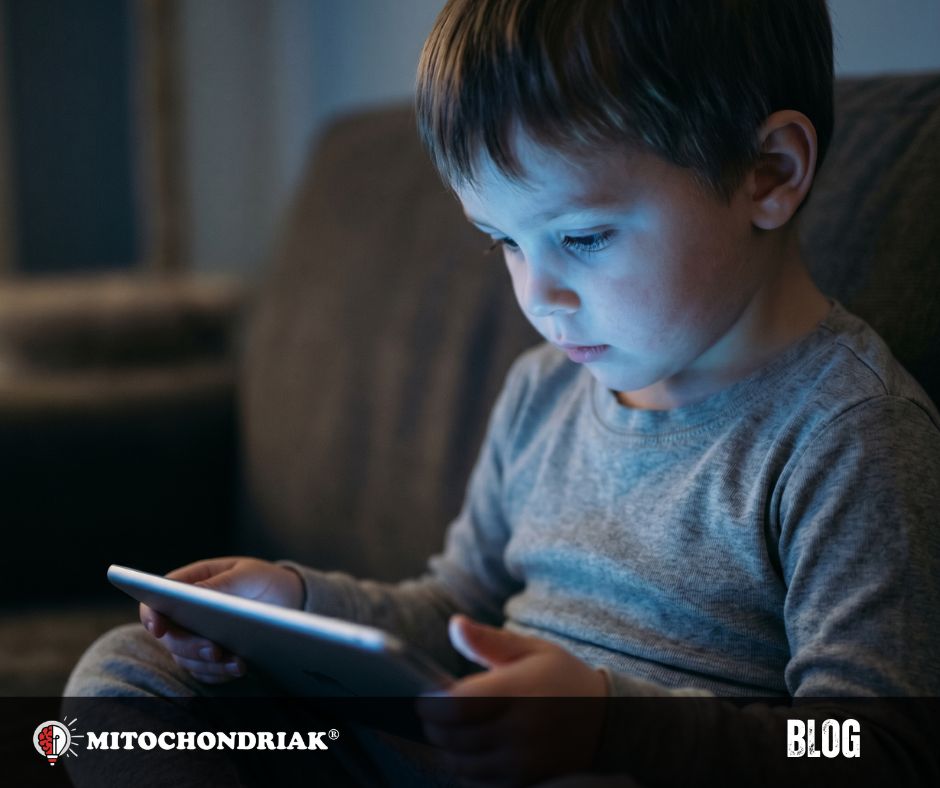
Children's eyes are more sensitive to blue light than adults' because their crystalline lens transmits more short wavelength light to the retina. During summer holidays, the time children spend in front of screens also increases, often extending into late evening hours.
A study published in BMC Ophthalmology in 2024 confirmed that excessive use of digital media is significantly associated with symptoms of digital eye strain and reduced sleep quality in young people. [R]
The situation is even more problematic for children for several reasons:
- The lens transmits more blue light to the retina (the lens yellows with age, filtering more over time)
- Children have larger pupils, meaning a greater volume of light enters the eye
- The circadian system of children is more sensitive to light signals
- In summer, sleep times shift and children often fall asleep later
This is why it is important to think about light hygiene for the entire family. For children, Kids Blue light blocking glasses Mitochondriak® are available, designed specifically for smaller heads from approximately age 5. For a deeper look at this topic, we have published a dedicated article on blue light and children.
How to set up evening light hygiene in summer
Evening light hygiene in summer requires a proactive approach because longer days and warm evenings naturally push activities into later hours. Here is a practical protocol for protecting your circadian rhythm and eyes during the summer months.
1. Start your day with morning sunlight
Expose yourself to morning sunlight within the first 30 to 60 minutes after waking. Morning light is rich in red and infrared wavelengths that prepare mitochondria for daytime mode and set the biological clock. In summer, thanks to early sunrises, this is easy to achieve.
2. Establish a "sunset protocol"
Approximately 2 hours before your planned bedtime, begin reducing artificial light. If you go to sleep at 23:00, put on red glasses from 21:00 and switch your lighting to red bulbs. This window is crucial for melatonin onset.
3. Change your indoor lighting
Standard LED bulbs emit a large amount of blue light. For evening hours, swap them for red bulbs or bulbs without blue light. After sunset, your entire room should glow with a warm red tone, not cool white. If you have LED lighting at home, red bulbs from Mitochondriak® are a simple swap into existing fixtures. Choose from Evening red bulb Mitochondriak® E27, E14, or GU10 sockets.
4. Wear blue light blocking glasses
If you need to work, watch a show, or read from your phone in the evening, red glasses blocking 100% of blue and green light are the most effective form of protection. More on why they are the best choice in the next section.
5. Limit screen time 30 minutes before bed
Even with glasses on, it is beneficial to spend the last 30 minutes before sleep without a screen. Read a printed book, have a conversation, or do some evening stretching. Your eyes deserve the rest. For more practical tips, see our article on 5 practical Mitochondriac tips for better sleep.
Why are blue light blocking glasses the most effective solution?
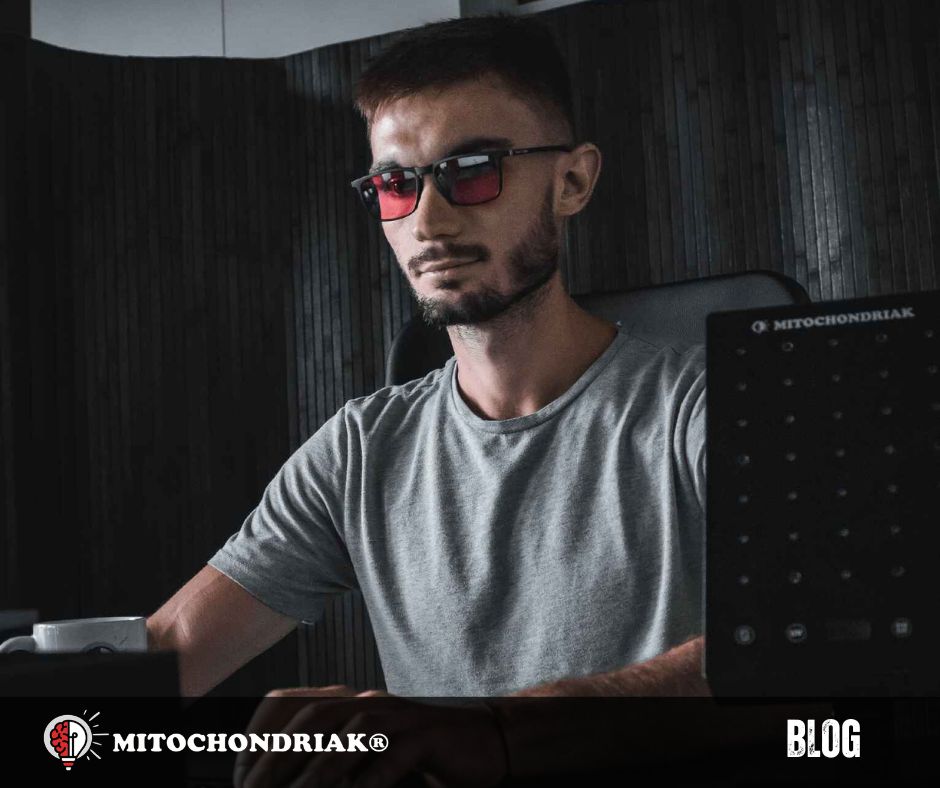
Red glasses blocking 100% of blue and green light are, based on available scientific evidence, the most effective tool for protecting evening melatonin. Unlike software filters, they shield your eyes from all sources of artificial light in a room, not just a single display.
When you are wearing red glasses, your eyes are protected from:
- Blue light from your phone, tablet, laptop, and TV
- Blue and green light from LED ceiling fixtures
- Light from kitchen lighting, the bathroom, and hallways
- Any source of artificial light indoors
The study by Sanchez-Cano et al. (2025) confirmed that red light (631 nm) does not suppress melatonin, whereas blue light (464 nm) significantly reduced it. [R] Red glasses work on the same principle. They transmit only red light, which is "invisible" to the circadian system, and block the spectrum that suppresses melatonin.
Blue light blocking glasses Mitochondriak® block 100% of blue and green light and are designed for comfortable all evening wear. For children, there are also Kids Blue light blocking glasses Mitochondriak®, suitable from approximately age 5.
If you are interested in a more detailed overview of choosing the right glasses, we recently published a complete guide to blue light blocking glasses on the blog, where you will find a comparison of different filter types and practical selection tips.
Summer sun is great, but evening screens steal your melatonin and sleep. Set up your evening light hygiene with Mitochondriak® products:
- Blue light blocking glasses Mitochondriak® for adults
- Kids Blue light blocking glasses Mitochondriak® for children from age 5
- Evening red bulb Mitochondriak® E27 for healthy indoor lighting
Browse all products in the Blue light blocking glasses and Indoor lighting solutions sections.
Frequently asked questions
Can you sleep less in summer because the days are longer?
No, longer days do not mean your body needs less sleep. An adult needs 7 to 9 hours of quality sleep regardless of the season. In summer, however, the window for melatonin production naturally shortens, which makes it all the more important to protect it from artificial blue light in the evening.
Is blue light from the sun just as harmful as blue light from a screen?
No, blue light from the sun is part of the full spectrum and arrives at a time when the body expects it (during the day). Solar blue light is balanced by red and infrared components. The problem arises with isolated blue light from LED displays after sunset, when the body expects darkness.
Why is night mode on a phone not enough?
Night mode only partially reduces blue light (approximately 20 to 40%). Even the remaining blue light is enough to suppress melatonin. Additionally, night mode only protects against one device, not the overall indoor lighting. For genuine protection, red glasses blocking 100% of the blue spectrum are more effective.
From what age can children wear blue light blocking glasses?
Kids Blue light blocking glasses Mitochondriak® are designed for children from approximately age 5. They are flexible, lightweight, and comfortable to wear. If a child is regularly exposed to screens in the evening, red glasses are a suitable tool for protecting their circadian rhythm and sleep.
Can I wear blue light blocking glasses during the day?
Red glasses are intended primarily for evening wear after sunset. During the day, the body needs blue light to maintain alertness and a proper circadian signal. If you work all day in an office without access to natural daylight, orange or yellow glasses with a milder filter may be a suitable compromise.
What is the difference between yellow, orange, and red glasses?
The main difference lies in the range of blue and green light blocked. Yellow glasses block a smaller portion of the blue spectrum (around 50 to 60%), orange glasses block roughly 70 to 80% of blue light and part of the green spectrum. Red glasses block 100% of both blue and green light, providing the most comprehensive melatonin protection before sleep.
Do blue light blocking glasses help with screen related headaches?
Many users report subjective improvement, but scientific evidence for transparent "blue block" glasses is inconclusive. For red glasses with full blockage of the blue and green spectrum, the situation differs because they eliminate the most irritating light component. If you experience chronic headaches, we recommend consulting an eye care professional.
Sources and references
- Chang, A.M., Aeschbach, D., Duffy, J.F., Czeisler, C.A., 2015. Evening use of light-emitting eReaders negatively affects sleep, circadian timing, and next-morning alertness. PNAS, 112(4), 1232–1237. PubMed
- Sanchez-Cano, A. et al., 2025. Comparative Effects of Red and Blue LED Light on Melatonin Levels During Three-Hour Exposure in Healthy Adults. Life, 15(5), 715. PubMed
- Figueiro, M.G. et al., 2010. The Effects of Red and Blue Lights on Circadian Variations in Cortisol, Alpha Amylase, and Melatonin. International Journal of Endocrinology, 2010. PMC
- Terán, E. et al., 2026. Home lighting, blue-light filtering, and their effects on melatonin secretion and sleep quality. Scientific Reports, 15. Nature
- Singh, S. et al., 2023. Blue-light filtering spectacle lenses for visual performance, sleep, and macular health in adults. Cochrane Database of Systematic Reviews. PubMed
- Aykutlu, M.Ş. et al., 2024. Digital media use and its effects on digital eye strain and sleep quality. BMC Ophthalmology. PMC
- Harvard Health Publishing, 2024. Blue light has a dark side. Harvard Health