.png)
Blue light and children is a topic that concerns more and more parents. Tablets, phones, and TVs shine directly into children's eyes, which are far more sensitive to this light than adult eyes. In this guide, we show you what happens in a child's body under the influence of blue light, how to recognize the warning signs, and what specific steps you can take today.
- Why children's eyes let through more blue light than adult eyes and what it means for their health
- How blue light from screens suppresses melatonin in children up to twice as much compared to adults
- How much screen time is safe by age and what the warning signs are
- 7 practical steps you can take today for better sleep for your children
- When to consider blue light blocking glasses and which bulb is safe for a child's bedroom
- Why are children's eyes more vulnerable to blue light?
- What does blue light do to a child's brain and melatonin?
- Symptoms of excessive blue light exposure in children
- How much screen time is too much?
- 7 practical tips for parents
- When to consider blue light blocking glasses for your child?
- Which bulb is safe for a child's bedroom in the evening?
- Frequently Asked Questions
Why are children's eyes more vulnerable to blue light?
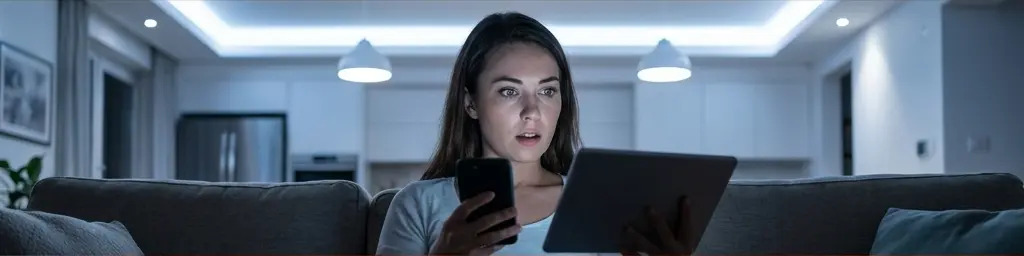
Children's eyes transmit significantly more blue light to the retina than adult eyes because their crystalline lens is not yet developed enough to filter out harmful short wavelengths. This physiological difference makes children the most vulnerable group.
Scientific measurements of light transmission through the human lens showed that the lens of a 4.5-year-old child transmits up to 96% of visible light, including the blue spectrum. [R] With age, the lens gradually yellows and naturally blocks an increasing portion of short wavelengths. In a fifty-year-old person, only light above approximately 410 nm reaches the retina. In a child, such a filter practically does not exist.
This difference has a profound impact. When a child looks at a tablet or TV, blue light in the 400 to 500 nm range penetrates directly to the retina at a much higher intensity. Children's eyes also have larger pupils and shorter axes, which further increases exposure. [R]
A simple rule applies: the younger the child, the greater the risk. And this risk is not limited to the eyes but affects the entire body, because blue light also impacts the brain, melatonin, and the circadian rhythm.
What does blue light do to a child's brain and melatonin?
Blue light from screens suppresses melatonin production in children up to twice as much compared to adults, directly disrupting their ability to fall asleep and their sleep quality. This effect is measurable and scientifically confirmed.
Research published in Physiological Reports showed that exposure to blue LED light during the evening caused significantly greater melatonin suppression in children than in adult participants. [R] Blue light activates special cells in the retina called intrinsically photosensitive retinal ganglion cells (ipRGCs), which contain the photopigment melanopsin. These cells send a signal to the suprachiasmatic nucleus (SCN), the master clock center in the brain, thereby regulating the circadian rhythm.
A more recent 2025 study tracked the response of young children (ages 3 to 5) to evening light of various spectra and confirmed that even relatively dim light in blue and green wavelengths can significantly reduce melatonin levels in young children and shift their circadian rhythm. [R]
In practice, this means that when your child watches a tablet, phone, or TV before bed, their brain receives a "it's daytime" signal at exactly the moment when it should be receiving a "it's nighttime" signal. Melatonin is not produced in sufficient quantities, the child takes longer to fall asleep, and sleep is shallower. The consequences show up not only in sleep quality but also in concentration, mood, and school performance the following day.
The contrast with red light is also striking. A 2025 study comparing the effects of red (631 nm) and blue (464 nm) LED light on melatonin demonstrated that red light does not affect melatonin production. [R] This is why red lighting is considered a safe alternative for children's rooms during evening hours.
Symptoms of excessive blue light exposure in children
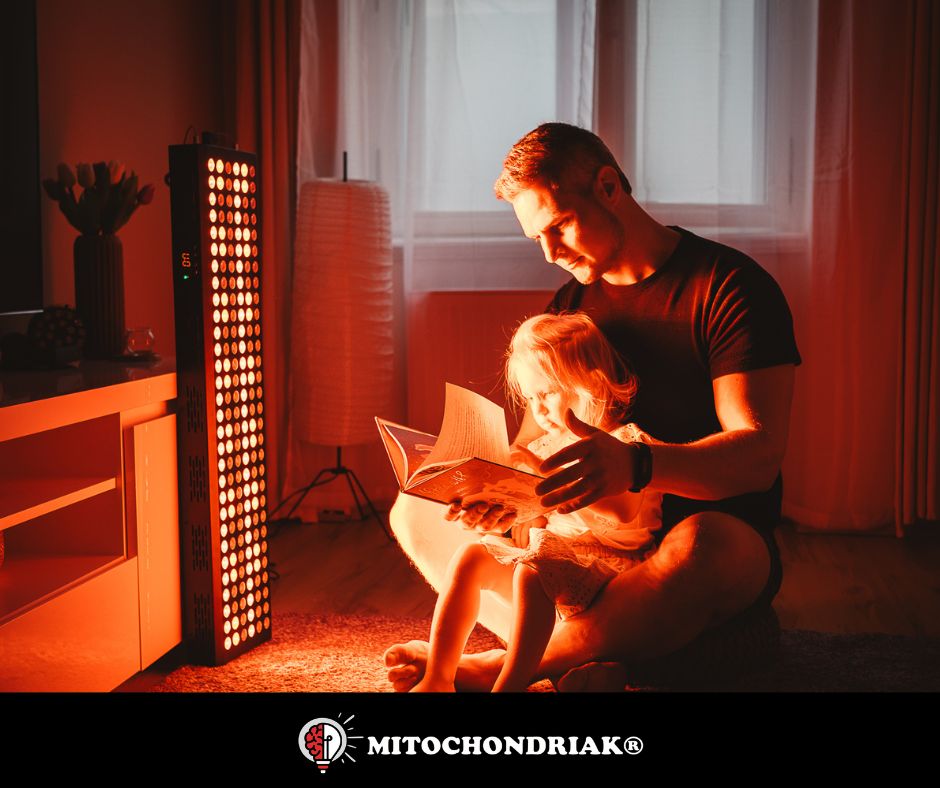
Excessive blue light exposure in children manifests as a combination of sleep, visual, and behavioral symptoms that parents often attribute to other causes. If you notice several of these in your child simultaneously, blue light may be the primary trigger.
Sleep symptoms
- Difficulty falling asleep (the child is tired but cannot fall asleep even 30 to 60 minutes after bedtime)
- Night awakenings and shallow, poor-quality sleep
- Morning fatigue even after sufficient time in bed
- Shifted sleep schedule (the child falls asleep later and later)
Visual symptoms
- Dry and irritated eyes after extended screen time
- Headaches, especially in the forehead area and behind the eyes
- Frequent blinking or eye rubbing
- Difficulty focusing when switching from a screen to distant objects
Behavioral symptoms
- Increased irritability and outbursts of anger, especially after extended screen time
- Concentration problems at school during the morning
- Reduced interest in physical activities and preference for passive screen time
A systematic review of 67 studies from 2015 confirmed that screen time is negatively associated with sleep (shortened duration and delayed sleep onset) in 90% of cases. [R] If you recognize these symptoms, it is time to change your child's evening routine.
How much screen time is too much?
Safe screen time depends on the child's age and timing. One hour of tablet use at 10:00 AM carries different risks than the same hour at 8:00 PM. The key factor is not just total time, but primarily when and under what lighting conditions the child uses the screen.
General recommendations for total screen time:
- Under 2 years: no screen time (except video calls with family)
- 2 to 5 years: maximum 1 hour per day, always during daytime only
- 6 to 12 years: 1 to 2 hours per day, with emphasis on stopping at least 1.5 to 2 hours before bedtime
- 13 to 17 years (teenagers): individual, but an evening digital detox is essential
More important than total hours, however, is evening exposure. A 2025 study demonstrated that blue light exposure after 9:00 PM has a significantly more negative impact on sleep and cognitive function than the same exposure during earlier evening hours. [R]
If your child must use a computer in the evening (for example, for homework), minimize blue light by using blue light blocking glasses, enabling night mode on the screen, and using red lighting in the room. More practical advice follows in the next section.
7 practical tips for parents
Completely eliminating screens from children's lives is not realistic. However, there are 7 specific steps that will significantly reduce the negative impact of blue light on your child, without having to ban technology entirely.
1. Establish an evening digital curfew
The most effective measure is also the simplest. Turn off all screens at least 1.5 to 2 hours before bedtime. Replace them with reading, drawing, board games, or conversation under red light. Children quickly adopt a new ritual when it is paired with an enjoyable activity.
2. Enable night mode on all devices
Set tablets, phones, and computers to automatic night mode (Night Shift, Night Light) from 6:00 PM or from sunset. These modes reduce the blue light component on the display. They are not perfect, however, as they still allow some of the blue-green spectrum through.
3. Change the evening lighting in your child's room
Standard LED and CFL bulbs have a high blue light component (peak around 450 nm), which disrupts melatonin just like a screen. In the evening hours, switch to red circadian bulbs that emit no blue or green spectrum. More about bulbs can be found below in the section on safe bulbs.
4. Increase daytime exposure to natural sunlight
Paradoxically, one of the best ways to mitigate the negative effects of blue light in the evening is sufficient exposure to daylight in the morning. Morning light (ideally direct sunlight) sets the child's circadian rhythm and increases their resilience against evening disruptions. Aim for at least 30 to 60 minutes outdoors in the morning.
5. Follow the 20-20-20 rule
During the day, when your child uses a screen, apply the rule: every 20 minutes, look at an object at least 20 feet (6 meters) away for 20 seconds. This simple exercise reduces eye fatigue and prevents excessive eye strain.
6. Create a screen-free zone in the bedroom
An ideal children's bedroom contains no display. If that is not possible (shared room), at least ensure devices are charged out of reach of the bed. Cover even standby LEDs and charger lights with opaque tape.
7. Consider blue light blocking glasses
For situations when screens cannot be avoided (homework, car rides with a tablet), quality blue light blocking glasses are an effective solution. Research from 2025 demonstrated that wearing blue light blocking glasses in the evening shifts the onset of melatonin production and makes falling asleep easier. [R] However, quality matters. Details in the next section.
When to consider blue light blocking glasses for your child?
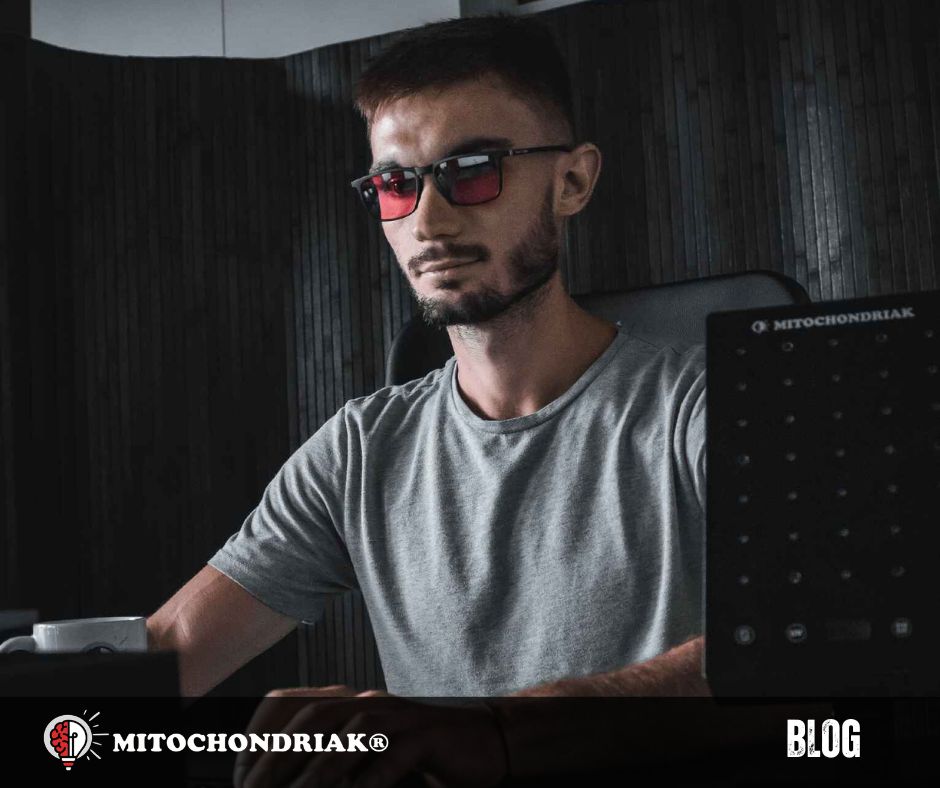
Blue light blocking glasses make sense when evening screen exposure cannot be completely avoided and when the child shows signs of disrupted sleep. They are not a replacement for proper light hygiene, but an effective complement.
Consider them if your child:
- Must work on a computer in the evening (homework, school projects)
- Has trouble falling asleep after using a screen
- Travels in a car in the evening and watches a tablet or phone
- Is exposed to bright LED lights in shopping centers, restaurants, or after-school activities
Not all glasses are equal, however. Most cheap "anti blue light" glasses block only a small portion of the blue spectrum (around 10 to 30%) and do not block green light at all. Green light (around 500 to 550 nm) also suppresses melatonin, although less intensely than blue.
Kids blue light blocking glasses Mitochondriak® have dark red lenses that block both blue and green light up to 550 nm. They are designed for children from approximately 5 years of age, have flexible ear hooks, and are durable enough for active use.
Glasses are most effective when the child starts wearing them 1.5 to 2 hours before the planned bedtime. It is important that they are worn consistently, not just occasionally.
Which bulb is safe for a child's bedroom in the evening?
A red LED bulb without blue and green spectrum is the only bulb that does not disrupt melatonin production in a child. Standard LED bulbs, even "warm white" ones, still contain a significant blue light component.
A standard "warm white" LED bulb with a color temperature of 2,700 K still has a pronounced emission peak in the blue spectrum around 450 nm. This means that even though the light appears visually yellow or orange, it contains enough blue photons to suppress melatonin in a child whose lens practically does not filter them.
Circadian red bulbs Mitochondriak® are designed to emit light exclusively in the red spectrum without blue and green wavelengths. The child can see well enough for reading, drawing, or getting ready for bed, but their brain receives a clear signal that it is nighttime and time for sleep.
Practical tips for lighting a child's room:
- During the day: maximize natural light (open curtains, ideally direct sunlight)
- Early evening (from 6:00 PM): dim the main lighting and switch on a red bulb
- During the night: if the child needs a nightlight, choose red or orange, never white or blue
The combination of red bulbs and blue light blocking glasses creates an environment in which the child's body naturally produces melatonin and transitions into sleep mode without artificial disruption.
Protect your child's sleep from blue light
Kids blue light blocking glasses Mitochondriak® block both blue and green light up to 550 nm and are designed specifically for children from age 5. Combined with red circadian bulbs, you create an environment where your child falls asleep more easily and sleeps more deeply.
Frequently Asked Questions
Why are children more sensitive to blue light than adults?
A child's crystalline lens is significantly more transparent than an adult's. In a 4.5-year-old child, it transmits up to 96% of visible light, including the blue spectrum. [R] With age, the lens gradually yellows and filters out more and more blue light. Children also have larger pupils, so more light reaches the retina overall. This means the same screen has a much stronger biological impact on a child than on an adult.
From what age can children wear blue light blocking glasses?
Kids blue light blocking glasses Mitochondriak® are suitable for children from approximately 5 years of age. They have flexible ear hooks adapted for a child's head. For younger children, it is more effective to limit screen time and use red bulbs for evening room lighting.
How many hours of screen time per day is safe for a child?
For children under 2, the recommendation is no screen time. For children 2 to 5, a maximum of 1 hour per day. For school-age children 6 to 12, 1 to 2 hours. More important than total time, however, is timing. A screen 2 hours before bedtime has a significantly more negative impact than the same time in the morning.
How does blue light affect a child's sleep?
Blue light activates melanopsin receptors in the retina, which signal to the brain that it is daytime. This suppresses melatonin production, the hormone needed for falling asleep. In children, this suppression is up to twice as strong compared to adults. [R] The result is later sleep onset, shallower sleep, and morning fatigue.
Do blue light blocking glasses help children with sleep problems?
Yes, provided the glasses block the entire blue and green spectrum up to 550 nm. A 2025 study demonstrated that wearing blue-blocking glasses in the evening shifted the onset of melatonin production and made falling asleep easier. [R] Cheap glasses with clear or light yellow lenses block only a small portion of the spectrum and have no significant effect.
Why can't my child fall asleep after using a tablet?
A tablet emits intense blue light that suppresses melatonin. Additionally, interactive content (games, videos, social media) stimulates the brain and raises cortisol and dopamine levels. The combination of light and psychological stimulation creates a state in which the child's body simply does not receive the signal for sleep.
What are the symptoms of excessive blue light exposure in children?
The most common include difficulty falling asleep, morning fatigue, headaches, dry eyes, increased irritability, and concentration problems. A systematic review of 67 studies confirmed the negative impact of screen time on sleep in 90% of cases. [R]
Is blue light harmful to a child's eyes long-term?
What we know with certainty is that blue light has a measurable negative impact on sleep, melatonin, and the circadian rhythm in children. Given that children's lenses filter blue light far less effectively, caution is warranted. Experts recommend minimizing unnecessary exposure, especially during evening hours.
What should I do when my child cannot live without screens?
Suddenly removing screens usually does not work. A more effective approach is gradual reduction paired with offering alternatives. Establish fixed "screen-free" periods (e.g. 1.5 hours before bedtime), offer shared activities (reading, games), and let the child co-create the rules. What matters more than a total ban is eliminating evening exposure. The child should also be regularly exposed to sunlight, which naturally reduces screen dependency.
Which bulb is safe for a child's bedroom in the evening?
The only truly safe evening bulb is a red LED bulb without blue and green spectrum. Standard "warm white" LED bulbs (2,700 K) still contain a blue emission peak around 450 nm that suppresses melatonin. Circadian red bulbs Mitochondriak® emit exclusively red light, making them the ideal choice for children's rooms.
Sources and References
- Artigas JM et al. (2012). Spectral Transmission of the Human Crystalline Lens in Adult and Elderly Persons. Investigative Ophthalmology & Visual Science. Link to study
- Lee S et al. (2018). Melatonin suppression and sleepiness in children exposed to blue-enriched white LED lighting at night. Physiological Reports. Link to study
- Hartstein LE et al. (2025). The Circadian Response to Evening Light Spectra in Early Childhood. Current Biology. Link to study
- Hale L, Guan S (2015). Screen time and sleep among school-aged children and adolescents: A systematic literature review. Sleep Medicine Reviews. Link to study
- Souissi MA et al. (2025). Impact of evening blue light exposure timing on sleep, motor performance, and cognitive function. Scientific Reports. Link to study
- Sanchez-Cano A et al. (2025). Comparative Effects of Red and Blue LED Light on Melatonin Secretion. Clocks & Sleep. Link to study
- Maeda-Nishino NJ et al. (2025). Partial blue light blocking glasses at night advanced sleep onset and melatonin levels. Scientific Reports. Link to study
- Kohnen T et al. (2024). Blue Light Filtration in Intraocular Lenses: Effects on Visual, Refractive, and Clinical Outcomes. Journal of Clinical Medicine. Link to study