.png)
More daylight should mean more energy, so why can spring leave you feeling drained? Spring fatigue often reflects a mismatch between the changing outdoor light environment and the signals reaching your circadian rhythm. By adjusting morning light, daytime exposure and evening lighting, you can help your body regain a clearer rhythm for energy, focus and sleep.
- Why longer spring days do not automatically translate into more energy.
- How morning light and evening darkness help synchronize your internal biological clock.
- Why a day spent indoors can leave your brain without a clear seasonal light signal.
- How red evening lighting can support a calmer transition from activity to sleep.
- Which simple lighting changes can make your home more compatible with human biology.
- Why can you feel tired when spring brings more daylight?
- How does light control your circadian rhythm?
- Why can energy remain low during the day?
- What is the most useful morning light habit?
- Why does evening lighting matter for sleep?
- How is red light different from conventional evening lighting?
- How can you improve your home lighting?
- How can light fit into your daily routine?
- Frequently asked questions about spring fatigue and light

Why can you feel tired when spring brings more daylight?
Spring fatigue can appear when the seasonal light environment changes faster than your daily routine. The days become longer and brighter, but your body may still spend most of its time indoors under artificial light. The calendar says spring, while your biological clock continues receiving an unclear mixture of weak daytime light and bright evening light.
During winter, your body adapts to shorter days and lower natural light intensity. In spring, sunrise shifts, daylight lasts longer and outdoor light becomes more intense. Yet glass, indoor architecture and artificial lighting can significantly change the light signal that reaches your eyes and skin.
The result may be daytime tiredness, reduced concentration, irritability or difficulty winding down at night. This does not mean that you lack discipline. It may simply mean that your internal clocks are not receiving a strong distinction between morning, day and evening.
How does light control your circadian rhythm?
Light is the primary environmental signal used by your brain to coordinate the roughly 24 hour circadian rhythm. Light entering the eyes is detected by specialized retinal cells, which communicate with the suprachiasmatic nucleus in the brain. This master clock helps coordinate sleep, wakefulness, hormone timing, body temperature and daily patterns of metabolism.
Morning and daytime light tell the body that the active part of the day has begun. Darkness and the disappearance of short wavelength light in the evening signal that biological night is approaching.
This is why light cannot be reduced to brightness alone. Timing, intensity and spectrum all matter. A bright screen at night and sunlight in the morning may both look like light, but they carry very different biological information.
For a deeper explanation of this internal timing system, read our guide to circadian rhythm and how to optimize it.
Why can energy remain low during the day?
Your daytime energy depends partly on whether your body receives a clear daytime signal. A person can spend eight hours awake yet experience only a fraction of the natural light available outdoors. The brain then receives a weaker contrast between day and night, which can make alertness and sleep timing less stable.
Energy is produced inside mitochondria, the cellular structures that convert nutrients and oxygen into usable energy. Mitochondria respond to many environmental inputs, and light is one of them.
Standard indoor LED lighting often lacks much of the red and infrared spectrum naturally present outdoors. At the same time, it can provide concentrated short wavelength light at biologically inappropriate hours. This combination creates an environment unlike the sunlight, firelight and darkness under which human biology evolved.
Natural daylight is richer and changes continuously throughout the day. Morning light is different from midday light, and sunset is different from a ceiling lamp. When these transitions disappear indoors, energy may feel less stable even though you are technically exposed to light all day.

What is the most useful morning light habit?
Going outdoors soon after waking is one of the simplest ways to give your biological clock a clear morning signal. Outdoor light is usually much stronger than indoor lighting, even when the sky is cloudy. It helps establish the beginning of your biological day and creates stronger contrast with the evening.
You do not need to stare directly at the sun. Spend time outdoors, allow natural light to enter your eyes normally and combine it with an easy walk whenever possible. A window is better than a dark room, but being outside gives you a broader and more natural spectrum.
Morning light also makes the evening easier. A clearly defined morning gives the body a reference point from which daily alertness and the later transition toward sleep can unfold.
Why does evening lighting matter for sleep?
Evening light can delay the body’s transition toward biological night, especially when it contains a strong blue component. Laboratory research has shown that light from LED screens can suppress melatonin, increase evening alertness and shift circadian timing when used before sleep.
This does not mean that all blue light is harmful. Blue light is a natural and valuable part of sunlight during the day. The problem is inappropriate timing. After sunset, bright white LEDs, phones, tablets and televisions continue sending a daytime-like signal when your environment should gradually become darker and warmer.
The practical goal is therefore not to fear light. It is to restore contrast:
- Morning: seek natural outdoor light.
- Daytime: work near daylight and spend regular time outdoors.
- Evening: reduce brightness and remove unnecessary blue and green light.
- Night: keep the bedroom as dark as possible.
How is red light different from conventional evening lighting?
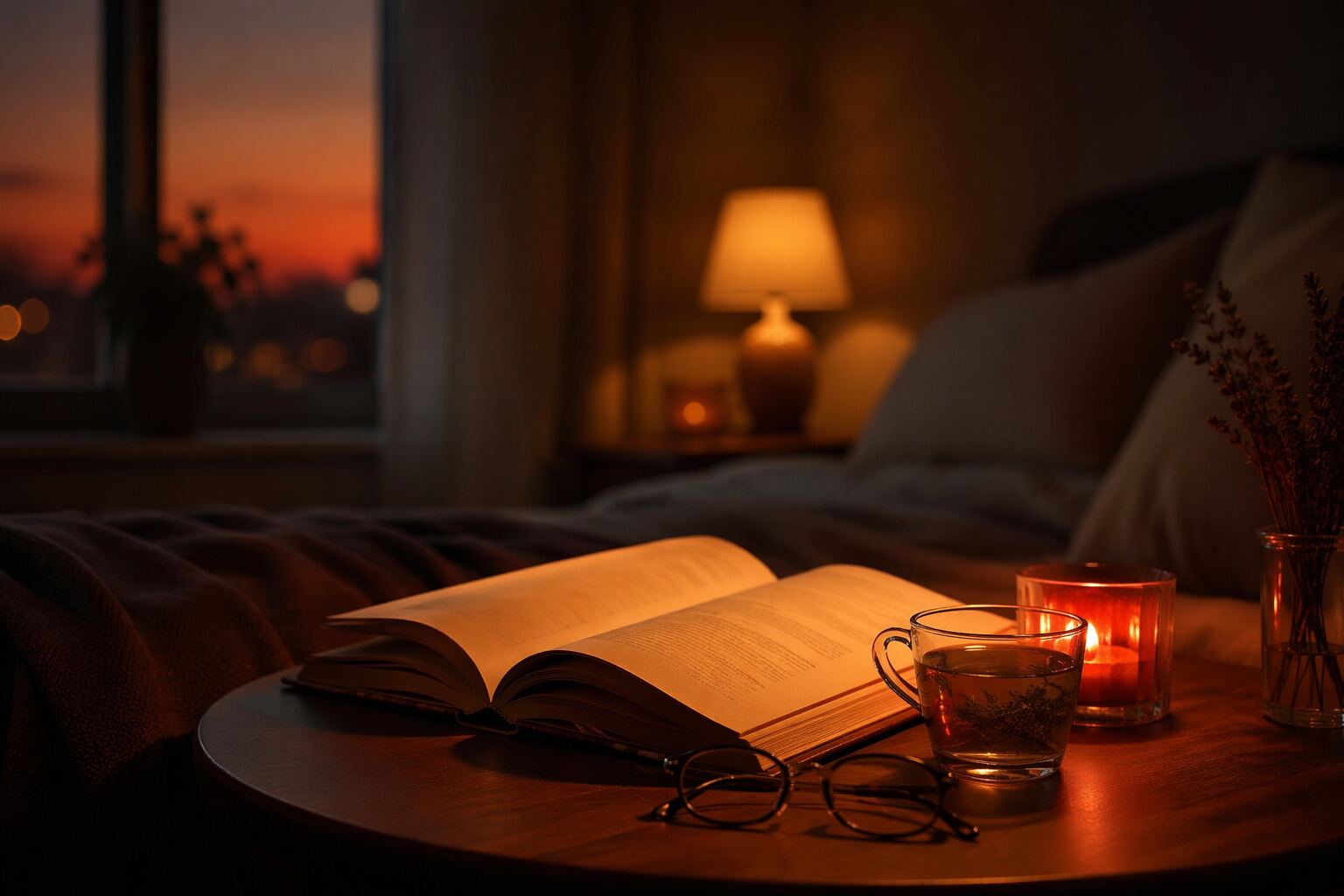
Red evening light provides visibility without recreating the same short wavelength signal produced by cool white LEDs. It helps preserve a warmer, calmer visual environment and makes the transition from daytime activity to darkness more natural.
Most households use the same ceiling lights in the evening that they use in the morning. Biologically, that is like leaving the daytime switch permanently on. Red lighting creates a different atmosphere. It is softer, less glaring and more compatible with reading, preparing for bed or moving through the home after sunset.
Red evening lighting and red light therapy should not be confused. A red household bulb is designed mainly to illuminate a room without blue and green light. A photobiomodulation device uses specific red and near infrared wavelengths at a much higher intensity for targeted light exposure.
The original principle remains simple: use rich natural light during the day and progressively warmer, dimmer light in the evening.
How can you improve your home lighting?
You do not need to rebuild your entire home to create a more biologically appropriate light environment. Begin with the rooms you use most after sunset, such as the bedroom, living room, bathroom and hallway. Replace the brightest evening light sources first.
During the day, prioritize windows, outdoor breaks and spectrally richer lighting. Incandescent lighting can also provide a warmer spectrum with an infrared component that conventional cool white LEDs lack.
In the evening, the Mitochondriak® range of indoor lighting solutions without blue light includes several socket types:
- Evening red bulb Mitochondriak® E27 for standard household lamps.
- Evening red bulb Mitochondriak® E14 for smaller lamp sockets.
- Evening red bulb Mitochondriak® Gu10 for compatible spot fixtures.
- Red self-adhesive filtering film for small indicator lights and illuminated appliances.
These changes are not only useful during spring. They help create a consistent difference between daytime and evening throughout the year.
How can light fit into your daily routine?
The most effective light routine is usually the one simple enough to repeat every day. You do not need a complicated protocol. Focus on creating reliable environmental signals that your body can recognize.
- Go outside after waking. Let natural morning light mark the beginning of the day.
- Take daylight breaks. Do not allow the screen to become your strongest daytime light source.
- Dim your home after sunset. Reduce both brightness and overhead lighting.
- Switch to red evening bulbs. Use them in the rooms where you spend the final part of the day.
- Protect yourself when screens are unavoidable. Wear Blue light blocking glasses Mitochondriak® during evening screen use.
- Sleep in darkness. Cover small indicator lights and remove unnecessary light sources from the bedroom.
Spring fatigue is not necessarily a sign that you need another stimulant. It can be a sign that your body has lost the contrast between day and night. Restore that contrast, and your biological clock receives a clearer map of where it is in time.
Create an evening environment that supports your rhythm
Morning sunlight starts the biological day. Warm, red evening lighting helps the home move in the opposite direction. Explore lighting designed to remove unnecessary blue and green light after sunset.
Frequently asked questions about spring fatigue and light
Is spring fatigue a real biological phenomenon?
Spring fatigue describes a real pattern of tiredness, reduced concentration or disrupted sleep reported during seasonal change. It is not a single medical diagnosis with one universal cause. Changes in daylight timing, indoor routines, sleep schedules and seasonal behaviour can all influence how energetic you feel.
Can a disrupted circadian rhythm make you tired during the day?
Yes. When your biological clock receives weak morning and daytime light but strong artificial light in the evening, sleep timing and daytime alertness can become less stable. A clearer contrast between bright natural days and dark evenings helps your internal clocks distinguish when to be active and when to slow down.
Does red light increase melatonin?
Red evening light is useful mainly because it avoids much of the blue and green spectrum that strongly stimulates the daytime light response. It should not be treated as a drug that directly forces melatonin production. Its practical value lies in creating an evening environment that is less disruptive than bright white or blue-rich lighting.
Should you use red light during the day?
Red and infrared light are natural parts of daylight, but a dark red room is not a replacement for outdoor daytime light. During the day, seek natural full-spectrum light and spend time outside. Red household bulbs are designed mainly for the evening, when you want visibility without maintaining a strong daytime signal.
What is the easiest first step against spring fatigue?
Begin with morning outdoor light and a darker evening. Go outside soon after waking, take at least one daylight break during the day and reduce bright white lighting after sunset. This creates a stronger daily light rhythm without supplements, complex equipment or a complete renovation of your home.
Sources and references
- Chang AM, Aeschbach D, Duffy JF, Czeisler CA. Evening use of light-emitting eReaders negatively affects sleep, circadian timing and next-morning alertness. Proceedings of the National Academy of Sciences. 2015. PubMed
- Cajochen C, Frey S, Anders D, et al. Evening exposure to a light-emitting diodes backlit computer screen affects circadian physiology and cognitive performance. Journal of Applied Physiology. 2011. PubMed
- Blume C, Garbazza C, Spitschan M. Effects of light on human circadian rhythms, sleep and mood. Somnologie. 2019. PubMed
- Duffy JF, Czeisler CA. Effect of light on human circadian physiology. Sleep Medicine Clinics. 2009. PubMed