.png)
Cortisol is not your enemy. It is the morning energy hormone that gets you out of bed and starts your day. The problem appears when cortisol is elevated in the evening instead of in the morning, and this shift has one main cause: lack of natural morning light. In this article we explain exactly how light controls your cortisol and how to restore a healthy circadian rhythm with a morning protocol.
What you will learn in this article
- What cortisol is: the morning hormone of energy and concentration with a natural daily rhythm and a peak 30 to 45 minutes after waking (CAR, cortisol awakening response)
- The light and cortisol mechanism: how photons activate melanopsin in the retina, the signal travels through the SCN to the adrenal glands and triggers the cortisol cascade
- Cortisol and melatonin relationship: two antagonists who hand over the shift to each other in the morning and in the evening
- Inverted cortisol profile: why so many people today have low cortisol in the morning and high in the evening, and how it relates to artificial blue light
- Mitochondriak® morning light protocol: 5 steps to restore CAR and stable energy throughout the day
- What is cortisol and why is it not just a stress hormone?
- Cortisol awakening response (CAR): the key event of the first hour of the day
- How does light control cortisol step by step?
- Cortisol and melatonin: two antagonists that govern your day
- Why so many people have an inverted cortisol profile today?
- How to amplify CAR naturally with a morning protocol?
- How does red and NIR light from an infrared panel affect cortisol?
- When is low morning cortisol not just about light?
- Frequently asked questions
What is cortisol and why is it not just a stress hormone?
Cortisol is a steroid hormone produced in the adrenal cortex, which the body needs for daily energy, concentration, blood sugar regulation and immune response. The label "stress hormone" is a misleading simplification: cortisol is not synthesized only in response to stress, it has a clear diurnal rhythm with a peak in the morning and the lowest level before midnight. Without morning cortisol you would not even be able to wake up reliably.
The 5 main roles of cortisol in the body
- Energy and metabolism: cortisol mobilizes glucose from liver stores so that you have readily available energy in the morning
- Stable blood sugar: it keeps blood glucose in a reasonable range during the overnight fast
- Anti inflammatory and immune modulation: it dampens excessive inflammatory reactions, the morning has a high anti inflammatory potential
- Salt and water balance: together with aldosterone it maintains blood pressure and hydration
- Alertness and cognition: the morning cortisol peak is linked to better attention and memory in the first hours of the day
Why "stress hormone" is a misleading name
Cortisol does rise in response to physical and psychological stress, but this is a short term adaptive response, not a defect. The problem is chronically elevated or dysregulated cortisol during the day, which manifests as burnout, anxious mood and poor sleep. The solution is not to "lower cortisol", but to restore its healthy daily rhythm.
Diurnal cortisol curve during the day
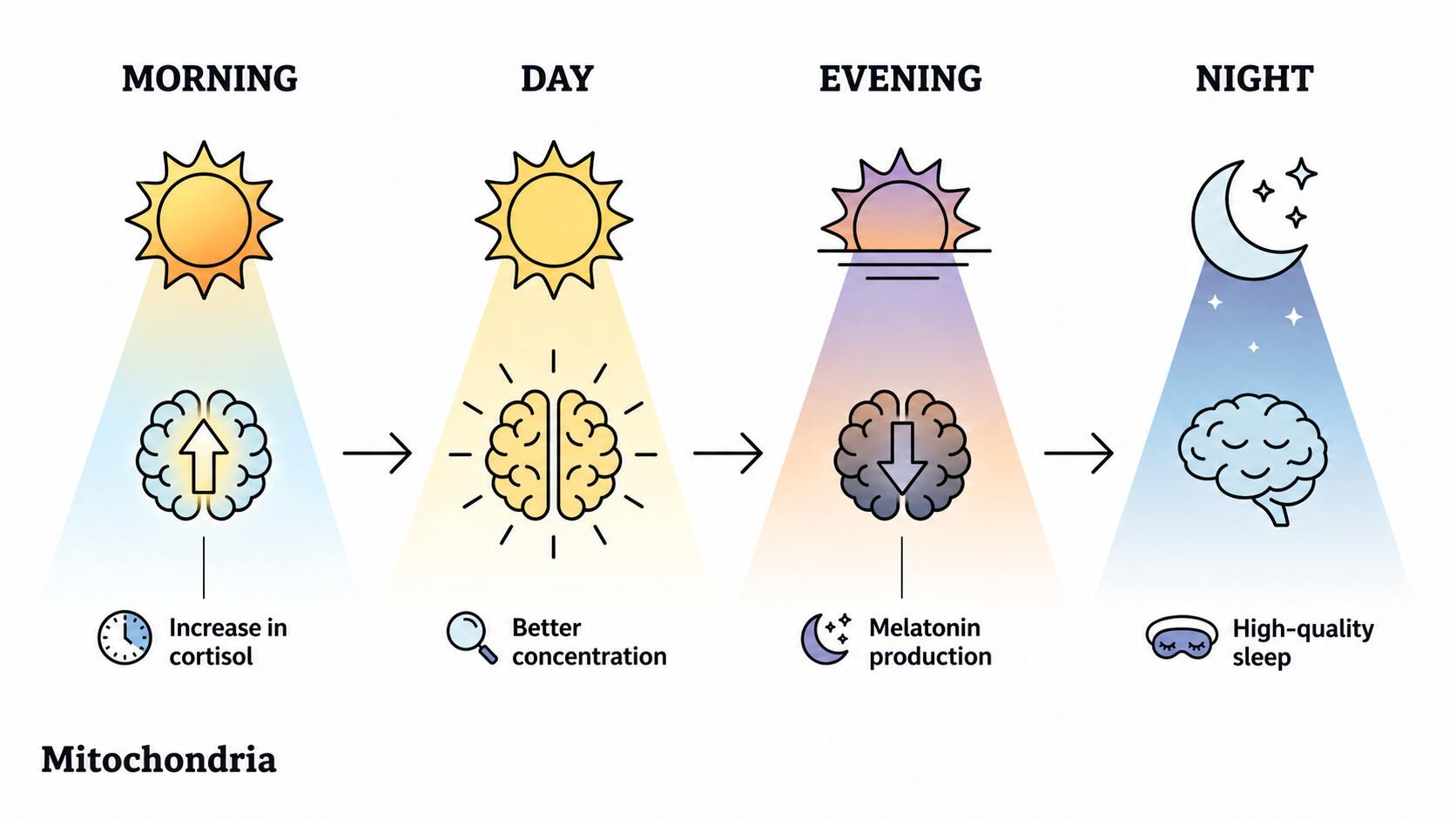
A healthy cortisol curve has a clear shape: the level rises sharply in the first hour after waking (CAR), gradually decreases during the day and reaches its minimum around midnight so the body can shift into regeneration. A flat or inverted curve has been linked in meta analyses to worse mental and physical health. [R]
Cortisol awakening response (CAR): the key event of the first hour of the day
Cortisol awakening response (CAR) is a specific rise in cortisol that occurs 30 to 45 minutes after waking. In a healthy person, the cortisol level in this window rises by roughly 50 to 75 % compared to the value at waking. CAR is distinct from the regular circadian curve and serves as a biological "starter" for energy, concentration and glycemic readiness for the day. [R]
What is the difference between healthy and blunted CAR?
A healthy CAR means a pronounced rise of cortisol in the first half hour after waking and a gradual decline during the day. A weakened or "blunted" CAR shows a minimal morning rise and often a "flat" curve during the day. It is exactly this flat curve that long term studies link with burnout, depressive symptoms and worse sleep quality. [R]
Why a strong CAR means an energetic day?
A strong CAR prepares the body for the active phase of the day: it increases glucose availability in the blood, supports alertness through brainstem activation and modulates the immune system. People with a strong CAR describe a clearer morning, better motivation and a more stable mood in the first hours. On the other hand, morning fatigue and a "crash" before ten often relate exactly to insufficient CAR.
Light as a CAR modulator
CAR is not determined only by the circadian rhythm: it is strongly modulated by light reaching the retina in the first 30 to 60 minutes after waking. The Petrowski et al. (2019) study showed that light exposure after waking influences both the size and time course of CAR in healthy adults. [R] The classic Scheer and Buijs (1999) work was the first to show that bright morning light raises salivary cortisol by approximately 35 % compared to dim light. [R]
How does light control cortisol step by step?
Light controls cortisol through a direct neural circuit: a photon enters the eye, activates special retinal cells, the signal travels to the circadian clock center in the brain, from there through the hypothalamus to the pituitary and finally to the adrenal glands, where cortisol is released. This circuit is called the HPA axis and light is its strongest external trigger.
Step 1: A photon activates melanopsin in retinal ipRGC cells
In the retina there are intrinsically photosensitive retinal ganglion cells (ipRGCs) that contain the pigment melanopsin. These cells do not serve vision but circadian signaling, their main role is to measure the intensity of ambient light and send this information to the brain. Melanopsin is most sensitive to wavelengths around 480 nm (blue light), which is why blue light in the evening has such a strong suppressive effect on melatonin. [R]
Step 2: The signal travels to the SCN, the master clock of the body
From the ipRGC cells, the signal travels through the optic nerve directly to the suprachiasmatic nucleus (SCN) in the hypothalamus. The SCN is the circadian pacemaker of the body, that is the master biological clock mechanism that synchronizes dozens of peripheral clocks in every organ. Without a light input, the SCN would gradually "drift" out of the 24 hour cycle.
Step 3: The SCN activates the HPA axis
After receiving the light signal, the SCN activates the hypothalamus, pituitary, adrenals (HPA) axis. The hypothalamus releases corticotropin releasing hormone (CRH), the pituitary responds by releasing adrenocorticotropic hormone (ACTH) and that travels through the blood to the adrenal glands. The whole cascade takes minutes.
Step 4: The adrenal glands release cortisol and CAR is born
After receiving ACTH, the adrenal glands begin to release cortisol into the bloodstream. In combination with the morning light signal, an amplified CAR is created, which prepares the body for the day. Bowles et al. (2022) demonstrated in an experiment that the circadian system modulates CAR independently of behavior and sleep, while light remains the strongest external trigger. [R]
Why light intensity (lux) is critical
For the light signal to trigger the HPA axis and amplify CAR, it needs to reach sufficient intensity on the retina. Common indoor lighting provides 100 to 300 lux, a cloudy sky outside 5,000 to 10,000 lux and direct morning sun 30,000 to 100,000 lux. This is exactly why 10 minutes outside is worth more in the morning than an hour at the window in a room. The Figueiro and Rea (2012) study showed that an hour of exposure to 800 lux of white light in the morning raised cortisol by 35 % compared to dim light. [R]
Cortisol and melatonin: two antagonists that govern your day
Cortisol and melatonin work as two antagonists in a 24 hour choreography. When one rises, the other falls. Their "shift handover" happens twice a day: in the morning when waking and in the evening at dusk. If this choreography is disrupted, the result is insomnia, morning fatigue and chronically elevated stress.
Inverse relationship: when cortisol rises, melatonin falls
Melatonin is the hormone of darkness and sleep, peaking around midnight to 3 a.m. Cortisol is the hormone of light and activity, peaking in the first hour after waking. In a healthy rhythm they never meet at high levels at the same time: when cortisol rises, melatonin is already falling, and vice versa. This antagonism is biologically elegant and critically dependent on light.
Morning shift handover
In the morning during light exposure, melatonin drops quickly and cortisol rises sharply. The SCN gets a strong "it is day" signal and activates the HPA axis. If light is missing in the morning (closed curtains, dark bedroom, no time outside), melatonin persists longer and CAR is weakened. The result is the feeling of a "broken morning" and difficulty starting up even after coffee.
Evening shift handover
In the evening with dim light, cortisol gradually falls and after sunset melatonin starts to rise. This transition is extremely sensitive to artificial blue light from screens and ceiling lighting, which activates melanopsin, suppresses melatonin and keeps cortisol levels higher than they should be.
What happens when this rhythm is disrupted
If you chronically disrupt the morning and evening light signals, the body shifts into a phase shift: cortisol is high in the evening, melatonin is low, you have trouble falling asleep, sleep is shallow, mornings are tired. This state is in the literature linked to burnout, depressive symptoms and metabolic dysregulation. [R]
Why so many people have an inverted cortisol profile today?
The inverted cortisol profile is a state where cortisol is lower in the morning than it should be, and higher in the evening. Subjectively it shows up as the feeling "I am wrecked until ten and then revved up at ten in the evening". In today's modern environment this is a mass epidemic, and the main cause is the disruption of light signals during the day and in the evening.
Main causes in modern life
- Living indoors during the day: an average person spends 90 % of the day inside at 100 to 500 lux, which is too little for a strong CAR
- Artificial blue light in the evening: screens, ceiling LEDs and the fridge with bright white light at night, all activate melanopsin and shift the cortisol curve
- Shifted sleep window: falling asleep after midnight pushes the entire HPA axis into later hours and weakens the morning peak
- Chronic psychological stress: long term activation of the HPA axis leads to a "flattened" response, the body adapts and CAR is reduced
- Shift work and jet lag: repeated shifting of the cycle disrupts the synchronization of the SCN with reality
Symptoms of weakened CAR and inverted profile
If you need two coffees in the morning to "get going", have an afternoon crash around two, get a second wind in the evening after eleven and even though exhausted you cannot fall asleep, there is a high probability that your cortisol curve is shifted. The Adam et al. (2017) study confirmed that a flat diurnal cortisol curve correlates with worse mental and physical health in 10 of 12 monitored health indicators. [R]
Connection to burnout and chronic fatigue
Long term "burning" of the HPA axis does not lead to permanently elevated cortisol, but on the contrary to a blunted CAR and a flat curve. The body stops reacting to common stimuli. This state is in the literature described in burnout, chronic fatigue syndrome and depression. The solution is not just "rest" but active restoration of the light signal.
How to amplify CAR naturally with a morning protocol?
The best way to restore healthy CAR is a 5 step morning protocol based on light, movement and contact with the ground. The principle is simple: give the body a clear "it is day" signal in the first hour after waking so the HPA axis launches its natural cascade. The protocol works in 1 to 4 weeks with consistent application.
Step 1: Avoid blue light for the first 5 to 10 minutes
Right after waking, avoid screens and bright artificial lighting. The morning cortisol peak is most sensitive in the first minutes and exposure to artificial blue light before natural sunlight can shift or blunt CAR. Give your body a moment to "wake up" in the same light environment in which it fell asleep.
Step 2: Get outside for natural light within 30 to 60 minutes
The goal is 10 to 20 minutes outside, ideally before breakfast. Even an overcast sky provides 5,000 to 10,000 lux, which is 20 to 50 times more than indoors. Go to the balcony, the garden or for a short walk around the block. This single step is the strongest part of the entire protocol.
Step 3: Add red and NIR light therapy from an infrared panel
In winter, in bad weather or if you have to go to a dark office in the morning, use the Mitochondriak® infrared panel. The Mekschrat et al. (2024) study compared the effect of red and blue light after waking and showed a different profile of HPA axis response and inflammatory markers. [R] Red and NIR light provide a gentle circadian signal and at the same time support mitochondrial ATP production, which is key for morning energy.
Step 4: Grounding and hydration
A short barefoot walk on grass, a wooden terrace or the ground connects the body with the electrical charge of the Earth and supports parasympathetic tone. Add a glass of plain water right after waking (the body is dehydrated after the overnight fast, which alone can mimic the feeling of fatigue).
Step 5: Movement before breakfast
A short walk, gentle exercise or a few squats in the morning amplify the effect of light and speed up the activation of metabolism. You do not need an intense workout, 10 to 15 minutes of movement outside is enough.
How does red and NIR light from an infrared panel affect cortisol?
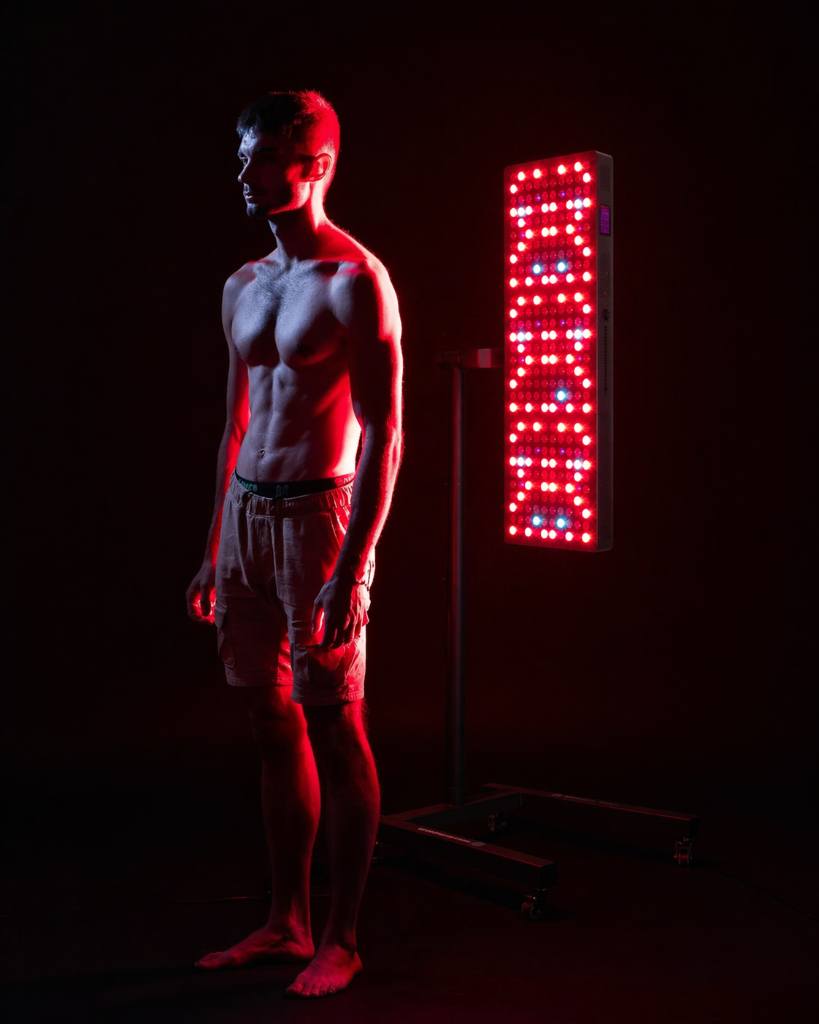
Red and near infrared light acts on cortisol via two pathways: through the retina (a mild circadian signal for the SCN) and through photobiomodulation of mitochondria in cells (higher ATP production, better energy reserve for the functioning of the HPA axis). Unlike bright blue light, the morning infrared panel does not act aggressively, but provides a gentle and synergistic complement to natural sunlight.
Mechanism: photobiomodulation plus circadian signal
Wavelengths 630 to 850 nm activate the enzyme cytochrome c oxidase in the mitochondria, which increases ATP synthesis. Higher cellular energy supports adrenal gland function and shows up as a more stable cortisol level during the day. We described the detailed mechanism in the article How mitochondria produce energy (ATP).
Studies on light, wavelengths and the cortisol response
Petrowski et al. (2021) showed that bright light and blue light raise the cortisol stress response more than dim white or red light, which makes red light a suitable morning tool without an abrupt stress impact. [R] Mekschrat et al. (2024) added that red light after waking shows a different profile of inflammatory markers than blue light. [R]
Why morning sun plus an infrared panel works synergistically
Sunlight provides high intensity (lux) for the circadian signal, the infrared panel provides a targeted wavelength for mitochondrial support. Together they cover both pathways through which light improves your cortisol response: the signaling one (through the retina to the SCN) and the energetic one (through cells to the adrenal glands). The Mitochondriak® Maxi Upgraded infrared panel contains 7 wavelengths (630, 670, 760, 810, 830, 850 and 940 nm) and illuminates half of the body at once at a distance of 45 to 60 cm for 10 to 20 minutes.
When is low morning cortisol not just about light?
Light is the strongest external modulator of cortisol, but it is not the only one. If after several weeks of a consistent morning protocol extreme fatigue persists, it is reasonable to also check other causes and if needed consult a doctor.
Burnout and chronic stress
Long term psychological burden leads to adaptive blunting of the HPA axis. The body stops reacting even to common stimuli and CAR "flattens". In this case it is necessary to also address mental hygiene, boundaries and recovery, not only light.
Sleep apnea and poor sleep quality
In sleep apnea the body wakes up repeatedly due to breathing pauses, which destabilizes the HPA axis and weakens CAR. If you snore, have a dry mouth in the morning and headaches, it is appropriate to undergo a sleep examination.
Nutritional causes
A lack of protein in the morning, high intake of fast sugars and chronic dehydration can mimic the symptoms of weakened CAR. A protein breakfast and enough water are a cheap experiment worth trying.
When to see a doctor
If extreme fatigue, morning dizziness or significant weight loss persists, visit your GP and ask for a salivary cortisol curve (4 samples during the day) or morning blood cortisol. The doctor will also assess whether to test thyroid function, vitamin D and iron.
Start your morning like a Mitochondriak
The strongest morning stimulus is natural sunlight. If you do not get enough of it in winter or during bad weather, complement it with the Mitochondriak® Maxi Upgraded infrared panel. It contains 7 wavelengths (630, 670, 760, 810, 830, 850 and 940 nm), illuminates half of the body at once and thanks to the touch display with preset programs you can set the morning mode in seconds.
At a distance of 45 to 60 cm from the body for 10 to 20 minutes you get a combination of mitochondrial support and a circadian signal that naturally amplifies your CAR. For evening completion of the cycle (lowering cortisol before sleep) we recommend the Blue light blocking glasses Mitochondriak® and the Evening red bulb Mitochondriak® E27.
See the complete range of Mitochondriak® red light therapy devices
Frequently asked questions about cortisol and morning light
What should normal morning cortisol be?
Morning cortisol typically ranges from 140 to 690 nmol/l in plasma, but exact reference values differ between laboratories. More important than the absolute number is the shape of the curve: a strong peak 30 to 45 minutes after waking (CAR), gradual decline during the day and minimum around midnight. If in doubt, get a salivary cortisol curve done.
Why do I have low morning cortisol and high evening cortisol?
Most often this is a shifted circadian rhythm due to lack of morning light and excessive artificial blue light in the evening. The body "thinks" it is day when it is night, and vice versa. The solution is to restore the light signal: 10 to 20 minutes outside in the morning and no screens or cool white ceiling light 90 minutes before sleep.
How quickly will morning light lower evening cortisol?
With a consistent morning protocol, the first changes in subjective energy appear after 3 to 7 days. Deeper improvement of the cortisol curve measured from saliva typically occurs after 2 to 6 weeks of regular practice. Consistency is more important than intensity, better 10 minutes every day than one hour once a week.
Will red light therapy help with high stress related cortisol?
Red and NIR light is not a direct cortisol "reducer", but it supports mitochondrial ATP production, reduces oxidative stress and modulates inflammatory markers. The Petrowski (2021) study showed that red light does not raise the cortisol stress response as much as blue or bright white light, which makes it a suitable morning and evening tool.
How is cortisol related to insomnia?
In the inverted cortisol profile, cortisol is high in the evening instead of in the morning, which activates the sympathetic nervous system and makes falling asleep difficult. At the same time melatonin is weakened, because evening blue light blocks its production. The result is "I am exhausted, but I cannot sleep". The solution goes through restoring the light rhythm, not through drug suppression of cortisol.
Can cortisol be the cause of morning fatigue?
Yes. A blunted CAR (insufficient morning rise of cortisol) subjectively shows up as a "broken morning", hard waking and the need for coffee to get going. In the Adam et al. (2017) meta analysis, a flat cortisol curve was associated with worse mental and physical health. The solution is to strengthen the light signal in the first hour after waking.
What is the relationship between cortisol and melatonin?
Cortisol and melatonin are antagonists in a 24 hour cycle. When one rises, the other falls. In the morning melatonin leaves and cortisol arrives, in the evening the opposite. This transition is extremely sensitive to light: morning light strengthens both "shift handovers", artificial blue light in the evening breaks them and leads to inverted profile, insomnia and chronic stress.
When in the morning should I go outside for light to start cortisol?
Ideally within 30 to 60 minutes after waking and at least 10 minutes. On sunny days a short walk is enough, with a cloudy sky extend to 15 to 20 minutes. Even a cloudy sky provides 5,000 to 10,000 lux, which is 20 to 50 times more than indoors. Moderate sunglasses during the day, but do not wear them in the morning, the retina needs the signal.
Sources and references
- Fries E., Dedovic K., Wüst S. (2009). The cortisol awakening response (CAR): facts and future directions. International Journal of Psychophysiology. [R]
- Adam E.K., Quinn M.E., Tavernier R. et al. (2017). Diurnal cortisol slopes and mental and physical health outcomes: A systematic review and meta analysis. Psychoneuroendocrinology. [R]
- Scheer F.A.J.L., Buijs R.M. (1999). Light affects morning salivary cortisol in humans. Journal of Clinical Endocrinology and Metabolism. [R]
- Petrowski K., Schmalbach B., Stalder T. (2019). The effects of post awakening light exposure on the cortisol awakening response in healthy male individuals. Psychoneuroendocrinology. [R]
- Petrowski K., Bührer S., Strahler J. et al. (2021). Increase in cortisol concentration due to standardized bright and blue light exposure on saliva cortisol in the morning. Psychoneuroendocrinology. [R]
- Figueiro M.G., Rea M.S. (2012). Short Wavelength Light Enhances Cortisol Awakening Response in Sleep Restricted Adolescents. International Journal of Endocrinology. [R]
- Mekschrat L. et al. (2024). IL 6 after wake up in human males: Exposure to red versus blue light. Brain, Behavior, and Immunity. [R]
- Bowles N.P. et al. (2022). The circadian system modulates the cortisol awakening response in humans. Frontiers in Neuroscience. [R]
- Hattar S., Liao H.W., Takao M., Berson D.M., Yau K.W. (2002). Melanopsin containing retinal ganglion cells: architecture, projections, and intrinsic photosensitivity. Science. [R]
- Blume C., Garbazza C., Spitschan M. (2019). Effects of light on human circadian rhythms, sleep and mood. Somnologie. [R]