.png)
What does it mean to be a Mitochondriak? It may look like a brand name at first, but it describes something much older and deeper: a way of living that puts mitochondria, natural light, water, biophysics and the environment before calorie counting, fashionable hacks and unnecessary extremes.
- Mitochondriak is a direction and a lifestyle, not merely a product brand or another label.
- Health and energy depend not only on food and training, but also on light, water, electrons, protons and environmental timing.
- Mitochondria act as biological transformers that connect your environment with cellular performance.
- The Mitochondriak approach differs from conventional biohacking because it begins with nature rather than isolated shortcuts.
- You can test the basic principles through a simple 14 day Mitochondriak challenge.
- What does the word Mitochondriak mean?
- Why are health and energy also about physics and light?
- Why do we keep returning to mitochondria?
- What are mitochondria in plain language?
- Why do light and water form the foundation of energy?
- How is the Mitochondriak lifestyle different from biohacking?
- Why was the Mitochondriak® brand created?
- How can you try the Mitochondriak lifestyle for 14 days?
- Will you become a Mitochondriak too?

What does the word Mitochondriak mean?
Mitochondriak describes a person who sees the human body as a biophysical system that constantly interacts with light and its environment. The word was not originally created as a marketing label. It emerged as a name for an attitude, a direction and a different way of understanding health and energy.
For years, I felt that something in the usual conversation about health and performance did not add up. The same subjects kept repeating: calories, diets, workouts, supplements, discipline and motivation. These things can matter, but the discussion often missed the level beneath them.
The body does not operate according to moral rules. It does not reward you simply because you chose a meal labelled healthy or completed a difficult workout. It responds to physical conditions, signals and inputs.
This is where the core of Mitochondriak begins.
I am Jaroslav Lachký, founder and CEO of Mitochondriak®. I went through the same process myself. For a long time, I believed I understood health reasonably well, yet I gradually had to admit that I had overlooked the most obvious factor of all.
It was never only about calories or vitamins. It was about the environment and the light in which we live. That environment influences our mitochondria, and our mitochondria influence almost every aspect of our performance, recovery and life.
The word Mitochondriak therefore became a name for someone who stops viewing the body as a primitive combustion engine. A Mitochondriak begins to see it as an electrical, photonic and biochemical system that is continuously shaped by its surroundings.
A Mitochondriak looks for answers in nature, because nature is the environment that has shaped our mitochondria throughout evolution.
And what is one environmental variable that is always present, yet almost everyone takes it for granted until it disappears?
Light.
Why are health and energy also about physics and light?
Energy is not merely a feeling, mindset or motivational state. At the biological level, it depends on electron flow, proton gradients, membrane potential, water, oxygen, molecular geometry and the timing of environmental signals. Food supplies material, but the system still needs the right conditions to transform it.
Close your eyes and imagine a healthy, energetic person. What do you see?
Many people imagine someone training hard, sweating, preparing clean meals and arranging a line of vitamins and supplements on the kitchen counter. But what if this picture begins halfway through the story?
Energy is physics. Electrons move. Protons form gradients. Water changes near membranes and proteins. Light acts as information. Biological clocks alter metabolism according to the time of day.
Energy is constantly moving through and around us. The important question is not only how many calories entered the body, but how effectively the body can capture, transform and use those inputs.
That is where mitochondria enter the picture.
If mitochondria do not have suitable conditions, the body cannot transform fuel efficiently. A person may eat a theoretically perfect diet and still feel exhausted. Another person may eat less often, spend more time outdoors, sleep deeply and maintain stable energy throughout the day.
The fuel matters, but so does the engine, the wiring and the environment in which the whole system operates.
Why do we keep returning to mitochondria?
Mitochondria are a common denominator connecting energy, recovery, sleep, mood, immunity, digestion and ageing. They sense nutrient availability, oxygen, redox state and environmental signals, then help determine how each cell responds.
Over the years, mitochondria kept appearing behind almost everything I observed in myself and others. The deeper I looked, the clearer the pattern became.
Research into ageing and longevity also repeatedly returns to mitochondrial function, mitochondrial quality control, redox balance and communication between mitochondria and the rest of the cell.
This is why the creation of our company, our products and the entire Mitochondriak® philosophy became a natural consequence of a much longer journey.
First came studying, experimenting and changing my own life. Later, other people joined. Then came the need to create practical tools and an environment that allowed people to apply what they had learned.
Our red and infrared light devices were not the beginning of the idea. They were one of its consequences.
What are mitochondria in plain language?
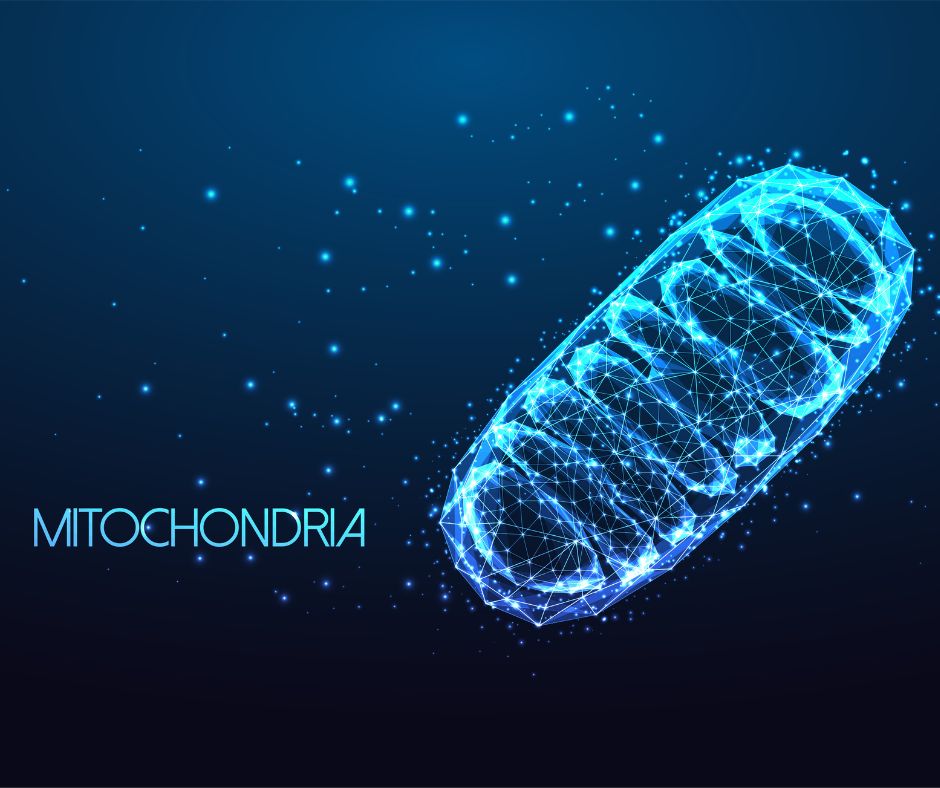
Mitochondria are biological transformers inside your cells. They help convert energy from nutrients into electrochemical gradients, ATP, heat, metabolic water and cellular signals. Calling them tiny power plants is convenient, but it hides much of what makes them important.
Mitochondria are not miniature furnaces that simply burn calories. They work with:
- Electrons, which move through the respiratory chain
- Protons, which create an electrochemical gradient
- Oxygen, which serves as a final electron acceptor
- Water, which is both part of the environment and a metabolic product
- Light and timing, which influence cellular and circadian signalling
- Redox balance, which reflects the cell's ability to manage electrons
ATP is often described as the energy of the cell. It is more accurate to see it as a rapidly recycled chemical carrier that allows cells to perform work.
The deeper point is that ATP does not appear in isolation. It emerges from a functioning system with a suitable proton gradient, membrane potential, oxygen supply, molecular geometry and redox state.
That is why someone can eat frequently and still feel weak, while another person can eat only once or twice during the day and feel stable. The difference is not automatically the amount of fuel. It may also be the ability of the system to transform it.
Why do light and water form the foundation of energy?
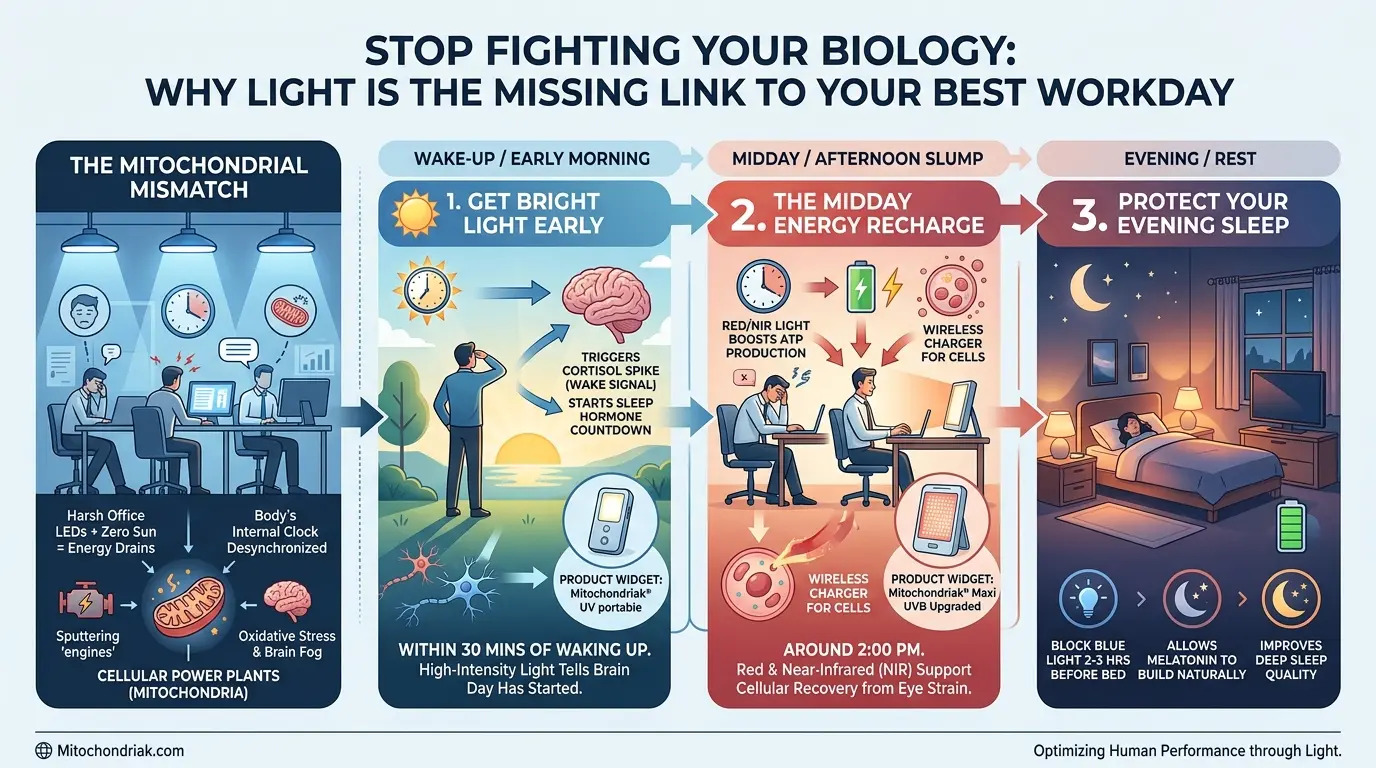
Light provides biological information, while water forms the medium in which biological chemistry and electrical organisation occur. Morning light helps synchronise circadian timing, darkness supports the night phase, and red, infrared and ultraviolet wavelengths have accompanied life throughout evolution.
Light is not present only so that we can see. Different wavelengths interact with different molecules, tissues and photoreceptors.
Morning outdoor light tells the body that a new day has begun. The changing solar spectrum helps coordinate hormonal and metabolic timing. Evening darkness provides a different signal and allows night biology to take over.
Red and infrared light are naturally present in sunlight and have accompanied biological life for an extremely long time. Ultraviolet light is also part of the natural spectrum and participates in processes that cannot be reduced to brightness alone.
In modern interiors, much of this spectral diversity has been replaced by artificial sources dominated by visible light and often a strong blue component. We may be able to see clearly, yet our biology receives a very different signal from the one found outdoors.
Water is the other side of this equation. It surrounds proteins, membranes, mitochondria and almost every structure in the cell. Interfacial water near hydrophilic surfaces may behave differently from bulk water.
Gerald Pollack and other researchers have studied particle exclusion near hydrophilic surfaces and the influence of radiant energy, including infrared radiation, on these zones. The exact mechanism remains debated, but the broader message is important: water inside biological systems is not merely an inert liquid filling empty space.
Light plus water creates the conditions through which biological charge, gradients and energy transformation can occur.
How is the Mitochondriak lifestyle different from biohacking?
The Mitochondriak lifestyle does not begin with shortcuts, gadgets or extreme interventions. It begins by understanding mitochondria, observing the environment and restoring basic signals such as sunlight, darkness, outdoor movement, seasonal timing and appropriate evening light.
I personally do not particularly like the word biohacking.
The term suggests that we need to hack the body, outsmart it or force it into a desired state. But why try to hack biology when we can first understand it and remove the obstacles we created?
A Mitochondriak first learns, observes and thinks. Only then do they act.
This does not mean rejecting all modern tools. A device can be useful when it compensates for a specific deficit in a modern environment. But the tool should remain subordinate to biology, not become the centre of the lifestyle.
The difference can be summarised simply:
| Typical isolated biohack | Mitochondriak approach |
|---|---|
| Search for a rapid intervention | Understand the biological context first |
| Add another supplement or device | Restore natural environmental signals |
| Optimise one isolated metric | Look at mitochondria, timing and the whole system |
| Follow a trend | Follow principles rooted in nature and biophysics |
When the foundations begin to work, many other choices become simpler. Diet gains context. Training gains purpose. Sleep becomes deeper. Recovery improves. The pieces begin to fit together.
Why was the Mitochondriak® brand created?
Mitochondriak® products were never the original goal. They were a consequence of the philosophy. We wanted to create practical tools for people who understood the importance of light, spectrum, flicker, timing and the mitochondrial environment.
From the beginning, our work was shaped by the journey that came before the products.
We focused on wavelengths, spectrum, pulsation, flicker and later selected ultraviolet components because we did not want to create another generic red light product that simply followed the market.
We wanted each decision to connect with the wider philosophy:
- Light is biological information, not merely illumination.
- Spectrum matters, because different wavelengths interact differently with biology.
- Timing matters, because the same signal may have a different meaning at different times of day.
- The environment comes first, and products should support it rather than replace nature.
The brand has therefore never been built only around selling products. Education and the underlying idea remain central.
You can help spread that idea without buying anything. Begin by paying less attention to calorie counting and more attention to where you spend your day, how much natural light reaches you, how you illuminate your evenings and when you sleep.
For environments dominated by artificial light, you can also explore our indoor lighting solutions designed around circadian biology.
How can you try the Mitochondriak lifestyle for 14 days?
You can test the basic Mitochondriak principles without buying anything. For 14 days, organise your routine around consistent timing, morning outdoor light, fewer meals during daylight, reduced artificial blue light after sunset and sufficient darkness and sleep.
Here is the challenge:
- Wake up at the same time every morning. Keep the timing consistent even at weekends. Choose a realistic time that you can maintain.
- Avoid screens and bright artificial light immediately after waking. Give the beginning of the day back to yourself.
- Go outdoors after waking. Spend at least a few minutes in natural morning light. Outdoor exposure is preferable to standing behind closed glass.
- Move and breathe. Walk, stretch or perform a short, gentle routine outdoors when possible.
- Eat two or three proper meals during the active part of the day. Avoid continuous snacking and leave several hours between meals.
- Finish dinner well before sleep. Give digestion time to settle before the night phase begins.
- Reduce blue and bright artificial light after sunset. Use dim, warm, amber or red lighting when illumination is necessary.
- Read before bed and sleep in darkness. Keep bedtime consistent and allow enough time for approximately seven to eight hours of sleep.
- Spend more of the day outdoors. Take breaks outside and let natural light reach your eyes and skin without staring directly at the sun.
This is enough for the beginning.
The effects may not be dramatic overnight, but consistency can reveal patterns that were previously hidden. You may notice more stable daytime energy, deeper sleep, calmer evenings, better recovery or changes in appetite and digestion.
From my own experience, digestion and regularity are among the areas that can change noticeably when the whole rhythm begins to work better. You may also find that you need fewer meals and can invest in less food of higher quality.
These observations are personal and do not guarantee the same result for everyone. Persistent fatigue, digestive problems, insomnia or other significant health issues should also be discussed with a qualified healthcare professional.
- Consistency matters more than perfection.
- Natural morning light and evening darkness form the basic daily signal.
- Do not add ten new hacks. Begin by removing obvious environmental mismatches.
- Observe your energy, sleep, appetite, digestion and mood without obsessing over measurements.
Will you become a Mitochondriak too?
Mitochondriak is not a club that requires registration or an identity that must be defended. It is a direction for people who want to understand how light, water, mitochondria and the environment shape human energy and health.
If this perspective makes sense to you and encourages you to explore, learn and lead by example, you are already moving in the same direction.
If it does not resonate with you, that is completely fine too.
Everyone can walk this path at their own pace and begin when they are ready. There is no need for perfection and no finish line that proves you have succeeded.
In the end, it is not only about reaching a destination. It is also about learning to enjoy the journey.
Explore the Mitochondriak® philosophy further
Continue learning about mitochondria, natural light, circadian biology and practical ways to improve the environment around you.
Sources and references
- Miwa S, Kashyap S, Chini E, von Zglinicki T. Mitochondrial dysfunction in cell senescence and aging. Journal of Clinical Investigation. 2022. Open the review
- Chai B, Pollack GH. Solute-free interfacial zones in polar liquids. Journal of Physical Chemistry B. 2010. Open the study
- Elton DC, Spencer PD, Riches JD, Williams ED. Exclusion zone phenomena in water: a critical review of experimental findings and theories. International Journal of Molecular Sciences. 2020. Open the review
- Wang A, Pollack GH. Exclusion-zone water inside and outside of plant xylem vessels. Scientific Reports. 2024. Open the study