Free worldwide shipping (orders over 90 USD)
Pre-sale 2026 of Maxi UVB Presale HERE
By clicking "Agree" you consent to the use of all cookies. You can specify your preferences by clicking "Settings". More information here.
.png)
When choosing an infrared panel for red light therapy, most people look at a single number: how many wavelengths it has. But an LED is semi monochromatic, which means that „8 wavelengths" on a spec sheet may in reality be only 3 meaningful bands. We will explain why the new generation Mitochondriak® has 7 or even 9 wavelengths, why each of them is scientifically justified, and how you can verify that a manufacturer is not misleading you.
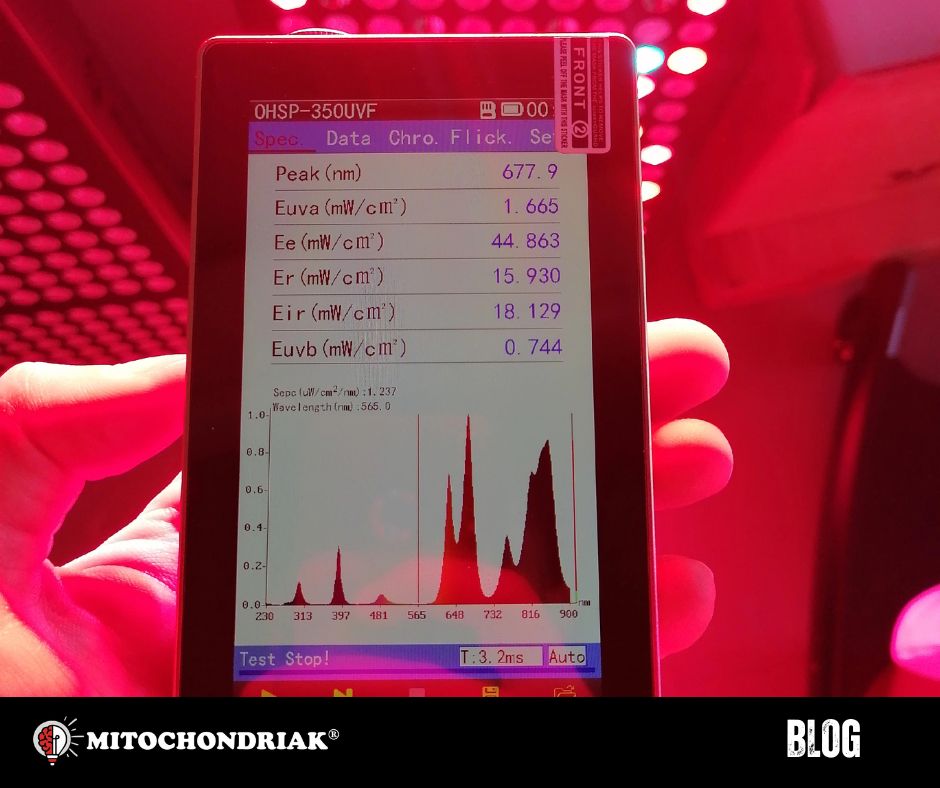
The number of wavelengths declared by a manufacturer is not a biological value, it is a marketing number. An LED does not emit light at a single exact value, it emits in a band roughly 20 to 30 nm wide. This means that if a panel declares 650, 660 and 670 nm at the same time, in reality it is one red band centred around 660 nm that behaves biologically as a single wavelength.
A typical layperson imagines an LED as a laser that emits exactly one colour. In reality, an LED is semi monochromatic, meaning it also emits surrounding wavelengths around its main peak. The width of this band is described by the parameter FWHM (Full Width Half Maximum), and for red and NIR LED diodes it typically ranges between 20 and 30 nm. In other words, a „pure" 660 nm LED actually covers a band of roughly 645 to 675 nm.
When a manufacturer lists three wavelengths only 10 nm apart in the specification, their bands overlap completely. A spectrometer applied to such a panel shows one wide peak, not three separate ones. For the cell, for the mitochondrion and especially for cytochrome c oxidase, which is the main photoacceptor in the body, this band acts as one signal, not three distinct ones.
Cytochrome c oxidase, the key enzyme of the mitochondria, has two main absorption windows: 620 to 680 nm (RED) and 760 to 825 nm (NIR). A mature panel design therefore deliberately combines wavelengths within both windows, yet never doubles them up just for the sake of a number in an ad. That is precisely why Mitochondriak® Maxi has 7 well spaced peaks, not 8 crowded ones.
At Mitochondriak® we design our infrared panels ourselves, we have them certified in house (CE, FCC, ROHS) and we measure every generation with a certified UPRtek spectrometer. These measurements are the reason we know exactly which wavelength the panel really emits and at what intensity. Most brands on the market do not rely on spectrometric measurement at all, which is why they can advertise numbers that do not hold up in practice.
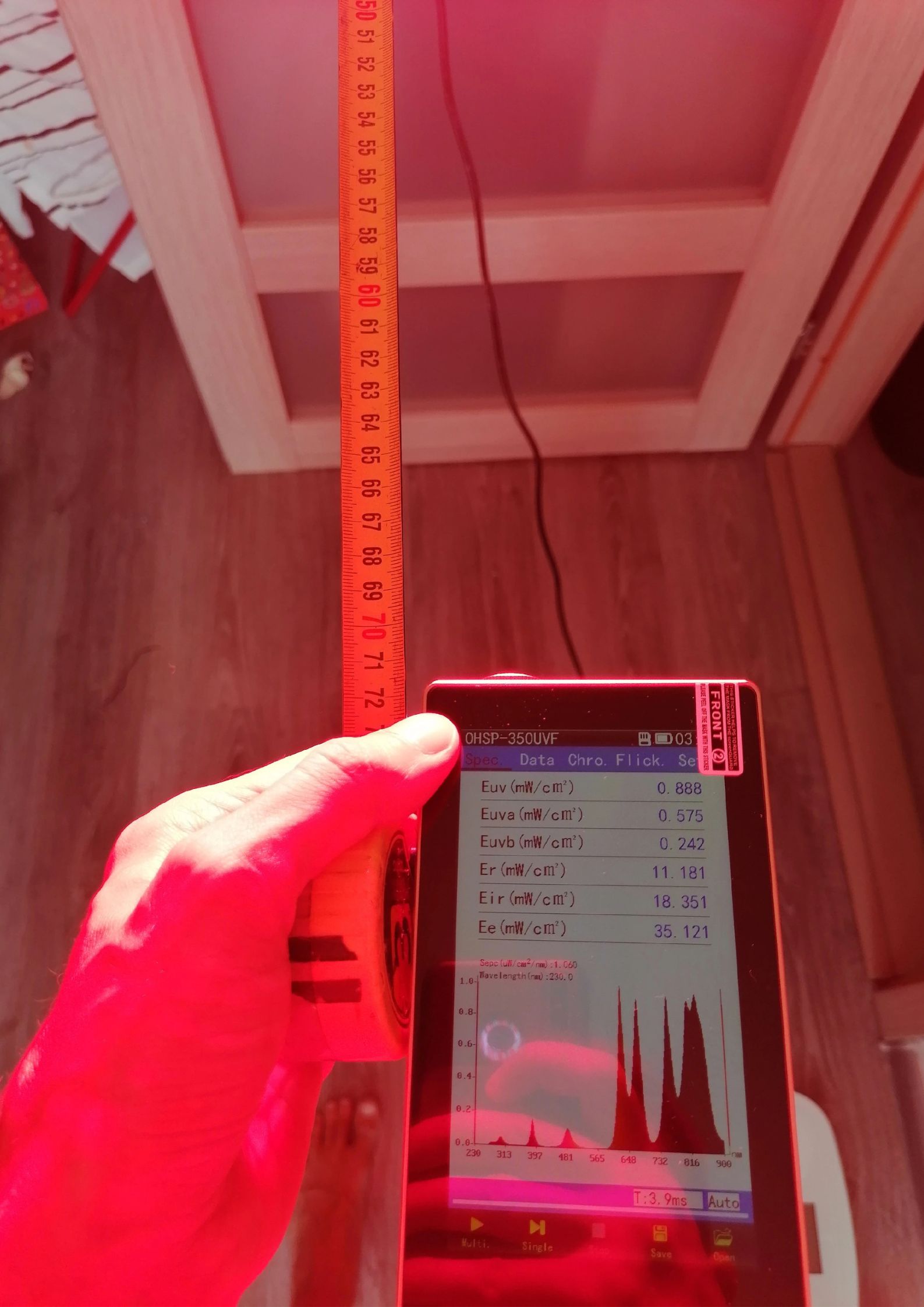
On the graph you can see clearly separated peaks, not a single fused block. You can identify UVB at 295 nm, UVA at 380 nm, blue light at 480 nm, the RED pair of 630 and 670 nm with a visible gap between them, and the NIR band of 760 to 850 nm with distinguishable peaks at 760, 810, 830 and 850 nm. That is exactly what a quality multi wavelength panel should display.
If we took a typical cheap panel that boasts eight wavelengths in the range of 630, 650, 660, 670, 810, 830, 850 and 1060 nm and measured it with the same spectrometer, we would actually get three meaningful bands. One red band around 660 nm (650 plus 660 plus 670 merge), one NIR band around 830 nm (810 plus 830 plus 850 overlap into a wide cap) and one isolated bump at 1060 nm, which however cytochrome c oxidase absorbs significantly more weakly than the classical 810 to 830 nm band.
We have been dealing with exactly the same problem for years when it comes to LED power ratings. As our internal spectrometric and wattage testing has consistently shown, a nominally higher wattage does not mean higher real output. The same applies here: a higher number of wavelengths does not mean broader biological coverage. It is one and the same marketing pattern, just applied to a different parameter.
Every wavelength in Mitochondriak® panels is there because it either has strong absorption in cytochrome c oxidase, or activates another validated photoreceptor (opsins, melanopsin, neuropsin). We never add one just for the number on the label. The table below gives an overview of what each wavelength does and in which model you will find it.
630 nm penetrates the first few millimetres of the skin and is the main working wavelength for the dermal layer. It stimulates fibroblasts, supports the production of collagen, improves epidermal hydration and speeds up healing of small wounds. This is the wavelength behind the studies that describe a reduction in wrinkles and an improvement in skin texture.
670 nm is one of the best studied wavelengths in all of photobiomodulation. Karu in her work and later Wong-Riley in 2005 showed that the region around 670 nm has strong absorption in cytochrome c oxidase, which leads to higher ATP production, reduced oxidative stress and neuronal support.
760 nm is one of the most important yet least used wavelengths on the market, and we are the only ones who include it as standard in both new models. Karu describes that the region around 760 nm corresponds to absorption of the reduced form of CuB in cytochrome c oxidase, while 820 to 830 nm corresponds to the oxidised form of CuA. In other words, without 760 nm you are only stimulating the enzyme from one side.
A study by Wong-Riley and colleagues from 2005 showed that 770 nm directly rescues primary neurons inactivated by toxins, and in the experiment there is no other candidate for the photoacceptor in this region than cytochrome c oxidase. Without 760 nm you therefore lose one of the two main „legs" of mitochondrial stimulation.
810 nm penetrates deep into tissues and has documented use in transcranial photobiomodulation. It is one of the most frequently studied wavelengths for cognitive function, memory and post stroke support. At the same time, it acts on peripheral nerves and supports regeneration after injuries.
830 nm is the „universal soldier" of the NIR band. It has excellent depth of penetration, it powerfully stimulates ATP production via the oxidised CuA form in cytochrome c oxidase, and in studies it has repeatedly shown effects on wound healing, joints, tendons and inflammatory processes.
850 nm is currently the most popular NIR wavelength in commercial panels, yet its real value lies not in fashion but in depth of penetration. For muscle tissues, the lymphatic system and after demanding training, 850 nm is a reliable tool. In combination with 760, 810 and 830 nm, it provides comprehensive NIR coverage.
940 nm in Mitochondriak® Maxi adds a longer wavelength that generates gentle thermal comfort, benefits peripheral tissues and supports local microcirculation. The slight rise in temperature and improved subcutaneous blood flow assist mobilisation of fat reserves within combined RED plus NIR plus 940 nm protocols. It is a complement, not a replacement for the classic 810 to 850 nm wavelengths.
Mitochondriak® Maxi UVB adds three more wavelengths that cover the non visual part of the circadian rhythm. 295 nm UVB supports vitamin D and melanin production directly in the skin. 380 nm UVA stimulates neuropsin (OPN5) and the release of nitric oxide, improving the cardiovascular system and recovery. 480 nm blue light activates melanopsin in the skin, which is key for the daytime circadian signal. Together, 9 wavelengths cover the spectrum that a single panel can realistically deliver indoors.
The power of a multi wavelength panel does not lie in the number of figures but in their distribution. A quality panel combines wavelengths so that they reach multiple tissue depths and multiple biological mechanisms at the same time. Without coordinating cytochrome c oxidase, opsins and thermal effects, therapy is only one dimensional. That is also why Mitochondriak is an exception and we go our own way. We do not chase cheap solutions and we do not focus on quantity, but on quality. We have been devoted to light for more than a decade and we translate our know how into our products.
Mitochondria reach their maximum response when we stimulate both absorption windows of cytochrome c oxidase at the same time. The combination of 670 nm plus 760 nm plus 830 nm keeps the enzyme active in multiple redox states, which according to Poyton also triggers the release of nitric oxide and thereby improves the supply of oxygen to tissues. This is why it makes sense to have 760 nm in the panel, even though it is less talked about.
For metabolism and fat burning support you need a combination of surface and deeper stimulation. The wavelengths 630 nm stimulate subcutaneous capillaries, 830 and 850 nm activate the metabolism of fat cells more deeply, and 940 nm gently warms peripheral tissues. Without the entire chain, the panel acts on only one level and the effect is significantly weaker.
For the skin you need a signal that reaches both the surface and the deeper layers. The wavelengths 630 plus 670 nm work in the dermal layer with fibroblasts and collagen, while 810 nm reaches all the way into the hypodermis and supports microcirculation. The result is better hydration, more collagen production and a more homogeneous skin texture.
Sleep and parasympathetic tone respond best to NIR wavelengths with deep penetration. The combination of 670 plus 760 plus 830 nm together with a 10 Hz pulsation simulates calming brain waves and stimulates the production of melatonin directly in the mitochondria. Studies have described a 28 percent improvement in sleep quality after 14 days.
1060 nm is a wavelength that some panels like to boast about, but its biological effectiveness is limited. In this region of the spectrum, cytochrome c oxidase absorption is significantly lower than at 810 to 830 nm, while water absorption in tissues rises. The result is more heat and less photochemical response. That is why we decided not to include 1060 nm and instead to strengthen 760 nm and 940 nm, where we get a clear biological benefit.
Even without a spectrometer, there are several reliable signals that help you tell a mature multi wavelength panel apart from a marketing product. They are simple, you can verify them at home, and they help you avoid most of the traps on the market.
Mitochondriak® designs its infrared panels in house, handles the LED layout itself and measures every generation. That is why we know exactly why we use these 7 or 9 wavelengths and not nine very close numbers. The same principle that we covered in our internal spectrometric and wattage testing on the 3 W versus 5 W dual chip LED question applies here as well. If you are not sure which model fits you, let our products guide walk you through the choice.
If you want a panel where every wavelength has a scientific reason to be there, the new generation of Mitochondriak® is exactly for you. Choose based on whether you want classic RED plus NIR therapy, or also the UV band for vitamin D support directly in the skin.
A quality panel typically has 5 to 9 wavelengths that are sufficiently spaced apart (at least 30 to 50 nm). More important than the count is the spacing, the presence of 760 nm and the fact that the manufacturer can back every wavelength with a spectrometric measurement.
Because 7 meaningfully distributed wavelengths provide a broader biological response than 8 numbers merging into three bands. An LED is semi monochromatic, so 650 plus 660 plus 670 nm merge into a single red band. We chose 630 and 670 nm with a visible gap between them, and in the NIR band the separated 760, 810, 830, 850 and 940 nm.
760 nm corresponds to the absorption of the reduced CuB form in cytochrome c oxidase, which is one of the two main „legs" of mitochondrial stimulation. Karu and Wong-Riley independently showed that this band activates the photoacceptor in the brain and neurons. Only a few brands on the market offer it, and Mitochondriak® includes it as standard in both new models.
1060 nm is marketing attractive, but biologically cytochrome c oxidase absorbs significantly less in this region than at 810 to 830 nm. At the same time, water absorption in tissues rises, so the panel produces more heat and less photochemical response. For this reason we decided not to include 1060 nm.
A semi monochromatic LED emits light in a band roughly 20 to 30 nm wide around its main peak, not at a single exact value. If a manufacturer therefore lists three wavelengths only 10 nm apart, their bands overlap and the spectrometer shows one peak, not three.
Ask for spectrometric measurements, not diagrams. Check that the wavelengths are spaced at least 30 to 50 nm apart. Verify certification (CE, FCC, ROHS) and the fact that the manufacturer designs the panel itself. Mitochondriak® publishes UPRtek measurements directly on the product pages.
[ { "@context": "https://schema.org", "@type": "Article", "mainEntityOfPage": { "@type": "WebPage", "@id": "https://www.mitochondriak.com/blog/how-many-wavelengths-should-a-red-light-infrared-panel-have/" }, "headline": "Wh\u0061t \u0079\u006f\u0075 w\u0069ll l\u0065\u0061rn \u0069n th\u0069s \u0061rt\u0069cl\u0065", "description": "Wh\u0065n ch\u006f\u006fs\u0069ng \u0061n \u0069nfr\u0061r\u0065d p\u0061n\u0065l f\u006fr r\u0065d l\u0069ght th\u0065r\u0061p\u0079, m\u006fst p\u0065\u006fpl\u0065 l\u006f\u006fk \u0061t \u0061 s\u0069ngl\u0065 n\u0075mb\u0065r: h\u006fw m\u0061n\u0079 w\u0061v\u0065l\u0065ngths \u0069t h\u0061s. B\u0075t \u0061n L\u0045D \u0069s s\u0065m\u0069 m\u006fn\u006fchr\u006fm\u0061t\u0069c,", "image": "https://www.mitochondriak.com/user/documents/upload/Images-blogs/blog-thumbnail-mitochondriak-maxi-uvb-spectrometer-spectrum-measurement-optimal-wavelengths.jpg", "author": { "@type": "Organization", "name": "M\u0069t\u006fch\u006fndr\u0069\u0061k\u00ae", "url": "https://www.mitochondriak.com/about-us/" }, "publisher": { "@type": "Organization", "name": "M\u0069t\u006fch\u006fndr\u0069\u0061k\u00ae", "logo": { "@type": "ImageObject", "url": "https://cdn.myshoptet.com/usr/www.mitochondriak.com/user/logos/mitochondriak-logo-white.png" } }, "datePublished": "2026-05-18", "dateModified": "2026-05-18", "inLanguage": "en-US" }, { "@context": "https://schema.org", "@type": "FAQPage", "mainEntity": [ { "@type": "Question", "name": "H\u006fw m\u0061ny w\u0061v\u0065l\u0065ngths sh\u006f\u0075ld \u0061 q\u0075\u0061l\u0069ty r\u0065d l\u0069ght \u0069nfr\u0061r\u0065d p\u0061n\u0065l h\u0061v\u0065?", "acceptedAnswer": { "@type": "Answer", "text": "\u0041 q\u0075\u0061l\u0069ty p\u0061n\u0065l typ\u0069c\u0061lly h\u0061s 5 t\u006f 9 w\u0061v\u0065l\u0065ngths th\u0061t \u0061r\u0065 s\u0075ff\u0069c\u0069\u0065ntly sp\u0061c\u0065d \u0061p\u0061rt (\u0061t l\u0065\u0061st 30 t\u006f 50 nm). M\u006fr\u0065 \u0069mp\u006frt\u0061nt th\u0061n th\u0065 c\u006f\u0075nt \u0069s th\u0065 sp\u0061c\u0069ng, th\u0065 pr\u0065s\u0065nc\u0065 \u006ff 760 nm \u0061nd th\u0065 f\u0061ct th\u0061t th\u0065 m\u0061n\u0075f\u0061ct\u0075r\u0065r c\u0061n b\u0061ck \u0065v\u0065ry w\u0061v\u0065l\u0065ngth w\u0069th \u0061 sp\u0065ctr\u006fm\u0065tr\u0069c m\u0065\u0061s\u0075r\u0065m\u0065nt." } }, { "@type": "Question", "name": "Why d\u006f\u0065s M\u0069t\u006fch\u006fndr\u0069\u0061k M\u0061x\u0069 h\u0061v\u0065 \u006fnly 7 w\u0061v\u0065l\u0065ngths wh\u0065n c\u006fmp\u0065t\u0069t\u006frs h\u0061v\u0065 8?", "acceptedAnswer": { "@type": "Answer", "text": "B\u0065c\u0061\u0075s\u0065 7 m\u0065\u0061n\u0069ngf\u0075lly d\u0069str\u0069b\u0075t\u0065d w\u0061v\u0065l\u0065ngths pr\u006fv\u0069d\u0065 \u0061 br\u006f\u0061d\u0065r b\u0069\u006fl\u006fg\u0069c\u0061l r\u0065sp\u006fns\u0065 th\u0061n 8 n\u0075mb\u0065rs m\u0065rg\u0069ng \u0069nt\u006f thr\u0065\u0065 b\u0061nds. \u0041n L\u0045D \u0069s s\u0065m\u0069 m\u006fn\u006fchr\u006fm\u0061t\u0069c, s\u006f 650 pl\u0075s 660 pl\u0075s 670 nm m\u0065rg\u0065 \u0069nt\u006f \u0061 s\u0069ngl\u0065 r\u0065d b\u0061nd. M\u0069t\u006fch\u006fndr\u0069\u0061k M\u0061x\u0069 \u0075s\u0065s 630 \u0061nd 670 nm w\u0069th \u0061 v\u0069s\u0069bl\u0065 g\u0061p b\u0065tw\u0065\u0065n th\u0065m, \u0061nd \u0069n th\u0065 N\u0049R b\u0061nd th\u0065 s\u0065p\u0061r\u0061t\u0065d 760, 810, 830, 850 \u0061nd 940 nm." } }, { "@type": "Question", "name": "Why d\u006f\u0065s 760 nm m\u0061k\u0065 s\u0065ns\u0065 \u0061nd wh\u0065r\u0065 \u0065ls\u0065 c\u0061n \u0049 f\u0069nd \u0069t?", "acceptedAnswer": { "@type": "Answer", "text": "760 nm c\u006frr\u0065sp\u006fnds t\u006f th\u0065 \u0061bs\u006frpt\u0069\u006fn \u006ff th\u0065 r\u0065d\u0075c\u0065d C\u0075B f\u006frm \u0069n cyt\u006fchr\u006fm\u0065 c \u006fx\u0069d\u0061s\u0065, wh\u0069ch \u0069s \u006fn\u0065 \u006ff th\u0065 tw\u006f m\u0061\u0069n l\u0065gs \u006ff m\u0069t\u006fch\u006fndr\u0069\u0061l st\u0069m\u0075l\u0061t\u0069\u006fn. K\u0061r\u0075 \u0061nd W\u006fng-R\u0069l\u0065y \u0069nd\u0065p\u0065nd\u0065ntly sh\u006fw\u0065d th\u0061t th\u0069s b\u0061nd \u0061ct\u0069v\u0061t\u0065s th\u0065 ph\u006ft\u006f\u0061cc\u0065pt\u006fr \u0069n th\u0065 br\u0061\u0069n \u0061nd n\u0065\u0075r\u006fns. \u004fnly \u0061 f\u0065w br\u0061nds \u006fn th\u0065 m\u0061rk\u0065t \u006fff\u0065r \u0069t \u0061nd M\u0069t\u006fch\u006fndr\u0069\u0061k \u0069ncl\u0075d\u0065s \u0069t \u0061s st\u0061nd\u0061rd \u0069n b\u006fth n\u0065w m\u006fd\u0065ls." } }, { "@type": "Question", "name": "\u0049s 1060 nm \u0061 \u0075s\u0065f\u0075l w\u0061v\u0065l\u0065ngth?", "acceptedAnswer": { "@type": "Answer", "text": "1060 nm \u0069s m\u0061rk\u0065t\u0069ng \u0061ttr\u0061ct\u0069v\u0065, b\u0075t b\u0069\u006fl\u006fg\u0069c\u0061lly cyt\u006fchr\u006fm\u0065 c \u006fx\u0069d\u0061s\u0065 \u0061bs\u006frbs s\u0069gn\u0069f\u0069c\u0061ntly l\u0065ss \u0069n th\u0069s r\u0065g\u0069\u006fn th\u0061n \u0061t 810 t\u006f 830 nm. \u0041t th\u0065 s\u0061m\u0065 t\u0069m\u0065, w\u0061t\u0065r \u0061bs\u006frpt\u0069\u006fn \u0069n t\u0069ss\u0075\u0065s r\u0069s\u0065s, s\u006f th\u0065 p\u0061n\u0065l pr\u006fd\u0075c\u0065s m\u006fr\u0065 h\u0065\u0061t \u0061nd l\u0065ss ph\u006ft\u006fch\u0065m\u0069c\u0061l r\u0065sp\u006fns\u0065. F\u006fr th\u0069s r\u0065\u0061s\u006fn w\u0065 d\u0065c\u0069d\u0065d n\u006ft t\u006f \u0069ncl\u0075d\u0065 1060 nm." } }, { "@type": "Question", "name": "Wh\u0061t \u0069s \u0061 s\u0065m\u0069 m\u006fn\u006fchr\u006fm\u0061t\u0069c L\u0045D?", "acceptedAnswer": { "@type": "Answer", "text": "\u0041 s\u0065m\u0069 m\u006fn\u006fchr\u006fm\u0061t\u0069c L\u0045D \u0065m\u0069ts l\u0069ght \u0069n \u0061 b\u0061nd r\u006f\u0075ghly 20 t\u006f 30 nm w\u0069d\u0065 \u0061r\u006f\u0075nd \u0069ts m\u0061\u0069n p\u0065\u0061k, n\u006ft \u0061t \u0061 s\u0069ngl\u0065 \u0065x\u0061ct v\u0061l\u0075\u0065. \u0049f \u0061 m\u0061n\u0075f\u0061ct\u0075r\u0065r th\u0065r\u0065f\u006fr\u0065 l\u0069sts thr\u0065\u0065 w\u0061v\u0065l\u0065ngths \u006fnly 10 nm \u0061p\u0061rt, th\u0065\u0069r b\u0061nds \u006fv\u0065rl\u0061p \u0061nd th\u0065 sp\u0065ctr\u006fm\u0065t\u0065r sh\u006fws \u006fn\u0065 p\u0065\u0061k, n\u006ft thr\u0065\u0065." } }, { "@type": "Question", "name": "H\u006fw c\u0061n \u0049 v\u0065r\u0069fy th\u0061t \u0061 m\u0061n\u0075f\u0061ct\u0075r\u0065r \u0069s n\u006ft ly\u0069ng \u0061b\u006f\u0075t w\u0061v\u0065l\u0065ngths?", "acceptedAnswer": { "@type": "Answer", "text": "\u0041sk f\u006fr sp\u0065ctr\u006fm\u0065tr\u0069c m\u0065\u0061s\u0075r\u0065m\u0065nts, n\u006ft d\u0069\u0061gr\u0061ms. Ch\u0065ck th\u0061t th\u0065 w\u0061v\u0065l\u0065ngths \u0061r\u0065 sp\u0061c\u0065d \u0061t l\u0065\u0061st 30 t\u006f 50 nm \u0061p\u0061rt. V\u0065r\u0069fy c\u0065rt\u0069f\u0069c\u0061t\u0069\u006fn (C\u0045, FCC, R\u004fHS) \u0061nd th\u0065 f\u0061ct th\u0061t th\u0065 m\u0061n\u0075f\u0061ct\u0075r\u0065r d\u0065s\u0069gns th\u0065 p\u0061n\u0065l \u0069ts\u0065lf. M\u0069t\u006fch\u006fndr\u0069\u0061k p\u0075bl\u0069sh\u0065s \u0055PRt\u0065k m\u0065\u0061s\u0075r\u0065m\u0065nts d\u0069r\u0065ctly \u006fn th\u0065 pr\u006fd\u0075ct p\u0061g\u0065s." } } ] } ]