
.png)
Choosing the right infrared panel can be confusing for a beginner. Mitochondriak® offers multiple generations and sizes, so it is easy to overlook what you actually need. This guide walks you step by step through selecting the Mitochondriak® infrared panel that fits your goal, your space and your budget.
- The 3 questions you should ask yourself before buying an infrared panel.
- Which panel size suits local therapy versus full body therapy.
- Why Mitochondriak® infrared panels have 5 to 9 wavelengths and what that means for effectiveness.
- Where to place your panel at home so you actually use it every day.
- What budget you realistically need, from the compact Office to the large Maxi UVB.
- Why choose a Mitochondriak® infrared panel over any other?
- What 3 questions should you ask before buying an infrared panel?
- What panel size should you choose based on your therapy goal?
- What wavelengths do Mitochondriak® infrared panels have and why do they matter?
- Where is the best place to set up an infrared panel at home?
- What budget should you prepare for a quality infrared panel?
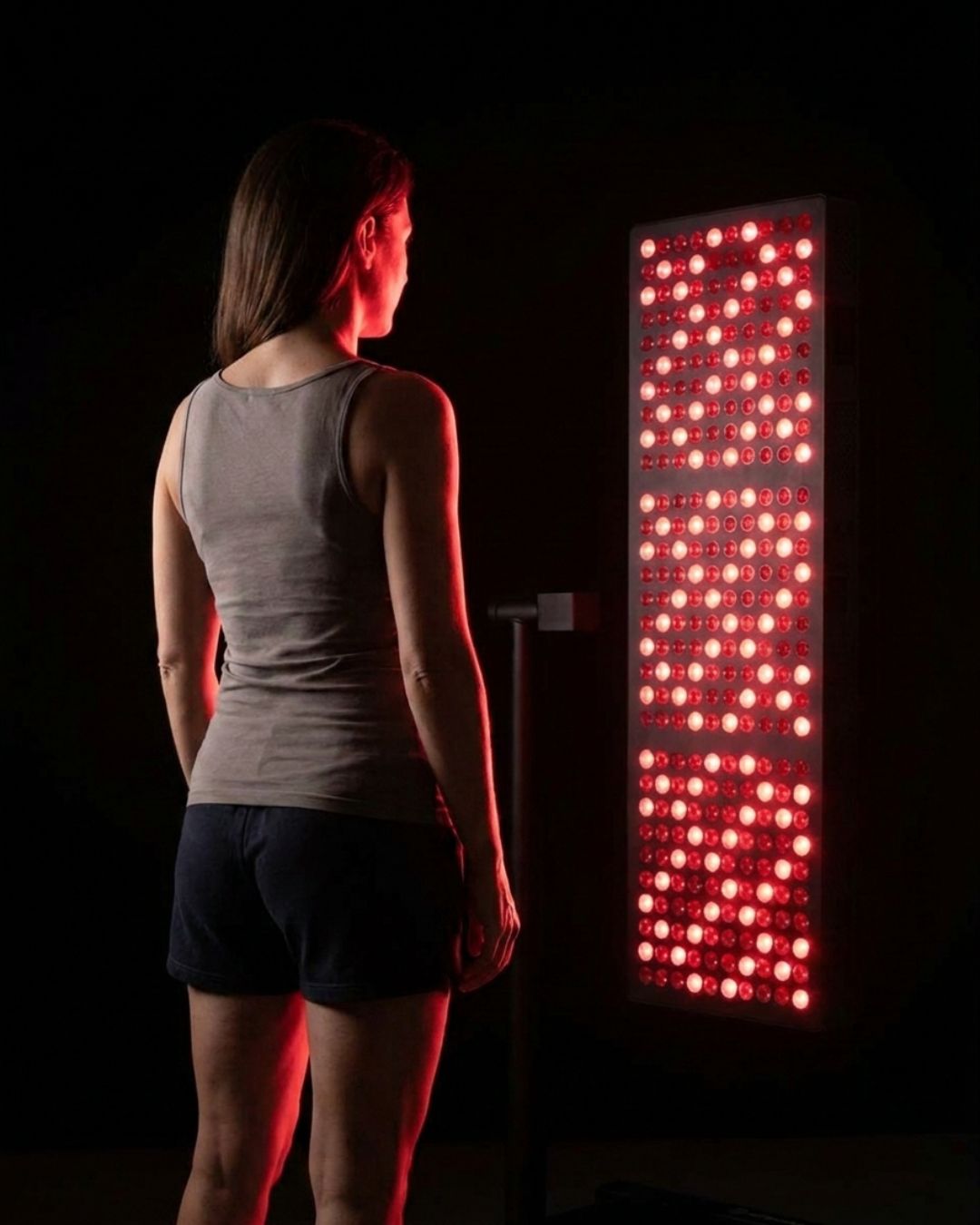
Why choose a Mitochondriak® infrared panel over any other?
Mitochondriak® infrared panels are engineered for therapeutic home use, not merely as decorative LED lighting. They deliver verified irradiance levels, a combination of red and near infrared light, and are designed to match the absorption curve of the human body. That sets them apart from cheap panels with unverified specifications that exist only on paper.
Key reasons to choose this brand, even as a beginner:
- Zero flicker and low EMF at the recommended distance, which is essential for daily use.
- 5 to 9 wavelengths (depending on the model) spanning 630 to 940 nm, and in the case of the Maxi UVB, even 295, 380 and 480 nm.
- The ability to switch between RED, NIR, or both depending on your therapy goal.
- Newer models feature a touchscreen display, built in timer, adjustable intensity and pulsation.
- The range includes the compact Office, the full body Maxi, and the specialised Mitochondriak® Maxi UVB Upgraded with added UV light.
For a beginner, the key takeaway is that you are not buying a "lamp" but a therapeutic tool with clearly defined parameters and support through the learning section.
What 3 questions should you ask before buying an infrared panel?
Before picking a specific model, answer 3 simple questions that will make the decision for you. The most common beginner mistake is buying the biggest panel available even though a smaller one would suffice, or, conversely, choosing a compact panel and then trying to treat the entire body with it. The questions are: where, what for and how often.
1. Where will you use the panel?
If you have a small bedroom or home office, a large Maxi panel may not fit comfortably. For a desk or a corner shelf, the compact Mitochondriak® Office is a better choice. For a dedicated biohacking corner, the Mitochondriak® Maxi Upgraded or Mitochondriak® Maxi UVB Upgraded makes sense.
2. What do you want to use the light for?
Local therapy (face, knee, shoulder, thyroid, scars, acne) can be handled by a smaller panel or a therapy bulb. Full body therapy (post workout recovery, energy, hormones, sleep, vitamin D from the UVB model) calls for a larger panel, ideally the Maxi or Maxi UVB.
3. How often and how long will you use it?
If you plan daily sessions of 10 to 20 minutes, investing in a full body panel is worthwhile because it shortens each session and you will actually use it consistently. For occasional use, a smaller, portable model is sufficient.
What panel size should you choose based on your therapy goal?
Panel size determines how much of your body is illuminated at once, and therefore the length of each session. Mitochondriak® offers two main form factors: compact local panels and large full body panels. For a beginner, the best approach is to decide based on your primary goal, not on the "bigger is always better" principle.
Compact panels (Office)
The Mitochondriak® Office is designed for face, neck, joints, acne and a morning cortisol boost at your desk. It is portable, easy to store, and doubles as supplemental red light in your indoor environment. Browse the full range of infrared panels to see all currently available models.
Full body panels (Maxi and Maxi UVB)
Large panels like the Mitochondriak® Maxi Upgraded illuminate a large portion of the body at once and are ideal for recovery, sport, hormonal balance and overall energy. The Mitochondriak® Maxi UVB Upgraded adds a 295 nm wavelength that supports vitamin D production directly in the skin. Check all the latest generation devices in the infrared panel category.
What wavelengths do Mitochondriak® infrared panels have and why do they matter?
Depending on the model, Mitochondriak® infrared panels contain 5 to 9 wavelengths. Each wavelength penetrates the skin at a different depth and is absorbed differently by mitochondria via the enzyme cytochrome c oxidase. That is precisely why a combination of wavelengths matters more than a single one.
The most common wavelengths found in Mitochondriak® infrared panels:
- 630 nm and 670 nm (RED) penetrate into the skin and subdermal tissues, supporting collagen production, skin regeneration and cellular energy.
- 760 nm is unique because it targets cytochrome c oxidase directly and is included in the new generation Maxi models.
- 810, 830 and 850 nm (NIR) penetrate deeper, reaching muscles, joints, the brain and internal organs.
- 940 nm goes even deeper and supports deep tissue regeneration.
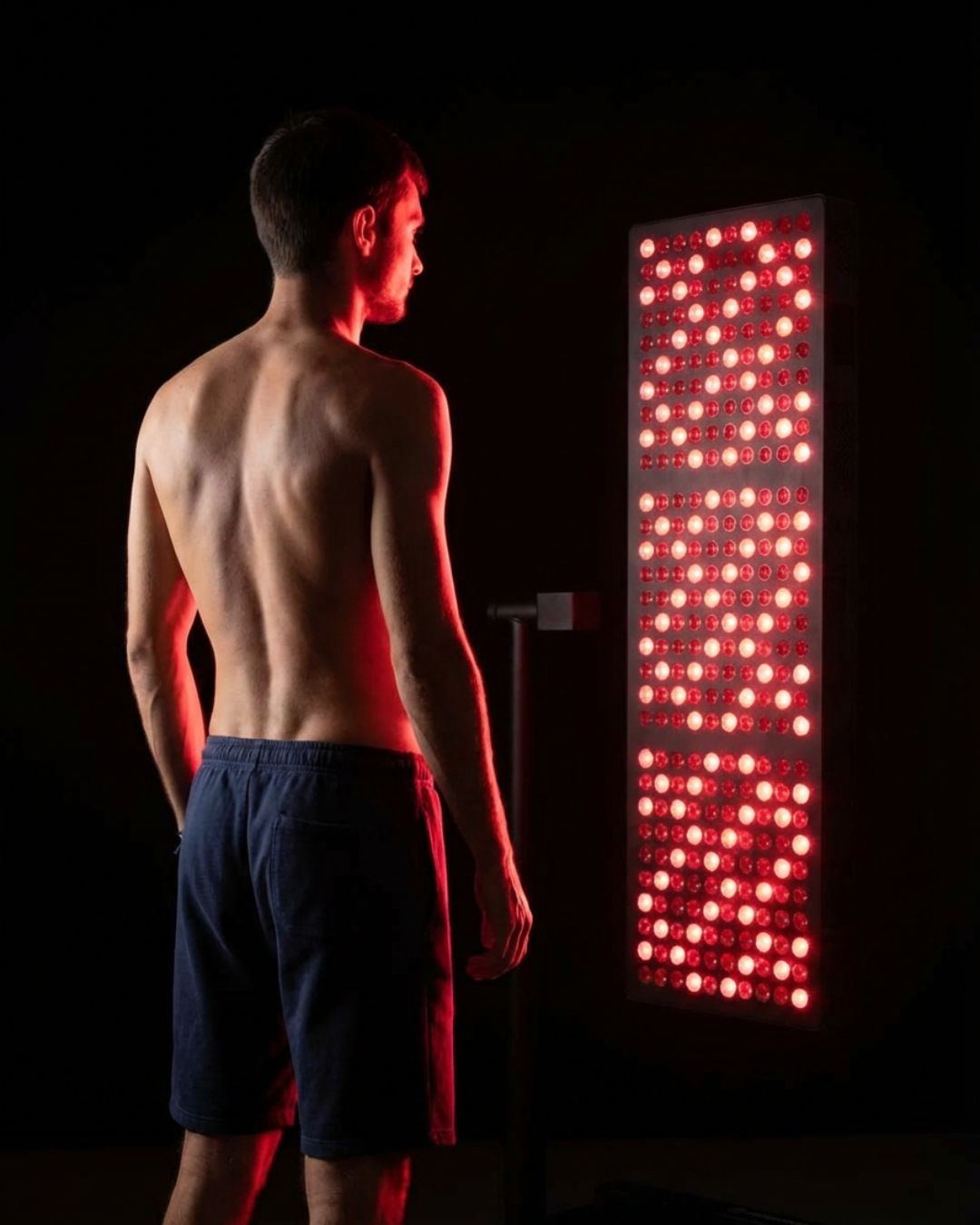
A study by Wunsch and Matuschka (2014) showed that a combination of red and NIR light improves skin elasticity and collagen density after 30 sessions. [R] Mitochondriak® devices contain wavelengths precisely within this range, covering the spectrum validated by research.
For vitamin D production in the skin, a wavelength in the UVB range around 290 to 315 nm is essential. [R] This wavelength is included in the specialised Mitochondriak® Maxi UVB Upgraded, available in the UV light therapy devices category.
Where is the best place to set up an infrared panel at home?
The best panel is the one you use every day. That is why placement matters just as much as technical specifications. The goal is to naturally spend 10 to 20 minutes in front of it daily, without having to disrupt your routine.
Bedroom and evening routine
In the bedroom, a compact panel makes sense for evening face or back therapy before sleep. Combine it with red evening bulbs so that overhead blue light does not wake you up after the session.
Home office and desk setup
At your desk, a small panel works as supplemental daylight. It helps with morning cortisol, energy and focus. When working at your monitor, consider pairing it with blue light blocking glasses for the evening hours.
Dedicated biohacking corner
For full body therapy, ideally set up a floor stand and a Mitochondriak® Maxi Upgraded or Mitochondriak® Maxi UVB Upgraded panel in a corner. A stand is important because it lets you position yourself 30 to 60 cm from the panel and rotate your body. Check available floor stands for Mitochondriak® panels.
Specific values for distance, session duration and frequency are always available on the product page of each model and in the learning section. The recommended protocol there is tailored to each generation and panel intensity.
What budget should you prepare for a quality infrared panel?
Price is often the main hesitation for beginners. A realistic budget ranges from approximately €900 for compact models to €1,500 and above for full body panels with UV or a touchscreen display. However, the investment is spread over years of use and is better compared to annual spending on supplements or physiotherapy.
Budget orientation:
- Therapy bulbs and small modules as an entry point into light therapy, ideal for local treatment and as a complement to a main panel. Browse red and infrared bulbs.
- Compact panel: the Mitochondriak® Office for targeted local therapy of the face, joints and as supplemental desk light.
- Full body panel: the Mitochondriak® Maxi Upgraded at €1,469 for fast, single session therapy with 7 wavelengths and a touchscreen.
- Maxi with UV: the Mitochondriak® Maxi UVB Upgraded in the UV light therapy devices category for vitamin D production outside the summer season.
We will help you choose the right infrared panel
If you are still unsure which model is right for you, visit our learning section for detailed guidance. For a complete overview of available models, browse the full infrared panel category.
For beginners looking for a compact, versatile panel that fits any desk or bedroom, the Mitochondriak® Office is an excellent starting point. For full body therapy, the Mitochondriak® Maxi Upgraded is the most popular choice.
Frequently asked questions about choosing an infrared panel
Which Mitochondriak® infrared panel is best for a beginner?
For a beginner with a moderate budget who wants targeted local therapy, the Mitochondriak® Office with 7 wavelengths (630, 670, 760, 810, 830, 850 and 940 nm) is a versatile entry point. If your budget allows for full body therapy in a single session, choose the Mitochondriak® Maxi Upgraded.
What is the difference between a small and a large panel?
A small panel (Office) is suitable for local therapy of the face, joints or acne, and as supplemental daylight indoors. A large panel (Maxi) illuminates a large portion of the body at once and is ideal for recovery, hormonal balance and overall energy. For most goals, a full body panel is more efficient, but it requires more space.
What is the correct distance from the panel?
The specific distance depends on the model and your therapy goal. For full body therapy, the general recommendation is to stand 30 to 60 cm from the panel. For surface level skin therapy, the distance can be shorter. Exact values for each model are available on the product page and in the Mitochondriak® learning section.
Do I also need UVB light, or is red and infrared enough?
For recovery, sleep, energy and skin health, a combination of red and near infrared light is sufficient. If you also want vitamin D production outside the summer season, choose the Mitochondriak® Maxi UVB Upgraded model with a 295 nm wavelength. UVB should complement sunlight, not fully replace it.
How often should I use an infrared panel?
Most users achieve the best results with sessions of 10 to 20 minutes, five to seven days a week, over several weeks. Specific recommendations for your model can be found on the product page and in the learning section.
Sources and references
- Wunsch, A., Matuschka, K., 2014. A controlled trial to determine the efficacy of red and near-infrared light treatment in patient satisfaction, reduction of fine lines, wrinkles, skin roughness, and intradermal collagen density increase. PubMed
- Holick, M. F., Chen, T. C., Lu, Z., Sauter, E., 2007. Vitamin D and skin physiology: a D-lightful story. PubMed
- Hamblin, M. R., 2017. Mechanisms and applications of the anti-inflammatory effects of photobiomodulation. PubMed
- Mitochondriak®, 2026. Learning section. mitochondriak.com