.png)
Red light therapy devices can be a significant investment, so the store behind the product matters almost as much as the panel itself. A trustworthy seller should be able to support its claims with EU compliance documentation, transparent measurements, clear consumer terms and real technical support. This guide gives you a practical checklist for evaluating any online store before you pay.
- Why a CE logo alone is not enough, and which EU documents are worth checking.
- How to assess wavelengths, irradiance, measurement distance, flicker and EMF without being misled by a large wattage number.
- What return terms, service arrangements, review policies and technical support reveal about a seller.
- How to verify an online store step by step before ordering a red light therapy device.
- Which warning signs point to anonymous reselling, weak documentation or exaggerated health claims.
- What makes a red light therapy store trustworthy?
- Which EU documents and business details should you check?
- How do you recognise transparent technical specifications?
- What do returns, service and reviews reveal?
- How can you verify an online store step by step?
- Which warning signs should you not ignore?
- How does Mitochondriak® meet these criteria?
- What should you remember?
- Frequently asked questions
What makes a red light therapy store trustworthy?
A trustworthy red light therapy store provides a verifiable chain of responsibility. You should be able to identify the legal operator, the manufacturer or brand owner, the exact device, the relevant EU documentation, the measured technical parameters and the party responsible for support after the sale.
A polished website is not evidence on its own. Neither is a laboratory photograph without a result, a CE logo in the footer, or a large number followed by the word watts. Reliable sellers connect each important claim to something concrete: a product model, an EU Declaration of Conformity, a measurement report, a manual, a return condition or a named business.
This matters because a red light therapy panel is an electrical device used repeatedly and relatively close to the body. The buyer needs to know more than whether the LEDs turn on. You should be able to determine what spectrum the device emits, how its output was measured, which company is responsible for placing it on the EU market and what happens if the product needs service.
A useful first assessment is built around five layers:
- Traceable business identity: company name, registered address, contact details and clear terms.
- Product specific EU documentation: documents must identify the relevant model or clearly defined product family.
- Technical transparency: exact wavelengths, irradiance, distance, units and measurement method.
- Safety and support: instructions, warnings, service access and realistic explanations of product limits.
- Fair purchasing conditions: understandable withdrawal, return, complaint and review policies.
If you are also deciding which size or type of device suits your needs, read our guide on how to choose a red light therapy panel.
Which EU documents and business details should you check?
For products placed on the European Union market, a CE logo should lead to a clear compliance trail. Look for the EU Declaration of Conformity, identifiable product models, the responsible company and references to the applicable EU requirements. RoHS information should also relate to the device, rather than appearing as an unexplained badge.
CE marking is often described incorrectly as a quality certificate. The official Your Europe portal explains that the manufacturer uses CE marking to indicate that a product meets the applicable EU product rules. There is no central EU authority that automatically issues a universal CE certificate. Before placing the mark on a product, the manufacturer must identify the relevant requirements, assess conformity, compile supporting technical documentation and sign an EU Declaration of Conformity. [R]
This leads to a better set of questions than simply asking, “Does it have CE?”
- Can the seller provide an EU Declaration of Conformity linked to the device or model family?
- Does the document identify the manufacturer, product, date, signatory and relevant EU legislation or standards?
- Is it clear who is responsible for the device on the EU market and who handles service?
- Can the seller explain whether third party conformity assessment was required for that product category?
- Are safety instructions and product warnings available in a language the customer can understand?
The RoHS framework concerns restricted hazardous substances in electrical and electronic equipment. The European Commission states that it currently restricts ten substances, including lead, cadmium, mercury and several flame retardants and phthalates. [R] A serious seller should be able to connect its RoHS statement to the product and supporting documentation.
There is another important distinction. CE marking does not automatically mean that a wellness light panel is an EU medical device. Electrical equipment may carry CE marking because it falls under electrical safety, electromagnetic compatibility or other applicable product legislation. Unless the seller can document medical device status under the relevant EU framework, do not interpret the CE logo as medical approval.
| What to check | What is not enough | What to look for |
|---|---|---|
| CE marking | A logo on the product page | EU Declaration of Conformity and product identification |
| RoHS | A generic “RoHS certified” statement | A documented link to the relevant device or product family |
| Business identity | A brand name with no legal operator | Company, address, registration details and service contact |
| Testing | A photograph of a meter | Result, units, distance, instrument and test conditions |
How do you recognise transparent technical specifications?
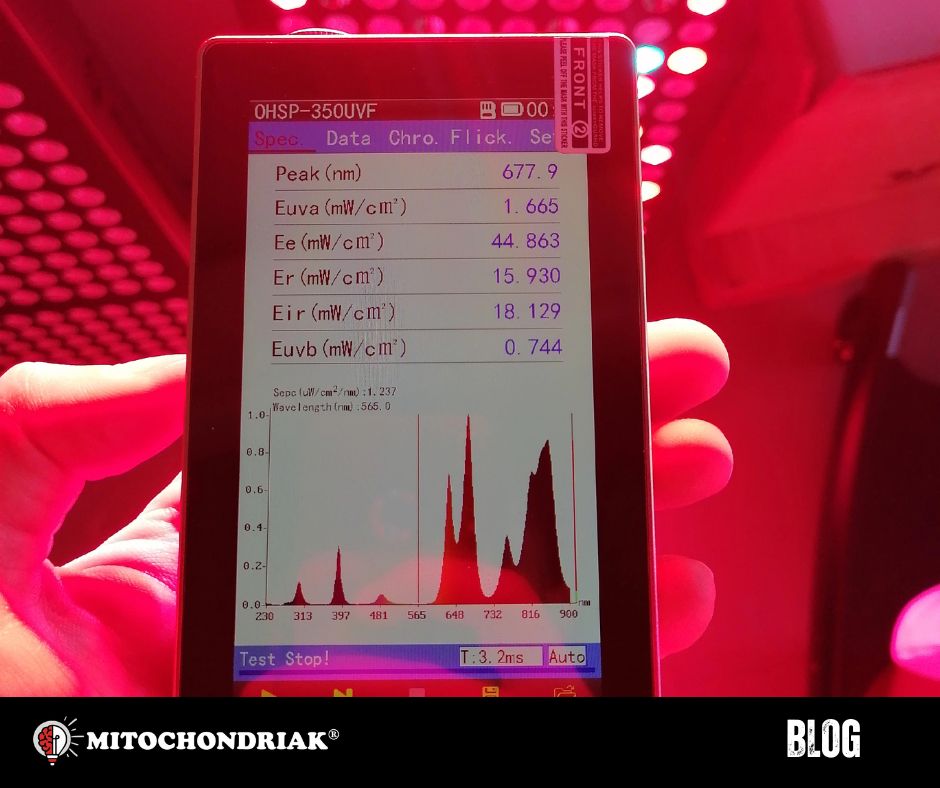
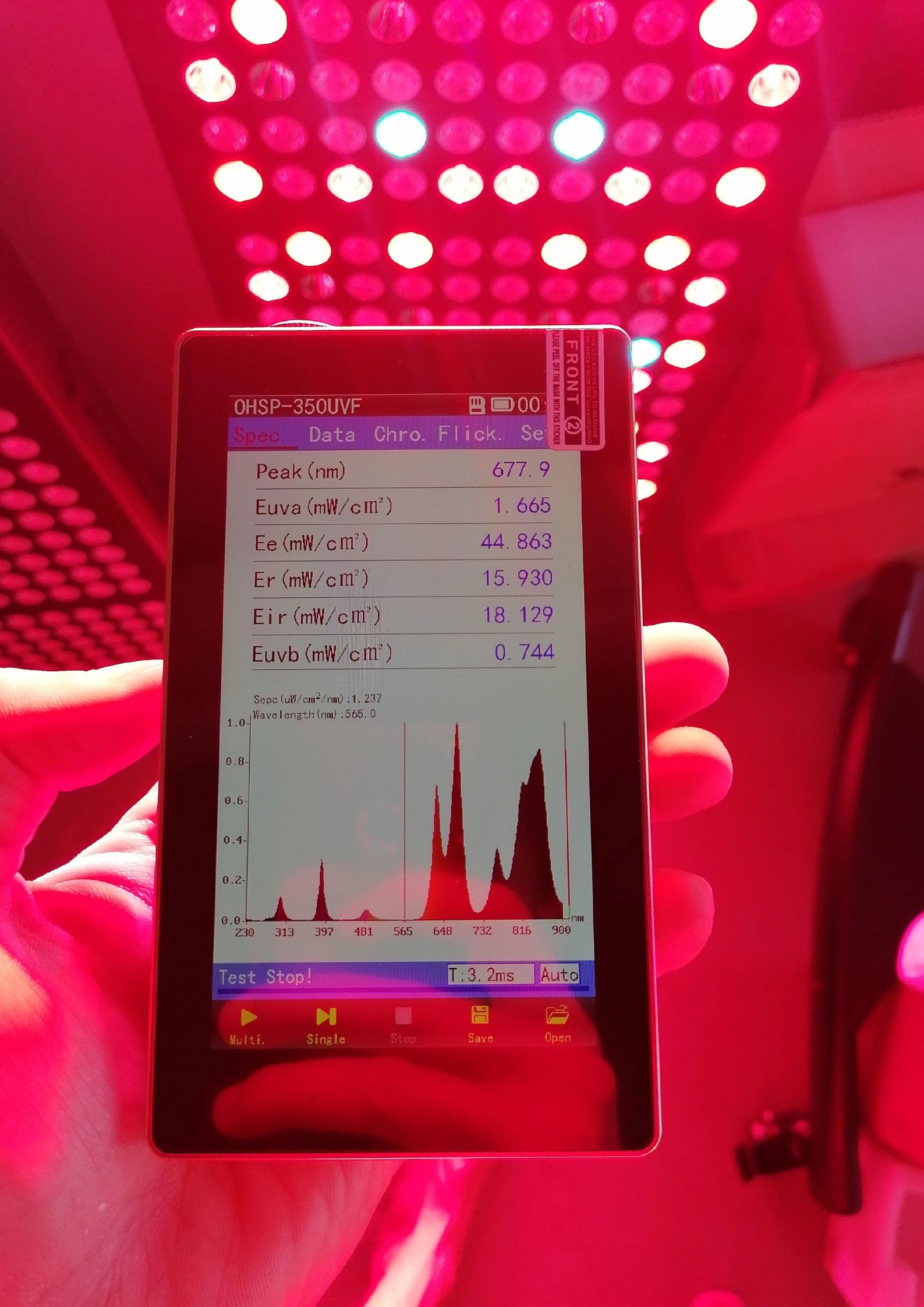
A transparent specification does more than list red and near-infrared light. It tells you the exact wavelengths, measured irradiance, measurement distance, units, instrument and relevant test conditions. These details help separate optical output from electrical consumption and make comparisons between panels more meaningful.
Photobiomodulation is not governed by a simple rule that more watts must be better. A review by Hoon Chung, Michael R. Hamblin and colleagues explains that biological responses depend on the combination of wavelength, power density, exposure time and total dose. It also discusses a biphasic dose response, meaning that a very low and a very high dose may produce different outcomes from an appropriate dose range. [R]
A useful product page should answer the following questions:
- Which wavelengths are present? “Red and infrared” is not precise enough. Look for values in nanometres.
- What irradiance reaches the target area? The value should include units and measurement distance.
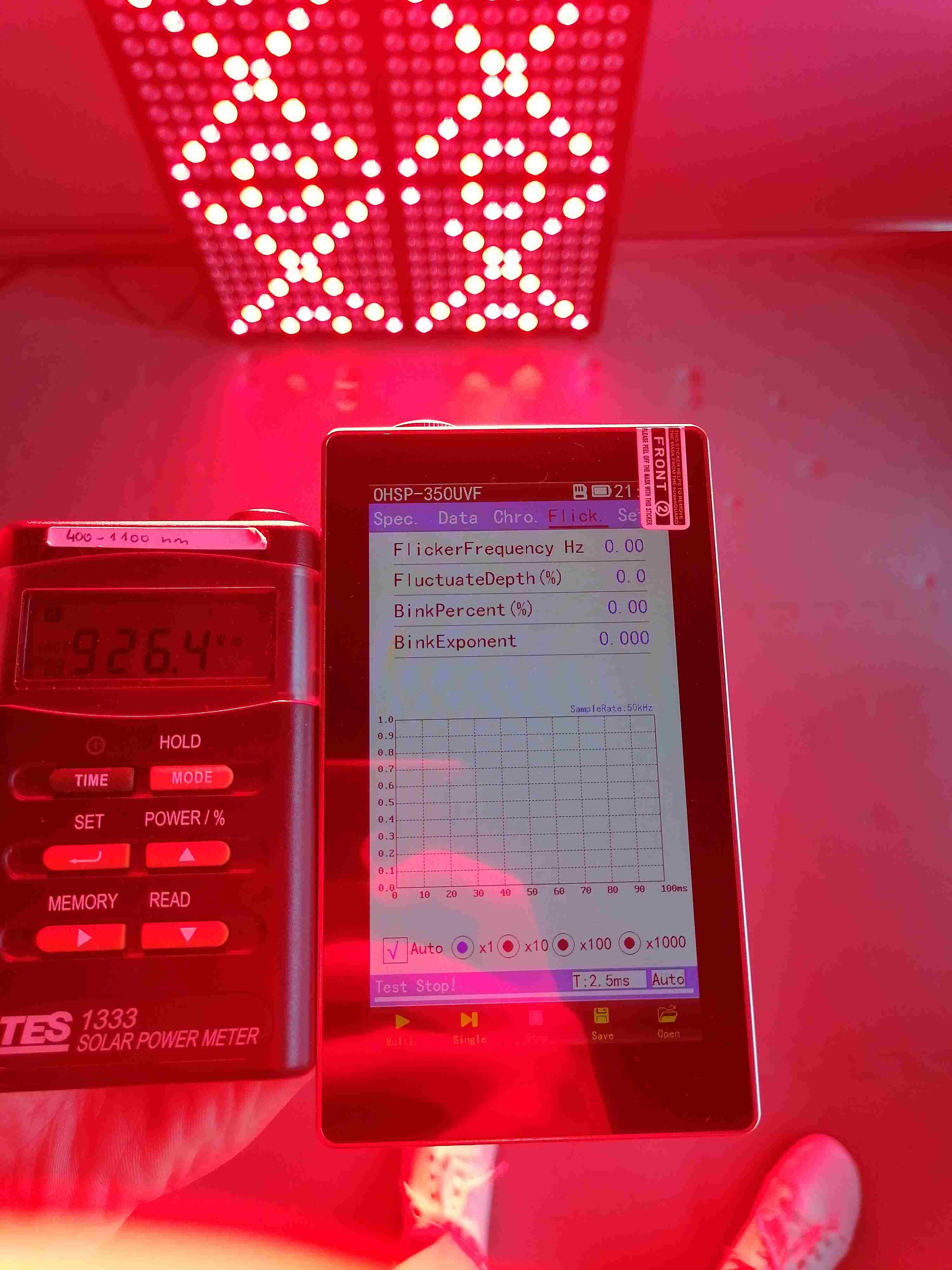
- Which instrument was used? Different meters answer different questions. Ask whether the seller measured spectral distribution, broadband optical power or both.
- Was only the centre point measured? One high reading in the middle does not show how evenly the full panel illuminates an area.
- Are electrical input and optical output clearly separated? Power consumption in watts is not the same as irradiance at the body.
- Are flicker and EMF claims tied to a method and distance? “Zero” or “low” has little meaning without test conditions.
Multiple wavelengths can be useful, but the number alone is not a quality score. What matters is whether the values are accurately stated, how the LEDs are distributed, whether red and NIR groups can be controlled, and whether the seller explains the design without turning every wavelength into a guaranteed health outcome. For a deeper explanation, see how many wavelengths a red light panel should have.
What do returns, service and reviews reveal?
Trust does not end with technical specifications. A reliable seller clearly explains withdrawal rights, return conditions, complaints, warranty, service access and review processing. It should also be possible to reach a real person who can answer a technical question before and after the purchase.
For consumers buying online in the European Union, the general statutory cooling-off period is 14 days, subject to legal exceptions. For goods, the period normally begins on the date of delivery. The official Your Europe guidance also explains that return costs and exceptions should be communicated before purchase. [R]
A longer voluntary period is an additional commercial benefit, not a replacement for statutory consumer rights. The current Mitochondriak.com terms and conditions state a 30-day withdrawal period from receipt of the goods, subject to the stated conditions. The practical process is described on the Complaints and Returns page.
Read the details rather than relying on a banner. Check whether original packaging is required, who pays return transport, where the item must be sent, how incomplete or damaged goods are assessed, and whether exclusions apply. Clear conditions protect both sides and reduce disputes.
Reviews should also have a visible method behind them. Detailed experiences, verified purchases and calm responses to criticism are more useful than a wall of short five-star statements. Check whether the store publishes a review processing policy and whether customer ratings can be traced to actual product pages or a dedicated review section.
Finally, test the support team before ordering. Ask one concrete question about measurement methodology, the Declaration of Conformity for a model, spare parts or post-warranty service. The precision of the answer often reveals whether the seller understands the device or merely resells a catalogue item.
How can you verify an online store step by step?
The safest approach is a short but systematic review before payment. The following eight steps can be used for almost any red light therapy store operating under the EU product framework. Each completed step reduces uncertainty and makes it harder for vague marketing to replace documentation.
- Verify the legal operator. Find the company name, registered address, contact details and terms. Check that the information is consistent across the website.
- Request model specific EU documentation. Look for the Declaration of Conformity, product identification and references to the applicable requirements.
- Check the wavelengths. Require exact values in nanometres rather than generic RED and NIR labels.
- Separate wattage from irradiance. Determine whether a number describes electrical input, nominal LED power or measured optical output.
- Review the measurement method. Ask about instrument, units, distance, measured area and test conditions. Compare devices only under reasonably similar conditions.
- Read instructions and safety information. A serious seller explains limitations and refers you to the manual for the specific device instead of publishing one universal protocol for every person and goal.
- Inspect withdrawal, complaint and service terms. Check deadlines, return costs, exclusions, support access and the process used when a fault occurs.
- Test support and review quality. Ask a technical question and look for detailed reviews, transparent processing rules and evidence of constructive complaint handling.
Only after these checks should price become the deciding factor. A lower price can be poor value when documentation is missing, service is unreachable or technical numbers cannot be reproduced.
Which warning signs should you not ignore?
The strongest warning is a combination of an anonymous operator, vague specifications, unavailable documents and guaranteed health outcomes. One missing detail may be an oversight. Several red flags together suggest that the customer is being asked to carry nearly all of the risk.
- CE and RoHS shown only as icons, with no document or model connection.
- A “CE certificate” presented as medical approval, without evidence that the product is an EU medical device.
- A very large wattage claim, with no irradiance, distance or measurement method.
- A spectrum image without context, product identity, scale or test conditions.
- Guaranteed treatment or cure claims, especially when the seller has no knowledge of the customer’s health status.
- Permanent countdown timers and artificial urgency, combined with unclear original prices.
- No accountable company or service address, and communication limited to an anonymous form.
- Copied descriptions and identical panels under changing brand names, with no explanation of product development or quality control.
- Perfect reviews with no detail, no processing policy and no visible response to criticism.
Educational content and medical diagnosis must also remain separate. A seller can discuss photobiomodulation research, but it should not promise that a consumer device will diagnose, cure or replace professional healthcare.
How does Mitochondriak® meet these criteria?
Mitochondriak® is operated from Slovakia and makes its company background, founders, contact details, EU compliance information, product specifications and consumer terms available on its English-language store. These details matter because customers can review them before ordering instead of relying solely on brand claims.
The people behind the brand are introduced on the About us page, and the store publishes a physical showroom address and direct support details on its Contact page. Device documentation is organised on a dedicated EU compliance documentation page.
Current device and category pages provide exact wavelengths and publish irradiance values together with measurement distances and instrument descriptions. The store also provides a 30-day withdrawal period in its terms, a defined complaints and returns process, and a public review processing policy.
We recommend applying the same checklist to Mitochondriak® that you would apply to any other seller. Open the documents, compare the measurements, read the terms and ask questions. Trustworthy commerce does not require the customer to stop checking. It gives the customer enough information to check properly.
Would you like to compare verified device specifications?
Explore the Mitochondriak® red light therapy device range to compare wavelengths, panel sizes, controls and measurement data. You can also use the product guide or contact our support team before choosing a model.
What should you remember?
A trustworthy red light therapy store makes its claims verifiable. Look for a traceable EU business, product specific conformity documents, exact technical data, explained measurement methods, realistic language, accessible service and fair consumer terms.
The simplest rule is this: do not buy the largest number, buy the best documented system. Wavelengths without measurement conditions are incomplete, a meter reading without a method is weak evidence, and a CE logo without a product specific compliance trail tells you very little.
Frequently asked questions
How can I quickly check whether a red light therapy store is trustworthy?
Start with the legal operator, EU compliance documents, exact wavelengths, irradiance measurement conditions, return terms and direct contact details. A trustworthy seller can connect important claims to a specific product, document or test. If the site relies on large numbers, generic CE icons and anonymous contact forms, pause the purchase and request evidence before paying.
Is CE marking a quality certificate issued by the European Union?
No. CE marking is not a general quality award and there is no central EU body that automatically issues a universal CE certificate. The manufacturer uses the mark to declare conformity with the EU requirements that apply to the product. The useful evidence is the product specific compliance trail, including the EU Declaration of Conformity and supporting technical documentation.
Does a CE mark mean that a red light panel is an EU medical device?
No. Electrical equipment may require CE marking under legislation covering electrical safety, electromagnetic compatibility or other product requirements. That does not automatically give the product medical device status. Unless the seller can document classification and conformity under the relevant EU medical device framework, CE should not be described as medical approval.
Which technical specifications matter most when comparing red light panels?
Check the exact wavelengths, irradiance in mW/cm², measurement distance, instrument, measured area, flicker conditions and EMF distance. Also separate electrical power consumption from optical output. Comparisons are meaningful only when values were obtained under reasonably similar conditions. A single centre reading or a wattage figure cannot describe the performance of the whole panel.
What withdrawal period applies to an online purchase in the European Union?
EU consumers generally have a 14-day cooling-off period for distance purchases, subject to legal exceptions. For goods, the period usually begins on delivery. A seller may voluntarily offer a longer period. Mitochondriak.com currently states a 30-day withdrawal period in its terms, subject to the published conditions and return procedure.
Is an EU-based seller automatically trustworthy?
No. Being established in the European Union can make legal identity, consumer terms and market responsibility easier to verify, but it is not proof of quality by itself. Apply the same checklist to every seller: identify the company, inspect model specific documents, review measurements, read return terms, test technical support and examine how reviews and complaints are handled.
Sources and references
- European Union. CE marking. Manufacturer responsibilities, conformity assessment, technical documentation and the EU Declaration of Conformity. Your Europe.
- European Commission. RoHS Directive. Restrictions on hazardous substances in electrical and electronic equipment. European Commission.
- European Union. Returns and the right of withdrawal. The 14-day cooling-off period for distance purchases and its exceptions. Your Europe.
- Chung H, Dai T, Sharma SK, Huang YY, Carroll JD, Hamblin MR. 2012. The Nuts and Bolts of Low-level Laser (Light) Therapy. Annals of Biomedical Engineering.