.png)
Did you know that red and near-infrared light can influence testosterone levels directly at the cellular level? If you're a man looking for a natural way to support your hormones without synthetic supplements, photobiomodulation offers a fascinating solution. In this article, we’ll explore what the science says, how it works, and how you can apply it at home.
- How red and near-infrared light (630 to 940 nm) affects Leydig cells and testosterone production
- Which scientific studies support the link between photobiomodulation and male hormones
- The difference between direct application to the testicles and full-body exposure
- A practical protocol: wavelengths, distance, timing, and frequency
- Why light alone isn’t enough and what other factors influence testosterone levels
- What is testosterone and why does it decline?
- How does red light affect testosterone levels?
- What do scientific studies say about photobiomodulation and testosterone?
- Which wavelengths are most effective for testosterone support?
- What does a practical protocol look like?
- What else influences testosterone besides light?
- Is applying red light to the testicles safe?
- Frequently Asked Questions
What is testosterone and why does it decline?
Testosterone is the primary male sex hormone, produced mainly in the Leydig cells of the testicles. Beyond its role in sexual function, it influences muscle mass, bone density, fat distribution, energy levels, mood, and cognitive performance. After the age of 30, testosterone levels naturally decline at a rate of approximately 1 to 2% per year.
However, this decline is not just about aging. Modern lifestyle accelerates it significantly. Chronic stress increases cortisol levels, which directly suppress testosterone production. Poor sleep, a sedentary lifestyle, excessive exposure to artificial blue light at night, and insufficient exposure to natural light during the day create an environment where mitochondria operate below their potential.
This is where light becomes crucial. Leydig cells are highly metabolically active and contain a large number of mitochondria, because steroid hormone production, including testosterone, is an energy-demanding process that requires sufficient ATP. When mitochondrial function is compromised, hormone output declines as well.
How does red light affect testosterone levels?
Red and near-infrared light (630 to 940 nm) influence cells through a process known as photobiomodulation. Light photons are absorbed by the enzyme cytochrome c oxidase (CCO) in the mitochondria, which increases ATP production and reduces oxidative stress.
In the context of testosterone, this leads to several key effects:
- Increased ATP production in Leydig cells provides the energy required for steroid hormone synthesis
- Reduction of reactive oxygen species (ROS) protects testicular cells from oxidative damage
- Stimulation of nitric oxide (NO) improves microcirculation in testicular tissue
- Support of mitochondrial biogenesis increases the overall capacity of cells to produce energy and hormones
In simple terms, red light gives Leydig cells more “fuel” to do their job. It is not an external hormone or stimulant. It enhances a natural biological process that already exists in your body.
What do scientific studies say about photobiomodulation and testosterone?
Research in this area is still relatively young, but existing studies consistently show promising results. Most of the research has been conducted on animal models, yet the underlying biological mechanisms are directly transferable to humans.
Aghajanpour et al. (2024) from Iran published a study in Photobiomodulation, Photomedicine, and Laser Surgery demonstrating that photobiomodulation improves the histological structure of testicular tissue and increases Leydig cell activity. The results showed enhanced androgen and testosterone production, especially at the beginning of the therapeutic cycle (PMC, 2024).
Soltani et al. (2024), in a review published in Lasers in Medical Science, analyzed the effects of photobiomodulation on male reproductive health. They found significant improvements in sperm quality and quantity, testicular volume, and a reduction in reactive oxygen species (ROS) levels (PMC, 2024).
Moskvin and Apolikhin (2018), in a review for BioMedicine, examined the effectiveness of low-level laser therapy in treating male infertility. Their findings showed improved sperm survival, motility, and velocity, along with enhanced overall testicular function (PMC, 2018).
Aqajanpor et al. (2025), in a more recent study, confirmed that photobiomodulation can be more effective in restoring testicular function than long-term antioxidant supplementation. The therapy reduced ROS production and supported spermatogenesis (PubMed, 2025).
It’s important to note that most of these studies were conducted on animal models. Large randomized clinical trials in humans are still limited. However, the biological mechanisms are consistent and align with thousands of studies on photobiomodulation in other areas, including muscle recovery, inflammation, and cognitive performance.
Which wavelengths are most effective for testosterone support?
For supporting testicular function and testosterone production, two key wavelength ranges are most relevant, the same ranges used in Mitochondriak® devices:
- Red light (630 to 670 nm) penetrates superficial tissue layers (approximately 1 to 3 cm). It primarily affects the skin, superficial blood vessels, and cells near the surface, making it suitable for localized application.
- Near-infrared light (810 to 940 nm) penetrates deeper (approximately 4 to 7 cm) and can reach deeper structures, including Leydig cells. This makes the NIR spectrum essential for hormonal support.
The combination of both spectra is ideal. Red light improves surface-level circulation and tissue health, while near-infrared light penetrates deeper and directly stimulates mitochondrial activity in Leydig cells.
Infrared panels from Mitochondriak® combine wavelengths in the 630 to 940 nm range, and uniquely include 760 nm, covering the full therapeutic spectrum for this purpose.
What does a practical application protocol look like?
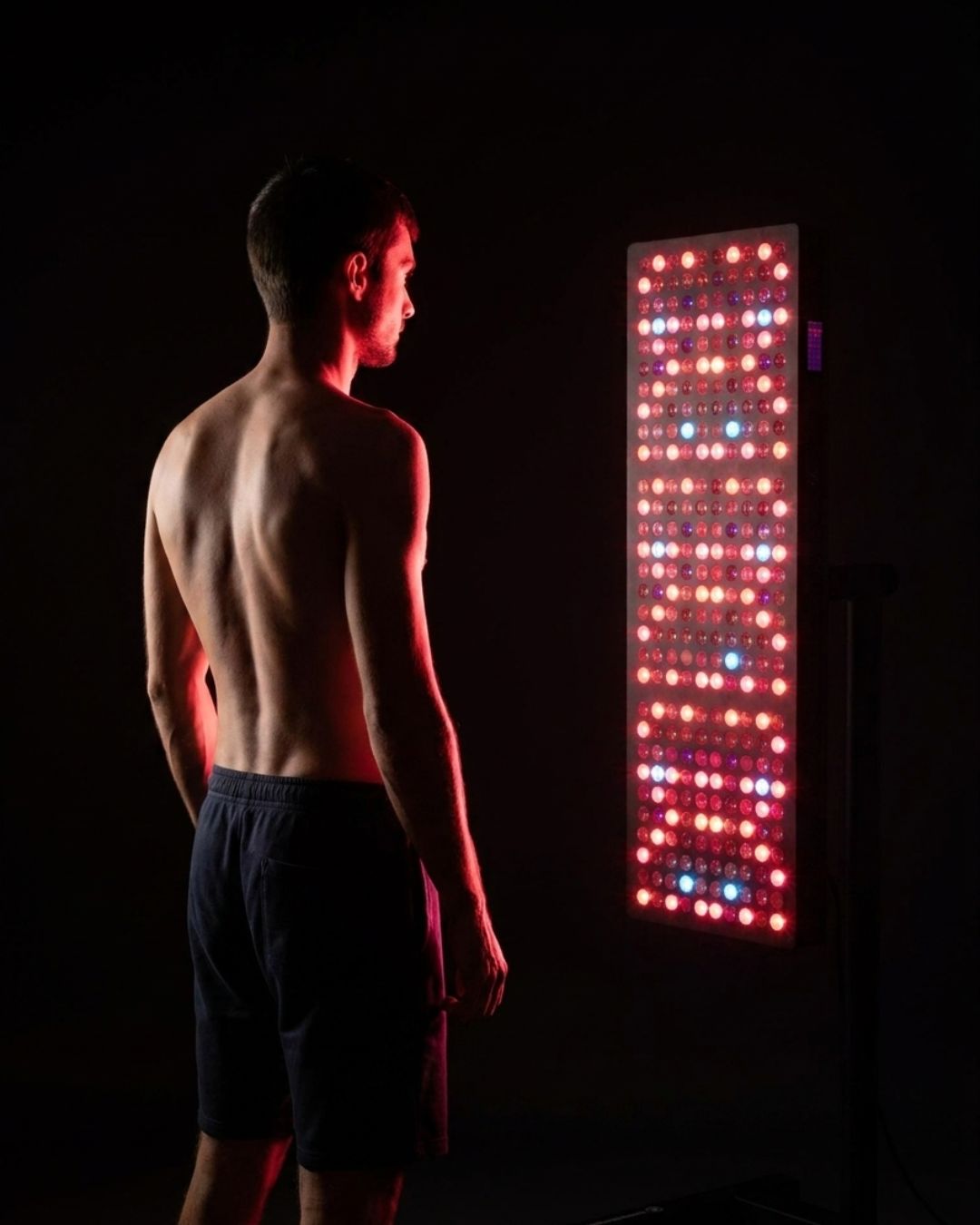
If you want to use red light therapy to support testosterone, proper parameters matter. More is not always better. The key is the right dose, distance, and frequency.
Recommended protocol for testosterone support
- Distance: 30 to 60 cm from the panel (depending on device size)
- Time: 10 to 15 minutes per session
- Frequency: 3 to 5 times per week
- Wavelengths: combined RED + NIR mode (630 to 940 nm)
- Clothing: apply to bare skin, with no clothing covering the target area
- Best time: morning or late morning, when testosterone levels are naturally highest
For a broader hormonal effect, it’s beneficial to combine local application with full-body exposure. Larger panels, such as Mitochondriak® Maxi or professional-grade systems, allow you to treat larger areas at once, supporting overall metabolism and recovery.
What else influences testosterone besides light?
Red light therapy is a powerful tool, but it works best as part of a broader mitochondrial approach to health. Light alone is not enough if other key pillars are missing.
Sleep and circadian rhythm
Most testosterone is produced during deep sleep. A study from the University of Chicago showed that restricting sleep to 5 hours per night for just one week reduced testosterone levels by 10 to 15%. Quality sleep is therefore essential. Reducing blue light exposure in the evening, for example by using blue light blocking glasses or red light bulbs, can significantly improve both sleep quality and hormonal balance.
Morning sunlight exposure
Exposure to natural sunlight within the first 30 minutes after waking helps regulate your circadian rhythm and supports a healthy cortisol peak, which is essential for optimal testosterone levels throughout the day. As emphasized by Andrew Huberman from Stanford School of Medicine, morning light is one of the most powerful tools for regulating the neuroendocrine system.
Movement and strength training
Strength training is one of the most effective ways to naturally increase testosterone. Compound exercises such as squats, deadlifts, and bench press activate large muscle groups and trigger a strong hormonal response. Combining resistance training with red light therapy for recovery creates a powerful synergistic effect.
Nutrition and dietary fat
Cholesterol is the precursor for all steroid hormones, including testosterone. From a Mitochondriac perspective, fat is not the enemy. High-quality animal fats, egg yolks, butter, and organ meats provide the building blocks for hormone production. A seasonal diet rich in healthy fats and protein is essential for optimal hormonal function.
Reducing stress and oxidative load
Chronically elevated cortisol directly suppresses testosterone production. In addition to stress management, grounding can help reduce inflammatory markers and support parasympathetic nervous system activity. Barefoot contact with the earth is a simple yet powerful addition.
Is applying red light to the testicles safe?
Yes, when proper parameters are followed, photobiomodulation is a safe and non-invasive method. Red and near-infrared light are non-ionizing forms of radiation. They do not generate heat at levels that would damage tissue, unlike excessive exposure to saunas or hot baths, which can overheat the testicles.
The key is to follow these guidelines:
- Maintain proper distance (at least 15 cm) to avoid excessive heat exposure
- Use appropriate session duration (10 to 15 minutes) and avoid overdosing
- Choose high-quality devices with verified wavelengths and no harmful flicker
Mitochondriak® devices are designed to deliver therapeutic light doses without excessive heat. Pulse mode further reduces thermal load while improving light penetration efficiency.
Want to support your testosterone with red light?
Mitochondriak® infrared panels combine wavelengths from 630 to 940 nm in a single device. For both local and full-body application, models like the Mini and Maxi offer proven performance and optimal spectrum.
Frequently Asked Questions
Does red light therapy increase testosterone in men?
Current scientific evidence, mostly from animal studies, suggests that photobiomodulation using red and near-infrared light (630 to 940 nm) can stimulate Leydig cells, increase ATP production in their mitochondria, and support the synthesis of steroid hormones, including testosterone. Large-scale human clinical trials are still ongoing, but the biological mechanism is consistent.
Which wavelengths are best for supporting testosterone?
The optimal combination includes red light (630 to 660 nm) and near-infrared light (810 to 940 nm). Red light affects superficial tissues and improves microcirculation, while near-infrared light penetrates deeper (approximately 4 to 7 cm) and directly influences Leydig cells. Mitochondriak® devices cover this full spectrum.
How long and how often should I apply red light to the testicles?
The recommended duration is 10 to 15 minutes per session from a distance of 15 to 30 cm from the panel. A frequency of 3 to 5 times per week is optimal for most men. It’s important not to exceed the recommended duration, as light therapy follows the principle of an optimal dose, not a maximal one.
Can red light therapy replace TRT (testosterone replacement therapy)?
No, photobiomodulation is not a replacement for TRT in cases of clinically diagnosed hypogonadism. However, it can serve as a complementary method that supports natural hormone production. For men with mildly reduced testosterone levels, due to stress, poor sleep, or aging, it can be an effective natural tool.
Is it safe to apply red light to the testicles?
Yes. Red and near-infrared light are non-ionizing and, when used correctly (minimum distance of 15 cm and duration of 10 to 15 minutes), do not generate excessive heat. On the contrary, studies suggest that photobiomodulation can reduce oxidative stress and protect cells from damage. The key is to use a high-quality device with verified wavelengths.
How long does it take to see results?
Some men report subjective improvements, such as better energy, mood, and libido, within 2 to 4 weeks of regular use. Measurable changes in testosterone levels (via blood tests) may appear after 4 to 8 weeks of consistent application. Results vary depending on lifestyle, sleep quality, and nutrition.
Sources and References
- Aghajanpour, F. et al., 2024. Photobiomodulation Improves Histological Parameters of Testis. PMC
- Soltani, R. et al., 2024. The Impact of Photobiomodulation Therapy on Enhancing Spermatogenesis. PMC
- Moskvin, S.V. and Apolikhin, O.I., 2018. Effectiveness of low level laser therapy for treating male infertility. PMC
- Aqajanpor, F. et al., 2025. Photobiomodulation is more effective than long-term antioxidant supplementation for testicular function recovery. PubMed
- Ferraresi, C. et al., 2016. Photobiomodulation in human muscle tissue: an advantage in sports performance? PMC