.png)
Spring pressure changes, pollen season, more hours behind screens. April is the month when migraines hit hardest. What if there is a natural tool that can reduce both their frequency and intensity? Discover how red light photobiomodulation affects headache pain mechanisms and why a growing number of studies confirm its potential for migraine relief.
- Red light (630–670 nm) and near-infrared light (810–850 nm) act on mitochondria in brain cells, reducing inflammation and oxidative stress associated with migraine.
- Clinical studies from 2022–2025 show a reduction in migraine days and pain intensity after regular use of photobiomodulation.
- The optimal protocol involves 10–20 minutes, 3–5 times per week, used preventively (not during an acute attack with photophobia).
- Blue light from screens is a proven migraine trigger. Blocking it with Mitochondriak® red glasses in the evening helps with prevention.
- Women suffer from migraines 3 times more often than men, which is linked to hormonal cycles and higher sensitivity to light triggers.
- What happens in the brain during a migraine?
- What is photobiomodulation and how does it affect pain?
- What do studies say about red light and migraine?
- How to use red light for migraine?
- How are blue light blocking glasses related to migraine?
- What are the spring migraine triggers and what to do about them?
- When will red light not help with migraine?
- Frequently Asked Questions

What happens in the brain during a migraine?
Migraine is not an "ordinary headache." It is a complex neurological condition involving abnormal activation of the trigeminovascular system, vasospasm followed by vasodilation of meningeal blood vessels, the release of inflammatory mediators (CGRP, substance P), and significant oxidative stress in neurons.
During an attack, levels of reactive oxygen species (ROS) increase in the mitochondria of brain cells. Mitochondrial dysfunction, the inability of cells to efficiently produce ATP, is considered one of the key mechanisms behind why some people suffer from recurrent migraines. Researchers at Johns Hopkins University confirmed that patients with chronic migraine have measurably reduced mitochondrial function compared to healthy controls.
Why does light hurt, and why is red light the exception?
Up to 80% of migraine patients suffer from photophobia, an extreme sensitivity to light. The key role is played by intrinsically photosensitive retinal ganglion cells (ipRGCs), which are most sensitive to blue light at a wavelength of around 480 nm. Blue and white light activate these cells and amplify the pain signal through the posterior thalamus.
Red light (630–700 nm) activates this pathway minimally. A study published in the journal Brain (Noseda et al., 2016) demonstrated that red light generates significantly less activation of thalamic neurons compared to blue, white, and amber light. This explains why a migraine patient can tolerate red light even during a milder attack.
What is photobiomodulation and how does it affect pain?
Photobiomodulation (PBM) is a therapeutic method that uses red and near-infrared light to stimulate cellular processes. Light at wavelengths of 630–670 nm (RED) and 810–940 nm (NIR) penetrates the skin and skull, where it is absorbed by the enzyme cytochrome c oxidase (CCO), a key complex IV in the mitochondrial electron transport chain.
The mechanism of action is direct: photons release nitric oxide (NO) that blocks CCO, thereby restoring electron flow and increasing production of ATP, the cell's primary energy substrate. Simultaneously, levels of reactive oxygen species decrease, the transcription factor NF-kB is activated, and the expression of anti-inflammatory cytokines increases. The result is a triple effect: more energy for cells, less inflammation, and improved tissue blood flow.
Michael R. Hamblin from Harvard Medical School, one of the world's leading experts on photobiomodulation, emphasized in his 2017 review that PBM affects pain through multiple pathways: directly on nociceptors (nerve endings that detect pain), through its anti-inflammatory effect, and by improving mitochondrial function in damaged tissues. You can read more about how mitochondria produce energy (ATP) in our dedicated article.
What do studies say about red light and migraine?
Scientific research on photobiomodulation for headaches and migraines has expanded significantly in recent years. While it remains a developing field, the existing data are promising and consistently show a positive trend. Here are the most important findings.
Photobiomodulation for primary headaches (Gomes et al., 2022)
A systematic review of randomized clinical trials published in Photobiomodulation, Photomedicine, and Laser Surgery (Gomes et al., 2022) evaluated the efficacy and safety of photobiomodulation as an adjunctive treatment for primary headaches. The main inclusion criterion was headache frequency of more than 15 days per month (chronic form). Results showed that PBM significantly reduces pain intensity and attack frequency compared to placebo, with no serious side effects. The authors emphasized the need for further studies but described PBM as a "promising adjunctive method" (PMC8781567).
Photobiomodulation, headache, and fatigue (Abdulrashid et al., 2024)
A study published in Lasers in Medical Science (Springer, 2024) examined the effects of PBM on headache, fatigue, and sinus opacification in patients with chronic sinusitis. Results demonstrated statistically significant improvement in all three parameters in the PBM group compared to controls. Headache was reduced by an average of 42% after an 8-week protocol using wavelengths of 630–850 nm. This is particularly relevant because sinusitis is a common comorbid condition in migraine and shares inflammatory mechanisms with it (Springer, 2024).
LLLT and serotonin in women with TMD (de Magalhaes et al., 2016)
A Brazilian study from 2016 examined the effects of low-level laser therapy (LLLT) on serotonin levels, blood flow velocity, and cholinesterase activity in women with temporomandibular dysfunction (TMD), a condition closely associated with chronic headaches. LLLT led to increased serotonin levels, a neurotransmitter whose deficit is directly linked to migraine pathogenesis. The study used a wavelength of 780 nm and a dose of 35 J/cm2, achieving measurable improvements in pain and quality of life (PubMed 26202374).
Auricular neuromodulation with LLLT for migraine (Sagui et al., 2025)
A French study published in 2025 tested auricular (ear) neuromodulation using LLLT in patients with chronic migraine. The aim was to verify whether 3 LLLT sessions at monthly intervals could reduce the number of migraine days, duration, and intensity of attacks. Results confirmed a significant reduction in migraine days, with the effect persisting even 3 months after treatment ended (PMC12522478).
Integrative migraine therapy: review 2025 (Hariga et al.)
An extensive narrative review from 2025 (Hariga et al., PMC12843410) maps current non-pharmacological approaches to migraine treatment including photobiomodulation. The authors state that "PBM may represent a non-pharmacological adjunct targeting neurovascular dysfunction in migraine," although they emphasize the heterogeneity of existing protocols as the main limitation (PMC12843410).
PBM and pain mechanisms (Cheng et al., 2021)
A review by Cheng et al. (2021) published in Frontiers in Neuroscience analyzed in detail the mechanisms by which photobiomodulation reduces pain. The authors document that PBM "reduced the number of headache days as well as the intensity and duration of attacks in patients with both episodic and chronic migraine." The key mechanism is the modulation of neural excitability and suppression of neurogenic inflammation through reduced levels of CGRP, the peptide that is the primary therapeutic target of modern anti-migraine drugs (PMC8277709).
Women and migraine: 3 times higher risk (2026)
A global analysis published in January 2026 confirmed that women face migraine three times more often than men. Attacks in women last longer, are more intense, and more frequently lead to work disability. The hormones estrogen and progesterone play a key role: fluctuations in their levels during the menstrual cycle, pregnancy, and menopause directly correlate with attack frequency. For women with migraine, supporting mitochondrial function through photobiomodulation is particularly interesting because mitochondria are the primary site of steroid hormone synthesis (Global Burden of Disease 2023, The Lancet Neurology).
Section summary: The science is not definitive, and none of these studies alone proves that red light "cures" migraine. However, the data are consistently promising. Across various protocols, wavelengths, and patient populations, reductions in pain, attack frequency, and inflammatory markers have been repeatedly observed. For people seeking a non-pharmacological addition to migraine management, photobiomodulation is one of the best-researched options available.
How to use red light for migraine?
The right protocol is the key to effective photobiomodulation for migraine. Based on available clinical data and recommendations from experts such as Tiina Karu (Russian Academy of Sciences) and Michael R. Hamblin (Harvard Medical School), here is a practical guide.
Which wavelengths are most effective?
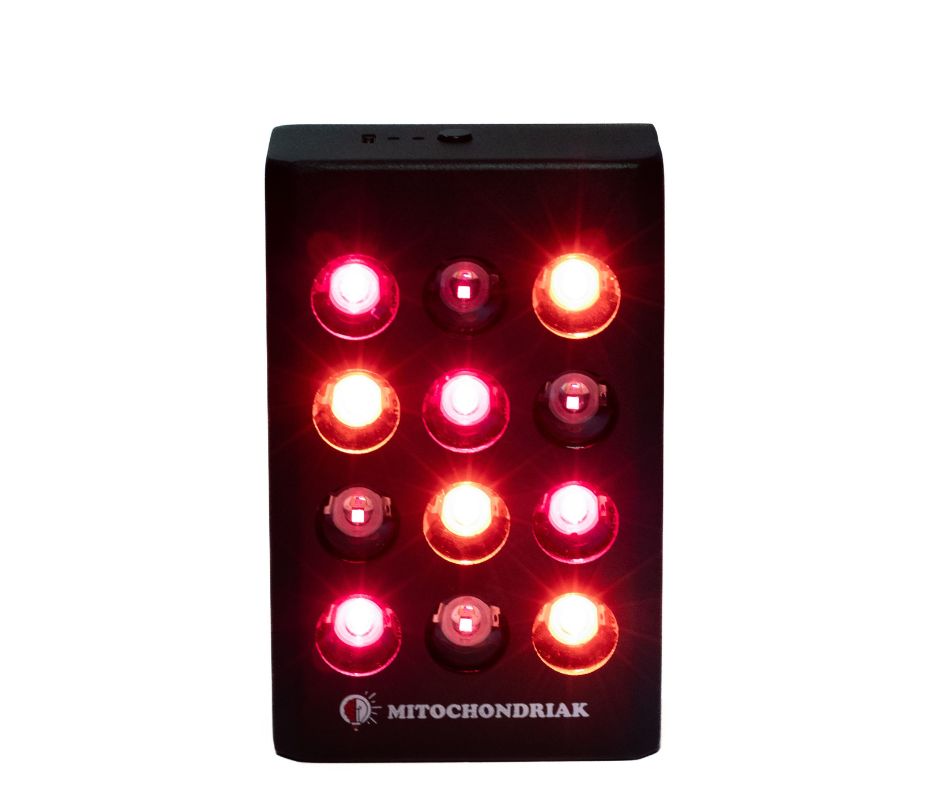
Two wavelength ranges are relevant for migraine. Red light at 630–670 nm acts primarily on surface tissues, skin, and superficial blood vessels. Near-infrared light at 810–940 nm penetrates deeper, through the skull to brain tissue, where it directly stimulates the mitochondrial enzyme cytochrome c oxidase. Ideally, use a device that combines both ranges. You can use either a larger panel such as the Mitochondriak® Office, or something smaller, easily portable, and even battery-powered like the Mitochondriak® mini panel.
Which body areas should you target?
- Forehead - prefrontal area, the main zone for transcranial PBM
- Temples - the area of temporal arteries, often the epicenter of migraine pain
- Back of the head / occiput - visual cortex, relevant for migraine with aura
- Neck / cervical area - trapezius muscles, cervicogenic pain component
For targeted local application on the temples or back of the head, the Mitochondriak® laser pulse is also suitable, allowing precise targeting of a small area.
How long and how often?
- Session length: With a smaller device (mini/laser) 10–20 minutes per area, with a larger one (Office) we recommend 5 to 10 minutes
- Frequency: 3–5 times per week for regular prevention
- Distance: With a smaller device (mini/laser) 5–15 cm from the skin, and with a larger one 50 to 60 cm from the body
- Cumulative effect: First results typically appear after 2–4 weeks of regular use
- Recommended mode: On your Mitochondriak® panel, turn on continuous mode (no pulsing)
When is the best time to apply?
Use red light for migraine preventively, that is, during the period between attacks, not during an acute episode accompanied by severe photophobia. Morning or afternoon application is ideal because it supports the natural circadian rhythm. An afternoon session (2 or more hours before bedtime) can improve sleep quality, which is itself a strong preventive factor against migraine.
Tip: Combine photobiomodulation with blue light blocking. Wear Mitochondriak® blue light blocking glasses 2–3 hours before bedtime for maximum protection of your circadian rhythm and melatonin production.
How are blue light blocking glasses related to migraine?
Blue light from screens, LED lighting, and fluorescent fixtures is one of the most common light-based migraine triggers. The reason is neurobiological: blue light at a wavelength of around 480 nm maximally excites intrinsically photosensitive retinal ganglion cells (ipRGCs), which communicate directly with brain areas involved in pain processing, including the posterior thalamus.
In people with migraine, this pathway is sensitized and responds more strongly than in healthy individuals. This explains why hours spent at a computer or under artificial lighting can trigger an attack. Evening exposure to blue light also suppresses melatonin production, disrupts sleep, and increases the overall inflammatory burden on the body, all factors that raise the risk of migraine.
The solution: Blocking blue light in the evening with red glasses is a simple yet highly effective preventive strategy. Mitochondriak® blue light blocking glasses block virtually the entire blue light spectrum (up to 550 nm), protecting melatonin production and preventing excessive stimulation of ipRGC cells. For people with migraine, this means fewer triggers, better sleep, and lower inflammatory burden, three pillars of effective prevention.
What are the spring migraine triggers and what to do about them?
Spring is the most challenging season for migraine sufferers. The combination of multiple factors creates a "perfect storm" of triggers that increase both the frequency and intensity of attacks.
- Barometric pressure changes - spring weather fronts bring rapid pressure fluctuations that affect the vascular tone of cerebral blood vessels
- Pollen season - allergic inflammation raises histamine levels and pro-inflammatory cytokines, which sensitize the trigeminovascular system
- Circadian rhythm shift - the daylight saving time change and longer days disrupt the internal biological clock, weakening mitochondrial function
- Dehydration - higher temperatures and physical activity increase fluid loss, and even mild dehydration (1–2%) is a proven migraine trigger
- Increased UV exposure - intense spring sunshine after winter months can overwhelm the eye's adaptive mechanisms
Photobiomodulation helps with spring migraine in several ways. Regular morning sessions with red and infrared light support circadian rhythm stabilization, because red light (unlike blue light) does not signal "daytime" to the brain but helps mitochondria in retinal and brain cells produce more ATP. At the same time, PBM suppresses inflammatory markers that are elevated in spring due to allergies. We covered this topic in detail in our article Spring fatigue? Mitochondriaks have no chance of getting it.
When will red light not help with migraine?
Photobiomodulation is a promising tool, but it is not a universal solution. A responsible approach requires clearly naming its limitations as well.
- During an acute attack with severe photophobia - if light sensitivity is so intense that even dim red light causes discomfort, postpone the therapy. Although red light has the lowest potential to trigger a photophobic reaction, during severe attacks the priority is rest and darkness.
- Migraine with aura - this subtype involves visual, sensory, or motor symptoms before the attack. The aura mechanism (cortical spreading depression) responds differently to light stimuli. For this type of migraine, we recommend consulting a neurologist before beginning any light therapy.
- Secondary headaches - headache can be a symptom of serious conditions (tumor, vascular malformation, increased intracranial pressure). PBM does not replace diagnosing the cause of pain.
- As a substitute for medical care - photobiomodulation is a complementary method, not a primary treatment. If you have new, worsening, or unusual headaches, or if you are unsure about using light therapy, see a neurologist.
This article is informational and does not replace medical consultation. Photobiomodulation is a complementary health support tool, not a cure for migraine.
Try photobiomodulation for migraine with a 30-day satisfaction guarantee
If you are looking for a non-pharmacological way to reduce the frequency and intensity of migraines, start with the Mitochondriak® mini panel for targeted use on the forehead and temples, or with the Mitochondriak® Office for broader coverage. For evening prevention, we recommend Mitochondriak® blue light blocking glasses.
Frequently Asked Questions
Does red light help with migraine?
Yes, available clinical studies show that photobiomodulation with red and infrared light (630–940 nm) can reduce the frequency and intensity of migraines. The mechanism involves stimulation of mitochondrial ATP production, reduction of inflammatory markers, and modulation of neural excitability. It is a complementary method, not a replacement for medical care.
How many minutes a day should you use a red light panel for headaches?
The recommended protocol is 10–20 minutes per area (forehead, temples, back of the head), 3–5 times per week. First results typically appear after 2–4 weeks of regular use. Consistency is key because a single session does not have the same cumulative effect as regular application.
Can you use red light during a migraine attack?
During milder attacks without severe photophobia, red light is usually tolerated because it activates thalamic pain pathways minimally. However, during a severe attack with intense light sensitivity, we recommend postponing the therapy and prioritizing rest in darkness. Photobiomodulation is most effective as a preventive method between attacks.
What wavelength is best for headaches?
Two wavelengths are most effective for headache and migraine: red light at 630–670 nm (acts on surface tissues and blood vessels) and near-infrared light at 810–850 nm (penetrates through the skull to brain tissue). Ideally, use a device that combines both ranges, such as Mitochondriak® panels or the Mitochondriak® laser pulse.
Can blue light blocking glasses prevent migraine?
Blue light blocking glasses cannot completely prevent migraine, but they can eliminate one of its most common triggers. Blue light from screens excites ipRGC cells in the retina, which communicate directly with pain centers in the brain. Wearing red glasses in the evening also protects melatonin production and improves sleep, both factors that reduce the risk of an attack.
Sources and References
- Gomes AO et al., 2022. Photobiomodulation for the Treatment of Primary Headache: Systematic Review of Randomized Clinical Trials. PMC8781567
- Abdulrashid NA et al., 2024. Effect of photobiomodulation therapy on headache, fatigue and sinus opacification. Lasers Med Sci, Springer 2024
- de Magalhaes MT et al., 2016. Light therapy modulates serotonin levels and blood flow in women with headache. PubMed 26202374
- Sagui E et al., 2025. Auricular neuromodulation by low level laser therapy reduces migraine days. PMC12522478
- Hariga CS et al., 2025. Integrative Migraine Therapy: From Current Concepts to Photobiomodulation. PMC12843410
- Cheng K et al., 2021. Mechanisms and Pathways of Pain Photobiomodulation. PMC8277709
- GBD 2023 Headache Collaborators, 2026. Global, regional, and national burden of migraine. The Lancet Neurology, 2026