
.png)
Spring allergies are not only an uncomfortable reaction to pollen. They are an immune and inflammatory response involving immunoglobulin E, mast cells, histamine, eosinophils and inflammatory cytokines. Alongside standard allergy care, photobiomodulation may help regulate inflammatory processes and reduce symptoms of allergic rhinitis.
- Why pollen triggers an IgE-mediated inflammatory reaction in the nasal mucosa.
- How photobiomodulation may influence mitochondrial and inflammatory signalling.
- What clinical trials have found about intranasal red light and allergic rhinitis.
- Why the evidence from specialised intranasal devices cannot be transferred automatically to every external LED panel.
- How to use a Mitochondriak® panel conservatively as complementary support during pollen season.
- Why is spring a burden on the immune system?
- What happens during an allergic reaction?
- How can photobiomodulation influence inflammation?
- What do clinical studies say?
- What are the limits of the evidence?
- How can red light be used during pollen season?
- How does PBM fit into complete allergy care?
- Frequently asked questions

Why is spring a burden on the immune system?
Spring exposes sensitive people to large quantities of airborne pollen while changes in daylight, sleep timing and daily routines can influence the wider regulation of immunity and inflammation.
Allergic rhinitis is one of the most common chronic inflammatory conditions. It develops when the immune system reacts disproportionately to substances that are harmless to most people, such as grass, tree or weed pollen.
Common symptoms include:
- Nasal congestion and swelling of the mucosa.
- Sneezing and watery discharge.
- Itching in the nose, throat or palate.
- Watery, irritated eyes.
- Disturbed sleep and daytime fatigue.
- Reduced concentration and quality of life.
Pollen exposure cannot always be avoided completely. However, the intensity of the inflammatory response and the way symptoms are managed can be influenced.
Morning daylight also helps anchor the circadian rhythm and morning cortisol response. This does not eliminate an allergy, but sleep and circadian disruption may make the overall burden of symptoms harder to tolerate.
What happens during an allergic reaction?
Allergic rhinitis is primarily an IgE-mediated inflammatory reaction in the nasal mucosa. After sensitisation, contact with a relevant allergen activates mast cells and triggers the release of histamine and other inflammatory mediators.
The reaction develops in several overlapping steps:
- Pollen reaches the nasal mucosa and is recognised by the sensitised immune system.
- Immunoglobulin E activates mast cells associated with the allergen.
- Histamine and inflammatory mediators are released, producing itching, sneezing, swelling and discharge.
- Eosinophils and other immune cells enter the tissue, helping sustain the later inflammatory response.
- Cytokines including IL-4 and IL-5 contribute to the persistence of allergic inflammation.
Antihistamines mainly reduce the effect of histamine at its receptors. Nasal corticosteroids act more broadly on inflammation. Allergen immunotherapy attempts to change the immune response to the allergen over time.
Photobiomodulation represents a different supportive approach because it aims to influence cellular signalling rather than blocking one specific receptor.
How can photobiomodulation influence inflammation?
Photobiomodulation uses red or near-infrared photons to influence mitochondrial activity, redox signalling and downstream inflammatory pathways. It does not work like an antihistamine and should not be presented as a direct replacement for prescribed allergy treatment.
A commonly discussed photoacceptor is cytochrome c oxidase in Complex IV of the mitochondrial respiratory chain. Photon absorption may influence:
- Electron transport and ATP production.
- Nitric-oxide signalling and local circulation.
- Controlled reactive oxygen species that act as biological signals.
- Transcription factors involved in inflammation and cellular protection.
- Inflammatory cytokine production in a dose-dependent manner.
The inflammatory pathway NF-κB is frequently discussed in photobiomodulation research. PBM does not simply switch inflammation off. Depending on the dose, cell type and biological state, it may help modulate inflammatory signalling and support a return towards balance.
Preclinical research has also examined eosinophils, IL-4, IL-17 and total IgE in experimental models of allergic inflammation. These findings provide a possible biological explanation, but animal and laboratory results are not automatically proof of the same clinical effect in humans.
For a broader explanation of these mechanisms, read our guide to photobiomodulation and inflammatory signalling.
What do clinical studies say about red light and allergic rhinitis?
Clinical studies suggest that specialised intranasal red light or low-level laser therapy can improve nasal symptoms and quality of life in some patients with allergic rhinitis. The strongest available studies used light inside the nasal cavity rather than a standard external full-body panel.
A 650 nm pilot study with 42 patients
A 2013 open-label pilot study followed 42 people with perennial allergic rhinitis who received intranasal treatment using a 650 nm laser system.
After four weeks:
- 68 percent of participants reported improvement in nasal symptoms.
- Nasal obstruction, discharge, sneezing and itching improved significantly.
- The overall Rhinoconjunctivitis Quality of Life Questionnaire score improved by 45 percent from baseline.
The study is encouraging, but it did not include a blinded placebo group.
A randomised double-blind placebo-controlled trial
A 2021 trial randomised 67 participants with perennial allergic rhinitis to real low-level laser therapy or sham treatment. Forty-one participants were included in the efficacy analysis.
Compared with sham treatment, the active group achieved:
- A significantly better total nasal symptom score at the end of treatment.
- A significantly greater improvement in quality of life related to nasal symptoms.
- No severe adverse events during the treatment period.
This provides stronger clinical evidence than an uncontrolled case series, although the analysed sample was still relatively small.
Earlier controlled research at 660 nm
A double-blind randomised study published in 1997 examined narrow-band 660 nm light delivered inside the nose. Participants received repeated daily intranasal illumination over 14 days, while the control group received sham treatment.
This earlier work supports the principle that local red-light delivery may influence symptoms of allergic rhinitis. It also demonstrates that the clinical protocols used in research were highly specific in wavelength, dose, location and frequency.
| Study | Design | Application | Main finding |
|---|---|---|---|
| Lee et al., 2013 | Open-label pilot, 42 participants | Intranasal 650 nm laser | Improved symptoms and quality of life after 4 weeks |
| Jung et al., 2021 | Randomised, double-blind, sham-controlled | Intranasal low-level laser | Better symptom and quality-of-life scores than sham |
| Neuman and Finkelstein, 1997 | Double-blind randomised study | Intranasal 660 nm light | Supported symptom improvement with local red light |
What are the limits of the evidence?
Research on intranasal phototherapy cannot be transferred automatically to ordinary external red light panels. The treatment location, wavelength, irradiance, exposure time and total dose may differ substantially.
This distinction matters for three reasons:
- Intranasal devices place light directly against or inside the nasal cavity. An external panel must pass through skin, soft tissue and bone before reaching deeper sinus structures.
- Some studies used lasers or dedicated medical applicators. A consumer LED panel has a different beam profile and dose distribution.
- Allergic rhinitis is heterogeneous. Pollen allergy, perennial allergy, asthma, nasal polyps and non-allergic rhinitis are not identical conditions.
External red and near-infrared panels may still provide broader systemic or local photobiomodulation support, but they should not be advertised as proven equivalents to intranasal clinical devices.
Important: Red light therapy does not replace antihistamines, nasal corticosteroids, emergency medication or allergen immunotherapy. Severe breathing difficulty, facial swelling or symptoms of anaphylaxis require urgent medical help.
How can red light be used during pollen season?
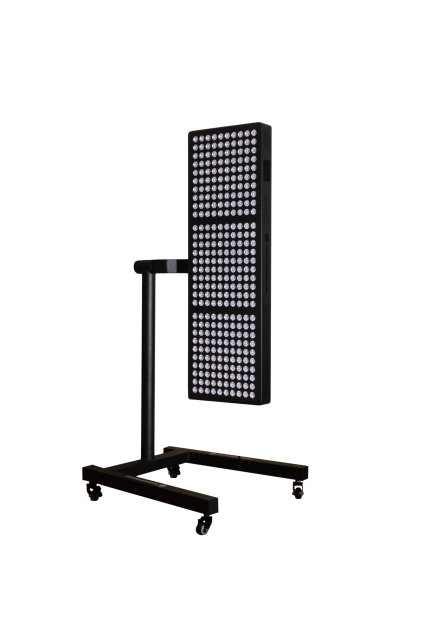
With an external Mitochondriak® panel, use a conservative general photobiomodulation protocol rather than copying the intranasal doses used in clinical trials. The panel can be directed towards the face, neck or upper body, but light should never be inserted into the nose unless the device was specifically designed and approved for intranasal use.
Verified starting protocol for Mitochondriak® Maxi Upgraded
- Distance: begin approximately 30 to 60 cm from the panel.
- Duration: use approximately 5 to 10 minutes for a superficial facial area.
- General upper-body session: approximately 10 to 20 minutes is a practical starting range.
- Wavelengths: use RED and NIR according to the current manual.
- Skin exposure: expose the target area directly without thick clothing.
- Eyes: keep the eyes closed or use suitable protective goggles when the light feels uncomfortably bright.
- Progression: begin with more distance, a shorter session and lower intensity, then adjust gradually.
The Mitochondriak® Maxi Upgraded contains seven wavelengths at 630, 670, 760, 810, 830, 850 and 940 nm. Its RED and NIR channels can be adjusted independently.
For a smaller facial or upper-body target, the Mitochondriak® Office Upgraded offers the same seven-wavelength combination in a more compact format.
Consistency matters more than using the maximum intensity. Clinical studies of intranasal therapy commonly assessed outcomes after several weeks rather than after one isolated session.
People with diagnosed photosensitivity or those taking photosensitising medication should discuss photobiomodulation with their doctor or pharmacist before use.
Support your light environment during pollen season
Mitochondriak® panels combine adjustable red and near-infrared wavelengths for general home photobiomodulation. Use them conservatively as complementary support and continue following the allergy treatment recommended by your healthcare professional.
How does PBM fit into complete allergy care?
Photobiomodulation is best understood as one supportive layer within a wider allergy strategy. It does not remove pollen from the environment and does not replace medical treatment.
A complete approach may include:
- Identifying the relevant allergen through medical history or allergy testing.
- Monitoring local pollen levels and adapting outdoor activity when exposure is highest.
- Rinsing the nasal cavity with an appropriate saline solution when recommended.
- Changing clothes and washing the face or hair after heavy outdoor exposure.
- Using antihistamines or nasal medication according to professional guidance.
- Supporting sleep and circadian rhythm with morning daylight and darkness at night.
- Using photobiomodulation conservatively as an additional tool rather than a replacement.
The goal is not to suppress every immune signal. It is to reduce unnecessary inflammatory burden while preserving the immune system's ability to protect the body.
Frequently asked questions
Can red light therapy replace antihistamines?
No. Red light therapy does not replace antihistamines or prescribed treatment for allergic rhinitis. It may be used as complementary support, but changes to medication should always be discussed with a doctor or allergist.
Does research prove that an external LED panel treats allergic rhinitis?
Not directly. The strongest clinical studies used specialised intranasal light or low-level laser devices. External red light panels use a different application method, so the clinical results cannot be transferred automatically.
Which area can I expose with an external red light panel?
An external panel can be directed towards the face, neck or upper body according to the device instructions. Do not insert a panel, torch or other device into the nose unless it was specifically designed and approved for intranasal use.
How should I start using Mitochondriak® Maxi during pollen season?
Begin approximately 30 to 60 cm from the panel. For a superficial facial area, start with about 5 to 10 minutes. Use more distance, lower intensity and a shorter session at first, then adjust gradually according to comfort.
Is red light therapy safe for people with pollen allergies?
Red and near-infrared photobiomodulation is generally non-invasive when used correctly. People with photosensitivity, eye conditions or photosensitising medication should consult a qualified healthcare professional before starting.
Sources and references
- Lee HM et al. A comparative pilot study of symptom improvement before and after phototherapy in Korean patients with perennial allergic rhinitis. Photochemistry and Photobiology. 2013. PubMed PMID 23253070.
- Jung HJ et al. Clinical efficacy and safety of low-level laser therapy in patients with perennial allergic rhinitis: a randomized, double-blind, placebo-controlled trial. Journal of Clinical Medicine. 2021. PubMed PMID 33671931.
- Neuman I, Finkelstein Y. Narrow-band red light phototherapy in perennial allergic rhinitis and nasal polyposis. Annals of Allergy, Asthma and Immunology. 1997. PubMed PMID 9109708.
- Glass GE. Photobiomodulation CME part I: overview and mechanism of action. Journal of the American Academy of Dermatology. 2024. PubMed PMID 38309304.
- Hamblin MR. Proposed mechanisms of photobiomodulation or low-level light therapy. IEEE Journal of Selected Topics in Quantum Electronics. 2017. PubMed PMID 28070154.