Free worldwide shipping (orders over 90 USD)
Pre-sale 2026 of Maxi UVB Presale HERE
By clicking "Agree" you consent to the use of all cookies. You can specify your preferences by clicking "Settings". More information here.
.png)
Do you know that feeling when you sit at the computer all day, your eyes get tired, and image contrast gets worse? Most people in that situation pull down the blinds, increase the monitor brightness, or buy a stronger bulb. We look for the solution in light intensity. But the problem lies elsewhere.
The latest research suggests that the key to eye health is not how much light we get, but what kind of light we receive during the day. And this is exactly where modern LED lighting usually fails.

Modern LED bulbs are energy-efficient and cheap to operate. From a biological point of view, however, they are often incomplete for our eyes. They lack what sunlight has always had: red and infrared spectrum, in other words, long wavelengths.
These frequencies are crucial for the proper functioning of mitochondria, which are also found in the retina of the eye. When we do not get enough of them during the day, it may show up as:
This is the same principle by which light affects the entire body. The eye is no exception - quite the opposite. It is one of the most sensitive light receptors we have.
Professor Glen Jeffery’s team has long been studying the effects of light on vision, and the results are fascinating. One of the key studies showed that just a single short exposure to 670 nm light leads to improved contrast vision for several days. [R]
The latest results from 2025 go even further. They show that long wavelengths from sunlight act systemically throughout the whole body and improve vision. [R] This is especially important for those of you who spend most of the day indoors and only get outside for a short while.
The eye is not a passive receiver of light. It is an active system that constantly consumes energy. That energy is supplied by mitochondria, which produce ATP.
Long wavelengths of light, specifically red and near-infrared (NIR), can directly support mitochondrial function in the retina. The result is better processing of visual information, higher contrast sensitivity, and less fatigue throughout the day. This is the same mechanism on which red light therapy works. Here, however, we use it in a gentler form directly in the environment where we live and work.
The good news is that this solution is simple and accessible. You do not have to replace all the lighting in your home or invest in a red light therapy device. It is enough to supplement your workspace with a source that contains red and infrared spectrum.
This is exactly where incandescent bulbs make sense, because they naturally produce full-spectrum light including long wavelengths. Compared to standard LEDs, they offer several biologically relevant advantages for daytime use: a broader spectrum closer to sunlight, direct support for mitochondria in the eye, and a real impact on contrast vision throughout the day.
In practice, it is enough, for example, to complement your desk with Mitochondriak® bulbs for daytime use, which respect the biological needs of the eye and provide the spectrum that modern LEDs simply do not have. It is a low-cost solution that can have a real impact on how your eyes feel after a full working day.
How can I improve my vision while working on a computer?
Focus on light quality. Add natural light to your environment, open the window, look into the distance from time to time, or add a source with red to infrared spectrum and limit excessive white LED light.
Do incandescent bulbs help the eyes?
Yes, indirectly, because they contain long wavelengths that support mitochondria and may improve contrast vision.
Is this a replacement for sunlight?
No. Sunlight is the foundation. This is only a way to supplement the spectrum indoors. But as you could see from the studies, even this small addition can help a lot.
Is one bulb enough?
Yes, it is better than nothing. Even a small amount of the right light can have a biological effect. However, if you work long hours at a computer and do not have access to sunlight, we recommend installing at least 2 behind the monitor. You can buy a simple and affordable desk lamp, for example, at IKEA.
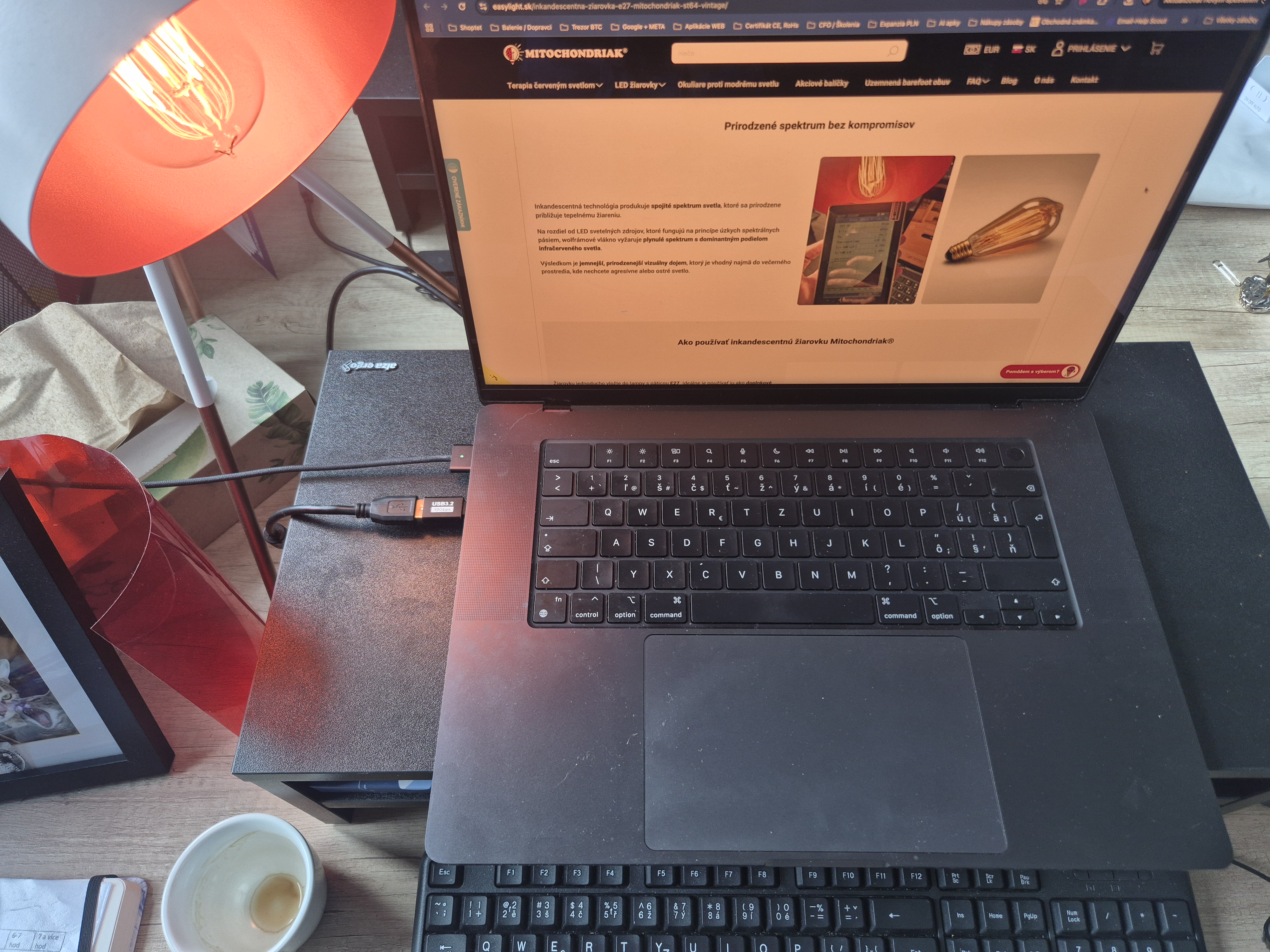
If we were to summarize it simply: the problem with the eyes when working indoors is not only about light intensity. It is about its spectrum. Modern LED lighting is usually missing long wavelengths, which are essential for mitochondria in the retina. Incandescent bulbs are a simple solution to replace this deficit in the everyday environment.
Light controls your mitochondria, and mitochondria control your performance. That applies to vision too.
Want to learn more or try Mitochondriak® bulbs for daytime use? Check out the full range of Mitochondriak® indoor lighting solutions designed exactly for this purpose.