Free worldwide shipping (orders over 90 USD)
Pre-sale 2026 of Maxi UVB Presale HERE
By clicking "Agree" you consent to the use of all cookies. You can specify your preferences by clicking "Settings". More information here.
.png)
In today’s modern world, our phones/smartphones and screens have become an essential part of our daily routine. We use them for work, communication, and entertainment. However, we must realize that constant exposure to blue light emitted from these screens is a significant problem for our health for two main reasons.
1. Blue light stimulates melanopsin, which controls (or disrupts) our circadian rhythm.
2. Blue light suppresses melatonin (the sleep hormone), which makes it harder for us to sleep well.
Our body has its own internal clock, known as the circadian rhythm. This complex system relies on various environmental cues, including light, to synchronize our sleep–wake cycles. Today it is no secret that blue light, through melanopsin, regulates our circadian rhythm. [R]
Exposure to natural light during the day helps regulate the circadian rhythm and promotes alertness, while darkness and red light signal the body to produce melatonin, the hormone that regulates sleep. [R, R]
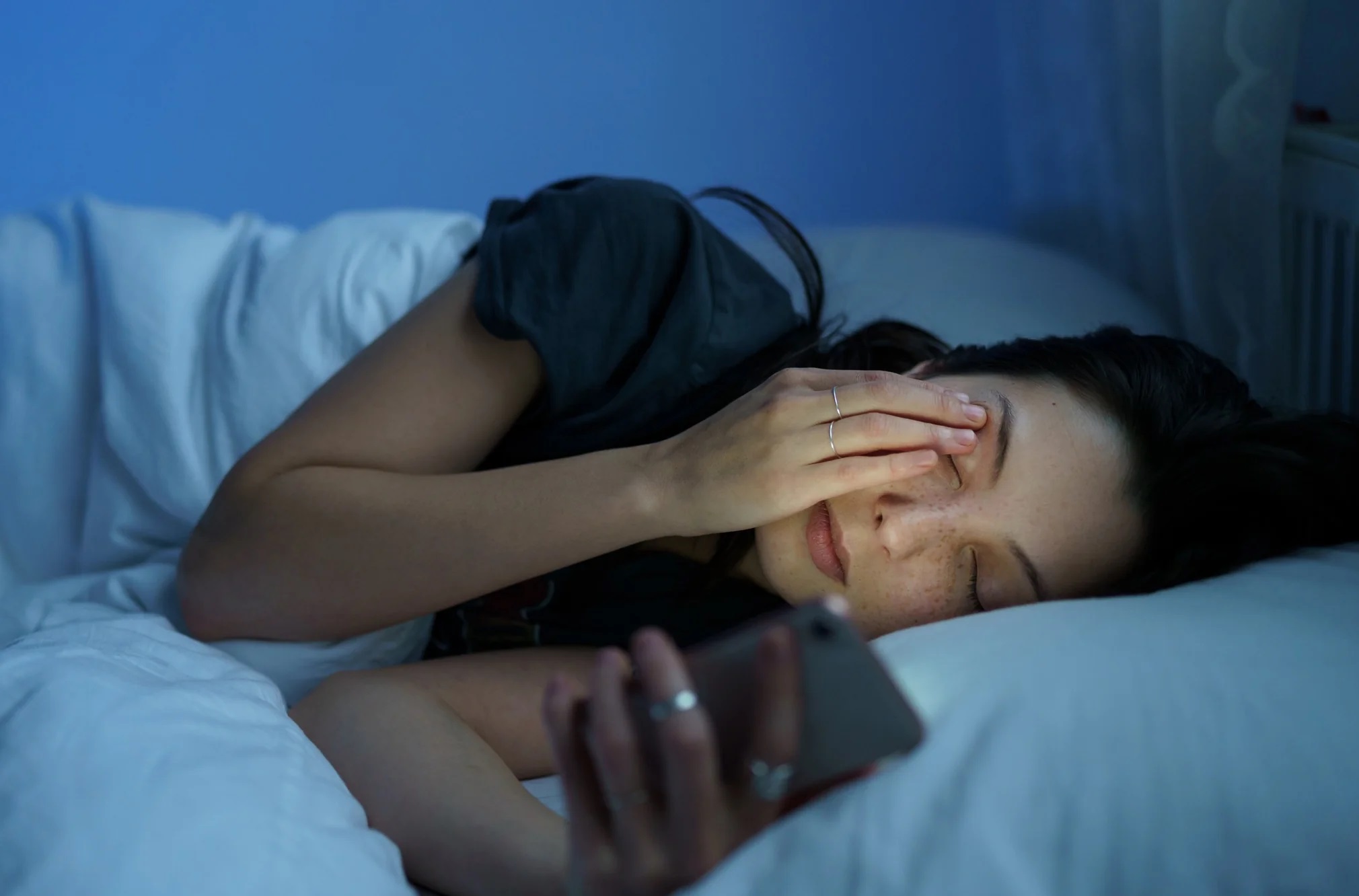
However, many people today spend their evenings in front of screens, which causes their circadian rhythm to receive “false” signals.
Melatonin is the main sleep hormone and even helps our mitochondria (our “power plants”) stay healthy. When we sleep well and avoid blue light sources before bedtime, the melatonin released during sleep helps repair our mitochondria.
Today there are already many studies pointing out that red and near-infrared light (NIR) can stimulate melatonin production in our cells.
This means that not only the absence of blue light in the evening, but also sufficient red and infrared light plays an important role in melatonin production!
In one study, it was even found that athletes who were exposed to red light for 30 minutes every evening for 14 days experienced better sleep quality and higher melatonin levels during sleep.
Today, constant exposure to screens from phones or TVs — especially in the evening — is becoming a serious problem. This phenomenon is called "ALAN" (Artificial Light at Night).
The problem therefore does not lie only in excessive exposure to blue light, but also in the lack of red and infrared light. According to many studies, this is exactly the type of light that helps keep us healthier.
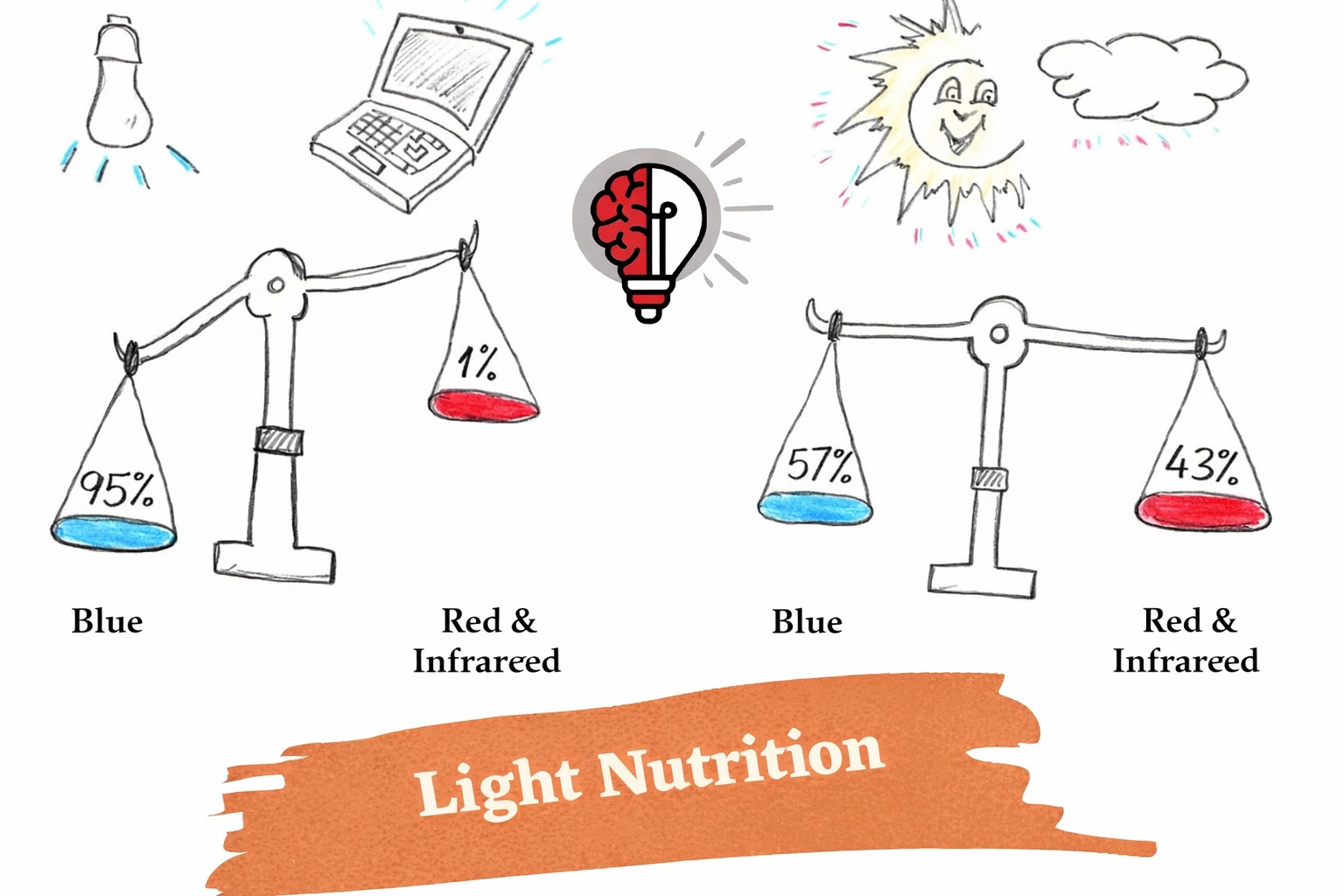
Many of us, in our busy lives, simply do not have enough time to get sufficient healthy sunlight exposure. We wake up for work or school even before sunrise and usually return home only after sunset.
All of us therefore spend too much time indoors, usually under artificial light — especially blue light — and often sitting in front of a “blue-lit” screen.
"Red and infrared panels Mitochondriak® were created and designed to focus on replenishing these critical frequencies of sunlight that are missing indoors!"
If you want to reduce the risks associated with blue light exposure, there are several things you can do. The simplest ones are:
If you decide to purchase a red and infrared light therapy device, choose wisely — select a brand that is transparent and provides all the important parameters such as flicker, intensity, percentage flicker, etc. At Mitochondriak®, we list all these parameters in the product description, and based on the measurements our devices undergo, we know they are high quality.
If what you’re reading resonates with you — and if you feel the desire to explore, learn, and share this perspective — you naturally become part of a movement that has the potential to change how people understand health and energy.
If this way of thinking resonates with you, you’re in the right place.
If not, that’s perfectly fine.
Mitochondriak is not a club you sign up for. It’s not an identity you need to defend.
Mitochondriak is a direction. Everyone can walk this path at their own pace, in their own way, and when the time is right. In the end, it’s not about reaching the destination — but enjoying the journey.
If our way of thinking resonates with you, help us spread the idea of light-based nutrition. Tag us on social media.
#Mitochondriak