Free worldwide shipping (orders over 90 USD)
Pre-sale 2026 of Maxi UVB Presale HERE

By clicking "Agree" you consent to the use of all cookies. You can specify your preferences by clicking "Settings". More information here.
.png)
The arrival of spring should mean more energy. Yet for most people it is the opposite, and they experience spring fatigue. We often do not realize it, but spring brings a rapid environmental shift that changes photochemical and biochemical reactions in the body, transforming our entire biology from a “winter mode” into a more “sun-driven” (almost summer) state. And that is exactly where the problem begins. Modern humans barely change their indoor environment, their bodies receive chaotic signals, and mitochondria respond chaotically.
Let’s take a closer look - from the perspective of quantum biology and mitochondria.
So why do so many people in spring feel fatigue, slower thinking, weakness, a strange inner imbalance? This is not just subjective or psychological. From a quantum biology perspective, it is a state in which the external physical environment changes faster than internal bioenergetics can adapt.
Spring is not just a weather change. It is a rapid shift in the physical parameters of the environment. Days become longer, the light spectrum changes, solar radiation intensity increases and UVB appears. The issue arises when these changes occur faster than mitochondria can adapt - and at the same time, this is also the solution for those who want to prevent or quickly improve spring fatigue.
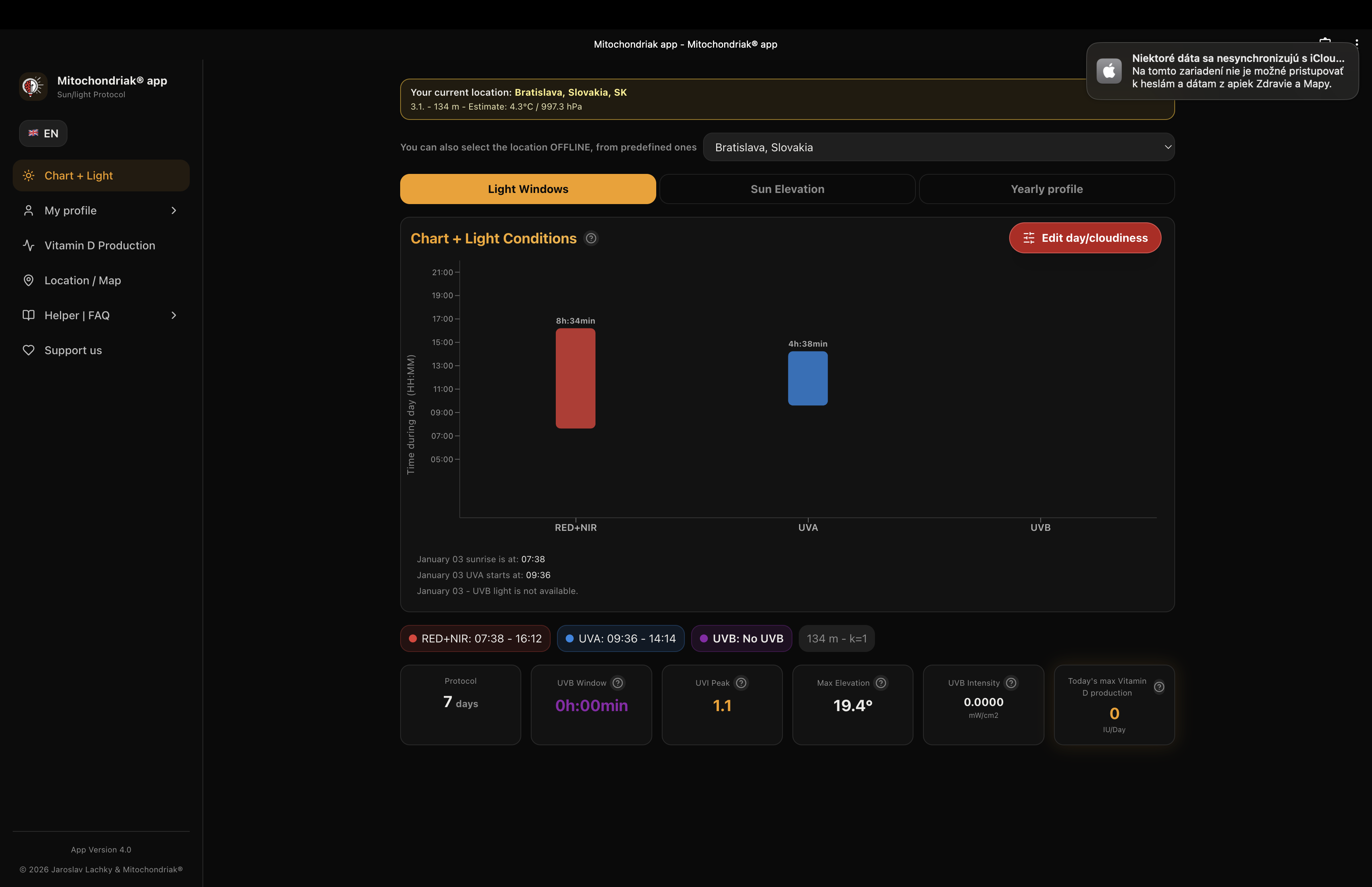
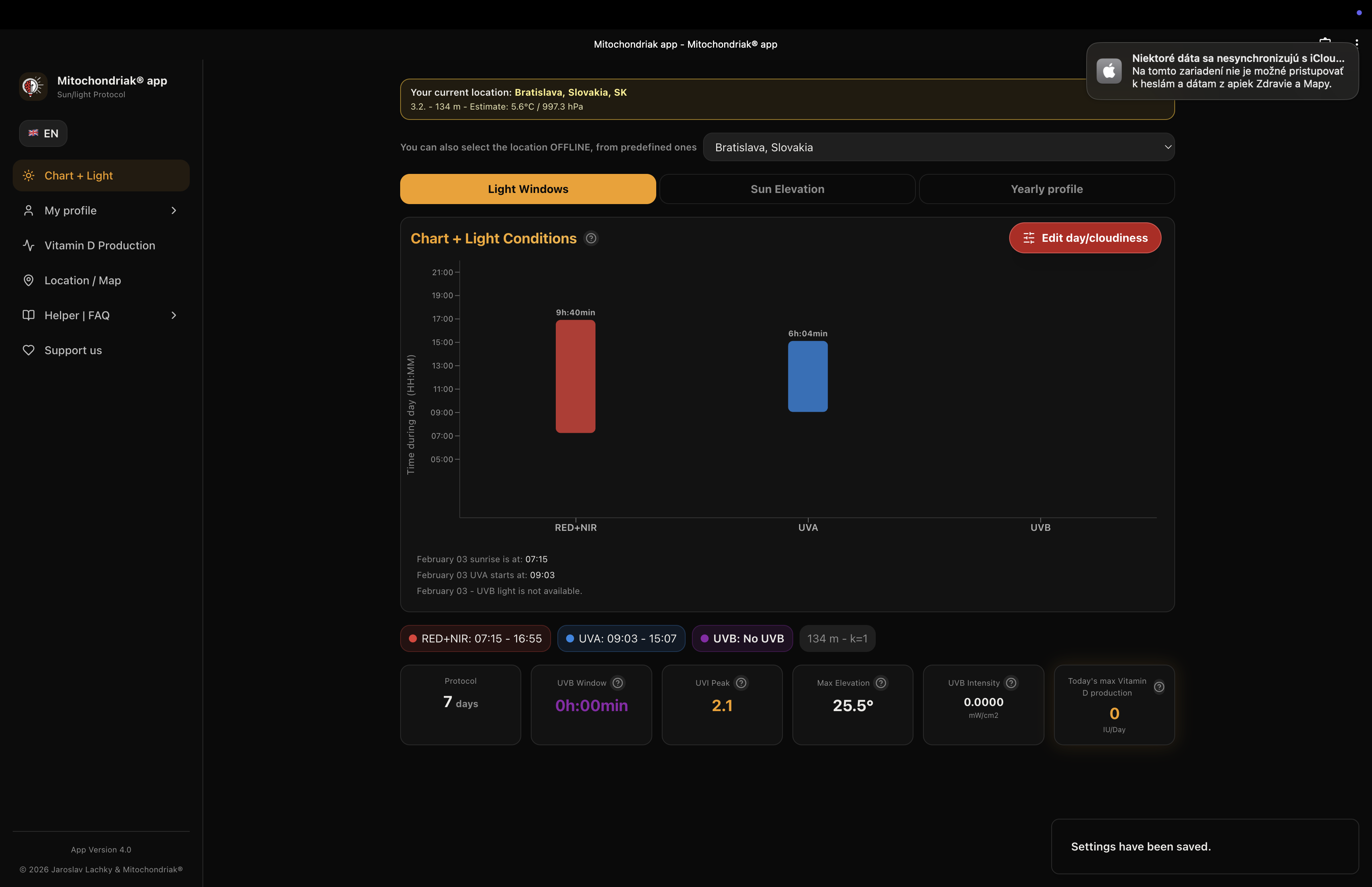
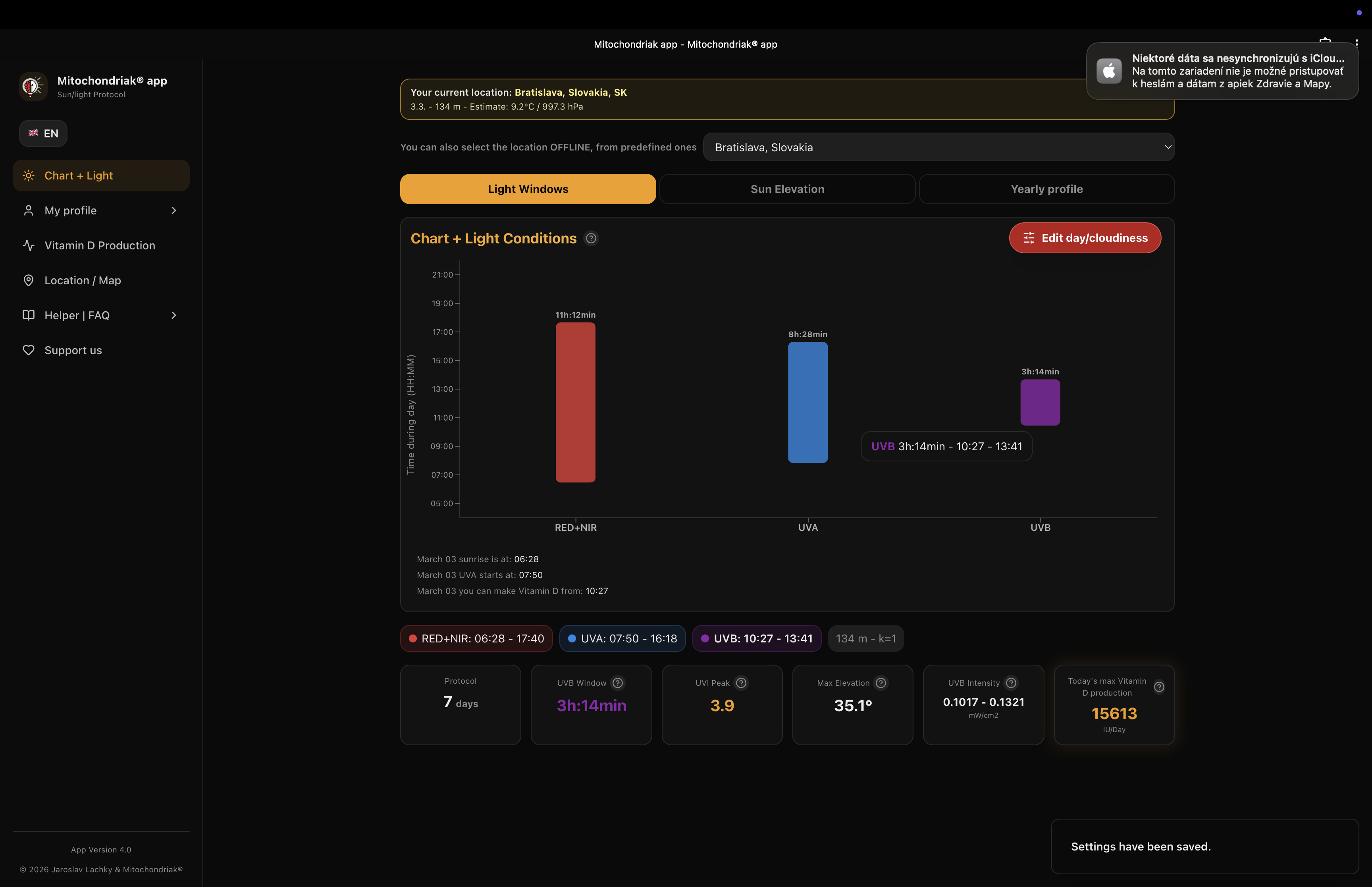
Just look at these graphs from our Mitochondriak application. Notice the steep changes. In January, daylight lasted 8 hours, total UV exposure slightly over 2 hours, UVB none. Suddenly, within days, we have 11 hours of light, over 7 hours of total UV, and more than 3 hours of UVB. By the way, UVB is what produces Vitamin D.
Let’s go further. Free radicals (ROS = reactive oxygen species) are often portrayed as enemies, but that is an oversimplification. From a quantum biological perspective, a free radical is a molecule or atom with an unpaired electron. An unpaired electron means a magnetic moment. In other words, free radicals act as carriers of magnetic and informational signaling, and our mitochondria, through ATP production, generate a local magnetic field. This is how the body communicates.
In spring, free radical production naturally increases. Not because the body makes a mistake, but because metabolic mode shifts. Free radicals serve as signals for growth, renewal and mitochondrial adaptation to local conditions. The problem only arises when their production exceeds what mitochondria can regulate. Then the signal becomes stress.
Few people realize that spring is biologically a period of increased insulin sensitivity. The body prepares for growth, regeneration and energy utilization. Historically, this meant a short window of higher carbohydrate intake - roots, young plants, later fruit and honey. Rising UVB and temperature naturally stimulate insulin, while increasing red light exposure maintains its sensitivity. This signal was precisely limited in time and quantity. Today, the situation is completely different.
Modern humans consume carbohydrates year-round, and insulin is chronically elevated even in winter. When insulin sensitivity increases in spring, the system becomes overloaded, mitochondria face higher electron flow, and the result is increased free radical production and a feeling of energetic collapse.
As shown in the graphs, UVB radiation reappears in our latitude with the arrival of spring. UVB stimulates Vitamin D production but also promotes the release of nitric oxide in the skin, which plays a crucial yet often overlooked role. Nitric oxide is a powerful signaling gas that temporarily inhibits the mitochondrial respiratory chain and stops water production.
This inhibition is not dysfunction. It is regulation. During this period, mitochondria can stimulate apoptosis more effectively and subsequently repair themselves, preparing for higher stress, greater load and increased carbohydrate intake in summer. Unfortunately, modern lifestyles often skip this step.
By avoiding UVB exposure - spending days indoors in offices - mitochondria once again receive incorrect signals. If you doubt this, check your blood Vitamin D levels. A healthy average person should already reach 25(OH)D above 40 ug/ml in March. And supplements do not count. If you relied on them all winter to artificially increase Vitamin D, you may be making a mistake.
The key to understanding spring fatigue is not a single factor, but synchronization. UVB light only makes sense when accompanied by red and infrared spectra as it naturally occurs. Carbohydrates only make sense when consumed during daylight and seasonally. Only then will insulin remain under proper daily and seasonal control - along with steroid hormones.
If these signals align, spring brings energy. If not, conflict arises - what most people call “spring fatigue,” though in reality it is simply desynchronization between our body and the environment.
Remember, spring fatigue is not a disease nor lack of motivation. It is a quantum biological response to unsynchronized environmental signals. It arises at the interface of light, insulin, magnetic fields and mitochondria. The solution is not symptom suppression but restoring coherence. Light, food, movement and timing must speak the same language.
When we understand this, spring stops being a “transition period” and becomes what it truly is - a natural shift into a more energy-rich state. And that is the Mitochondriak perspective.
That is it for now. Changes may not be dramatic immediately, but with consistency they will come. Over time you will notice more stable energy, deeper recovery, better sleep and a calmer mind.