Free worldwide shipping (orders over 90 USD)
Pre-sale 2026 of Maxi UVB Presale HERE
By clicking "Agree" you consent to the use of all cookies. You can specify your preferences by clicking "Settings". More information here.
.png)
Easter is a long-awaited break for many of us. Long family dinners, staying up late, movies until midnight, endless mobile notifications, and interiors filled with bright, cold LED lighting. And then what? The Monday after the holidays is one of the hardest days of the year for most people. That is not a coincidence. It is your circadian rhythm, asking you to pay the price for what you have been doing to it over the past few days. The good news is - it does not have to be this way if you know what truly disrupts it and how to protect yourself.
Every holiday is basically a combination of three things your circadian rhythm hates: irregular sleep timing, increased exposure to artificial light in the evening, and eating more food and alcohol at a time when your body should be slowing down. These three things can shift your biological time by several hours in just 3 to 4 days. And then the work week begins.
Jaroslav Lachký describes it perfectly: "It took me years to realize that after every holiday I felt weird not because of food, but because of the way I used light. I stayed up late under white LEDs, watched shows until midnight, and then wondered why I could not wake up in the morning. Light, not food, was always the first culprit."
From a biological point of view, the problem is clear. Your mitochondria and your entire hormonal system depend on a regular light signal. Sunlight in the morning, darkness in the evening. When you mix that signal with a living-room lamp, a TV, and your phone until one in the morning, your body receives conflicting information and simply does not know what to do.
Melatonin is a hormone your body starts producing when light intensity drops after sunset. It is a biological signal that it is time to slow down and regenerate. The problem begins when artificial light tells your body something else.
A 2018 systematic review published in Chronobiology International confirms that two hours of exposure to blue light at a wavelength of 460 nm in the evening significantly suppresses melatonin, while the maximum suppressive effect occurs at wavelengths around 424 nm. [R] The same review also points out that even low-intensity light exposure of just 5 to 10 lux at night during sleep with closed eyes is enough to trigger a circadian response. [R]
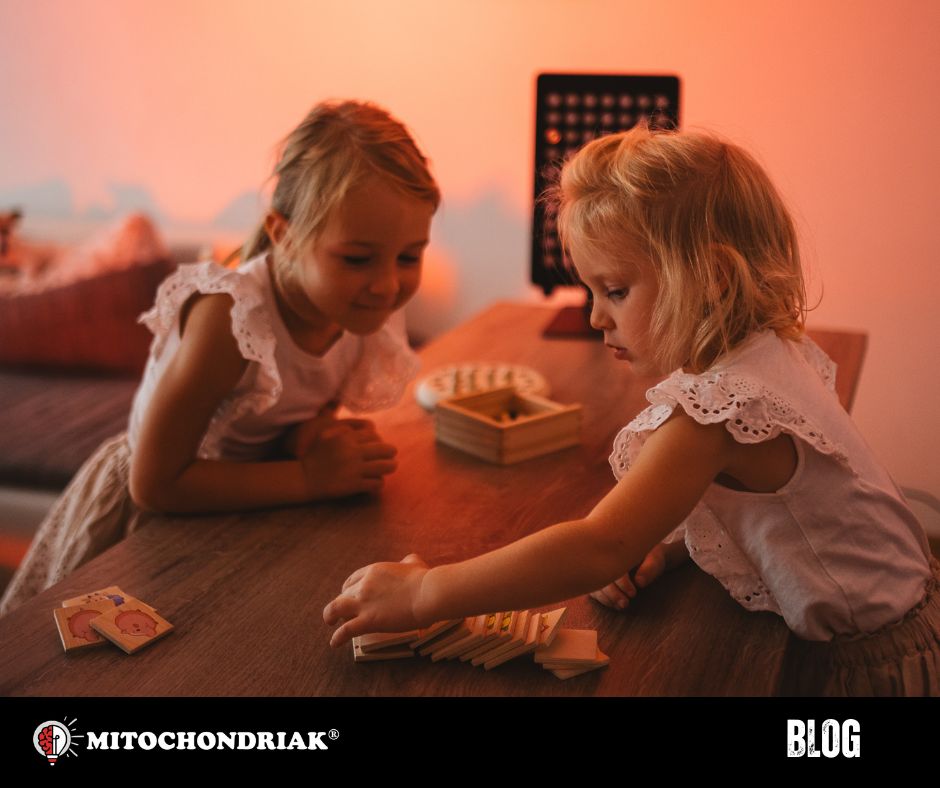
Translated into Easter language: every evening when you sit in a living room lit by white or cool LED bulbs and stare at screens, your melatonin is effectively blocked. Your body thinks it is noon. And it behaves accordingly. You fall asleep harder, your sleep becomes shallower, and in the morning you feel as if you had not slept at all.
We perceive light mainly through a retinal photoreceptor called melanopsin, which is extremely sensitive to the blue-green part of the spectrum, especially around 480 nm. These wavelengths are heavily present in white LED lamps, television screens, smartphones, and tablets. This is the type of light most commonly found in modern indoor lighting. [R]
During the holidays, the situation is even worse than during a normal week. We spend more time indoors, keep lights on longer, use screens more intensively, and sleep irregularly. Research published in Clinical & Experimental Optometry (2021) shows that ordinary blue-filtering lenses do not block enough blue light to effectively protect nighttime melatonin production unless they block light across the full 380 to 500 nm range. [R]
That means regular "anti-blue light" glasses from a store are usually not enough. To protect evening melatonin, you need glasses with red or deep orange lenses that block 100% of both blue and green light.
Red light in the 620 to 660 nm range has almost no effect on melanopsin activation. Your body does not perceive it as a daytime signal, which means melatonin can continue rising normally even while you keep the lights on. That is exactly why red indoor lighting is one of the smartest things you can do for your circadian rhythm during holiday evenings.
In practice, it looks like this: after sunset, you switch off white lights and turn on Mitochondriak® evening red bulbs. They screw directly into standard E27, E14, or GU10 sockets, so there is no need to change anything. You can still spend time with family, watch a movie, or read. The only difference is that your body is finally receiving the correct evening signal.
If you cannot avoid screens in the late afternoon or evening, there is a second tool that goes hand in hand with red bulbs: blue light blocking glasses with red lenses. Unlike yellow or clear-grey alternatives, they block 100% of blue and green light. Put them on at least 90 minutes before your planned bedtime. And because they look stylish, you can even wear them during a family dinner. No need to explain anything - people will ask on their own. :)

Easter does not have to become a synonym for a broken rhythm and an exhausted Monday. Most of the circadian damage caused by holidays comes down to one thing: evening light with the wrong spectrum. A few simple changes - red lighting instead of white light, and red glasses around screens - can make a real difference, and your mitochondria will thank you during the holidays just as much as on a normal day.
If you want to turn these holidays into a small experiment, try these changes for at least 3 days in a row and observe how you feel in the morning. The results reported by many people in our community speak for themselves.
Want to get started? Take a look at our evening red bulbs and blue light blocking glasses designed precisely for these situations.